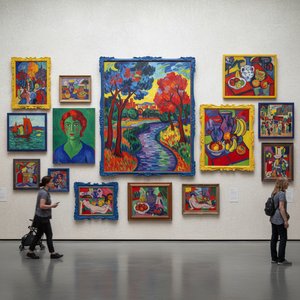
Étienne Terrus: A Pioneer of Fauvist Landscape Painting
Étienne Joseph Mathieu Terrus (1857 – 1922) stands as a significant figure in the burgeoning landscape painting movement of early 20th-century France, particularly recognized as one of the formative influences on Fauvism. Born in Elne, Pyrénées-Orientales, Terrus’s artistic journey began with formal studies in Paris but swiftly returned him to his native region where he established himself as a prolific artist and cultivated enduring friendships with fellow luminaries like George Daniel de Monfreid, André Derain, and Henri Matisse—relationships that profoundly shaped his creative vision.- Early Life & Education: Terrus’s formative years were marked by an upbringing steeped in the traditions of Roussillon, a region celebrated for its vibrant pigments and dramatic landscapes. Despite pursuing academic training in Paris, he consistently prioritized capturing the essence of his homeland through painting.
- Style & Technique: Terrus's distinctive style is characterized by bold brushstrokes, expressive color palettes—often dominated by intense reds, yellows, and blues—and a deliberate rejection of traditional tonal shading. He embraced Impressionistic principles while simultaneously forging a path toward Fauvist experimentation, prioritizing emotional impact over meticulous realism.
- Notable Works: Among Terrus’s most celebrated paintings are “La Plage d’Argelès” (1907), depicting the coastal scenery of Argeles-sur-Mer with remarkable luminosity and dynamism, and “Le Racou” (1908), a panoramic vista capturing the rugged beauty of the Pyrenees mountains. These canvases exemplify his masterful ability to convey atmosphere and emotion through color and texture.
- Connections & Collaborations: Terrus’s correspondence with Matisse proved invaluable in shaping his artistic sensibilities, fostering intellectual exchange and inspiring mutual encouragement. Their shared passion for landscape painting cemented their position as pivotal figures within the avant-garde movement.
The Influence of Impressionism and Fauvism
Terrus's artistic development was undeniably shaped by the prevailing currents of Impressionism, which championed capturing fleeting moments of light and color—a departure from academic conventions that prioritized detailed representation. However, Terrus transcended mere imitation, pushing beyond Impressionistic boundaries into the realm of Fauvism. This movement, spearheaded by Matisse and Derain, advocated for unrestrained artistic expression through vibrant hues and simplified forms, prioritizing emotional intensity over objective observation. Terrus’s embrace of Fauvist techniques—particularly his bold use of color—demonstrated a willingness to challenge established norms and forge new paths in landscape painting.Recognition & Legacy
Terrus's work gained considerable acclaim during his lifetime, securing him a respected place within the artistic community of Paris and Roussillon. The Musée Terrus in Elne serves as a testament to his enduring legacy, showcasing a comprehensive collection of his paintings—a remarkable achievement considering the relatively limited scope of his oeuvre. Furthermore, the discovery that over half of his artworks were fraudulent underscored the importance of meticulous provenance research and highlighted the challenges faced by art historians attempting to reconstruct Terrus’s artistic history. Despite this setback, Terrus's contribution to landscape painting remains undeniable, securing him a prominent position in the annals of modern art.Further Exploration
For deeper insights into Étienne Terrus’s life and work, consult scholarly publications exploring his stylistic innovations and contextualizing his contributions within the broader artistic landscape of early 20th-century France. Examining biographical accounts alongside critical analyses offers a nuanced understanding of Terrus's artistic journey and lasting impact on Fauvist aesthetics.Perguntas e Respostas
Qual é o nível de popularidade das obras de Étienne Terrus?
As estatísticas sobre as obras de Étienne Terrus estão disponíveis na página de Estatísticas do artista.
Quantas obras de Étienne Terrus estão disponíveis para visualização?
Você pode explorar 9 obras de arte obras de Étienne Terrus na página Todas as Obras de Arte.
Posso navegar pelas obras de Étienne Terrus por técnica?
A página Todos os Meios agrupa as obras de Étienne Terrus por técnica.
Onde estão as obras de Étienne Terrus agrupadas por paleta?
Para encontrar obras de Étienne Terrus em uma paleta específica, utilize a página de Por Paletas do artista.
Em qual período histórico Étienne Terrus trabalhou?
Étienne Terrus trabalhou no período 19th Century. O período situa a atividade do artista na história.
Existe uma lista completa das obras de Étienne Terrus?
Todas as obras de Étienne Terrus no este site podem ser visualizadas na página de Todas as Obras de Arte do artista.
Onde posso ver o perfil de cores da obra de Étienne Terrus?
O perfil de cores da obra de Étienne Terrus pode ser visualizado na página Genoma da Paleta do artista.