
Prezentat: · Cu ramă:
 Previzualizare
 Trimite prin felicitare
 Distribuie
 Detalii despre lucrare
 Ghid
Ghid

 Descarcă imaginea
 Produse similare
 Radiografie
 Galerie foto
 Întrebări și răspunsuri
 Statistici
- 29.0 x 21.0 cm


lei 1286
Reproducere pictată manual în ulei
Pictură în ulei pe pânză, pictată manual de artiștii noștri la dimensiunea și ramele dorite de dumneavoastră, pe comandă. ( Comută pe versiunea Print Comută pe Imagine Digitală)
Dimensiune
·Standard
personalizat
CM
INCH
Alegeți dintre dimensiunile noastre prestabilite, care respectă proporțiile originale ale operei de artă.
Se încarcă dimensiunile...

lățime
înălțime
Introduceți lățimea și înălțimea necesare pentru a se potrivi ramei sau peretelui dumneavoastră. Această lucrare este pictată manual, așa că, pentru o dimensiune cu o formă diferită, artistul poate picta puțin mai mult în jurul imaginii sau poate tăia puțin din margini — dumneavoastră decideți. Vă vom trimite o simulare digitală pentru aprobare înainte de a începe pictarea. Imaginea afișată pe această pagină nu reprezintă rezultatul real — doar simularea este reprezentativă.
 Citește mai mult
Finalizare
·
Alb lei1

Margini difuze lei1

Extins lei1

P118B lei10

P118H lei10

P118W lei10

P438Z lei10

P508JH lei12

P508YH lei12

P805H lei10

P805Z lei10

P919BZ lei10

P919G lei10

P919XJ lei10

P959ZH lei10

P968JZ lei12

W106C lei8

W218G lei10

W218JH lei8

W218Y lei10

W307PJ lei10

W316G lei10

W316PJ lei8

W316Y lei10

W398PJ lei8

W4111J lei10

W500HY lei15

W500JH lei15

W692G lei12

W849H lei8

W940BG lei15

W953PJ lei8

H24-GOLD lei30

H24-SILVER lei30

H36-GOLD lei45

H36-SILVER lei45
Expediat într-un tub protector, gata pentru montarea la propria ramă.
Servicii suplimentare
opționalCe includ extrasele?
Exemple de elemente care pot fi modificate: Înlocuirea feței cu fotografia clientului; Adăugarea unui animal de companie (de ex., înlocuirea unei pisici cu un câine); Includerea unui mesaj ascuns în fundal; Modificarea peisajului sau a elementelor din fundal.
După plasarea comenzii, echipa TopImpressionists.com va contacta clientul prin e-mail pentru instrucțiuni și va furniza o previzualizare (mockup)
După plasarea comenzii, echipa TopImpressionists.com va contacta clientul prin e-mail pentru instrucțiuni și va furniza o previzualizare (mockup)
Livrare în întreaga lume () în 3-4 săptămâni, în loc de cele 5 săptămâni standard. (7 Noiembrie). Fără compromisuri în ceea ce privește calitatea.
Lac de protecție
Etichetă de prezentare
Detalii plăcuță din bronz gravat
This elegant plaque features the artist's name and the title of the artwork, finely engraved for a timeless presentation.
It is made from bronze with a refined, elegant finish. The text is precisely laser-engraved for a sharp and permanent result. Measuring 9x2 cm, the plaque is compact yet easy to read. It's built to be durable and scratch-resistant, offering a professional, museum-quality look. Mounting is simple thanks to the included adhesive backing.
Detalii plăcuță din acril transparent
The plaque includes essential engraved details such as the artist's name, the title of the artwork, the date it was created, the type of media used-like oil on canvas or watercolor-a brief description of the piece, and a QR code that links to the complete artwork information.
It is crafted from clear acrylic, offering a sleek, modern appearance. The text is UV-engraved in black to ensure strong visual contrast. With a size of 10x15 cm, it ensures optimal readability. It comes equipped with two metal hooks for secure wall mounting. The plaque is designed to be weather-resistant, making it suitable for various environments, and it includes interactive features that work seamlessly with smartphone scanning.
Detalii placă din acril negru
This elegant plaque includes engraved information such as the artist's name, the title of the artwork, the date it was created, the type of media used (like oil on canvas or watercolor), a short description of the artwork, and a QR code for quick access to more information.
The plaque itself is made from refined black acrylic with a premium finish. The text is laser-engraved in white for high contrast and readability. Its size is 10x15 cm, designed to be easy to read. It comes with two metal hooks for professional mounting. The design is sleek and fits any interior style. It is also weather-resistant and durable, with built-in digital integration for mobile compatibility.
Opțiunea cu sticlă este disponibilă doar pentru dimensiuni de sub 110 cm
 Opțiunea cu sticlă este disponibilă doar pentru dimensiuni de sub 110 cm
- Livrare expres gratuită la nivel mondial
- Pânză de in de înaltă calitate
- Asigurare completă pentru transport
- Garanție de rambursare a taxelor vamale
- Garanția fidelității culorilor
- Politica de retur în 100 de zile (doar pentru defecte de fabricație)
- Garanție de rambursare 100%
- Ofertă pentru comenzi multiple


Descriere obiect de colecție
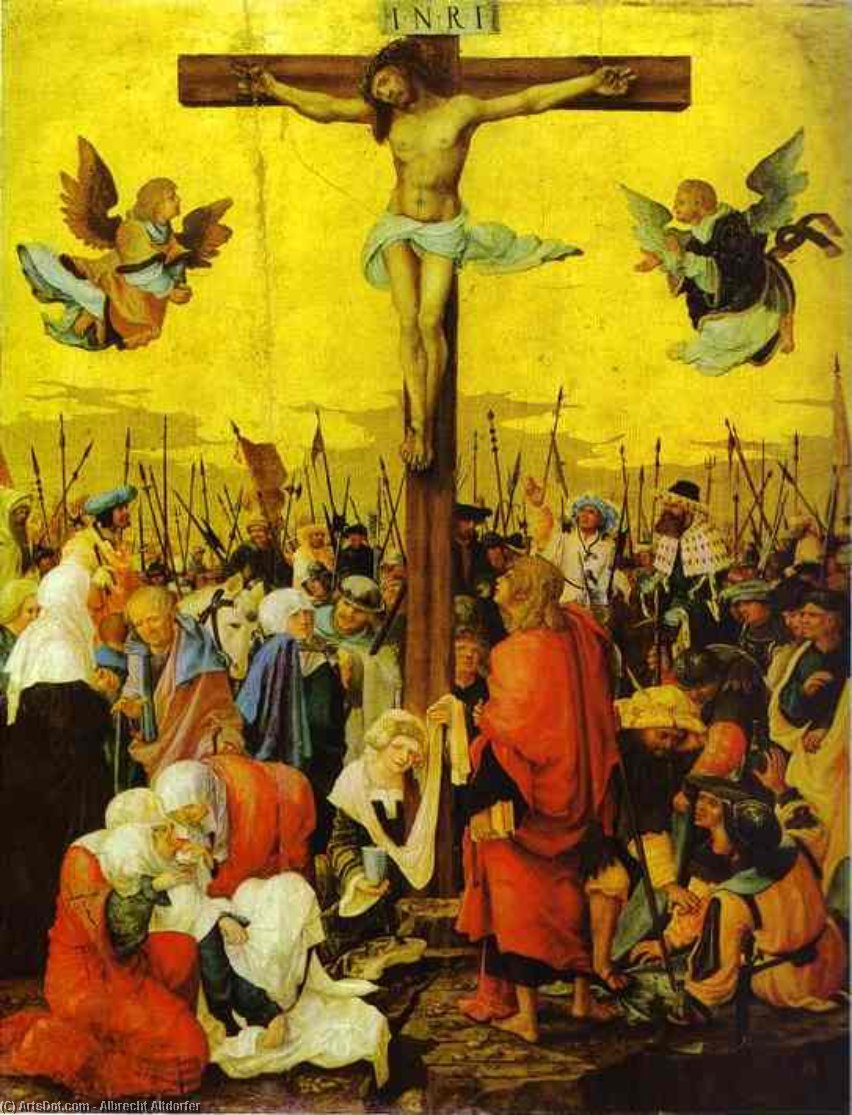
Albrecht Altdorfer's "Crucifixion" (1526) is a dramatic, evocative depiction of Christ’s suffering, showcasing the artist's pioneering landscape style and masterful use of color within the Northern Renaissance.
Biografie artist
Albrecht Altdorfer (1480-1538): Pionier al picturii de peisaj renascentistei germane, figura cheie a școlii Danubei. Explorează gravurile sale, opere religioase și arta inovatoare.
Despre pictură
The Weight of Sorrow: Albrecht Altdorfer’s “Crucifixion”
Albrecht Altdorfer's "Crucifixion," painted in 1526, isn’t merely a depiction of a pivotal religious event; it’s a visceral experience. Emerging from the burgeoning German Renaissance, Altdorfer wasn’t simply replicating biblical narratives; he was forging a new visual language, one deeply rooted in the natural world yet imbued with profound spiritual intensity. This particular rendition transcends simple illustration, becoming a landscape saturated with grief and a haunting meditation on sacrifice. The painting immediately commands attention not through grand scale – it's remarkably intimate, measuring just 29 x 21 cm – but through its masterful manipulation of light, color, and composition to evoke an overwhelming sense of sorrow.
The scene unfolds against a dramatically rendered landscape—a brooding, almost primeval forest. The trees, rendered in thick, layered brushstrokes of deep greens, browns, and purples, seem to writhe with the weight of the event. This isn’t a picturesque vista; it's a wilderness imbued with an unsettling energy. Altdorfer deliberately eschews traditional depictions of serene backgrounds, instead presenting a landscape actively participating in the drama. The distant mountains, shrouded in mist and shadow, amplify the feeling of isolation and despair. Notice how the artist uses atmospheric perspective – lighter hues for objects further away – to create a sense of depth and distance, drawing the viewer’s eye into the heart of the scene.
A Pioneer of Landscape
Albrecht Altdorfer stands as a pivotal figure in art history, largely credited with establishing landscape painting as an independent artistic subject within Europe. Prior to his work, landscapes were typically relegated to mere backgrounds for religious or mythological scenes. However, Altdorfer recognized the power of the natural world to convey emotion and meaning. His meticulous observation of nature—evident in the detailed rendering of foliage, rocks, and atmospheric conditions—transformed the landscape from a passive backdrop into an active participant in the narrative. This shift was revolutionary, paving the way for later generations of landscape artists like Albert Bierstadt and Frederic Church.
His background as a town architect and council member further informs his artistic approach. Altdorfer possessed a keen eye for spatial relationships and a deep understanding of how to create a sense of harmony and balance within a composition. This skill is brilliantly demonstrated in “Crucifixion,” where the human figure—Jesus—is carefully positioned within the landscape, creating a dynamic interplay between the earthly realm and the divine.
Symbolism and Emotional Resonance
Beyond its technical brilliance, "Crucifixion" resonates deeply with viewers through its potent symbolism. The stark simplicity of Jesus’s pose – arms outstretched, head bowed – is profoundly moving. Altdorfer avoids any overtly dramatic or theatrical elements, opting instead for a quiet, understated portrayal of suffering. The figures surrounding the cross—angels and soldiers—are rendered in muted tones, emphasizing the central tragedy. Even the light itself seems to weep, casting long shadows across the landscape.
The choice of a dark, foreboding forest as the setting is particularly significant. Forests have historically been associated with death, mourning, and the unknown. In this context, it serves as a powerful metaphor for the spiritual darkness surrounding Jesus’s sacrifice. The painting isn't simply depicting an event; it’s exploring the profound emotional consequences of that event—the grief, despair, and sense of loss experienced by those who witnessed it.
A Timeless Masterpiece
“Crucifixion” is more than just a religious painting; it’s a testament to Altdorfer's artistic genius and his ability to capture the essence of human emotion. The meticulous detail, masterful use of color and light, and profound symbolism combine to create an unforgettable image that continues to resonate with viewers centuries after its creation. Reproductions, like this one, offer a remarkable opportunity to experience the power and beauty of this iconic work, bringing its haunting message into our own spaces.
Întrebări și răspunsuri
Ce tip de operă de artă este "Crucifixion" de Albrecht Altdorfer?
"Crucifixion" este o piesă de tip WallArt.
Ce punct comun are "Crucifixion" cu restul creației lui Albrecht Altdorfer?
„Crucifixion” împarte cu celelalte opere ale lui Albrecht Altdorfer stilul German Renaissance Landscape și temele recurente: danube school landscape influence, medieval religious symbolism strong, early renaissance artistic trends, german cultural identity depicted, altdorfer's innovative landscape role.
Opera "Crucifixion" se află în țara creatorului său?
Nu – opera de artă este păstrată în străinătate. Țara natală a Albrecht Altdorfer este Germania, iar muzeul care păstrează originalul operei „Crucifixion” se află în Germany.
Informații rapide și quiz despre artă
Despre Albrecht Altdorfer

Albrecht Altdorfer
1480 - 1538, Germania
Biografie artist
A Pioneer of the Northern Renaissance Landscape
Albrecht Altdorfer, born around 1480 in Regensburg, Germany, stands as a pivotal figure bridging the late Gothic period and the burgeoning German Renaissance. He wasn’t merely an artist *of* his time; he actively reshaped its artistic trajectory, particularly in the realm of landscape painting. Coming from a family deeply rooted in artistic tradition—his father, Ulrich Altdorfer, was a painter and miniaturist—the younger Altdorfer quickly distinguished himself not as a follower, but as an innovator. Regensburg, a free imperial city strategically positioned on the Danube River, provided a vibrant cultural backdrop for his formative years. This location profoundly shaped his artistic sensibilities, fostering a connection to the natural world that would become central to his oeuvre. Beyond his artistry, Altdorfer was a man of civic duty, serving as both town architect and council member—a testament to his versatile talents. However, it was through his art—particularly his early engravings and drawings from around 1506, such as *Stygmata of St. Francis* and *St. Jerome*—that he first revealed a unique artistic voice, hinting at the emotional intensity and meticulous detail that would characterize his mature style. His work immediately demonstrated an unusual sensitivity to light and shadow, capturing the atmosphere of the natural world with unprecedented realism and feeling.The Danube School and a Revolutionary Vision
Altdorfer is most prominently recognized as a leading member of the Danube School, an influential group of artists active in southern Germany during the early 16th century. This artistic circle shared a common fascination with exploring the expressive potential of landscape, elevating it from a mere backdrop to become a central subject in its own right. Before Altdorfer, landscapes primarily served as settings for religious or historical narratives; he dared to depict nature *for itself*, imbued with atmosphere and emotional resonance. A transformative journey down the Danube River and into the Alps around 1511 proved crucial to his artistic development. The dramatic vistas, dense forests, and imposing mountains ignited within him a passion for depicting nature with unprecedented fidelity and feeling. He became, arguably, the first modern landscape painter, not simply replicating what he saw but conveying an emotional response—a sense of awe, mystery, and even spiritual connection. This wasn’t topographical accuracy alone; it was about capturing the *experience* of being within a landscape. His work, like “The Large Spruce,” exemplifies this shift, offering a serene and intricate depiction of nature's beauty. The Danube School artists, including Altdorfer, sought to move beyond the stylized representations of earlier periods, embracing a more direct and emotionally charged approach to their subjects.Masterpieces and Artistic Influences
Throughout his career, Altdorfer produced a diverse body of work encompassing paintings, engravings, drawings, and architectural designs. Among his most celebrated achievements is *The Battle of Alexander at Issus* (1529), commissioned by Duke William IV of Bavaria. This monumental painting showcases not only his mastery of composition and detail but also his innovative use of landscape to heighten the dramatic tension of the battle scene. The swirling clouds, jagged mountains, and chaotic melee of soldiers create a sense of overwhelming energy and spectacle. It’s a testament to Altdorfer's ability to integrate narrative with atmospheric effect, transforming a historical event into a powerful visual experience. His collaboration with Emperor Maximilian I in Innsbruck from 1513 further expanded his artistic horizons and provided opportunities for large-scale projects. Altdorfer’s style wasn’t formed in isolation; he absorbed influences from various sources. The poetic lyricism of Giorgione, the expressive figures of Lucas Cranach the Elder, and the meticulous detail of Albrecht Dürer all left their mark on his work. However, he synthesized these influences into a uniquely personal vision, characterized by its emotional intensity, dramatic lighting, and evocative landscapes. His engravings, such as “Venus after the Bath”, demonstrate his skill in this medium, showcasing delicate lines and intricate details. The influence of German woodcut tradition is also evident in his work, particularly in his early prints.Legacy and Lasting Impact
Albrecht Altdorfer’s artistic legacy extends far beyond the 55 panels, 120 drawings, and numerous engravings he created during his lifetime. He fundamentally altered the way artists approached landscape painting, paving the way for future generations to explore its expressive possibilities. His influence can be seen in the works of later German Romantic painters who similarly sought to capture the sublime beauty and emotional power of nature. Today, Altdorfer’s art is represented in major museum collections worldwide, including the Museum Ostdeutsche Galerie in Germany—which houses his *Madonna (Beautiful Maria of Regensburg)*—and the Kunstsammlungen und Museen Augsburg in Austria. His innovative spirit, technical skill, and profound connection to the natural world continue to inspire artists and captivate audiences centuries after his death in 1538. He remains a towering figure of the German Renaissance, a true pioneer who dared to see landscape not merely as scenery but as a powerful force capable of evoking deep emotion and spiritual meaning. His work serves as a testament to the enduring power of art to transform our perception of the world around us—a legacy that continues to resonate with viewers today.Exploring Altdorfer’s Diverse Works
Beyond his iconic landscapes and battle scenes, Altdorfer's artistic range encompassed religious subjects, mythological narratives, and even architectural designs. His depictions of biblical stories, such as “Abraham’s Sacrifice”, are imbued with a dramatic intensity and emotional depth that set them apart from earlier interpretations. He wasn’t simply illustrating scripture; he was exploring the human condition through the lens of faith. His religious works often feature dynamic compositions and expressive figures, reflecting his broader artistic interests. His engravings frequently depict scenes from classical mythology, showcasing his ability to combine technical skill with imaginative storytelling. Furthermore, Altdorfer's architectural designs, particularly those related to the fortifications of Regensburg, demonstrate a practical understanding of urban planning alongside his artistic talent. His versatility as an artist and civic leader highlights the breadth of his influence on 16th-century Germany.Informații rapide despre Albrecht Altdorfer
- Artistic Movement Or Style: Danube School, Rena.
- Artists Or Movements Influenced By This Artist: ['Romantici Germani']
- Artists Who Influenced This Artist:
- Giorgione
- Cranach cel Bătrân
- Date Of Birth: c. 1480
- Date Of Death: 1538
- Full Name: Albrecht Altdorfer
- Nationality: German
- Notable Artworks:
- Bătălia lui Alexander
- Pădurea Mare
- Place Of Birth: Regensburg, Germania
Explorați opere de artă organizate pe teme, stiluri și caracteristici.


Albrecht Altdorfer
Crucifixion
() ·
Cu ramă: · Pictată manual în ulei pe pânză de in
Total