

Prezentat: · Cu ramă:
 Previzualizare
 Trimite prin felicitare
 Distribuie
 Detalii despre lucrare
 Ghid
Ghid

 Descarcă imaginea
 Produse similare
 Radiografie
 Galerie foto
 Întrebări și răspunsuri
 Statistici

lei 1282
Reproducere pictată manual în ulei
Pictură în ulei pe pânză, pictată manual de artiștii noștri la dimensiunea și ramele dorite de dumneavoastră, pe comandă. ( Comută pe versiunea Print Comută pe Imagine Digitală)
Această lucrare este protejată de drepturile de autor
Lucrarea de artă afișată pe această pagină este protejată de legile privind drepturile de autor, ceea ce înseamnă că nu putem crea sau vinde în mod legal o reproducere identică. Această protecție este garantată prin acorduri internaționale, precum Convenția de la Berna și de legile naționale, inclusiv cele prevăzute de Legea dreptului de autor din S.U.A. – Titlul 17. Toate drepturile rezervate. Orice reproducere neautorizată este interzisă.
Ca alternativă respectuoasă și legală, oferim tablouri pictate manual, personalizate, inspirate de original. Artistii noștri experimentați și profesioniști studiază cu atenție stilul, starea de spirit și esența artistică a originalului pentru a crea o piesă nouă și unică, care evocă aceeași emoție – rămânând, în același timp, o creație originală în sine.
Această metodă respectă pe deplin reglementările privind drepturile de autor, deoarece nu implică copierea sau duplicarea operei protejate. În schimb, este o reinterpretare creativă – o pictură nouă, influențată de original, dar care nu este identică cu acesta.
 Citește mai mult
Dimensiune
·Standard
personalizat
CM
INCH
Alegeți dintre dimensiunile noastre prestabilite, care respectă proporțiile originale ale operei de artă.
Se încarcă dimensiunile...

lățime
înălțime
Introduceți lățimea și înălțimea necesare pentru a se potrivi ramei sau peretelui dumneavoastră. Această lucrare este pictată manual, așa că, pentru o dimensiune cu o formă diferită, artistul poate picta puțin mai mult în jurul imaginii sau poate tăia puțin din margini — dumneavoastră decideți. Vă vom trimite o simulare digitală pentru aprobare înainte de a începe pictarea. Imaginea afișată pe această pagină nu reprezintă rezultatul real — doar simularea este reprezentativă.
Finalizare
·
Alb lei1

Margini difuze lei1

Extins lei1

P118B lei10

P118H lei10

P118W lei10

P438Z lei10

P508JH lei12

P508YH lei12

P805H lei10

P805Z lei10

P919BZ lei10

P919G lei10

P919XJ lei10

P959ZH lei10

P968JZ lei12

W106C lei8

W218G lei10

W218JH lei8

W218Y lei10

W307PJ lei10

W316G lei10

W316PJ lei8

W316Y lei10

W398PJ lei8

W4111J lei10

W500HY lei15

W500JH lei15

W692G lei12

W849H lei8

W940BG lei15

W953PJ lei8

H24-GOLD lei30

H24-SILVER lei30

H36-GOLD lei45

H36-SILVER lei45
Expediat într-un tub protector, gata pentru montarea la propria ramă.
Servicii suplimentare
opționalCe includ extrasele?
Exemple de elemente care pot fi modificate: Înlocuirea feței cu fotografia clientului; Adăugarea unui animal de companie (de ex., înlocuirea unei pisici cu un câine); Includerea unui mesaj ascuns în fundal; Modificarea peisajului sau a elementelor din fundal.
După plasarea comenzii, echipa TopImpressionists.com va contacta clientul prin e-mail pentru instrucțiuni și va furniza o previzualizare (mockup)
După plasarea comenzii, echipa TopImpressionists.com va contacta clientul prin e-mail pentru instrucțiuni și va furniza o previzualizare (mockup)
Livrare în întreaga lume () în 3-4 săptămâni, în loc de cele 5 săptămâni standard. (9 Noiembrie). Fără compromisuri în ceea ce privește calitatea.
Lac de protecție
Etichetă de prezentare
Detalii plăcuță din bronz gravat
This elegant plaque features the artist's name and the title of the artwork, finely engraved for a timeless presentation.
It is made from bronze with a refined, elegant finish. The text is precisely laser-engraved for a sharp and permanent result. Measuring 9x2 cm, the plaque is compact yet easy to read. It's built to be durable and scratch-resistant, offering a professional, museum-quality look. Mounting is simple thanks to the included adhesive backing.
Detalii plăcuță din acril transparent
The plaque includes essential engraved details such as the artist's name, the title of the artwork, the date it was created, the type of media used-like oil on canvas or watercolor-a brief description of the piece, and a QR code that links to the complete artwork information.
It is crafted from clear acrylic, offering a sleek, modern appearance. The text is UV-engraved in black to ensure strong visual contrast. With a size of 10x15 cm, it ensures optimal readability. It comes equipped with two metal hooks for secure wall mounting. The plaque is designed to be weather-resistant, making it suitable for various environments, and it includes interactive features that work seamlessly with smartphone scanning.
Detalii placă din acril negru
This elegant plaque includes engraved information such as the artist's name, the title of the artwork, the date it was created, the type of media used (like oil on canvas or watercolor), a short description of the artwork, and a QR code for quick access to more information.
The plaque itself is made from refined black acrylic with a premium finish. The text is laser-engraved in white for high contrast and readability. Its size is 10x15 cm, designed to be easy to read. It comes with two metal hooks for professional mounting. The design is sleek and fits any interior style. It is also weather-resistant and durable, with built-in digital integration for mobile compatibility.
Opțiunea cu sticlă este disponibilă doar pentru dimensiuni de sub 110 cm
 Opțiunea cu sticlă este disponibilă doar pentru dimensiuni de sub 110 cm
- Livrare expres gratuită la nivel mondial
- Pânză de in de înaltă calitate
- Asigurare completă pentru transport
- Garanție de rambursare a taxelor vamale
- Garanția fidelității culorilor
- Politica de retur în 100 de zile (doar pentru defecte de fabricație)
- Garanție de rambursare 100%
- Ofertă pentru comenzi multiple


Descriere obiect de colecție
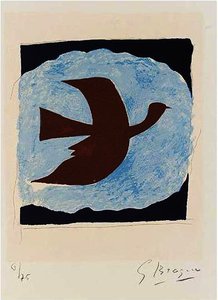
Georges Braque’s "Bistre Bird" is a pivotal Cubist study of avian form & flight. Explore fragmented shapes, earthy tones, and the dawn of modern art's revolutionary perspective. Hand-painted reproduction.
Biografie artist
Descoperă Georges Braque (1882-1963): Pionierul cubismului și maestru al fauvizmului! Explorează operele sale inovatoare, inclusiv „Case la L'Estaque” și impresionante collage pentru iubitorii de artă.
Despre pictură
Georges Braque’s “Bistre Bird”: A Study in Form and Flight
Georges Braque's "Bistre Bird," a captivating study in avian form, offers a glimpse into the artist’s pivotal role in the development of Cubism. Painted around 1908-1912 – a period of intense experimentation and collaboration with Pablo Picasso – this work transcends mere representation, becoming a profound exploration of perception and spatial relationships. The painting depicts a bird in mid-flight, its wings outstretched as if caught in an eternal moment of propulsion. Its plumage is rendered in shades of brown—a “bistre” hue that lends the piece a quiet dignity and earthy resonance – contrasting beautifully against the vibrant blue expanse of the sky. Noticeably, Braque doesn’t aim for photographic realism; instead, he dissects the bird's form into fragmented geometric shapes, mirroring the core tenets of Cubism. This approach wasn’t born in isolation; Braque’s early training as a house painter instilled within him an acute awareness of structure and perspective – skills that would prove invaluable as he dismantled traditional artistic conventions.
The Dawn of Cubism: Deconstructing Reality
“Bistre Bird” is inextricably linked to the revolutionary movement of Cubism, a style that emerged in Paris around 1907. Braque and Picasso, driven by a shared desire to challenge established notions of perspective and representation, began to break down objects into their constituent parts and reassemble them on the canvas from multiple viewpoints simultaneously. This wasn’t simply an aesthetic choice; it was a philosophical one, reflecting a growing interest in scientific theories of optics and the way our eyes perceive depth. The painting exemplifies this approach – the bird's wings are not presented as a single, continuous surface but rather as a series of overlapping planes, each rendered with careful attention to light and shadow. The background sky is similarly fragmented, suggesting an infinite space beyond the confines of the canvas. This deliberate distortion of reality aimed to capture the essence of an object – its underlying structure – rather than merely imitating its appearance.
Influences and Techniques: Cézanne’s Legacy
Braque's artistic journey leading up to "Bistre Bird" was profoundly shaped by the work of Paul Cézanne, a Post-Impressionist painter whose emphasis on geometric forms and multiple perspectives served as a crucial precursor to Cubism. Cézanne’s meticulous studies of landscapes and still lifes, particularly his exploration of how light interacts with solid objects, deeply influenced Braque's approach to composition and form. The artist spent considerable time studying Cézanne’s retrospective exhibition in 1907, recognizing the profound impact it would have on the avant-garde movement. Technically, Braque employed a technique known as “Analytical Cubism,” characterized by monochromatic color palettes – predominantly browns, grays, and ochres – and a focus on dissecting objects into their basic geometric components. The brushstrokes are often subtle and precise, contributing to the painting’s overall sense of controlled fragmentation.
Symbolic Resonance: Flight, Freedom, and Observation
Beyond its formal innovations, “Bistre Bird” carries a potent symbolic weight. The act of flight itself represents freedom, aspiration, and transcendence – themes that resonated deeply with the artists of the early 20th century. The bird’s poised stance suggests both vulnerability and strength, inviting contemplation on the delicate balance between observation and interpretation. Braque's choice of “bistre,” a muted brown tone, adds to this sense of quiet introspection. It evokes the earth, grounding the soaring image while simultaneously hinting at the vastness of the sky. Ultimately, "Bistre Bird" is not simply a depiction of a bird in flight; it’s an invitation to engage with the complexities of perception and the enduring power of art to transform our understanding of the world.
Întrebări și răspunsuri
Ce intensitate de culoare are "Bistre bird" de Georges Braque?
Culorile din "Bistre bird" de Georges Braque au o intensitate Balanced.
Care este dimensiunea și orientarea recomandate pentru printarea lucrării „Bistre bird”?
Pentru o printare a lucrării "Bistre bird" de Georges Braque, recomandăm dimensiunea de Large în orientare Portrait.
Pot viziona "Bistre bird" sub formă de diaporama cu ecran întreg?
"Bistre bird" de Georges Braque poate fi vizualizată sub formă de diaporama pe pagina dedicată operei, Galerie foto.
Informații rapide și quiz despre artă
Despre Georges Braque

Georges Braque
1882 - 1963, Franța
Biografie artist
Early Life and Artistic Foundations
Georges Braque, născut în Argenteuil, Franța, în 1882, a pornit într-un drum profund împletit cu peisajul în evoluție al artei moderne. Creșterea sa într-o familie de pictori și zugravi, precum și decoratori a instillat nu doar o măiestrie tehnică în utilizarea materialelor, ci și o apreciere timpurie pentru formă și structură. Deși inițial urmând exemplul tatălui său, Braque’s instinct artistic natural l-a condus curând la o pregătire formală la École des Beaux-Arts din Le Havre, marcând începutul călătoriei sale către a deveni unul dintre cei mai influenți pictori ai secolului XX. Această fundație – un amestec de meșteșug practic și studiu academic – s-a dovedit crucială pe măsură ce ulterior a deconstrucit și a reimaginat convențiile artistice tradiționale.
Mutându-se în Paris în 1902, Braque a continuat studiile la Académie Humbert, imersându-se în mediul artistic vibrant al orașului. Aici a întâlnit artiști precum Marie Laurencin și Francis Picabia, întărind conexiuni care au modelat dezvoltarea sa timpurie. Primele sale lucrări au reflectat influențele predominante ale Impresionismului și Post-Impresionismului, dar o întâlnire decisivă cu culorile îndrăznețe și libertatea expresivă a Fauvismului în 1905 a aprins o nouă direcție în explorarea sa artistică.
The Embrace of Fauvism and the Dawn of Cubism
Adoptarea principiilor Fauvistice de către Braque – caracterizate prin culori intense, non-naturaliste și expresie emoțională – este exemplificată vivid în picturi precum The Patience. Această perioadă a văzut-l lucrând alături de artiști precum Henri Matisse și André Derain, experimentând cu palate vibrante și forme simplificate. Cu toate acestea, implicarea lui Braque cu Fauvismul nu a fost doar o imitație; el a infuzat-o cu o sensibilitate unică, temperând exuberanța necontrolată a mișcării cu o abordare mai restrânsă și analitică. Un punct de cotitură a sosit în 1907 cu expoziția retrospectivă a operelor lui Paul Cézanne. Accentul pus de Cézanne pe forme geometrice și perspective multiple a avut un impact profund asupra Braque, pregătind terenul pentru colaborarea sa revoluționară cu Pablo Picasso. Începând din 1908, acești doi titani ai artei au pornit împreună într-o perioadă intensă de schimburi intelectuale care au dat naștere Cubismului – un mișcare revoluționară care a sfidat concepțiile tradiționale despre reprezentare.
Împreună, Braque și Picasso au dezvoltat Cubismul analitic, descompunând obiectele în forme geometrice fragmentate și prezentându-le din mai multe perspective simultan. Lucrări precum Houses at L'Estaque demonstrează această fază timpurie, evidențiind o abatere radicală de la perspectiva convențională și un focus pe structura subiacentă a formelor. Paleta lor a devenit deliberat palidă, punând accent pe formă în detrimentul culorii, pentru a reprezenta totalitatea prezenței unui obiect, mai degrabă decât doar aspectul său.
Innovation Through Fragmentation and Collage
Colaborarea dintre Braque și Picasso a continuat să depășească limitele expresiei artistice, conducând la dezvoltarea Cubismului sintetic în jurul anului 1912. Această fază a introdus *papier collé* – incorporarea de materiale din lumea reală, cum ar fi ziare, hârtie tapetată și țesături, în picturi. Această inovație a contestat ierarhia tradițională dintre pictură și sculptură, amestecând liniile dintre artă și viață.
Utilizarea pionieristică de către Braque a *papier collé* (pasted paper) a marcat un punct de cotitură semnificativ în evoluția sa artistică. Prin integrarea fragmentelor de obiecte din lumea reală în compozițiile sale, el a perturbat spațiul iluzionist al picturii tradiționale și a introdus un nou nivel de materialitate și textură.
Later Years and Enduring Legacy
După război, stilul lui Braque s-a dezvoltat dincolo de limitele stricte ale Cubismului timpuriu, incorporând elemente ale compoziției clasice și o nouă interes pentru natură moartă. În timp ce a păstrat influențele geometrice care au definit lucrarea sa timpurie, el a dezvoltat o abordare mai nuanțată și contemplativă a picturii. Pânzele sale mai târziu sunt caracterizate de atmosfera lor senină și armonii subtile de culoare. Pe tot parcursul carierei sale, Braque s-a angajat să exploreze principiile fundamentale ale formei, spațiului și reprezentării. A continuat să experimenteze cu diferite materiale și tehnici, depășind limitele expresiei artistice până la moartea sa în 1963. Moștenirea sa este imensă, modelând cursul artei moderne și inspirând generații întregi de pictori, sculptori și artiști colagiști.
Influences and Notable Works
- Influenced By: Henri Matisse, André Derain, Paul Cézanne
- Key Works: Houses at L'Estaque, The Patience, Violin and Palette, Mandola
- Impact on Art History: Revolutionized 20th-century art through Cubism; challenged traditional notions of perspective and representation.
Informații rapide despre Georges Braque
- Artistic Movement Or Style: Cubism, Fauvism
- Artists Or Movements Influenced By This Artist:
- Pablo Picasso
- Arta modernă
- Artists Who Influenced This Artist:
- Henri Matisse
- André Derain
- Paul Cézanne
- Date Of Birth: 13 mai 1882
- Date Of Death: 31 aug 1963
- Full Name: Georges Braque
- Nationality: Francez
- Notable Artworks:
- Houses at L'Estaque
- The Patience
- Violin și Paletă
- Place Of Birth: Argenteuil, Franța
Explorați opere de artă organizate pe teme, stiluri și caracteristici.


Georges Braque
Bistre bird
() ·
Cu ramă: · Pictată manual în ulei pe pânză de in
Total