

 Vezi în context
 Trimite
 Distribuie
 Detalii
 Ghidul

 Descarcă
 Produse similare
 Radiografie
 Diaporama
 Statistici
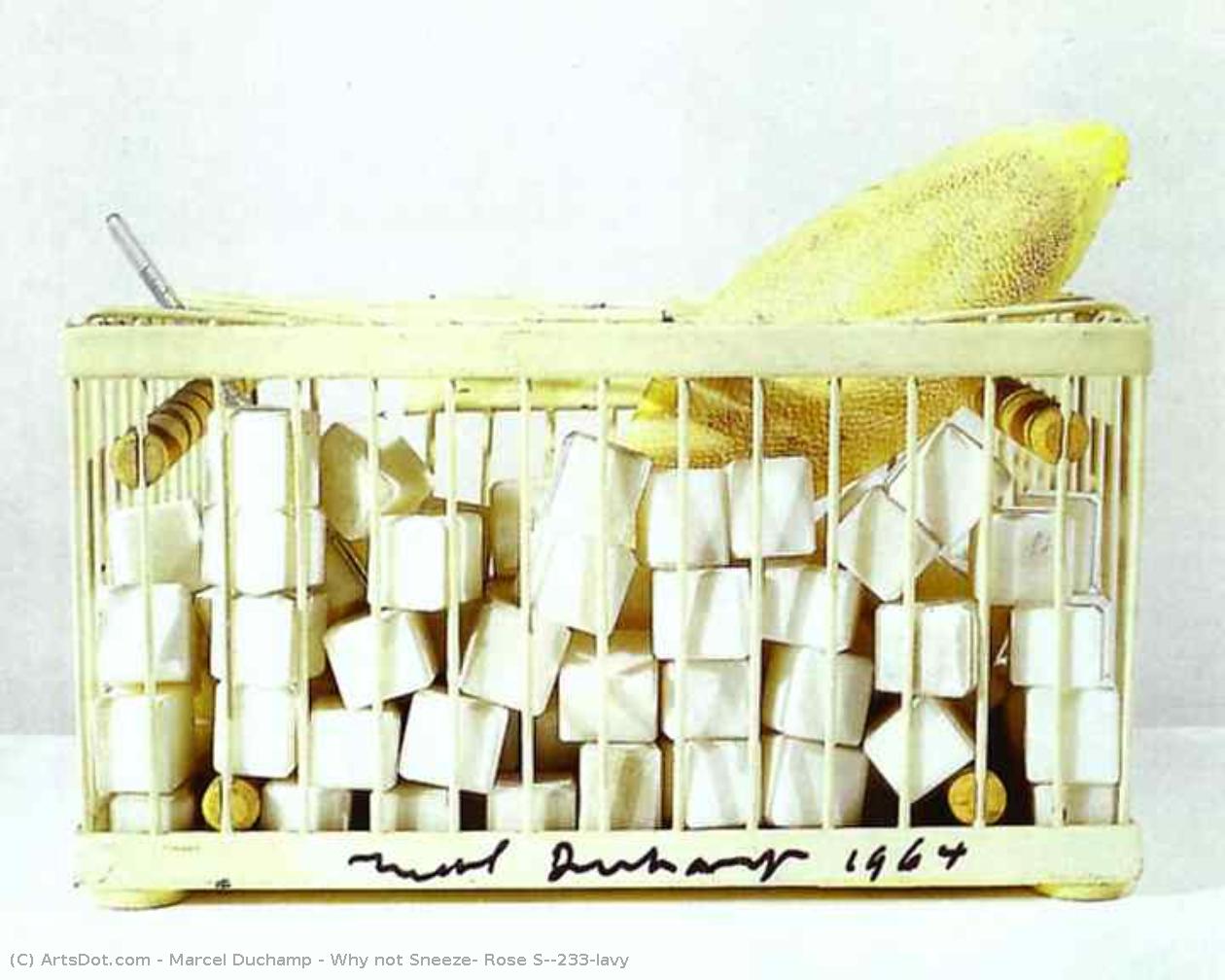
Why not Sneeze, Rose Sélavy
 Acrylic On Canvas
- WallArt
- Dada Gesamtkunstwerk
 1921
1921 12.0 x 22.0 cm
 Tate Modern
 Citește mai mult
Marcel Duchamp: Artist revoluționar care a provocat definiția artei prin Dadaism și readymade-uri precum „Fountain”. Descoperă operele sale iconice și impactul său filosofic.
Lucrarea de artă afișată pe această pagină este protejată de legile privind drepturile de autor, ceea ce înseamnă că nu putem crea sau vinde în mod legal o reproducere identică. Această protecție este garantată prin acorduri internaționale, precum Convenția de la Berna și de legile naționale, inclusiv cele prevăzute de Legea dreptului de autor din S.U.A. – Titlul 17. Toate drepturile rezervate. Orice reproducere neautorizată este interzisă.
Această metodă respectă pe deplin reglementările privind drepturile de autor, deoarece nu implică copierea sau duplicarea operei protejate. În schimb, este o reinterpretare creativă – o pictură nouă, influențată de original, dar care nu este identică cu acesta.
Giclée / Imprimare artistică
Printuri giclée sau pe canvas de calitate muzeală, cu proces de producție rapid și opțiuni flexibile de finisare. ( Comandă pictură realizată manual Treci la imagine digitală)




P118B lei10

P118H lei10

P118W lei10

P438Z lei10

P508JH lei12

P508YH lei12

P805H lei10

P805Z lei10

P919BZ lei10

P919G lei10

P919XJ lei10

P959ZH lei10

P968JZ lei12

W106C lei8

W218G lei10

W218JH lei8

W218Y lei10

W307PJ lei10

W316G lei10

W316PJ lei8

W316Y lei10

W398PJ lei8

W4111J lei10

W500HY lei15

W500JH lei15

W692G lei12

W849H lei8

W940BG lei15

W953PJ lei8




Dimensiuni standard
personalizat
CM
INCH
Alegeți dintre dimensiunile noastre prestabilite, care respectă proporțiile originale ale operei de artă.
Loading sizes...

lățime
înălțime
Introduceți lățimea și înălțimea de care aveți nevoie, pentru a se potrivi ramei sau peretelui dumneavoastră. O printare poate fi doar tăiată, niciodată extinsă dincolo de dimensiunea imaginii originale, astfel încât o dimensiune cu o formă diferită va pierde o parte din imagine. Vă trimitem o simulare digitală pentru aprobare înainte de a imprima orice. Imaginea afișată pe această pagină nu prezintă tăierea reală — doar simularea arată acest lucru.
Livrare în întreaga lume () în 2 săptămâni, în loc de cele 4/5 săptămâni standard. (22 Octombrie)

Livrare expres gratuită la nivel mondial

Pânză de in premium

Asigurare completă pentru transport

Garanție de rambursare a taxelor vamale

Garanția fidelității culorilor

Politica de retur în 100 de zile (doar pentru defecte)

Garanție de rambursare 100%

Reducere pentru comenzi multiple
 Opțiunea cu sticlă este disponibilă doar pentru dimensiuni de sub 110 cm

Why not Sneeze, Rose Sélavy
Giclée / Imprimare artistică
Dimensiune reproducere
-


Preț total
lei 317
A Provocative Pause: Unpacking “Why Not Sneeze, Rose Sélavy”
Marcel Duchamp’s "Why Not Sneeze, Rose Sélavy," painted in 1921, isn't merely a still life; it’s an audacious declaration. This deceptively simple image – a white box containing a yellow banana alongside several cups and spoons – immediately throws the viewer off balance, demanding they reconsider their assumptions about art itself. Duchamp, a pivotal figure in the Dada movement, wasn’t interested in replicating reality or expressing personal emotion through traditional means. Instead, he sought to dismantle established artistic conventions, forcing us to confront the very definition of what constitutes “art” and its role within society.
The painting's genesis lies within Duchamp’s exploration of chance and readymades – everyday objects presented as art without alteration. "Why Not Sneeze" exemplifies this approach perfectly. The choice of a banana, an utterly mundane item, elevates it to the status of subject matter through its placement within the box, transforming it into something worthy of contemplation. The inclusion of the cups and spoons further complicates the scene, suggesting a potential for consumption or ritual – elements deliberately devoid of inherent meaning, yet imbued with a subtle tension.
Dadaist Disruptions: Style and Technique
“Why Not Sneeze” is firmly rooted in the principles of Dadaism, a movement born from the disillusionment following World War I. Rejecting logic and reason, Dada artists embraced absurdity, chance, and anti-art sentiments. Duchamp’s technique reflects this ethos; he employed a precise, almost clinical approach to rendering the objects, using oil paint on canvas with a smooth, matte finish. There's no attempt at illusionistic depth or vibrant color – instead, the focus is entirely on the arrangement of the elements and their juxtaposition. The stark white box acts as a frame, isolating the objects and intensifying their impact.
Interestingly, Duchamp’s process involved a degree of chance. He reportedly placed the banana in the box after it had been emptied, allowing the positioning to be determined by accident. This element of randomness underscores the movement's core belief that art should not be dictated by conscious intention but rather emerge from unexpected encounters and unforeseen circumstances.
Symbolic Whispers: Interpretation and Context
The symbolism within “Why Not Sneeze” is deliberately ambiguous, inviting multiple interpretations. The banana itself has been suggested to represent fertility, sexuality, or even a subtle critique of consumer culture – a small, yellow object placed in an enclosed space, hinting at both abundance and confinement. The cups and spoons could symbolize hospitality, offering, or perhaps the act of consuming – again, devoid of any specific narrative but laden with potential meanings.
Furthermore, the title itself, “Why Not Sneeze?”, is a direct challenge to conventional artistic expectations. Duchamp’s question implies that there are no rules governing art, no prescribed methods for creating it. It's an invitation to embrace spontaneity and reject rigid constraints. The painting can be viewed as a meditation on the absurdity of artistic norms and a playful provocation against established aesthetic values.
A Timeless Dialogue: Emotional Impact and Legacy
Despite its seemingly simple composition, “Why Not Sneeze, Rose Sélavy” possesses a profound emotional impact. It’s unsettling, humorous, and thought-provoking – qualities that have cemented its place as one of the most significant works in modern art history. Duchamp's work continues to resonate today, prompting us to question our own perceptions of beauty, value, and the very nature of artistic expression. A reproduction of this iconic piece offers a unique opportunity to engage with a pivotal moment in art history and contemplate the enduring legacy of Marcel Duchamp’s revolutionary spirit.
Întrebări și răspunsuri
„Why not Sneeze, Rose Sélavy” este disponibil(ă) sub formă de print de fine art?
Pentru a achiziționa o ediție print a lucrării "Why not Sneeze, Rose Sélavy" de Marcel Duchamp, vă este suficient să o comandați pe pagina dedicată Print de Fine Art: o printă de fine art pe canvas din bumbac sau pe hârtie canvas arhivistică.
Ce stare și ce emoție se regăsesc în "Why not Sneeze, Rose Sélavy"?
În "Why not Sneeze, Rose Sélavy", o atmosferă Playful însoțește o emoție Playful.
În ce perioadă a carierei lui Marcel Duchamp se încadrează "Why not Sneeze, Rose Sélavy"?
„Why not Sneeze, Rose Sélavy” aparține perioadei Dada Phase din cariera lui Marcel Duchamp. Această clasificare corelează opera cu evoluția artistului.
Biografie artist
Un Spirit Revoluționar: Viața și Arta lui Marcel Duchamp
Marcel Duchamp, născut Henri-Robert-Marcel Duchamp în 1887 la Blainville-Crevon, Normandia, a fost mai mult decât un artist; a fost un provocator filosofic care a schimbat fundamental cursul artei moderne. Primii săi ani de viață, deși aparent convenționali – crescut într-o familie care aprecia exprisia artistică, cu ambii frați urmărind cariere reușite în artă – au prefigurat iconoclasmul ce urma să vină. Inițial, Duchamp a urmat o pregătire formală, stăpânind tehnici tradiționale și experimentând cu stiluri post-impresioniste. Cu toate acestea, această bază academică nu a servit ca un scop în sine, ci ca o trampolină pentru a pune sub semnul întrebării însăși natura artei, scopul său și definiția sa. Nu era mulțumit să reprezinte pur și simplu lumea; căuta să provoace modul în care o percepem și ceea ce constituie valoarea artistică. Această curiozitate intelectuală nesățioasă avea să devină caracteristica definitorie a carierei sale prolifice.De la Cubism la Dadaism: O Refuzare a Convențiilor
Călătoria artistică a lui Duchamp a fost marcată de o evoluție constantă, de o lepădare deliberată a normelor stabilite. Implicarea sa inițială în Cubism, evidentă în lucrări precum Portrait of Chess Players (1911), a demonstrat un interes pentru formele fragmentate și perspectivă multiple – o îndepărtare de reprezentarea tradițională. Totuși, el a depășit rapid preocupările pur estetice, recunoscând că simpla rearanjare a elementelor vizuale nu era suficientă pentru a aborda întrebările profunde care îi revoltau. Horrorul Primului Război Mondial a alimentat acest nemulțumire, conducing-l pe Duchamp să îmbrățișeze Dadaismul, un mișcare născută din deziluzie și din respingerea logicii, a rațiunii și a valorilor artistice tradiționale. Într-un cadru dadaist, Duchamp a început cu adevărat să deconstruiască noțiunile convenționale de artă. Nu era interesat să creeze obiecte frumoase; dorea să provoace gândirea, să sfideze presupunerile și să expună arbitrarul judecății estetice. Această perioadă a văzut nașterea celei mai radicale inovații a sa: „readymade”-ul.Readymade-urile și Subversiunea Artei
Introducerea readymade-urilor – obiecte fabricate obișnuite, selectate și prezentate ca artă – a fost cea mai semnificativă contribuție a lui Duchamp la secolul XX. Acestea nu erau pur și simplu obiecte găsite; erau acte deliberate de subversiune artistică. Luând un obiect cotidian, precum un urinar (Fountain, 1917), semnându-l cu „R. Mutt” și prezentându-l la o expoziție de artă, Duchamp a provocat însăși definiția îndemânării artistice și a autoratului. Era mâna artistului cea care crea lucrarea sau era vorba despre ideea artistului? Această întrebare a devenit centrală în practica sa și a pus bazele Artei Conceptuale. Alte readymade-uri notabile, precum L.H.O.O.Q. (1919), o reproducere pe o felicitare a Mona Lisa defasată cu o mustață și o barbă mică, au fost critici jucăușe, dar incisive, aduse istoriei artei și iconelor culturale consacrate. Aceste opere nu erau menite să fie admirate pentru calitățile lor estetice; ele aveau scopul de a provoca dezbaterea și de a forța privitorii să își reevalueze noțiunile preconcepute despre ceea ce constituie arta. Duchamp credea că arta trebuie să rezide în minte, nu doar în ochi.Moștenire și Influență Durabilă
Impactul lui Marcel Duchamp asupra generațiilor ulterioare de artiști este nemăsurabil. El a alterat fundamental înțelegerea noastră asupra artei, deschizând calea pentru mișcări precum Arta Conceptuală, Minimalismul, Pop Art și numeroase altele. Accentul său pus pe ideea artistului – conceptul din spatele lucrării – în detrimentul calităților estetice, continuă să inspire artiștii și astăzi.- Cubism: Explorarea timpurie a formelor fracturate și a reprezentării spațiale.
- Dadaism: Refuzul logicii, al rațiunii și al valorilor artistice tradiționale ca răspuns la Primul Război Mondial.
- Artă Conceptuală: Accentul pe ideea din spatele operei de artă, mai degrabă decât pe calitățile sale estetice.

Marcel Duchamp
1887 - 1968 , Franța
Informații rapide
- Artistic Movement Or Style:
- Cubism
- Dadaism
- Artists Or Movements Influenced By This Artist: ['Conceptual Art']
- Date Of Birth: 28 iulie 1887
- Date Of Death: 2 octombrie 1968
- Full Name: Marcel Duchamp
- Nationality: Francez-American
- Notable Artworks:
- Fountain
- L.H.O.O.Q.
- The Large Glass
- Place Of Birth: Blainville, Franța
Articole conexe

Dadaism Unveiled: The Beautiful Chaos of Art's Most Rebellious Movement
Explore the profound rebellion of Dadaism. Discover how this avant-garde movement emerged from the chaos of WWI to redefine art through absurdity, anti-logic, and a legacy that shaped Surrealism and Pop Art. A deep dive into the beautiful chaos of art history for the true enthusiast.

Pop Surrealism Unveiled: The Sophisticated Intersection of Vibrant Pop Art and Dreamlike Subconscious Landscapes
Explore the captivating world of Pop Surrealism. Discover how vibrant Pop Art meets dreamlike subconscious imagery through the works of masters like Jeff Soto and Ryan Heshka. An expert guide for discerning collectors seeking to understand this profound contemporary art movement.
Explorați opere de artă organizate pe teme, stiluri și caracteristici.


