

 Previzualizare
 Trimite prin felicitare
 Distribuie
 Detalii despre lucrare
 Ghid
Ghid

 Descarcă imaginea
 Produse similare
 Radiografie
 Galerie foto
 Întrebări și răspunsuri
 Statistici
Celtic Tale

- 110.0 x 101.0 cm


Paul Sérusier's 'Celtic Tale' (1894) is a vibrant Synthetist masterpiece, showcasing bold forms and nature’s harmony within a lush forest setting. Explore this Cloisonnism-inspired artwork.
 Vezi mai mult
Paul Sérusier (1864-1927) a fost pictor francez, pionier al artei abstracte și influent în mișcarea Nabis. Celebre sunt operele sale din stilul cloisonnism, precum "The Talisman", care au inspirat generații de artiști.
Obțineți un fișier gata de imprimare care depășește cu mult calitatea previzualizării web. Fiecare imagine digitală pe care o vindem provine dintr-un master de înaltă rezoluție din baza noastră de date — având, de regulă, o lățime între 5.000 și 15.000 de pixeli — astfel încât să puteți printa în format mare, să decupați strâns sau să reproduceți detalii fine cu încredere.
Niciun fișier nu părăsește studioul nostru fără să fie tratat. Un expert digital verifică nuanțele de culoare în raport cu pictura originală și le corectează acolo unde este necesar, apoi îmbunătățește claritatea și detaliile folosind instrumente profesionale de retușare — rămânând întotdeauna fidel gestului pictural și stilului artistului. Rezultatul este o imagine care seamănă cu tabloul propriu-zis, nu cu o scanare filtrată.
Aprobați înainte de finalizare: expertul nostru vă va trimite imaginea prin e-mail în termen de 72 de ore pentru revizuire. Nu sunteți mulțumit? Solicitați îmbunătățiri sau corecturi, ori cereți o restituire a plății dacă calitatea nu este pe măsura așteptărilor.
Aceasta este calitatea pe care se bazează editorii, studiourile de design, galeriile și tipăriturile.
Imagine Digitală
Descărcați un fișier la rezoluție înaltă pentru afișare personală, imprimare și proiecte creative. ( Comută pe versiunea Print Comandă pictură realizată manual)
Inclus în fiecare comandă de imagini digitale
Livrare digitală de expertiză, garantată
Când alegeți TopImpressionists.com, nu primiți doar o simplă imagine – primiți o operă de artă digitală îmbunătățită profesional, creată cu precizie și susținută de o garanție de satisfacție. Iată tot ceea ce primești odată cu comanda ta, în mod automat:

Livrare rapidă prin e-mail
Fișierul imaginii digitale la rezoluție înaltă vă va fi trimis prin e-mail în termen de 72 de ore de la finalizarea comenzii – gata pentru utilizare imediată.

Fișier digital optimizat prin IA
Opera ta de artă este optimizată profesional prin intermediul unor instrumente AI avansate și al editării manuale, asigurând un nivel maxim de detalii, claritate și acuratețe a culorilor.

Retransmitere gratuită pe viață
Ai șters sau ai pierdut din greșeală fișierul? Nu îți face griji – ți-l vom retrimite oricând, gratuit.

Fără taxe de import – Întotdeauna
Bucură-te instant de noua ta operă de artă, fără taxe vamale, taxe de import sau costuri de livrare – descărcările digitale sunt întotdeauna fără taxe.

Garanția acurateții culorilor
Asigurăm o reflectare cât mai fidelă a culorilor originale în imaginea ta digitală, prin utilizarea unor instrumente profesionale și a proceselor de gestionare a culorii.

Garanție de satisfacție de 100 de zile
Dacă nu sunteți mulțumit de imaginea digitală achiziționată, o vom revizui sau vă vom returna 100% în termen de 100 de zile – fără nicio întrebare.

Garanție de returnare 100% a banilor
Nu ești mulțumit? Primești rambursarea integrală în termen de 100 de zile de la primirea fișierului digital – fără nicio întrebare.

Reduceri pentru comenzi în volum
Cumpără 3 imagini, economisește 10% - Cumpără 5, economisește 15% - Cumpără 10+, economisește 20%. Ideal pentru proiecte creative, galerii și agenții.
Paul Sérusier’s “Celtic Tale”: A Window into Synthetist Vision
Paul Sérusier's "Celtic Tale," painted in 1894, isn’t merely a depiction of a forest scene; it’s a profound exploration of light, color, and the nascent principles of abstract art. This oil on canvas, now residing within the Dallas Museum of Art, offers a captivating glimpse into the artist's innovative approach to capturing the essence of nature – a style he would later define as Synthetism. Born in Paris in 1864, Sérusier’s artistic journey was marked by a restless pursuit of new forms of expression, culminating in his groundbreaking work with the Nabis movement and his pioneering experiments with Cloisonnism.
The painting immediately draws the eye with its vibrant palette. Bold swathes of emerald green, sapphire blue, and ochre yellow dominate the composition, creating a sense of luminous intensity. These colors aren’t applied realistically; instead, Sérusier employs them in a flattened, almost geometric manner – a hallmark of Synthetism. He deliberately rejects traditional perspective, opting for simplified forms and strong contours that delineate shapes rather than mimicking their three-dimensional appearance. This technique, reminiscent of the decorative art of cloisonné enamelwork (hence “Cloisonnism”), creates an arresting visual effect, pulling the viewer into the heart of the scene.
The Spirit of Pont-Aven: Synthetism and its Roots
Sérusier’s artistic evolution was profoundly shaped by his summer sojourn in 1888 to Pont-Aven, a small village in Brittany. There, he encountered Paul Gauguin, who became a mentor and introduced him to the principles of Synthetism. Gauguin encouraged Sérusier to abandon academic realism and instead focus on capturing the *feeling* of a subject – its essence rather than its literal representation. This shift is powerfully evident in "Celtic Tale," where the forest itself becomes a symbolic entity, imbued with an almost mystical quality.
The painting’s composition echoes the work of Seurat and Signac, key figures in Pointillism and Neo-Impressionism, both movements that influenced Sérusier's development. However, unlike their meticulous application of tiny dots of color, Sérusier utilizes broader brushstrokes and bolder blocks of pigment to achieve a similar effect – creating an impression of light and atmosphere through the manipulation of color itself. The figures within the scene are deliberately simplified, almost dissolving into the surrounding landscape, further emphasizing the painting’s abstract qualities.
Symbolism Within the Scene: Nature, Community, and Mystery
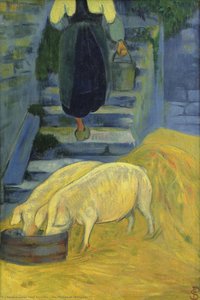
Beyond its formal innovations, “Celtic Tale” is rich in symbolic meaning. The gathering of individuals amidst the forest evokes a sense of community and shared experience – a celebration of life and connection with nature. The two dogs present add to this feeling of warmth and conviviality. However, there’s also an underlying current of mystery and perhaps even melancholy. The cloaked figures, their faces obscured, suggest a ritualistic gathering, hinting at ancient Celtic traditions and the enduring power of myth.
The dappled sunlight filtering through the trees creates a sense of ethereal beauty, while the dark, rocky outcrop in the background provides a stark contrast, representing both obstacles and hidden depths. The painting’s overall mood is one of serene contemplation – an invitation to lose oneself in the beauty of the natural world and reflect on its timeless mysteries. It's a testament to Sérusier's ability to translate complex emotions and ideas into a visually arresting and deeply resonant work of art.
A Legacy of Innovation: Paul Sérusier’s Enduring Influence
Paul Sérusier’s “Celtic Tale” stands as a pivotal work in the history of modern art. It represents a crucial step towards abstraction, demonstrating the power of color and form to convey emotion and meaning independently of representational accuracy. His pioneering use of Synthetism paved the way for subsequent movements such as Fauvism and Cubism, solidifying his place as one of the most important figures in the development of 20th-century art. Reproductions of this captivating painting continue to inspire artists and collectors alike, offering a window into the visionary world of Paul Sérusier.
Întrebări și răspunsuri
Unde și în ce scop este recomandată piesa „Celtic Tale”?
„Celtic Tale” este recomandat pentru Reflective, iar spațiul ideal de expunere este o Living Room.
Ce subiecte sunt reprezentate în "Celtic Tale" de Paul Sérusier?
Subiectele din "Celtic Tale" sunt forest, figures, sunlight, community, breton, landscape, synthetism.
"Celtic Tale" de Paul Sérusier este o operă de artă luminoasă sau întunecată?
Luminozitatea percepută a operei "Celtic Tale" de Paul Sérusier este shadow. Aceasta poate fi adaptată la lumina spațiului în care va fi expusă.
Opere similare




Biografie artist
Early Life and Artistic Foundations
Paul Sérusier, a pivotal figure in the evolution of modern art, was born on November 9th, 1864, within the elegant surroundings of Paris. His lineage boasted a distinguished heritage – his father, a successful businessman involved in the burgeoning perfume industry, provided a privileged upbringing for young Paul. This early exposure to refined tastes and an appreciation for craftsmanship undoubtedly shaped his artistic sensibilities. Following a solid education at the Lycée Condorcet, where he excelled in both philosophy and science, Sérusier’s path led him towards the world of art. He enrolled at the Académie Julian, not as a conventional student seeking formal training, but rather as a seeker of alternative approaches to painting – a reaction against the rigid constraints of the established École des Beaux-Arts. It was during this period that he encountered and befriended fellow artists Maurice Denis and Édouard Vuillard, forging connections that would prove instrumental in shaping his artistic vision. A significant turning point arrived in the summer of 1888 when Sérusier ventured to Pont-Aven in Brittany – a region renowned as a haven for artists seeking inspiration amidst the rugged beauty of the landscape. Here, he encountered Paul Gauguin, an encounter that would profoundly influence his artistic trajectory. Gauguin’s guidance encouraged Sérusier to abandon traditional methods of representation, urging him to embrace pure color, simplify forms, and imbue his work with a sense of personal expression and symbolic meaning. This marked a decisive shift towards abstraction, laying the groundwork for his future innovations.The Nabis Movement and Cloisonnism
Emerging from the crucible of Pont-Aven’s artistic community, Sérusier became a central figure in the formation of the “Nabis” – a collective name derived from the Hebrew word "nebiim," meaning "prophets." This group, comprised of artists including Pierre Bonnard, Maurice Denis, Henri-Gabriel Ibels, and Paul Ranson, sought to break free from the conventions of Impressionism and Post-Impressionism. The Nabis were united by a shared desire to explore new avenues in artistic expression, delving into symbolism, mysticism, and the occult – subjects often veiled within their paintings. Sérusier’s role as a leader within this movement was crucial; he championed a distinctive approach known as “cloisonnism.” This technique involved dividing the canvas into distinct areas of color, separated by bold, dark outlines—akin to the individual cells of a stained-glass window (hence "cloison," French for "cell"). The resulting effect was strikingly graphic and flattened, prioritizing visual impact over realistic representation. His seminal work, *Le Talisman* (1888), perfectly exemplifies this style, pushing the boundaries of abstraction and foreshadowing the developments of Synthetic Cubism. The painting’s vibrant colors and simplified forms created a powerful emotional resonance, capturing a sense of mystery and spiritual depth.Key Works and Artistic Evolution
Sérusier's artistic journey spanned several decades, marked by continuous experimentation and refinement. His early works in Brittany—such as *L’Averse* (1893), now housed at the Musée d’Orsay in Paris—demonstrate a contemplative mood, characterized by muted colors and a focus on capturing the essence of the landscape. He also produced evocative portraits, notably his depiction of Paul Ranson (1890), which reveals a keen eye for psychological nuance. A particularly striking piece is *Les Bateaux* (1894), currently residing in the Muzeum Narodowe in Warsaw, showcasing his exploration of form and color within a dynamic composition. Later in his career, Sérusier turned to teaching at the École Ranson, where he instilled his principles of abstraction and expressive painting in a new generation of artists. His final book, *ABC de la peinture* (1921), served as a testament to his lifelong dedication to artistic exploration and education. Throughout these works, Sérusier consistently sought harmony between form and color, striving for an aesthetic that transcended mere representation—a pursuit deeply rooted in his belief that art could evoke emotions and convey spiritual truths.Legacy and Influence
Paul Sérusier’s contribution to the development of modern art is undeniable. His pioneering work in abstraction, particularly through the technique of cloisonnism, profoundly influenced subsequent generations of artists. He demonstrated a willingness to challenge conventional artistic norms, paving the way for movements like Synthetic Cubism and Expressionism. His exploration of symbolism and his embrace of non-objective forms established him as a key figure in the transition from Impressionism to modern art. Sérusier’s legacy extends beyond his individual works; he played a vital role in shaping the artistic landscape of late 19th and early 20th century France, leaving an enduring mark on the course of art history. His influence can be seen in the work of artists who followed, demonstrating the lasting impact of his innovative approach to painting and his unwavering commitment to artistic expression.
Paul Sérusier
1864 - 1927 , Franța
Detalii rapide
- Artistic Movement Or Style: Post-Impresionism
- Artists Or Movements Influenced By This Artist:
- Nabis
- Synthetism
- Cloisonnism
- Artists Who Influenced This Artist:
- Paul Gauguin
- Maurice Denis
- Date Of Birth: 9 noiembrie 1864
- Date Of Death: 7 octombrie 1927
- Full Name: Louis-Paul-Henri Sérusier
- Nationality: Francez
- Notable Artworks:
- L'Averse
- Portret Paul Ranson
- Melancolie
- Șopârla
- Place Of Birth: Paris, Franța