

Shown: · With its frame:
 Previzualizare
 Trimite prin felicitare
 Distribuie
 Detalii despre lucrare
 Ghid
Ghid

 Descarcă imaginea
 Produse similare
 Radiografie
 Galerie foto
 Q&A
Q&A Statistici
- 125.0 x 81.0 cm


lei 1276
Reproducere pictată manual în ulei
Pictură în ulei pe pânză, pictată manual de artiștii noștri la dimensiunea și ramele dorite de dumneavoastră, pe comandă. ( Comută pe versiunea Print Comută pe Imagine Digitală)
Size
·Standard
personalizat
CM
INCH
Alegeți dintre dimensiunile noastre prestabilite, care respectă proporțiile originale ale operei de artă.
Loading sizes...

lățime
înălțime
Introduceți lățimea și înălțimea necesare pentru a se potrivi ramei sau peretelui dumneavoastră. Această lucrare este pictată manual, așa că, pentru o dimensiune cu o formă diferită, artistul poate picta puțin mai mult în jurul imaginii sau poate tăia puțin din margini — dumneavoastră decideți. Vă vom trimite o simulare digitală pentru aprobare înainte de a începe pictarea. Imaginea afișată pe această pagină nu reprezintă rezultatul real — doar simularea este reprezentativă.
 Citește mai mult
Finish
·
White lei1

Blurside lei1

Extended lei1

P118B lei10

P118H lei10

P118W lei10

P438Z lei10

P508JH lei12

P508YH lei12

P805H lei10

P805Z lei10

P919BZ lei10

P919G lei10

P919XJ lei10

P959ZH lei10

P968JZ lei12

W106C lei8

W218G lei10

W218JH lei8

W218Y lei10

W307PJ lei10

W316G lei10

W316PJ lei8

W316Y lei10

W398PJ lei8

W4111J lei10

W500HY lei15

W500JH lei15

W692G lei12

W849H lei8

W940BG lei15

W953PJ lei8

H24-GOLD lei30

H24-SILVER lei30

H36-GOLD lei45

H36-SILVER lei45
Shipped in a protective tube, ready for your own framer.
Above 105 cm the frame is shipped as a kit for a professional framer — read the details.
Extras
optionalWhat do the extras include?
Examples of what can be changed: Replace face with customer photo; Add pet (e.g., replace cat with dog); Include hidden message in background; Change background landscape or elements.
After order, TopImpressionists.com team will email client for instructions and provide a mockup preview
After order, TopImpressionists.com team will email client for instructions and provide a mockup preview
Livrare în întreaga lume () în 3-4 săptămâni, în loc de cele 5 săptămâni standard. (1 Noiembrie). Fără compromisuri în ceea ce privește calitatea.
Lac de protecție
Etichetă de prezentare
Detalii plăcuță din bronz gravat
This elegant plaque features the artist's name and the title of the artwork, finely engraved for a timeless presentation.
It is made from bronze with a refined, elegant finish. The text is precisely laser-engraved for a sharp and permanent result. Measuring 9x2 cm, the plaque is compact yet easy to read. It's built to be durable and scratch-resistant, offering a professional, museum-quality look. Mounting is simple thanks to the included adhesive backing.
Detalii plăcuță din acril transparent
The plaque includes essential engraved details such as the artist's name, the title of the artwork, the date it was created, the type of media used-like oil on canvas or watercolor-a brief description of the piece, and a QR code that links to the complete artwork information.
It is crafted from clear acrylic, offering a sleek, modern appearance. The text is UV-engraved in black to ensure strong visual contrast. With a size of 10x15 cm, it ensures optimal readability. It comes equipped with two metal hooks for secure wall mounting. The plaque is designed to be weather-resistant, making it suitable for various environments, and it includes interactive features that work seamlessly with smartphone scanning.
Detalii placă din acril negru
This elegant plaque includes engraved information such as the artist's name, the title of the artwork, the date it was created, the type of media used (like oil on canvas or watercolor), a short description of the artwork, and a QR code for quick access to more information.
The plaque itself is made from refined black acrylic with a premium finish. The text is laser-engraved in white for high contrast and readability. Its size is 10x15 cm, designed to be easy to read. It comes with two metal hooks for professional mounting. The design is sleek and fits any interior style. It is also weather-resistant and durable, with built-in digital integration for mobile compatibility.
Opțiunea cu sticlă este disponibilă doar pentru dimensiuni de sub 110 cm
 Opțiunea cu sticlă este disponibilă doar pentru dimensiuni de sub 110 cm
- Livrare expres gratuită la nivel mondial
- Pânză de in de înaltă calitate
- Asigurare completă pentru transport
- Garanție de rambursare a taxelor vamale
- Garanția fidelității culorilor
- Politica de retur în 100 de zile (doar pentru defecte de fabricație)
- Garanție de rambursare 100%
- Ofertă pentru comenzi multiple


Descriere obiect de colecție
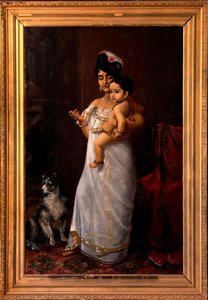
Raja Ravi Varma’s "There Comes Papa" (1893) captures an aristocratic Indian family scene with a captivating mother, child, and dog – a stunning example of late 19th-century painting. Discover this beautiful hand-painted reproduction and bring art home.
Biografie artist
Raja Ravi Varma (1848-1906): pictor revoluționar al artei indiene, care a fuzionat tradiția cu modernitatea și a democratizat accesul la artă prin gravuri.
About the painting
A Moment of Joyful Anticipation: Raja Ravi Varma’s “There Comes Papa”
Raja Ravi Varma's "There Comes Papa," painted in 1893, is more than just a portrait; it’s a poignant snapshot of domestic bliss rendered with the meticulous detail and evocative storytelling characteristic of the artist. Measuring 125 x 81 cm, this work transports us to a refined Indian household at the cusp of a significant event – the reunion of a family. The scene unfolds with an aristocratic lady, likely from the Malabar region, holding her infant son while gesturing towards the arrival of his father. A loyal dog, brimming with excitement, mirrors the anticipation, adding a layer of warmth and domesticity to the composition.
A Fusion of Styles: Ravi Varma’s Technique
Raja Ravi Varma was a pivotal figure in the transition from traditional Indian painting styles to a more modern approach. Born in 1848, he skillfully combined European academic techniques – particularly those influenced by French Orientalism – with deeply rooted Indian mythological and aesthetic traditions. This synthesis is strikingly evident in "There Comes Papa." The woman’s attire, a pristine white gown adorned with a delicate gold necklace, speaks to the wealth and status of her family, while the precise rendering of fabrics and textures demonstrates Ravi Varma's mastery of European academic training. Yet, the subject matter – a scene of familial joy rooted in Indian culture – firmly anchors the painting within its historical context.
Symbolism and Narrative
The painting’s narrative is rich with symbolism. The arrival of the father represents not just a reunion but also the establishment of lineage, tradition, and social order. The child's excited gaze embodies innocence and hope, while the dog’s eagerness symbolizes loyalty and companionship. Ravi Varma was renowned for his ability to imbue his paintings with narrative depth, often drawing upon Hindu mythology and folklore. While this particular work doesn't explicitly depict a mythological story, it captures a universal human experience – the joy of family connection – with remarkable sensitivity.
Historical Context and Artistic Significance
"There Comes Papa" was created during a period of significant change in India. The late 19th century witnessed the rise of Indian nationalism alongside increasing contact with Western cultures. Ravi Varma’s work played a crucial role in shaping modern Indian painting, establishing him as one of the most important artists of his time. His paintings were commissioned by royal families and wealthy patrons, reflecting the opulent lifestyles and cultural values of the era. The inclusion of a golden frame further elevates the artwork, emphasizing its elegance and reinforcing its status as a significant piece of art history. This reproduction offers a unique opportunity to own a piece of this pivotal moment in Indian artistic heritage.
Întrebări și răspunsuri
Ce atmosferă transmite "There Comes Papa"?
"There Comes Papa" emană o atmosferă Elegant.
Din ce țară provine lucrarea de Academic Romanticism „There Comes Papa”?
"There Comes Papa" face legătura între mișcarea Academic Romanticism și India, prin locul de naștere al creatorului său.
"There Comes Papa" de Raja Ravi Varma face parte din domeniul public?
În ceea ce privește drepturile de autor, "There Comes Papa" este în domeniul public – drepturile de autor au expirat.
Quick facts and art quiz
About Raja Ravi Varma

Raja Ravi Varma
1848 - 1906, India
Biografie artist
The Princely Brush: Raja Ravi Varma and the Dawn of Modern Indian Painting
Raja Ravi Varma, a name that echoes through the halls of Indian art history, wasn’t merely a painter; he was a cultural architect, a bridge between tradition and innovation. Born in 1848 within the opulent confines of Kilimanoor Palace, nestled amidst the verdant hills of Kerala, his life unfolded as a remarkable synthesis of aristocratic privilege and an incandescent creative spirit. He didn't simply capture images on canvas; he breathed life into ancient myths, imbued them with human emotion, and ultimately, reshaped how India perceived its own artistic heritage. Ravi Varma’s lineage was deeply intertwined with the Travancore royal family – two of his daughters were later adopted into the court, a testament to his noble standing and the profound respect he commanded. From a young age, a keen eye for detail and an innate talent for drawing manifested itself within the palace walls, nurtured initially by his uncle, Raja Raja Varma, who recognized and cultivated this burgeoning artistic ability. This early training, rooted in the established Tanjore School tradition, provided a solid foundation, but Ravi Varma’s ambition extended far beyond mere imitation; he yearned to master techniques that would allow him to translate not just likeness, but also feeling and narrative depth onto canvas.A Fusion of Worlds: Technique and Inspiration
Ravi Varma's artistic journey took an extraordinary turn during his travels – both within India and through interactions with British officials stationed in the region. He became utterly captivated by the meticulous realism and technical precision of European academic painting, diligently studying its principles: perspective, anatomy, light, and shadow. This wasn’t a simple appropriation; rather, it was a masterful adaptation. Unlike many of his contemporaries who merely replicated Western styles, Varma ingeniously integrated these techniques into his own distinctly Indian subject matter. His canvases transformed into vibrant stages for scenes drawn from the Ramayana, the Mahabharata, and the Puranas – epic tales brought to life with an unprecedented level of naturalism. He didn’t simply illustrate religious stories; he imbued them with palpable human emotion, psychological complexity, and a profound sense of drama. Consider his portrayal of *Shakuntala*, for instance—a scene brimming with longing, vulnerability, and quiet strength. The heroine's gaze, rendered with exquisite detail, conveys a depth of feeling previously unseen in Indian art. Similarly, *The Maharani of Travancore* is not merely a portrait; it’s a study of regal composure, capturing both the outward appearance of power and the subtle nuances of inner character. This fusion of European academic rigor and deeply rooted Indian aesthetics was revolutionary—a testament to Ravi Varma's artistic vision. His embrace of oil painting – a relatively new medium in India at the time – further amplified his ability to achieve an astonishing level of detail, luminosity, and emotional resonance.Democratizing Art: Lithographs and Public Appeal
Raja Ravi Varma’s influence extended far beyond the confines of royal courts and art circles. Recognizing that original paintings were largely inaccessible to the vast majority of Indians, he took a bold step—establishing the Raja Ravi Varma Fine Arts Lithographic Press in 1894. This groundbreaking venture marked a pivotal moment in Indian art history: it allowed for the mass production of affordable lithographs based on his iconic works. Suddenly, images of Hindu deities and mythological scenes were no longer confined to temples or palaces; they adorned homes across India, becoming objects of worship, cultural pride, and accessible beauty for all. These weren’t mere reproductions; they were carefully crafted interpretations—each lithograph a testament to Ravi Varma's artistic vision. The act of “democratizing art” had a profound and lasting impact on Indian society, fostering a wider appreciation for visual culture and fundamentally shaping how Indians perceived their own religious iconography. The *Hansa Damayanthi* lithograph, perhaps one of his most beloved creations, became a ubiquitous symbol of Indian identity, its image reproduced countless times and cherished by generations.Royal Portraits and Artistic Patronage
Ravi Varma’s career was further enriched through royal patronage. He served as court painter to several prominent princely states – Mewar, Baroda, and Mysore – each offering unique artistic challenges and opportunities. These experiences broadened his artistic horizons, exposing him to diverse cultural traditions and refining his skills. His portraits of Indian and British dignitaries were particularly noteworthy, capturing the essence of both cultures with remarkable sensitivity and detail. The meticulousness evident in these works reflects Ravi Varma’s dedication to portraying subjects with accuracy and grace. His ability to capture not only physical likeness but also personality and character was a hallmark of his artistic style.Legacy and Enduring Influence
Raja Ravi Varma passed away in 1906, leaving behind an indelible mark on the landscape of Indian art. He wasn’t just a painter; he was a pioneer who challenged conventional norms, embraced innovation, and skillfully blended tradition with modernity. His influence can be seen in the works of subsequent generations of Indian artists who sought to forge a distinctly national artistic identity. Museums like The Raja Ravi Varma Heritage Foundation and The Ganesh Shivaswamy Foundation continue to preserve and celebrate his legacy, ensuring that his vision endures for future generations. His paintings remain powerful testaments to his genius—masterpieces that capture the beauty, spirituality, and cultural richness of India. He truly transformed the way Indians perceived art and their own cultural heritage, solidifying his place as one of the most important figures in Indian artistic history.Exploring Varma’s World Today
For those seeking to delve deeper into the world of Raja Ravi Varma, numerous resources are available:- Explore artworks: Discover masterpieces like "Portrait of a Gentleman," "Hansa Damayanthi," and "The Maharani of Travancore" through online databases.
- Visit museums: Immerse yourself in Varma’s legacy at The Raja Ravi Varma Heritage Foundation, The Ganesh Shivaswamy Foundation, and the Kiran Nadar Museum of Art.
- Further research: Consult Wikipedia and Google Arts & Culture for detailed biographical information and scholarly insights.
Quick facts about Raja Ravi Varma
- Artistic Movement Or Style: Fusion tradițional
- Artists Or Movements Influenced By This Artist: ['Arta indiană modernă']
- Artists Who Influenced This Artist: ['Maestri europeni']
- Date Of Birth: 29 Apr 1848
- Date Of Death: 2 Oct 1906
- Full Name: Raja Ravi Varma
- Nationality: Indian
- Notable Artworks:
- Shakuntala
- Hansa Damayanthi
- Place Of Birth: Kilimanoor, India
Explorați opere de artă organizate pe teme, stiluri și caracteristici.


Raja Ravi Varma
There Comes Papa
() ·
With its frame: · Hand-painted in oil on linen
Total