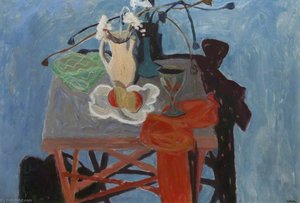
Previzualizare
 Trimite prin felicitare
 Distribuie
 Detalii despre lucrare
 Ghid
Ghid

 Descarcă imaginea
 Produse similare
 Radiografie
 Galerie foto
 Statistici
Castleton, Haystacks
 Acrilic pe pânză întinsă
- Artă de perete
- Scottish Colourist Movement
 41.0 x 60.0 cm
 Royal Scottish Academy of Art - Architecture
Descoperă pictura impresionistă "Castleton, Haystacks" de William George Gillies! O analiză profundă asupra stilului său cubist și influențelor artistice în peisajul scotian.
 Vezi mai mult
W.G. Gillies a fost un pictor scoțian remarcabil, cunoscut pentru peisajele sale lirice și stilul său unic, influențat de cubism și Paul Klee. A fost un educator influent și o figură cheie în scena artistică scoțiană din secolul XX.
Lucrarea de artă afișată pe această pagină este protejată de legile privind drepturile de autor, ceea ce înseamnă că nu putem crea sau vinde în mod legal o reproducere identică. Această protecție este garantată prin acorduri internaționale, precum Convenția de la Berna și de legile naționale, inclusiv cele prevăzute de Legea dreptului de autor din S.U.A. – Titlul 17. Toate drepturile rezervate. Orice reproducere neautorizată este interzisă.
Această metodă respectă pe deplin reglementările privind drepturile de autor, deoarece nu implică copierea sau duplicarea operei protejate. În schimb, este o reinterpretare creativă – o pictură nouă, influențată de original, dar care nu este identică cu acesta.
Giclée / Imprimare artistică
Printuri giclée sau pe canvas de calitate muzeală, cu proces de producție rapid și opțiuni flexibile de finisare. ( Comandă pictură realizată manual Comută pe Imagine Digitală)




P118B lei10

P118H lei10

P118W lei10

P438Z lei10

P508JH lei12

P508YH lei12

P805H lei10

P805Z lei10

P919BZ lei10

P919G lei10

P919XJ lei10

P959ZH lei10

P968JZ lei12

W106C lei8

W218G lei10

W218JH lei8

W218Y lei10

W307PJ lei10

W316G lei10

W316PJ lei8

W316Y lei10

W398PJ lei8

W4111J lei10

W500HY lei15

W500JH lei15

W692G lei12

W849H lei8

W940BG lei15

W953PJ lei8




Standard
personalizat
CM
INCH
Alegeți dintre dimensiunile noastre prestabilite, care respectă proporțiile originale ale operei de artă.
Loading sizes...

lățime
înălțime
Introduceți lățimea și înălțimea necesare pentru a se potrivi ramei sau peretelui dumneavoastră. O printare poate fi doar tăiată, niciodată extinsă dincolo de dimensiunea imaginii originale, astfel încât o dimensiune cu o formă diferită va pierde o parte din imagine. Vă trimitem o simulare digitală pentru aprobare înainte de a imprima orice. Imaginea afișată pe această pagină nu prezintă tăierea reală — doar simularea arată acest lucru.
Livrare în întreaga lume () în 2 săptămâni, în loc de cele 4/5 săptămâni standard. (26 Octombrie)

Livrare expres gratuită la nivel mondial

Pânză de in de înaltă calitate

Asigurare completă pentru transport

Garanție de rambursare a taxelor vamale

Garanția fidelității culorilor

Politica de retur în 100 de zile (doar pentru defecte de fabricație)

Garanție de rambursare 100%

Ofertă pentru comenzi multiple
 Opțiunea cu sticlă este disponibilă doar pentru dimensiuni de sub 110 cm

Castleton, Haystacks
Giclée / Imprimare artistică
Dimensiune reproducere
-


Preț total calculat
lei 319
Castleton Haystacks: A Vision of Scottish Pastoral
“Castleton Haystacks,” painted by Sir William George Gillies around 1934, stands as a cornerstone of Scottish Colourist painting—a movement dedicated to capturing the immediacy and beauty of the Highlands with vibrant colour palettes and expressive brushstrokes. This artwork isn’t merely a depiction of landscape; it's an embodiment of Romantic idealism filtered through the lens of Cubism and Surrealism.
Gillies, deeply influenced by Paul Klee’s exploration of childlike imagination and tonal harmonies, approached this scene with remarkable sensitivity. He eschewed photographic realism in favor of conveying mood and atmosphere—a deliberate choice that aligns perfectly with the broader artistic currents of his time.
Style and Technique: Impressionistic Echoes
- The painting’s style leans heavily into Impressionism, despite Gillies' initial foray into Cubism. However, unlike Picasso or Braque’s fragmented forms, Gillies prioritizes capturing the diffused light of Highland skies over dissecting individual elements.
- Gillies employed a technique characterized by loose brushstrokes and blended colours—a masterful manipulation that creates an illusion of shimmering surface texture. This layering of pigment contributes significantly to the painting's luminous quality.
- Detailed observation informs Gillies’ work, particularly evident in the depiction of the haystacks themselves – rendered with meticulous attention to form and shading, yet harmoniously integrated into the overall composition.
Historical Context: The Scottish Colourist Movement
Gillies' painting emerged during a period of significant artistic experimentation in Britain. The Scottish Colourists—including George Henderson, Francis Cadell and John Duncan—rejected academic conventions and sought to express emotion through colour and form. They drew inspiration from Symbolism and Japanese prints, rejecting the prevailing obsession with scientific accuracy.
This movement aimed to revitalize British art after the horrors of World War I, responding to a desire for beauty and contemplation amidst turbulent times. Gillies’ “Castleton Haystacks” exemplifies this spirit—a testament to the enduring power of landscape painting to evoke profound feelings of serenity and wonder.
Symbolism and Emotional Impact
The haystacks themselves hold symbolic significance, representing resilience and steadfastness against the forces of nature – mirroring the Scottish Highlands’ rugged terrain. Simultaneously, the cloudy sky conveys a sense of melancholy and introspection—a reflection of Gillies' own contemplative spirit as an artist.
"Castleton Haystacks" invites viewers to immerse themselves in its tranquil beauty, prompting contemplation on themes of solitude, memory, and the sublime. It remains a captivating masterpiece demonstrating Gillies’ ability to transform observation into emotive expression – a skill that continues to inspire artists today.
Întrebări și răspunsuri
Care sunt culorile dominante în "Castleton, Haystacks" de William George Gillies?
Identitatea cromatică a operei "Castleton, Haystacks" de William George Gillies: o paletă Tonalități pământii, dominată de Magenta de quinacridonă (#72584e).
Cum este descrisă atmosfera din "Castleton, Haystacks" de William George Gillies?
"Castleton, Haystacks" emană o atmosferă Serenitate.
Ce tehnică a fost utilizată pentru "Castleton, Haystacks" de William George Gillies?
"Castleton, Haystacks" este realizat în Acrilic pe pânză întinsă."
Biografie artist
Early Life and Artistic Beginnings
Sir William George Gillies, born in Haddington, a charming market town nestled in East Lothian, Scotland, on September 21st, 1898, embarked on an artistic journey that would profoundly shape the landscape of Scottish art. His early years were marked by a deep connection to his native land – a connection that would become inextricably woven into the very fabric of his paintings. Initially enrolled at the Edinburgh College of Art, Gillies’ studies were abruptly interrupted by the exigencies of World War I, where he served with distinction as an engineer in the Royal Engineers. This experience, steeped in the realities of conflict and loss, undoubtedly left an indelible mark on his psyche and would later inform the somber undertones that occasionally permeate his work. Following the war’s conclusion, Gillies returned to complete his education at the Edinburgh College of Art, ultimately graduating and dedicating himself to a career as both a painter and a teacher – a dual role that profoundly shaped his artistic development and legacy.A Journey Through Modernism: Cubism and Beyond
Gillies' artistic trajectory began with an enthusiastic exploration of Cubism in the early 1920s, spurred by his studies under André Lhote in Paris and a subsequent visit to Italy. This initial foray into the avant-garde movement is vividly reflected in works such as “Two Pots, Saucer and Fruit” (1933), where he skillfully employed Cézanne’s principles of spatial arrangement alongside the understated color palettes characteristic of artists like Braque and Picasso. However, Gillies possessed a deeply rooted sensibility that resisted rigid adherence to any single style. A pivotal moment arrived in 1934 when he encountered the evocative works of Paul Klee – an encounter that ignited within him a desire for greater imaginative freedom and a more childlike approach to composition. This influence is particularly evident in his later paintings, where bold colors and simplified forms create a sense of wonder and delight. Gradually, Gillies moved away from the strict constraints of Cubism, forging a distinctive style firmly rooted in Scottish landscape traditions and still life compositions.The 1922 Group: A Hub of Innovation
In 1922, Gillies played a crucial role in establishing the “1922 Group,” alongside fellow artists such as William Crozier, William Geissler, and William MacTaggart. This collective served as more than just an exhibition society; it functioned as a vital incubator for emerging Scottish talent, providing a platform for their work to be showcased at the New Gallery in Edinburgh – a space that had previously been dominated by established artists. The “1922 Group” fostered a remarkable sense of community and collaboration within the Scottish art scene, encouraging experimentation and pushing the boundaries of artistic expression. It was a period of intense creativity and shared ambition, laying the groundwork for future generations of Scottish painters.Themes and Artistic Expressions: Landscape, Still Life, and Loss
Gillies’ artistic output is characterized by two primary thematic concerns: landscapes and still lifes. He possessed an extraordinary ability to capture the essence of the Lothian, Fife, and Border regions of Scotland – translating their rugged beauty, atmospheric subtleties, and intimate details onto canvas with remarkable sensitivity. His landscapes are not merely depictions of scenery; they are imbued with a profound sense of place, reflecting his deep connection to the land and its history. Simultaneously, Gillies devoted considerable attention to still life compositions, often featuring ceramics crafted by his younger sister, Emma Smith Gillies – whose untimely death in 1936 profoundly impacted him. These still lifes, frequently dominated by muted tones and melancholic subjects, serve as poignant reminders of loss and the fragility of life. The influence of Klee is particularly apparent in these works, where a childlike quality and imaginative use of color are employed to evoke emotion and create a sense of intimacy.Recognition and Legacy: A Lasting Impact
Throughout his distinguished career, Sir William George Gillies received numerous accolades recognizing his artistic merit and contributions to the Scottish art world. He was elected as an Associate of the Royal Scottish Academy in 1940 and subsequently became a full Academician in 1947. In 1957, he was awarded the Commander of the Order of the British Empire (CBE) for his services to art, followed by knighthood in 1970. His legacy extends far beyond his individual paintings; he served as Principal of the Edinburgh College of Art from 1959 until his retirement in 1966, shaping the artistic development of countless students and leaving an enduring mark on the institution. His works are now held in prestigious collections across Scotland and internationally, including the National Galleries of Scotland, Aberdeen Art Gallery, and the Royal Scottish Academy – a testament to the lasting impact of this remarkable artist. Gillies died peacefully at his home in Temple, Midlothian, on April 15th, 1973, leaving behind a body of work that continues to captivate and inspire viewers today.
William George Gillies
1898 - 1973 , Regatul Unit al Marii Britanii și Irlandei de Nord
Detalii rapide
- Artistic Movement Or Style:
- Cubism
- Landscapes
- Artists Or Movements Influenced By This Artist: ['Scottish Colourists']
- Artists Who Influenced This Artist:
- André Lhote
- Cézanne
- Braque
- Picasso
- Paul Klee
- Date Of Birth: 1898
- Date Of Death: 1973
- Full Name: Sir William George Gillies
- Nationality: Scottish
- Notable Artworks:
- Two Pots...
- Mediterranean...
- Still Life – Yellow Jug...
- Place Of Birth: Haddington, UK
Articole similare

John Constable: Cele Mai Frumoase 25 de Capodopere – Artă Clasică pentru Decorul Casei Tale
Descoperă cele mai frumoase 25 de picturi ale lui John Constable, maestru al peisajului englezesc! Explorează stilul romantic, Dedham Vale și capodopere precum The Hay Wain. Reproduceri artă clasică pentru decorul casei tale – TopImpressionists.com.

Evocations of Place: A Historical Journey Through Landscape Art
Explore the rich history of landscape art with TopImpressionists. Discover renowned artists, movements like Impressionism & tonalism, and expert guidance for collecting timeless pieces. Find your perfect serene escape today!

Evocations of Place: A Historical Journey Through Landscape Art
Explore the rich history of landscape art with TopImpressionists. Discover renowned artists, movements like Impressionism & Romanticism, and expert guidance for collecting timeless pieces. Find your perfect serene escape today!

Cultivating Visions: A Historical Journey Through Rural Landscapes in Art
Explore the rich history of rural landscape painting with TopImpressionists. Discover Impressionist masterpieces, key artists & movements. Find your perfect serene artwork and bring nature's beauty home.

Paul Cézanne: Cele Mai Reprezentative 25 De Capodopere – Artă, Istorie și Decorațiuni Interioare
Descoperă cele mai frumoase 25 de capodopere Paul Cézanne! Explorează istoria, tehnicile și semnificația picturilor impresioniste iconice. Reproduceri artă de calitate muzeală & inspirație decor interioară pe TopImpressionists.com.
Explorați opere de artă organizate pe teme, stiluri și caracteristici.