

Prezentat: · Cu ramă:
 Previzualizare
 Trimite prin felicitare
 Distribuie
 Detalii despre lucrare
 Ghid
Ghid

 Descarcă imaginea
 Produse similare
 Radiografie
 Galerie foto
 Întrebări și răspunsuri
 Statistici


lei 1879
Reproducere pictată manual în ulei
Pictură în ulei pe pânză, pictată manual de artiștii noștri la dimensiunea și ramele dorite de dumneavoastră, pe comandă. ( Comută pe versiunea Print Comută pe Imagine Digitală)
Dimensiune
·Standard
personalizat
CM
INCH
Alegeți dintre dimensiunile noastre prestabilite, care respectă proporțiile originale ale operei de artă.
Se încarcă dimensiunile...

lățime
înălțime
Introduceți lățimea și înălțimea necesare pentru a se potrivi ramei sau peretelui dumneavoastră. Această lucrare este pictată manual, așa că, pentru o dimensiune cu o formă diferită, artistul poate picta puțin mai mult în jurul imaginii sau poate tăia puțin din margini — dumneavoastră decideți. Vă vom trimite o simulare digitală pentru aprobare înainte de a începe pictarea. Imaginea afișată pe această pagină nu reprezintă rezultatul real — doar simularea este reprezentativă.
 Citește mai mult
Finalizare
·
Alb lei1

Margini difuze lei1

Extins lei1

P118B lei10

P118H lei10

P118W lei10

P438Z lei10

P508JH lei12

P508YH lei12

P805H lei10

P805Z lei10

P919BZ lei10

P919G lei10

P919XJ lei10

P959ZH lei10

P968JZ lei12

W106C lei8

W218G lei10

W218JH lei8

W218Y lei10

W307PJ lei10

W316G lei10

W316PJ lei8

W316Y lei10

W398PJ lei8

W4111J lei10

W500HY lei15

W500JH lei15

W692G lei12

W849H lei8

W940BG lei15

W953PJ lei8

H24-GOLD lei30

H24-SILVER lei30

H36-GOLD lei45

H36-SILVER lei45
Expediat într-un tub protector, gata pentru montarea la propria ramă.
Servicii suplimentare
opționalCe includ extrasele?
Exemple de elemente care pot fi modificate: Înlocuirea feței cu fotografia clientului; Adăugarea unui animal de companie (de ex., înlocuirea unei pisici cu un câine); Includerea unui mesaj ascuns în fundal; Modificarea peisajului sau a elementelor din fundal.
După plasarea comenzii, echipa TopImpressionists.com va contacta clientul prin e-mail pentru instrucțiuni și va furniza o previzualizare (mockup)
După plasarea comenzii, echipa TopImpressionists.com va contacta clientul prin e-mail pentru instrucțiuni și va furniza o previzualizare (mockup)
Livrare în întreaga lume () în 3-4 săptămâni, în loc de cele 5 săptămâni standard. (7 Noiembrie). Fără compromisuri în ceea ce privește calitatea.
Lac de protecție
Etichetă de prezentare
Detalii plăcuță din bronz gravat
This elegant plaque features the artist's name and the title of the artwork, finely engraved for a timeless presentation.
It is made from bronze with a refined, elegant finish. The text is precisely laser-engraved for a sharp and permanent result. Measuring 9x2 cm, the plaque is compact yet easy to read. It's built to be durable and scratch-resistant, offering a professional, museum-quality look. Mounting is simple thanks to the included adhesive backing.
Detalii plăcuță din acril transparent
The plaque includes essential engraved details such as the artist's name, the title of the artwork, the date it was created, the type of media used-like oil on canvas or watercolor-a brief description of the piece, and a QR code that links to the complete artwork information.
It is crafted from clear acrylic, offering a sleek, modern appearance. The text is UV-engraved in black to ensure strong visual contrast. With a size of 10x15 cm, it ensures optimal readability. It comes equipped with two metal hooks for secure wall mounting. The plaque is designed to be weather-resistant, making it suitable for various environments, and it includes interactive features that work seamlessly with smartphone scanning.
Detalii placă din acril negru
This elegant plaque includes engraved information such as the artist's name, the title of the artwork, the date it was created, the type of media used (like oil on canvas or watercolor), a short description of the artwork, and a QR code for quick access to more information.
The plaque itself is made from refined black acrylic with a premium finish. The text is laser-engraved in white for high contrast and readability. Its size is 10x15 cm, designed to be easy to read. It comes with two metal hooks for professional mounting. The design is sleek and fits any interior style. It is also weather-resistant and durable, with built-in digital integration for mobile compatibility.
Opțiunea cu sticlă este disponibilă doar pentru dimensiuni de sub 110 cm
 Opțiunea cu sticlă este disponibilă doar pentru dimensiuni de sub 110 cm
- Livrare expres gratuită la nivel mondial
- Pânză de in de înaltă calitate
- Asigurare completă pentru transport
- Garanție de rambursare a taxelor vamale
- Garanția fidelității culorilor
- Politica de retur în 100 de zile (doar pentru defecte de fabricație)
- Garanție de rambursare 100%
- Ofertă pentru comenzi multiple


Descriere obiect de colecție
Descoperă dramaticul Crucifixion pictat de Tintoretto în stilul manierist! O capodopera venețiană impresionantă cu emoție intensă și compoziție dinamică. Explorează arta renașterii veneziane!
Biografie artist
Descoperi măiestria lui Tintoretto (Jacopo Comin), un maestru venețian al Renașterii, renumit pentru compoziții dramatice, tehnica expresivă ('Il Furioso') și utilizarea inovatoare a luminii & perspectivei. Explorează operele sale iconice și moștenirea sa!
Despre pictură
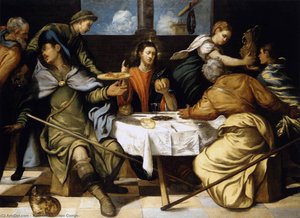
A Tempest of Faith: Exploring Tintoretto’s *The Crucifixion* (detail)
Jacopo Tintoretto, born Jacopo Robusti in Venice around 1518, remains one of the most compelling and enigmatic figures of the High Renaissance and early Baroque periods. His very nickname, “Tintoretto” – little dyer – speaks to his family’s trade, yet it belies the immense artistry that would distinguish him from all others. Unlike many artists who benefited from structured apprenticeships, Tintoretto's path was largely self-directed, fueled by an insatiable curiosity and a relentless drive for innovation. While Titian—the acknowledged master of Venetian colorism—allegedly dismissed the young Jacopo after only a few days—whether due to jealousy or artistic disagreement—it seemed the experience proved more contentious than formative. Titian’s active disparagement of Tintoretto, as did his adherents, spurred Tintoretto toward an independent course, one characterized by audacious experimentation and a uniquely dynastic ambition.- The Painting's Essence: *The Crucifixion* (detail) is more than just a depiction of Christ’s sacrifice; it’s a visceral experience—a confrontation with profound spiritual intensity. Tintoretto captures the Baroque spirit perfectly, prioritizing dramatic movement and emotional impact over meticulous realism.
- Baroque Drama & Venetian Innovation: Painted during the transition from Mannerism to full Baroque style, Tintoretto breaks decisively from traditional iconography. He abandons serene contemplation for a turbulent scene brimming with energy—a battlefield of faith and despair.
Technique & Materials
Tintoretto’s mastery lies in his revolutionary approach to painting. Employing oil paints on canvas, he achieves remarkable textural depth through loose brushwork and glazing techniques. Note the stark contrast between smooth surfaces—armor and weaponry—and rough textures—clothing and flesh—a deliberate choice designed to heighten visual drama. The artist's meticulous attention to detail is evident in every stroke, creating a sense of immediacy and raw emotion. Tintoretto’s innovative use of perspective—flattened space and dramatic foreshortening—draws the viewer directly into the heart of the action, mirroring the overwhelming scale of Christ’s suffering. The warm color palette—dominated by reds, browns, and ochres—amplifies the feeling of heat, violence, and fervent devotion.Decoding the Symbolism
Beyond the central event—Christ’s crucifixion—the artwork overflows with symbolic representations. Figures positioned outside the immediate scene—possibly saints or witnesses—suggest divine observation and intervention. Diagonal lines created by weapons, bodies, and gestures amplify the sense of unrest and conflict—a visual metaphor for the spiritual battle unfolding before our eyes. These aren't merely compositional elements; they are deliberate symbols conveying profound theological ideas. The overall impression is one of monumental scale, mirroring the magnitude of Christ’s sacrifice and its transformative power on humanity.Historical Context & Emotional Resonance
Tintoretto lived in Venice during a period marked by political upheaval and artistic ferment—a city grappling with religious dogma and embracing bold new aesthetic expressions. *The Crucifixion* reflects this complex environment, capturing the fervor of Venetian society’s faith amidst turbulent times. The painting evokes feelings of intense struggle, desperation, and perhaps even hope—themes that resonated deeply within 16th-century Venice. Tintoretto's unparalleled ability to convey such raw emotion cemented his place as one of the most influential painters of the Venetian School—a legacy that continues to inspire artists and collectors today.For Collectors & Designers
This detail from *The Crucifixion* transcends mere visual beauty; it represents a pivotal moment in art history and theological thought. A reproduction would serve as a striking focal point in any collection—adding depth, drama, and intellectual stimulation to both classic and contemporary interiors. Its rich colors and dynamic composition make it particularly well-suited for spaces seeking an atmosphere of grandeur and contemplation. Consider pairing this piece with complementary Baroque or Renaissance-inspired furnishings to create a truly immersive environment.Întrebări și răspunsuri
Ce amplasare se potrivește formatului lucrării "Crucifixion" de Tintoretto?
Formatul Format peisaj al operei "Crucifixion" de Tintoretto este recomandat pentru o Living Room. Formatul și spațiul împreună ghidează amplasarea unei reproduceri.
Ce atmosferă conferă "Crucifixion" de Tintoretto unui interior?
Cu atmosfera sa Dramatic, „Crucifixion” este recomandată pentru o Living Room.
Care este formatul pentru "Crucifixion"?
Formatul pentru "Crucifixion" este Format peisaj. Acest lucru este util atunci când planificați unde va fi amplificată o reproducere.
Informații rapide și quiz despre artă
Despre Tintoretto

Tintoretto
1518 - 1594, Italia
Biografie artist
A Venetian Master of Drama and Light
Jacopo Tintoretto, born Jacopo Robusti in Venice around 1518, remains one of the most compelling and enigmatic figures of the High Renaissance and early Baroque periods. His very nickname, “Tintoretto” – little dyer – speaks to his family’s trade, yet it belies the immense artistry that would distinguish him from all others. Unlike many artists who benefited from structured apprenticeships, Tintoretto's path was largely self-directed, fueled by an insatiable curiosity and a relentless drive for innovation. While accounts suggest a brief and unsuccessful stint under Titian, the acknowledged master of Venetian colorism, it seems the experience proved more contentious than formative. Titian’s alleged dismissal of the young Jacopo – whether due to jealousy or artistic disagreement – spurred Tintoretto toward an independent course, one characterized by audacious experimentation and a uniquely dynamic style. He immersed himself in anatomical study, reportedly through dissection, and honed his skills by meticulously copying classical sculpture and the works of other masters. This dedication laid the foundation for a career that would redefine Venetian painting.Forging a Distinctive Style: *Il Furioso*
Tintoretto’s artistic development was marked by an almost feverish energy, earning him another evocative nickname: *Il Furioso* – “the Furious One.” This moniker wasn't merely descriptive of his working pace but also captured the intensity and emotional charge that permeated his canvases. His early works already hinted at a departure from traditional Venetian conventions. While acknowledging Titian’s influence in color, Tintoretto gravitated towards Michelangelo’s powerful figures and dramatic compositions. He synthesized these influences into something entirely new: a style characterized by elongated forms, swirling draperies, and an innovative use of perspective that often created a sense of dizzying depth and movement. He abandoned the meticulous finish favored by his contemporaries, opting instead for a rapid, almost sketch-like brushstroke that conveyed immediacy and raw emotion. This technique, combined with his masterful manipulation of light and shadow – *chiaroscuro* – allowed him to create scenes of unparalleled drama and psychological intensity. He wasn’t simply depicting events; he was conveying their emotional core. His compositions were often dynamic and asymmetrical, defying the balanced arrangements typical of earlier Renaissance art.Monumental Achievements: San Rocco and Beyond
Tintoretto's prodigious output spanned decades, encompassing religious narratives, historical allegories, and portraits. However, his most significant achievement lies in the cycle of paintings he created for the Scuola Grande di San Rocco, a Venetian confraternity dedicated to Saint Roch. Over a period of more than fifty years, Tintoretto adorned the Scuola’s halls with over sixty canvases, transforming it into a breathtaking visual testament to faith and human experience. Works like “The Last Supper,” completed late in his life, demonstrate his continued experimentation with perspective and composition. Departing from traditional depictions, Tintoretto placed the scene in a dramatically lit, architecturally unstable space, emphasizing the emotional turmoil of Christ’s final meal with his disciples. Other notable works include “The Miracle of St Mark Freeing the Slave,” a powerful display of dynamic composition and foreshortening, and numerous paintings for Venetian churches and palaces that showcase his mastery of scale and narrative storytelling. These monumental projects cemented Tintoretto's reputation as one of Venice’s most important artists.Influences and Artistic Connections
Tintoretto’s artistic journey was shaped by a complex interplay of influences. While deeply indebted to Titian for his understanding of color, he also drew inspiration from the dynamism of Michelangelo, evident in the powerful musculature and dramatic gestures of his figures. The influence of classical sculpture is palpable in the idealized forms and carefully rendered draperies that characterize many of his works. Furthermore, Tintoretto’s studio was a hub of artistic exchange, attracting students and collaborators such as Paolo Veronese and Domenico Robusti (Tintoretto's son), who continued to develop and expand upon his innovative style. The rivalry with Titian, fueled by professional jealousy and differing aesthetic philosophies, undoubtedly spurred Tintoretto toward greater independence and experimentation. His work reflects a synthesis of these diverse influences, resulting in a uniquely Venetian style that pushed the boundaries of artistic expression.Legacy and Historical Significance
Jacopo Tintoretto died in Venice in 1594, leaving behind a vast and influential body of work. He bridged the gap between the High Renaissance and the Baroque period, anticipating many of the stylistic innovations that would define the latter. His dramatic compositions, expressive brushwork, and innovative use of light and shadow profoundly influenced artists such as Caravaggio, Rembrandt, and Delacroix. He wasn’t merely a painter; he was a visual storyteller who understood how to harness the power of art to evoke emotion and inspire awe. As one of the three great Venetian painters of the 16th century – alongside Titian and Paolo Veronese – Tintoretto played a crucial role in shaping the artistic landscape of Venice during its golden age. His work reflects not only the religious fervor and political tensions of his time but also a uniquely personal vision that continues to resonate with audiences today, solidifying his place as one of history’s most important and captivating artists. His legacy is a testament to the enduring power of artistic innovation and the transformative potential of human creativity.Informații rapide despre Tintoretto
- Artistic Movement Or Style: Renaștere, Mannerism
- Artists Or Movements Influenced By This Artist:
- Caravaggio
- Baroc
- Artists Who Influenced This Artist:
- Titian
- Michelangelo
- Date Of Birth: 1518
- Date Of Death: 1594
- Full Name: Jacopo Comin zis Tintoretto
- Nationality: Italian
- Notable Artworks:
- Miracolo S. Marco
- Ultima Cina
- Assunzione Vergine
- Place Of Birth: Venetia, Italia
Explorați opere de artă organizate pe teme, stiluri și caracteristici.




Tintoretto
Crucifixion
() ·
Cu ramă: · Pictată manual în ulei pe pânză de in
Total