Biografie artist
A Life Etched in Realism: Vasily Perov and the Soul of Russia
Vasily Grigoryevich Perov, born Vasily Vasiliev on January 21st, 1834, in the remote Siberian town of Tobolsk, was not merely a painter; he was a chronicler of his time, a social observer who wielded his brush to expose the realities—both beautiful and brutal—of 19th-century Russia. His life story is inextricably linked to his art, shaped by an unconventional upbringing that instilled within him a profound empathy for the marginalized and a relentless desire to capture the essence of ordinary Russian life. Born out of wedlock to Baron Grigory Kridener and Akulina Ivanova, Perov’s early years were marked not by privilege but by a sense of displacement and a keen awareness of social inequalities—themes that would become central to his artistic vision. The adoption of the surname “Perov,” derived from the Russian word for ‘feather,’ a reference to his early skill in calligraphy, subtly foreshadowed his meticulous attention to detail and his dedication to rendering the world around him with painstaking accuracy. His formal artistic journey began at the Alexander Stupin Art School in Arzamas, where he honed fundamental skills before enrolling at the Moscow School of Painting, Sculpture and Architecture in 1853—a pivotal step that exposed him to a wider range of artistic influences and solidified his commitment to pursuing a career as an artist.
Early Recognition and Artistic Development
Perov’s early works quickly garnered attention within the Imperial Academy of Arts, culminating in silver and gold medals for paintings like “Commissary of Rural Police Investigating” (1857) and, most notably, "Sermon in a Village" (1861). The latter painting, depicting a disengaged congregation during a church service, became an instant sensation, catapulting Perov into the national spotlight and securing him the extraordinary opportunity to study abroad. This period in Europe—primarily Paris and various German cities—proved transformative, exposing him to new artistic techniques and broadening his understanding of the world beyond Russia. However, it was not simply exposure that shaped his style; Perov’s time abroad deepened his commitment to realism, a movement he would later champion as a founding member of the Peredvizhniki (Wanderers). He absorbed the lessons of artists like Gustave Courbet and Jean-François Millet, masters of depicting everyday life with unflinching honesty. Returning to Russia in 1865, Perov embarked on a prolific period of artistic production, creating some of his most enduring masterpieces—works that would come to define his legacy as one of Russia’s greatest realist painters.
The Voice of the Voiceless: Themes and Techniques
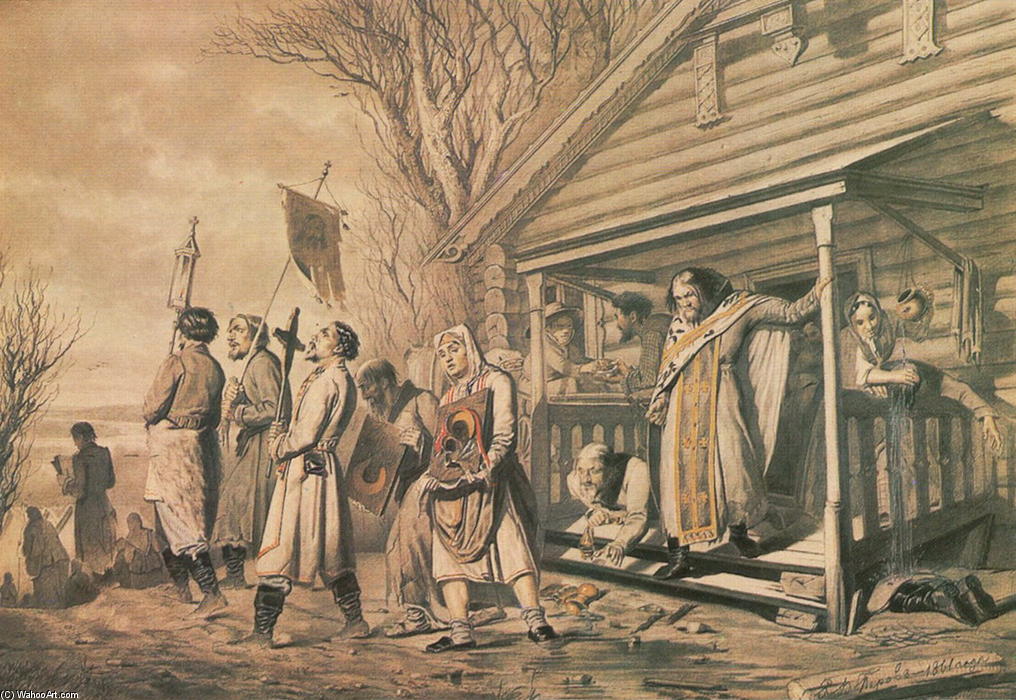
Perov's artistic vision was profoundly rooted in a commitment to portraying Russian society with an uncompromising honesty. He deliberately rejected the idealized depictions favored by many of his contemporaries, choosing instead to focus on the lives of ordinary people—peasants, laborers, the forgotten, and those struggling against poverty and injustice. His paintings are not mere representations; they are powerful social commentaries that expose the hardships, inequalities, and spiritual emptiness prevalent in 19th-century Russia. "Sermon in a Village," for example, subtly critiques religious hypocrisy by depicting a congregation largely detached from the sermon, while “The Queue at the Fountain” starkly illustrates the daily struggles of rural life—the long wait for water, the weariness etched on faces, and the palpable sense of hardship. His technique was characterized by meticulous detail, somber color palettes dominated by browns, grays, and muted greens, and a masterful use of light and shadow to create dramatic effect. He wasn’t interested in romanticizing poverty or suffering; rather, he sought to present it with dignity and empathy, forcing viewers to confront uncomfortable truths about their own society. Works like “The Last Journey,” depicting a peasant funeral procession, and "Troika: Apprentice Workmen Carrying Water" are poignant examples of his ability to evoke profound emotional responses through realistic portrayals of everyday life. Perov’s skill extended beyond oil painting; he also excelled in etching, as demonstrated by the powerful monochromatic work “Naushnitsa. Before the storm,” which showcases his mastery of chiaroscuro and intricate detail.
Founding a Movement: The Peredvizhniki
Perov's dedication to realism aligned perfectly with the burgeoning spirit of artistic rebellion that led to the formation of the Peredvizhniki (Wanderers) in 1870. This collective of Russian realist painters broke away from the constraints of the Academy, establishing an independent society dedicated to exhibiting art throughout Russia—reaching audiences beyond the confines of St. Petersburg and Moscow. The Peredvizhniki aimed to bring art directly to the people, to address social issues through their work, and to promote a uniquely Russian artistic identity. Perov was not merely a member; he was a founding force, instrumental in shaping the movement’s ideals and advocating for its principles. His commitment to portraying the lives of ordinary Russians resonated deeply with the Peredvizhniki's mission, solidifying his position as a leading figure within the group. The Wanderers’ exhibitions became immensely popular, attracting large crowds and sparking important conversations about art, society, and national identity.
Legacy and Enduring Influence
Vasily Perov’s untimely death from tuberculosis in 1882 at the age of 48 marked a significant loss for Russian art. However, his legacy continued to inspire generations of artists who followed in his footsteps. His influence can be seen in the works of Ilya Repin and Vasily Surikov, both masters of realist painting who further developed the tradition he helped establish. Perov’s paintings remain relevant today not only for their artistic merit but also for their enduring social commentary. They serve as a powerful reminder of the hardships faced by ordinary people throughout history and continue to provoke empathy and understanding. His works are now housed in prominent collections, including the Tropinin and Contemporary Moscow Artists Museum, ensuring that his vision continues to resonate with audiences worldwide. Perov’s contribution extends beyond mere artistic skill; he was a social conscience etched onto canvas, a voice for the voiceless, and a pioneer of Russian realism.


 Preview
 Switch to Print
 Trimite
 Distribuie
 Detalii despre lucrare

 Descarcă
 Similare
 Radiografie
 Diaporama


 Vezi mai mult






































 Opțiunea cu sticlă este disponibilă doar pentru dimensiuni de sub 110 cm



