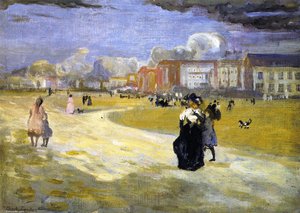
Early Life and Artistic Journey
Charles Edward Conder (1868 – 1909) was an English-born painter, lithographer and designer who left an indelible mark on the art world. Born in Tottenham, Middlesex, the second son of six children, of James Conder, civil engineer and Mary Ann Ayres, he spent several years as a young child in India until the death of his mother (aged 31 years) on 14 May 1873 in Bombay, when Charles was four; he was then sent back to England and attended a number of schools including a boarding school at Eastbourne, which he attended from 1877. He left school at 15, and his very religious, non-artistic father, against Charles’s natural artistic inclinations, decided that he should follow in his footsteps as a civil engineer.Artistic Career in Australia
In 1884, at the age of 16, he was sent to Sydney, Australia, where he worked for his uncle, a land surveyor for the New South Wales government. However he disliked the work, much preferring to draw the landscape rather than surveying it. In 1886, he left the job and became an artist for the *Illustrated Sydney News*, where he was in the company of other artists such as Albert Henry Fullwood and Frank Mahony. He also attended the painting classes of Alfred James Daplyn and had joined the Art Society of New South Wales. During his time in Melbourne, Conder collaborated with Tom Roberts, whom he had previously met in Sydney, sharing a studio and exploring new artistic horizons. The influence of Roberts’s expressive style undoubtedly shaped Conder's own approach to painting.The Heidelberg School and Notable Works
Conder’s masterpiece, *Departure of the Orient – Circular Quay* (1888), showcased his newfound mastery of form and brushwork. This dockside scene, depicting the bustling harbour at Sydney Cove at the moment when the *has cast off for her voyage to England*, was quickly purchased by the Art Gallery of New South Wales, making it Conder’s first work to enter a public collection. It exemplifies the Heidelberg School's fascination with capturing fleeting moments of light and atmosphere—a technique honed through meticulous observation and experimentation. Alongside Roberts and Arthur Streeton, Conder contributed significantly to the Heidelberg School movement, establishing it as a distinctive Australian tradition in Western art.Legacy and Later Life
Conder’s later years were marked by persistent illness, including paralysis and a bout of delirium tremens. Despite these challenges, he continued to paint, producing evocative landscapes and portraits that reflect his profound engagement with the natural world and human experience. His work gained recognition in England, where it contrasted sharply with its reception in Paris—a testament to Conder’s artistic vision and enduring appeal. Henri de Toulouse-Lautrec immortalized Conder's likeness in a portrait that now resides in the National Gallery of Australia, securing his place as one of Melbourne’s most celebrated artists. His legacy continues to inspire art enthusiasts worldwide, reminding us of the transformative power of creativity and perseverance.Întrebări și răspunsuri
Pot sorta operele lui Charles Edward Conder după culoare?
Pagina Indice Spectral organizează operele lui Charles Edward Conder în funcție de culoare.
Există o prezentare generală a tuturor subiectelor pictate de Charles Edward Conder?
Operele lui Charles Edward Conder pot fi explorate pe temă în pagina Atlas pe teme a artistului.
Unde pot fi explorate operele lui Charles Edward Conder, grupate pe teme și cuvinte cheie?
Operele lui Charles Edward Conder pot fi explorate pe baza cuvintelor cheie, în pagina de După cuvinte cheie a artistului. Fiecare cuvânt cheie grupează operele aferente.