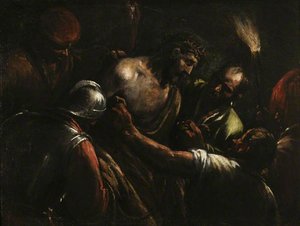
Jacopo Bassano: Bridging the Sacred and Rustic in Venetian Art
Jacopo Bassano (c. 1510 – 14 February 1592), often referred to as Jacopo dal Ponte, stands as a pivotal figure in the Venetian Renaissance, a master who subtly yet profoundly shaped the course of Venetian painting for decades. Born and raised in the small town of Bassano del Grappa, nestled near Venice, his life was inextricably linked to the artistic legacy of his father, Francesco il Vecchio, a respected local painter. Unlike many of his contemporaries who sought fame in the grand halls of Florence or Rome, Bassano’s career unfolded primarily within the confines of his native Veneto region, yet his influence resonated far beyond its borders.
Bassano's early training was deeply rooted in the traditions established by his father. Francesco il Vecchio’s workshop served as a crucible for artistic development, exposing young Jacopo to the fundamentals of painting – color mixing, composition, and technique. However, Bassano quickly distinguished himself through an innovative approach that blended classical influences with a distinctly Venetian sensibility. While he initially absorbed elements from masters like Titian and Raphael—evident in his early works such as “The Sacrifice of Noah” (1580)—he gradually developed a unique style characterized by a remarkable ability to capture fleeting moments, atmospheric effects, and the emotional nuances of everyday life.
A Synthesis of Genres: Religious Scenes with Rustic Charm
Bassano’s most enduring contribution lies in his masterful synthesis of religious themes with scenes of rural life. He didn't simply depict biblical narratives; instead, he reimagined them within a vernacular context, often featuring peasants, animals, and the familiar landscape of the Veneto region. This approach was revolutionary for its time, challenging the prevailing artistic conventions that typically relegated such subjects to secondary roles. In works like “The Adoration of the Magi” (1560), Bassano transforms a traditional religious scene into a vibrant tableau of rural activity—shepherds tending their flocks, merchants exchanging goods, and villagers engaging in everyday pursuits. The figures are not idealized or heroic; they are presented with an earthy realism that imbues the painting with a sense of immediacy and authenticity.
This shift towards genre painting wasn’t merely stylistic; it reflected Bassano's deep connection to his local environment. He meticulously observed the details of rural life—the textures of fabrics, the colors of wildflowers, the play of light on water—and translated these observations onto canvas with remarkable accuracy. His landscapes are not mere backdrops but active participants in the narrative, contributing to the overall mood and atmosphere of the scene.
The Influence of Bassano’s Sons
Bassano's artistic legacy extended far beyond his own lifetime, profoundly impacting the work of his four sons: Francesco Bassano the Younger, Leandro Bassano, Giambattista da Ponte, and Girolamo da Ponte. Each son inherited their father’s distinctive style and continued to produce paintings in a remarkably consistent manner for decades after his death. This familial continuity is particularly evident in the works of Francesco Bassano the Younger, who further developed his father's innovative approach to genre painting and landscape art. The brothers worked together in the family workshop, sharing techniques and ideas, creating a cohesive artistic lineage that solidified Bassano’s place as a central figure in Venetian painting.
It is often difficult to definitively attribute specific works to Jacopo versus his sons, highlighting the close collaboration within the family studio. However, studying their individual styles reveals a clear progression of influence, with each generation building upon the foundations laid by their father and predecessors.
Technique and Legacy
Bassano’s technical skill is characterized by a masterful use of *chiaroscuro*—the dramatic contrast between light and shadow—which he employed to create depth, volume, and emotional intensity. His paintings are imbued with a warm, luminous quality that reflects the Venetian tradition of using rich pigments and glazing techniques. He was also adept at capturing fleeting moments of movement and emotion, conveying a sense of immediacy and spontaneity in his compositions.
Despite the challenges posed by the passage of time and the proliferation of artistic styles, Jacopo Bassano’s work continues to captivate viewers with its beauty, originality, and emotional resonance. He remains one of the most beloved and influential artists of the Venetian Renaissance, a testament to the power of observation, imagination, and a deep connection to one's surroundings. His legacy endures not only in his paintings but also through the artistic lineage he established within his family—a remarkable example of intergenerational creativity and artistic continuity.
Întrebări și răspunsuri
Din ce epocă face parte Jacopo Bassano The Elder?
Jacopo Bassano The Elder a activat în perioada Renaissance. Această perioadă situează activitatea artistului în context istoric.
Unde pot fi găsite operele lui Jacopo Bassano The Elder grupate pe palete de culori?
Pagina După paletă de culori grupează operele lui Jacopo Bassano The Elder în funcție de paletele de culori.
Există o relatare cronologică a carierei lui Jacopo Bassano The Elder?
Cariera lui Jacopo Bassano The Elder se desfășoară etapă cu etapă pe pagina Cronologie a artistului: o cronologie orizontală a operelor de artă, grupate în capitole reprezentative ale perioadelor de activitate.