Atelier — Livrare gratuită în întreaga lume — Livrare în 2–6 săptămâni
      Edouard Cortès, 1882 – 1969

      Cele mai celebre 100 picturi ale lui Edouard Cortès

      La Place de la Bastille, Paris este pictura pentru care Edouard Cortès este cel mai cunoscut. Flower Market At La Madeleine și Theatre du Vaudeville completează trioul celor mai iubite picturi. Catalogul nostru cuprinde 212 lucrări ale lui Edouard Cortès. Iată cele 100 cele mai faimate, însoțite de anul realizării, muzeul și povestea fiecărei pânze.

      Clasate în funcție de scorul nostru de popularitate, care combină numărul de căutări, vizite și comenzi pentru fiecare operă. Actualizat Octombrie 2026.

      Portretul lui Edouard Cortès
      Edouard Cortès · 1882 – 1969
      Născut · Decedat
      1882 – 1969, Lagny-sur-Marne
      Mișcare
      Post-impressionism
      Lucrări din catalogul nostru
      212
      Cele mai celebre
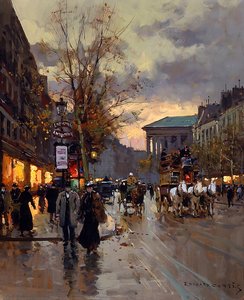
      La Place de la Bastille, Paris

      Cele mai iubite cele zece picturi ale lui Edouard Cortès

      La Place de la Bastille, Paris de Edouard Cortès
      1

      La Place de la Bastille, Paris

      Oil On Canvas

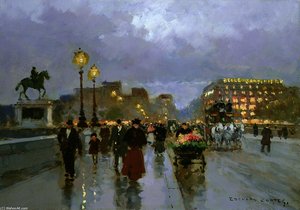
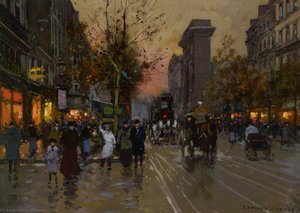
      Step closer and observe how the light settles upon the damp pavement of La Place de la Bastille. There is a particular weight to the air in this scene, a sense of an overcast autumn evening where the sky holds an orange haze. The streets are not merely surfaces but mirrors, reflecting the glow from nearby storefronts and the soft flicker of street lamps. You can almost feel the humidity…

      Flower Market At La Madeleine de Edouard Cortès
      2

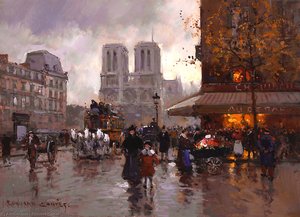
      Flower Market At La Madeleine

      Oil On Canvas

      This oil on canvas, titled Flower Market At La Madeleine, is a work by Edouard Cortès. It presents a cityscape focused on the daily rhythms of Parisian street life and the activity of a local market. The artist, Edouard Cortès, was known for his ability to capture the atmosphere of the city through a specific, personal lens. This particular piece is signed, marking the hand of the creator within the…

      Theatre du Vaudeville de Edouard Cortès
      3

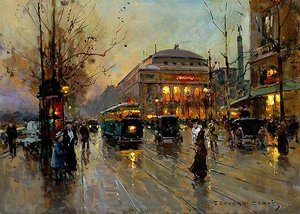
      Theatre du Vaudeville

      Oil On Canvas

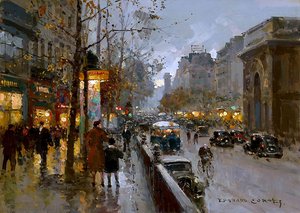
      is an oil painting by the artist Edouard Cortès. The work depicts a Parisian street scene, focusing on the urban landscape and the activity surrounding a theater. This specific composition captures a moment of city life within a metropolitan setting.

      Notre Dame, St. Michael, under the snow de Edouard Cortès
      8

      Notre Dame, St. Michael, under the snow

      Oil On Canvas

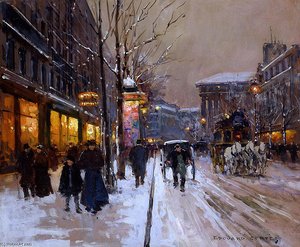
      Snow falls softly over the city, dusting the rooftops and the wide boulevards in a quiet, pale layer. The air feels heavy with moisture, a mix of falling flakes and a light rain that turns the cobblestones into dark, reflective mirrors. In the background, the massive silhouette of Notre Dame looms through the haze, its stone details softened by the winter atmosphere. People move through the scene, some huddled under…

      Edouard Cortès: pântecele 11 - 100 din clasament

      Rue Royale Madeleine de Edouard Cortès
      #12

      Rue Royale Madeleine

      In the evocative masterpiece Rue Royale Madeleine, the legendary Parisian poet of painting, Édouard Cortès, invites us to step into a moment of transient beauty amidst the rhythmic…

      Pont Neuf de Edouard Cortès
      #21

      Pont Neuf

      Another of Monet’s series of paintings, the Poplar paintings were painted in the summer and fall of 1891. The poplars trees were located on the banks of a…

      Opera, Paris de Edouard Cortès
      #42

      Opera, Paris

      To gaze upon this depiction of "Opera, Paris" is to be instantly transported into a cinematic moment—a quintessential Parisian evening washed clean by the persistent rhythm of rain.…

      Lamp Effect (1903) de Edouard Cortès
      #43

      Lamp Effect

      1903

      The painting titled Lamp Effect was created by the artist Edouard Cortès in 1903. This work is categorized within the Post-Impressionism style. It is presented in a landscape…

      Flower Market At La Madeleine de Edouard Cortès
      #64

      Flower Market At La Madeleine

      To gaze upon this depiction of a flower market at La Madeleine is to step unceremoniously into the heart of turn-of-the-century Paris. It is more than just a…

      St.Martin de Edouard Cortès
      #65

      St.Martin

      To stand before Edouard Cortès’ depiction of St. Martin is to be instantly enveloped by the exhilarating, yet strangely comforting, rhythm of city life itself. This painting is…

      Boulevard a Paris de Edouard Cortès
      #66

      Boulevard a Paris

      In the heart of the night, where the shadows of the Seine meet the golden glow of streetlamps, lies the soul of Edouard Cortès’ most enchanting vision. Boulevard…

      Place de la Republique de Edouard Cortès
      #67

      Place de la Republique

      A Glimpse into Parisian Nightlife: "Place de la Republique" by Édouard Cortès This evocative painting captures a vibrant scene of Place de la République in Paris, bathed in…

      Pânzele lui Edouard Cortès, perioadă cu perioadă

      Cele mai picturate opere ale lui Edouard Cortès

      Cele patru teme care apar cel mai des pe aceste pânze, fiecare cu cel mai apreciat exemplu al său.

      Cele mai celebrele picturi ale lui Edouard Cortès, anul după anul

      23 ani de lumină și culoare ale lui Edouard Cortès, de la 1903 la 1925: cele mai celebre picturi ale fiecărui an, una după alta.

      1. 1903
        Lamp Effect (1903) de Edouard Cortès
        Poziția 43 din 100

        Lamp Effect

        Vârsta 21

        The painting titled Lamp Effect was created by the artist Edouard Cortès in 1903. This work is categorized within the Post-Impressionism style. It is presented in a landscape…

      2. 1905
      3. 1905
      4. 1925

      Pânzele lui Edouard Cortès, întrebare cu întrebare

      Pentru care pictură este cel mai cunoscut Edouard Cortès?Citește răspunsul

      La Place de la Bastille, Paris, urmat de Flower Market At La Madeleine și Theatre du Vaudeville.

      Care sunt cele mai celebre zece picturi ale lui Edouard Cortès?Citește răspunsul

      La Place de la Bastille, Paris, Flower Market At La Madeleine, Theatre du Vaudeville, Rue de la Paix, Rain, View of the Street Rivoli and Notre Dame, Bouquinistes, St.Denis, Winter, Notre Dame, St. Michael, under the snow, Paris Evening și Place Saint Michel, Notre Dame. Fiecare pictură din clasamentul de mai sus este însoțită de anul creării și de muzeul în care este expusă.

      Câte picturi a creat Edouard Cortès?Citește răspunsul

      În catalogul nostru sunt 212 lucrări ale lui Edouard Cortès, datate între 1903 și 1925.

      Când a pictat Edouard Cortès cele mai celebre picturi?Citește răspunsul

      În 1905, care a inclus 2 dintre cele 100 lucrări de pe această pagină, Paris Evening printre acestea.

      Care a fost prima și care a fost ultima pictură a celebrului Edouard Cortès?Citește răspunsul

      Cea mai veche pânză de aici datează din Lamp Effect (1903), iar cea mai recentă este din Quay du Louvre (1925).

      Ce subiecte a pictat cel mai des Edouard Cortès?Citește răspunsul

      Roads (65), Buildings (65) și Forests (23), din cele 100 lucrări de pe această pagină.

      Care este tehnica cea mai prezentă în picturile lui Edouard Cortès?Citește răspunsul

      Oil On Canvas, utilizat în 9 dintre cele 100 lucrări de pe această pagină.

      Cu ce mișcare este asociat(ă) Edouard Cortès?Citește răspunsul

      Post-impressionism, așa cum demonstrează picturile de pe această pagină.

      Făcând cunoștință cu pictorul: Edouard Cortès

      The Parisian Poet: A Life in Light and Shadow

      Édouard Léon Cortès, affectionately known as “Le Poète Parisien de la Peinture” – the Parisian Poet of Painting – wasn’t born into the glittering world he would so vividly capture on canvas. His origins lay in Lagny-sur-Marne, a quiet town east of Paris, where he arrived on August 6th, 1882. Though France was his birthplace, artistic lineage flowed through his veins from his Spanish father, Antonio Cortés, a painter who had once served the Spanish Royal Court. This heritage instilled within young Édouard an early appreciation for artistry and a dedication to honing his skills. He began formal studies at the École des Beaux-Arts in Paris at just seventeen, immersing himself in the techniques of the masters while simultaneously forging his own distinct path. Even then, Cortès possessed a fiercely independent spirit, playfully rebuffing suggestions that he was merely a student of any particular master, declaring himself “a student of myself only.” This self-reliance would become a hallmark of his career and artistic vision.

      Capturing the Soul of Paris

      Cortès’s name became synonymous with Parisian cityscapes. He didn't simply paint buildings; he painted atmospheres – the soft glow of gas lamps on rain-slicked cobblestones, the bustling energy of boulevards teeming with life, the quiet intimacy of a café scene unfolding under a hazy sky. His work wasn’t about grand monuments or historical events, but rather the everyday poetry of Parisian existence. He possessed an uncanny ability to capture fleeting moments – a shaft of sunlight illuminating Notre Dame, the vibrant colors reflected in puddles after a shower, the hushed anticipation before a performance at the Opera. These weren't idealized visions; they were honest portrayals of a city brimming with life, beauty, and a touch of melancholy. His palette favored muted tones, skillfully blended to evoke mood and atmosphere, often employing shades of gray, blue, and ochre that perfectly mirrored the Parisian climate. He wasn’t interested in radical experimentation or abstract forms; his focus remained steadfastly on representing the world as he saw it – beautiful, transient, and deeply evocative. His paintings are not mere depictions of places but windows into a specific feeling, a particular moment in time.

      A Soldier's Brush: War and Resilience

      The idyllic world Cortès painted was shattered by the outbreak of World War I. Despite being a committed pacifist, duty called, and at the age of thirty-two, he enlisted in the French Infantry Regiment. The horrors of war profoundly impacted him, yet even amidst the chaos and destruction, his artistic spirit endured. Wounded early in the conflict, he was reassigned to utilize his talent for sketching, tasked with mapping enemy positions. This experience, though harrowing, likely sharpened his observational skills and deepened his appreciation for the fragility of life – themes that would subtly permeate his later work. He refused the Légion d'Honneur offered by the French Government, a testament to his unwavering pacifist beliefs. Personal tragedy also struck during this period; his first wife, Fernande Joyeuse, passed away in 1918, leaving him with their daughter, Jacqueline Simone. He later married Fernande’s sister, Lucienne Joyeuse, finding solace and companionship amidst the lingering shadows of war.

      Influences and Artistic Kinship

      While Cortès developed a uniquely personal style, echoes of other masters can be discerned within his work. The atmospheric effects and subtle play of light recall the Impressionists, particularly Camille Pissarro and Alfred Sisley. However, he lacked their focus on pure optical sensation, instead prioritizing narrative and emotional resonance. Post-Impressionist artists like Eugène Boudin also influenced his approach to capturing fleeting moments and atmospheric conditions. *His dedication to depicting everyday life aligns him with Realist painters*, yet his romanticized vision of Paris elevates his work beyond mere documentation. He wasn’t attempting to replicate reality precisely; he was striving to capture its essence, its mood, its poetry. Artists like Frederick Soulacroix and Paul Gauguin, though distinct in their styles, shared Cortès's fascination with capturing the spirit of a place and its people, imbuing their canvases with a sense of atmosphere and emotion. His legacy lies not in revolutionizing painting but in perfecting a particular vision – a deeply personal and profoundly moving portrayal of Paris that continues to resonate with audiences today.

      Major Achievements and Recognition

      Cortès’s career spanned several decades, during which he gained considerable recognition both in France and abroad. His early Salon successes established him as a promising young artist, and his work was exhibited extensively throughout Europe. Following the war, he achieved international acclaim, with exhibitions held in North America in 1945. His distinctive style – characterized by its atmospheric perspective, subtle color palettes, and evocative depictions of Parisian life – quickly gained admirers. In 1969, in his final year of life, he received the prestigious Prix Antoine-Quinson from the Salon de Vincennes – a fitting tribute to a lifetime dedicated to artistic expression. His paintings continue to be highly sought after by collectors and art enthusiasts worldwide, serving as enduring reminders of Paris’s beauty and charm.

      A Lasting Legacy

      Edouard Léon Cortès died on November 26th, 1969, in Lagny-sur-Marne, leaving behind a vast body of work that continues to captivate art lovers. A street in his hometown bears his name, ensuring that his artistic legacy will endure for generations to come. His paintings are not simply decorative objects; they are windows into a bygone era – glimpses of a Paris that exists now primarily through his evocative and enduring art. He remains a testament to the power of observation, the beauty of simplicity, and the ability of art to capture the soul of a city.

      Toate cele 212 de lucrări ale lui Edouard Cortès →