

На картине: · В раме:
 Предпросмотр
 Поделиться
 Поделиться
 Детали произведения
 Руководство

 Скачать
 Похожие предметы
 Рентгенография
 Слайд-шоу
 Вопросы и ответы
 Статистика просмотров
- 63.0 x 63.0 cm


$ 269
Масляная репродукция ручной работы
Картина маслом на холсте в выбранном вами размере и раме, написанная на заказ нашими художниками. ( Перейти к печатным копиям Перейти к цифровым изображениям)
Размер
·Стандартный размер
на заказ
CM
INCH
Выберите один из наших стандартных размеров, соответствующих оригинальным пропорциям произведения искусства.
Загрузка размеров...

ширина
высота
Введите необходимую ширину и высоту, чтобы репродукция подошла к вашей раме или стене. Поскольку работа выполняется вручную, при изменении пропорций художник может немного увеличить область вокруг картины или, наоборот, обрезать края — выбор за вами. Перед началом работы мы пришлем вам цифровой макет на утверждение. Изображение на этой странице не является точным результатом — увидеть реальный вид можно только на макете.
 Узнать больше
Завершить
·
Белый торцевой край $1

Размытый край $1

С продолжением изображения $1

P118B $10

P118H $10

P118W $10

P438Z $10

P508JH $12

P508YH $12

P805H $10

P805Z $10

P919BZ $10

P919G $10

P919XJ $10

P959ZH $10

P968JZ $12

W106C $8

W218G $10

W218JH $8

W218Y $10

W307PJ $10

W316G $10

W316PJ $8

W316Y $10

W398PJ $8

W4111J $10

W500HY $15

W500JH $15

W692G $12

W849H $8

W940BG $15

W953PJ $8

H24-GOLD $30

H24-SILVER $30

H36-GOLD $45

H36-SILVER $45
Поставляется в защитной тубусе, готовый к оформлению в багет вашей мастерской.
Дополнительные услуги
необязательноЧто входит в дополнительные услуги?
Примеры того, что можно изменить: заменить лицо фотографией клиента; добавить питомца (например, заменить кошку на собаку); добавить скрытое послание на задний план; изменить пейзаж или элементы фона.
После оформления заказа команда TopImpressionists.com свяжется с клиентом по электронной почте для получения инструкций и предоставит предварительный макет
После оформления заказа команда TopImpressionists.com свяжется с клиентом по электронной почте для получения инструкций и предоставит предварительный макет
Доставка по всему миру () за 3–4 недели вместо стандартных 5 недель. (9 Ноябрь). Без компромиссов в качестве.
Защитный лак
Этикетка
Детали гравировки на бронзовой плакетке
This elegant plaque features the artist's name and the title of the artwork, finely engraved for a timeless presentation.
It is made from bronze with a refined, elegant finish. The text is precisely laser-engraved for a sharp and permanent result. Measuring 9x2 cm, the plaque is compact yet easy to read. It's built to be durable and scratch-resistant, offering a professional, museum-quality look. Mounting is simple thanks to the included adhesive backing.
Детали прозрачной акриловой таблички
The plaque includes essential engraved details such as the artist's name, the title of the artwork, the date it was created, the type of media used-like oil on canvas or watercolor-a brief description of the piece, and a QR code that links to the complete artwork information.
It is crafted from clear acrylic, offering a sleek, modern appearance. The text is UV-engraved in black to ensure strong visual contrast. With a size of 10x15 cm, it ensures optimal readability. It comes equipped with two metal hooks for secure wall mounting. The plaque is designed to be weather-resistant, making it suitable for various environments, and it includes interactive features that work seamlessly with smartphone scanning.
Информация о чёрной акриловой табличке
This elegant plaque includes engraved information such as the artist's name, the title of the artwork, the date it was created, the type of media used (like oil on canvas or watercolor), a short description of the artwork, and a QR code for quick access to more information.
The plaque itself is made from refined black acrylic with a premium finish. The text is laser-engraved in white for high contrast and readability. Its size is 10x15 cm, designed to be easy to read. It comes with two metal hooks for professional mounting. The design is sleek and fits any interior style. It is also weather-resistant and durable, with built-in digital integration for mobile compatibility.
Вариант со стеклом доступен только для размеров менее 110 см
 Вариант со стеклом доступен только для размеров менее 110 см
- Бесплатная экспресс-доставка по всему миру
- Высококачественный льняной холст
- Полное страхование при доставке
- Гарантия возмещения таможенных пошлин
- Гарантия точного цветового соответствия
- 100-дневная гарантия возврата (только при обнаружении дефектов)
- Гарантия возврата 100% средств
- Скидка при оптовом заказе


Описание предмета коллекционирования
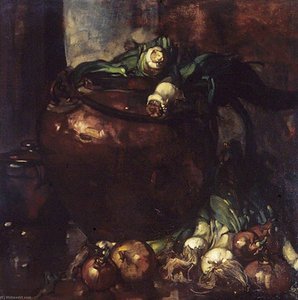
Explore Frank Brangwyn’s evocative painting 'Leeks,' depicting a bountiful harvest of vegetables – onions, leeks, and garlic – within a ceramic pot. Discover the artist's Belgian heritage and his influential apprenticeship with renowned craftsmen.
Биография художника
Фрэнк Брангвин (1867-1956) – выдающийся британский художник, известный своими яркими орийентальными картинами, морскими пейзажами и масштабными фресками. Ключевая фигура в движении Arts & Crafts.
Об этой картине
A Symphony of Harvest Bounty: Exploring Frank Brangwyn’s “Leeks”
The painting "Leeks," executed by Sir Frank Brangwyn in 1902, stands as a testament to the artist's unwavering dedication to capturing the essence of rural life and the tangible beauty of the natural world. More than just a depiction of vegetables—onions, leeks, garlic—it’s an ambitious undertaking that delves into themes of labor, resilience, and the cyclical rhythms of agricultural existence, reflecting Brangwyn’s profound connection to the landscapes he inhabited.- Subject Matter & Composition: At first glance, “Leeks” presents a deceptively simple tableau – a earthenware pot brimming with produce. However, Brangwyn skillfully orchestrates this visual element to convey a deeper narrative. The central pot dominates the canvas, anchoring the arrangement and drawing the viewer’s eye inwards. Surrounding it are strategically placed onions, leeks, and garlic cloves, creating an impression of abundance and mirroring the industrious spirit of the farmer's hand.
- Style & Technique: Brangwyn’s style is firmly rooted in Impressionism but transcends its limitations through a deliberate embrace of Symbolism. He employs bold brushstrokes—characteristic of his Northern European heritage—to imbue the painting with palpable energy and texture. The artist utilizes glazing techniques, layering translucent washes of pigment over underlayers to achieve luminous color palettes and create an atmospheric depth that captures the diffused light of a late summer day.
Historical Context & Influences
The year 1902 marks a significant period in British art history, coinciding with the burgeoning Aesthetic Movement. Brangwyn’s work aligns closely with this movement's preoccupation with capturing idealized visions of nature and celebrating craftsmanship. Furthermore, his artistic training under Arthur Heygate Mackmurdo and William Morris instilled within him a deep appreciation for Ruskinian ideals – emphasizing moral responsibility alongside artistic excellence—influencing his stylistic choices and thematic concerns. The painting reflects the broader cultural fascination with rural landscapes and the celebration of honest labor as emblems of virtue.- Symbolism & Color Palette: Beyond its literal representation, “Leeks” operates on a symbolic level. Leeks themselves hold significance in folklore and heraldry, representing humility, perseverance, and protection—qualities deemed essential for the farmer’s livelihood. Brangwyn's masterful use of color contributes to this emotive resonance. Dominant hues of ochre, russet, and emerald green evoke the warmth of the sun-drenched earth and the vibrancy of ripening vegetables. These colors are carefully blended to create a harmonious visual experience that stimulates contemplation.
Emotional Impact & Artistic Legacy
“Leeks” transcends mere botanical illustration; it succeeds in conveying a profound sense of tranquility mingled with industrious determination. The painting’s subdued palette and textured brushstrokes invite viewers to immerse themselves in the quiet beauty of rural life, prompting reflection on themes of sustenance, heritage, and connection to the land. Brangwyn's enduring influence can be seen in subsequent generations of landscape painters who sought to emulate his expressive style and capture the spirit of place with unwavering conviction. It remains a captivating example of how art can communicate complex ideas through deceptively simple visual forms.Вопросы и ответы
Является ли произведение «Leeks» свободным от авторских прав?
Что касается авторских прав, произведение «Leeks» находится в общественное достояние — срок действия авторского права истёк.
Как работа «Leeks» соотносится с общим творчеством Фрэнк Брангвин?
«Leeks» разделяет с другими работами Фрэнк Брангвин характерный стиль Early Modern Landscape и повторяющиеся темы: landscape impressionism influence, rural life observation, symbolic harvest imagery, brangwyn’s vision landscape, nature reflection artistic style.
Как можно описать настроение «Leeks», Фрэнк Брангвин?
Общее настроение «Leeks», Фрэнк Брангвин — Calm. Это настроение передает общую атмосферу произведения.
Краткие факты и викторина об искусстве
Об авторе Фрэнк Брангвин

Фрэнк Брангвин
1867 - 1956, Бельгия
Биография художника
Frank Brangwyn: A Life Painted in Light and Exotic Hues
Sir Frank William Brangwyn (1867-1956) – a name synonymous with vibrant Orientalist scenes, dramatic maritime vistas, and monumental murals – remains one of the most captivating figures in British art. Born Guillaume François Brangwyn in Bruges, Belgium, his artistic journey was not merely a progression through styles but a relentless exploration fueled by wanderlust, technical mastery, and an unwavering belief in the power of visual storytelling. His life unfolded as a rich tapestry woven with threads of craftsmanship, travel, controversy, and ultimately, enduring legacy.- Early Influences & Training: Brangwyn’s formative years were shaped by his father, William Curtis Brangwyn – a skilled church architect and furniture maker – who instilled in him an appreciation for meticulous design and the beauty of handcrafted objects. This early exposure to craftsmanship was further nurtured within the bustling workshops of William Morris, where young Frank honed his skills in glazing, embroidery, and wallpaper design, immersing himself in the core principles of the Arts and Crafts movement. Crucially, a chance encounter with Arthur Heygate Mackmurdo at South Kensington Museum ignited a passion for drawing and observation that would become central to his artistic practice.
- The Royal Academy Breakthrough: A pivotal moment arrived in 1891 when one of Brangwyn’s paintings, “Funeral at Sea,” was accepted into the prestigious Royal Academy Summer Exhibition. This validation propelled him onto the British art scene and cemented his commitment to a career as an artist. The medal awarded for this work marked not just recognition but a declaration of intent – a bold step away from the more conventional subjects of the time.
From Maritime Depths to Exotic Shores
Brangwyn’s artistic trajectory underwent a dramatic transformation with his travels throughout Europe and beyond. Beginning in the late 1890s, he embarked on extended journeys to Istanbul (Constantinople), Spain, Egypt, Turkey, Morocco, and South Africa – experiences that profoundly shaped his visual language and infused his work with an intoxicating blend of color, texture, and cultural richness. These voyages weren’t merely sightseeing trips; they were immersive explorations that demanded a radical shift in his artistic approach. The somber tones of his early maritime scenes gave way to the dazzling hues and intricate details of Orientalist landscapes – a deliberate departure from established conventions.- Orientalism as a Catalyst: Brangwyn’s fascination with the East wasn't simply aesthetic; it represented a rejection of European artistic norms and an embrace of a new visual vocabulary. He meticulously studied the light, color palettes, and decorative motifs of these exotic cultures, incorporating them into his paintings with remarkable sensitivity and authenticity.
- Technological Innovation: Brangwyn’s travels also spurred experimentation with new techniques and materials. He embraced oil paints, watercolors, lithography, and woodcuts, constantly pushing the boundaries of his artistic practice.
Monumental Murals and Architectural Visions
Brangwyn's ambition extended far beyond individual paintings; he sought to transform entire spaces through monumental murals. His commissions for buildings across Britain, Europe, and North America – including the Royal Exchange in London, the Worshipful Company of Skinners in London, Christ’s Hospital School Chapel in Horsham, and the Missouri State Capitol in Jefferson City – stand as testaments to his scale and ambition. These murals were not mere decorative additions; they were immersive experiences designed to transport viewers to distant lands and evoke a sense of wonder.- The House of Lords Panels: Arguably Brangwyn’s most significant commission was the series of sixteen large panels for the House of Lords in 1924-1932, depicting scenes from the British Empire. Initially lauded as a triumph of artistic vision, these murals were ultimately rejected by Parliament due to their unconventional style and perceived lack of patriotic fervor. Despite this setback, they found a new home in Swansea’s Guildhall, where they continue to captivate audiences today.
- Architectural Integration: Brangwyn's approach was deeply integrated with architectural design. He didn’t simply paint murals; he conceived them as integral components of the building’s overall aesthetic – a testament to his holistic artistic vision.
Legacy and Enduring Influence
Sir Frank William Brangwyn’s legacy extends far beyond his individual artworks. His influence can be seen in the work of subsequent generations of artists, particularly those who embraced Orientalist themes or explored the intersection of art and architecture. He remains a pivotal figure in British decorative arts, celebrated for his technical skill, imaginative vision, and unwavering commitment to artistic innovation.- A Polymath of the Arts: Brangwyn’s versatility – encompassing painting, drawing, engraving, illustration, stained glass design, furniture design, and ceramics – solidified his position as a true polymath of the arts.
- A Symbol of British Eccentricity: His unconventional approach to art and life, coupled with his extensive travels and diverse interests, has earned him a place in the annals of British eccentricity—a quality that continues to fascinate and inspire.
Краткая информация об авторе: Фрэнк Брангвин
- Artistic Movement Or Style: Искусство и ремесло, Ориентализм
- Artists Or Movements Influenced By This Artist: ['Британское декоративное искусство']
- Artists Who Influenced This Artist: ['Уильям Моррис']
- Date Of Birth: 1867
- Date Of Death: 1956
- Full Name: Sir Frank William Brangwyn
- Nationality: Британский
- Notable Artworks:
- «Похороны на море»
- «Золотой хорн», Стамбул
- Place Of Birth (City And Country): Брюгге, Бельгия




Фрэнк Брангвин
Leeks
() ·
В раме: · Масло по льну, ручная работа
Итого