

Shown: · With its frame:
 Примерить в интерьере
 Отправить
 Поделиться
 Подробнее
 Руководство

 Скачать
 Похожие объекты
 Рентгенография
 Слайд-шоу
 Q&A
Q&A Статистика
 Chalk
Chalk- Northern Renaissance
 1520
1520 316.0 x 215.0 cm
 Стейтлешские музеи Берлина
$ 269
Масляная репродукция ручной работы
Картина маслом на холсте в выбранном вами размере и раме, написанная на заказ нашими художниками. ( Переключиться на печать Перейти к цифровым изображениям)
Size
·Стандартный размер
индивидуальный заказ
CM
INCH
Выберите один из наших стандартных размеров, соответствующих оригинальным пропорциям произведения искусства.
Loading sizes...

ширина
высота
Введите необходимую ширину и высоту, чтобы репродукция подошла к вашей раме или стене. Поскольку работа выполняется вручную, при изменении пропорций художник может немного увеличить область вокруг картины или, наоборот, обрезать края — выбор за вами. Перед началом работы мы пришлем вам цифровой макет на утверждение. Изображение на этой странице не является точным результатом — увидеть реальный вид можно только на макете.
 Подробнее
Finish
·
White $1

Blurside $1

Extended $1

P118B $10

P118H $10

P118W $10

P438Z $10

P508JH $12

P508YH $12

P805H $10

P805Z $10

P919BZ $10

P919G $10

P919XJ $10

P959ZH $10

P968JZ $12

W106C $8

W218G $10

W218JH $8

W218Y $10

W307PJ $10

W316G $10

W316PJ $8

W316Y $10

W398PJ $8

W4111J $10

W500HY $15

W500JH $15

W692G $12

W849H $8

W940BG $15

W953PJ $8

H24-GOLD $30

H24-SILVER $30

H36-GOLD $45

H36-SILVER $45
Shipped in a protective tube, ready for your own framer.
Above 105 cm the frame is shipped as a kit for a professional framer — read the details.
Extras
optionalWhat do the extras include?
Examples of what can be changed: Replace face with customer photo; Add pet (e.g., replace cat with dog); Include hidden message in background; Change background landscape or elements.
After order, TopImpressionists.com team will email client for instructions and provide a mockup preview
After order, TopImpressionists.com team will email client for instructions and provide a mockup preview
Доставка по всему миру () за 3–4 недели вместо стандартных 5 недель. (31 Октябрь). Без компромиссов в качестве.
Защитный лак
Экспликация
Детали гравировки на бронзовой плакетке
This elegant plaque features the artist's name and the title of the artwork, finely engraved for a timeless presentation.
It is made from bronze with a refined, elegant finish. The text is precisely laser-engraved for a sharp and permanent result. Measuring 9x2 cm, the plaque is compact yet easy to read. It's built to be durable and scratch-resistant, offering a professional, museum-quality look. Mounting is simple thanks to the included adhesive backing.
Информация об акриловой табличке
The plaque includes essential engraved details such as the artist's name, the title of the artwork, the date it was created, the type of media used-like oil on canvas or watercolor-a brief description of the piece, and a QR code that links to the complete artwork information.
It is crafted from clear acrylic, offering a sleek, modern appearance. The text is UV-engraved in black to ensure strong visual contrast. With a size of 10x15 cm, it ensures optimal readability. It comes equipped with two metal hooks for secure wall mounting. The plaque is designed to be weather-resistant, making it suitable for various environments, and it includes interactive features that work seamlessly with smartphone scanning.
Информация о чёрной акриловой табличке
This elegant plaque includes engraved information such as the artist's name, the title of the artwork, the date it was created, the type of media used (like oil on canvas or watercolor), a short description of the artwork, and a QR code for quick access to more information.
The plaque itself is made from refined black acrylic with a premium finish. The text is laser-engraved in white for high contrast and readability. Its size is 10x15 cm, designed to be easy to read. It comes with two metal hooks for professional mounting. The design is sleek and fits any interior style. It is also weather-resistant and durable, with built-in digital integration for mobile compatibility.
Вариант со стеклом доступен только для размеров менее 110 см
 Вариант со стеклом доступен только для размеров менее 110 см
- Бесплатная экспресс-доставка по всему миру
- Высококачественный льняной холст
- Полное страхование при транспортировке
- Гарантия возврата таможенных пошлин
- Гарантия точного цветового соответствия
- 100-дневный период возврата (только при обнаружении дефектов)
- Гарантия возврата 100% средств
- Скидка при заказе нескольких работ


Описание предмета
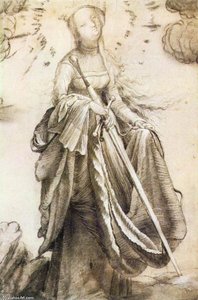
Admire Matthias Grünewald's 'St Catherine,' a captivating chalk drawing from 1520. Explore the Northern Renaissance master’s unique style, featuring a serene saint and symbolic details – available as a hand-painted replica.
Биография художника
Матиас Грюневальд – немецкий художник эпохи Возрождения, известный своими эмоциональными религиозными картинами, особенно алтарпьесом «Изенеим». Его стиль сочетает позднесредневековые традиции с реалистичным изображением страдания и глубоким духовным смыслом.
About the painting
The Enigmatic Saint: Matthias Grünewald’s St Catherine
Matthias Grünewald's 1520 chalk drawing, “St Catherine,” is more than just a portrait; it’s a profound meditation on faith, scholarship, and the enduring power of medieval symbolism. This remarkable work, currently residing in the Staatliche Museen zu Berlin, offers a captivating glimpse into the artist’s unique vision – a synthesis of late Gothic sensibilities with nascent Renaissance influences. Grünewald, a pivotal figure in German art, deliberately eschewed the prevailing Italian humanist trends, instead drawing deeply from the rich traditions of Central European religious painting, resulting in an intensely personal and emotionally resonant style.
The image depicts St Catherine from the waist up, her head tilted slightly downwards as if lost in contemplation. Her posture exudes a quiet dignity, while the subtle turn of her neck invites us into her inner world. She’s dressed in a gown with voluminous sleeves – a detail that speaks to both the formality of her status and the luxurious fabrics favored by wealthy patrons during the period. Crucially, she holds two objects: an open book or manuscript, symbolizing her role as a learned scholar, and a sword raised upright, representing her martyrdom and unwavering faith. These symbols aren’t merely decorative; they are potent visual statements about Catherine's life and devotion.
A Study in Northern Renaissance Technique
Grünewald’s masterful technique is immediately apparent. The drawing is executed with exquisite detail using chalk on paper, a medium that allowed for the delicate shading and fine lines characteristic of his work. Notice the subtle gradations of tone – the way light catches on her dress, the modeling of her face, and the atmospheric haze in the background. This meticulous attention to texture and form creates a remarkable sense of depth and realism, despite the relatively small scale of the piece. The artist’s use of chalk also lends a slightly ethereal quality to the image, contributing to its contemplative mood.
Furthermore, Grünewald's style deviates significantly from the prevailing Renaissance aesthetic. Unlike the idealized figures favored by artists like Albrecht Dürer, Catherine is rendered with a certain distortion – her proportions aren’t perfectly symmetrical, and her features possess an expressive intensity. This deliberate departure from classical ideals reflects Grünewald’s commitment to conveying emotional truth rather than purely visual accuracy. The background, deliberately minimalistic, consists of only a few suggestive lines—perhaps hinting at a cloudy sky or an abstract representation of the heavens – further emphasizing the saint's presence and drawing our focus entirely onto her.
Historical Context and Symbolic Resonance
Created in 1520, “St Catherine” exists within a fascinating transitional period in art history. Grünewald was working at a time when the influence of Italian Renaissance humanism was beginning to spread across Europe, yet he remained firmly rooted in the traditions of late medieval Central European painting. The saint herself holds significant religious importance – she is venerated as a martyr and patron saint of scholars, librarians, and translators. Her story, recounted in early Christian hagiographies, details her conversion after being saved from execution by St Peter, who recognized her divine calling.
Interestingly, the figure of Catherine has been associated with intellectual pursuits for centuries. Her association with learning stems from her devotion to scripture and her role as a translator of the Bible. The book she holds in the drawing symbolizes this scholarly dedication, while the sword represents her willingness to defend her faith against persecution. The combination of these symbols creates a powerful image of a woman who embodies both spiritual strength and intellectual prowess.
A Legacy of Emotion and Innovation
“St Catherine” is a testament to Matthias Grünewald’s artistic genius – a work that seamlessly blends technical skill with profound emotional depth. It's a poignant reminder of the artist’s ability to capture not just the likeness of his subject, but also her inner world. The drawing’s enduring appeal lies in its ability to evoke a sense of quiet contemplation and spiritual yearning. As a significant example of Northern Renaissance art, it continues to inspire artists and scholars alike, offering a valuable window into the artistic and intellectual landscape of 16th-century Germany.
Вопросы и ответы
Какая ориентация у «St Catherine», Гринев Wald?
Формат произведения «St Catherine» — Portrait. Это полезно при планировании места размещения репродукции.
В каком музее хранится оригинал «St Catherine»?
Вы можете увидеть оригинал произведения «St Catherine» в Стейтлешские музеи Берлина, Berlin, Germany.
Из чего создано произведение «St Catherine»?
Для создания «St Catherine» Гринев Wald использовал(а) технику Chalk. Эта техника определяет материальную природу оригинального произведения.
Quick facts and art quiz
About Гринев Wald

Гринев Wald
1480 - 1528, Германия
Биография художника
Matthias Grünewald: Жизнь и Наследие
Матиас Грёнуввальд, родившийся Матиас Готардт Найтарт примерно в 1470-1475 годах в Вюрцбурге, Германия, был ключевой фигурой немецкого Ренессанса. Несмотря на то, что он жил в период, все больше подвергающийся влиянию итальянских Ренессансных идеалов, Грёнуввальд оставался глубоко укорененным в художественных традициях позднего средневекового Центральной Европы. О деталях его ранней жизни известно немного, но известно, что он получил обучение как художник, вероятно, в местных мастерских.
Развитие искусства Грёнуввальда было сформировано преобладающими северными европейскими традициями реализма, эмоциональной интенсивности и тщательного наблюдения. Его работы демонстрируют влияние художников, таких как Альбрехт Дюрер и Мартин Шонгауэр, но он проложил себе уникальный путь, характеризующийся драматическим выражением и яркими цветами. Он не был напрямую вовлечен в гуманистические круги, преобладавшие в Италии; вместо этого его искусство служило преимущественно религиозным целям, отражая духовные тревоги своего времени.
Ранняя Жизнь и Художественное Начало
Матиас Грёнуввальд родился примерно в 1470-1475 годах в Вюрцбурге, Германия. Его ранние годы окутаны тайной, но известно, что он получил образование как художник, вероятно, в местных мастерских. Он был частью художественного сообщества, где передавались традиции позднего Средневековья, сочетая реализм и эмоциональную интенсивность с детальной проработкой.
Художественное Развитие и Влияния
Искусство Грёнуввальда было сформировано преобладающими северными европейскими традициями реализма, эмоциональной интенсивности и тщательного наблюдения. Его работы демонстрируют влияние художников, таких как Альбрехт Дюрер и Мартин Шонгауэр, но он проложил себе уникальный путь, характеризующийся драматическим выражением и яркими цветами. Он не был напрямую вовлечен в гуманистические круги, преобладавшие в Италии; вместо этого его искусство служило преимущественно религиозным целям, отражая духовные тревоги своего времени.
Основные Работы и Художественный Стиль
Изенхаймская Алтарь (1512-1516): Это шедевр, расположенный в Музее д’Юнтерлинден в Кольмар, считается главным произведением Грёнуввальда. Он изображает сцены из жизни Христа с пугающей реалистичностью, особенно фокусируясь на страданиях и искуплении. В этой работе он использует драматические композиции, яркую цветовую палитру и реалистичное изображение страданий, что делает ее одним из самых значительных произведений западного искусства.
Распятие (около 1502-1503): Ранняя работа, демонстрирующая его развивающийся стиль, подчеркивающая интенсивное выражение эмоций и анатомическую детализацию. В этой картине он показывает глубокую связь между человеческой фигурой и религиозным событием.
Дева Мария с Вознесением (1512-14): Исследование для Изенхаймского алтаря, демонстрирующее его тщательный процесс планирования. Эта работа является примером того, как художник продумывал детали будущей картины, создавая сложную структуру и композицию.
Моисей (1511): Рисунок, подчеркивающий мастерство Грёнуввальда в изображении выразительных фигур и драматических поз. В этом произведении он показывает умение передать силу и величие религиозных персонажей.
Художественный стиль Грёнуввальда отличается:
- Драматическая композиция: Он использовал динамичные уклады для усиления эмоционального воздействия.
- Яркая цветовая палитра: Его использование интенсивных, часто контрастных цветов создавало мощный визуальный опыт.
- Реалистичное изображение страданий: Грёнуввальд не избегал изображения физических и эмоциональных страданий, связанных с религиозными повествованиями.
- Выразительные фигуры: Его фигуры наполнены сильными эмоциями и психологической глубиной.
Историческая Значимость и Наследие
Работа Грёнуввальда является свидетельством непреходящей силы художественных традиций позднего Средневековья в Германии во время Ренессанса. Он соединил поздготическую стилистику с возникающим Ренессансом, создав уникальный визуальный язык, который резонировал со своими современниками. Его влияние можно увидеть в более поздних немецких художниках, которые продолжали исследовать темы религиозного фанатизма и эмоциональной интенсивности. Хотя он во многом был забыт после своей смерти в 1528 году, Грёнуввальд пережил возрождение в 19 веке, и сегодня он признан одним из самых важных художников немецкого Ренессанса. Его искусство продолжает очаровывать зрителей своим первобытным эмоциональным воздействием, техническим мастерством и глубоким духовным содержанием.
Дальнейшее Изучение
Узнайте больше о жизни и работах Матиаса Грёнуввальда на: TopImpressionists
Quick facts about Гринев Wald
- Artistic Movement Or Style: Ренессанс Северной Европы
- Artists Or Movements Influenced By This Artist: ['Альбрехт Дюрер']
- Artists Who Influenced This Artist:
- Альбрехт Дюрер
- Мартин Шонгауэр
- Date Of Birth: Около 1470 г.
- Date Of Death: 31 августа 1528 г.
- Full Name: Матиас Груневальд
- Nationality: Немецкий
- Notable Artworks:
- Изинем Альтерписце
- Крестус
- Дева Мария с Благоветием
- Place Of Birth: Вюрцбург, Германия
Откройте для себя произведения искусства, распределенные по темам, стилям и характеристикам.


Гринев Wald
St Catherine
() ·
With its frame: · Hand-painted in oil on linen
Total