


 Примерить в интерьере
 Отправить
 Поделиться
 Подробнее
 Руководство

 Скачать
 Похожие объекты
 Рентгенография
 Слайд-шоу
 Q&A
Q&A Статистика
The Grammar


Paul Sérusier's 'The Grammar' (1892) is an iconic Cloisonnism painting, pioneering abstract art & inspiring the Nabis movement. Explore its symbolism and artistic innovation.
 Развернуть текст
Пауль Сёрюзэр – французский художник-новатор, пионер абстрактного искусства и вдохновитель движения «Наби». Известен картиной "Талисман", новаторским использованием цветов и форм, оказавшим влияние на развитие современного искусства.
Жикле / Арт-принты
Печать (жикле) или холст музейного качества с быстрыми сроками изготовления и широким выбором вариантов отделки. ( Заказать репродукцию ручной работы Перейти к цифровым изображениям)




P118B $10

P118H $10

P118W $10

P438Z $10

P508JH $12

P508YH $12

P805H $10

P805Z $10

P919BZ $10

P919G $10

P919XJ $10

P959ZH $10

P968JZ $12

W106C $8

W218G $10

W218JH $8

W218Y $10

W307PJ $10

W316G $10

W316PJ $8

W316Y $10

W398PJ $8

W4111J $10

W500HY $15

W500JH $15

W692G $12

W849H $8

W940BG $15

W953PJ $8




Стандартный размер
индивидуальный заказ
CM
INCH
Выберите один из наших стандартных размеров, соответствующих оригинальным пропорциям произведения искусства.
Loading sizes...

ширина
высота
Введите необходимую ширину и высоту, чтобы репродукция подошла к вашей раме или стене. При печати изображение можно только уменьшить, но нельзя увеличить больше оригинала, поэтому при выборе другого формата часть изображения может быть обрезана. Перед печатью мы отправим вам цифровой макет на утверждение. Изображение на этой странице не отображает реальную обрезку — ее можно увидеть только на макете.
Доставка по всему миру () за 2 недели вместо стандартных 4–5 недель. (30 Октябрь)

Бесплатная экспресс-доставка по всему миру

Высококачественный льняной холст

Полное страхование при транспортировке

Гарантия возврата таможенных пошлин

Гарантия точного цветового соответствия

100-дневный период возврата (только при обнаружении дефектов)

Гарантия возврата 100% средств

Скидка при заказе нескольких работ
 Вариант со стеклом доступен только для размеров менее 110 см

The Grammar
Жикле / Арт-принты
Размер репродукции
-


Итоговая стоимость
$ 69
The Grammar: A Pioneering Exploration of Abstraction
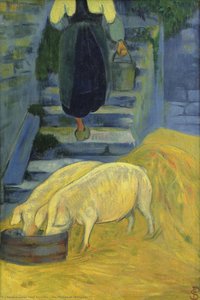
Paul Sérusier’s “Grammar,” painted in 1892, stands as a pivotal work not just within the artist's oeuvre but also as a foundational piece in the development of modern art. More than simply a portrait, it’s an intensely personal and experimental exploration of color, form, and the very nature of representation – a bold step towards abstraction that profoundly influenced generations of artists to come. The painting depicts a woman seated on the ground, absorbed in reading a book, a scene rendered with remarkable intimacy and a deliberate departure from traditional academic styles.
Sérusier’s artistic journey was deeply intertwined with the burgeoning Nabis movement, a group of Symbolist painters who sought to move beyond mere imitation of nature towards expressing inner emotions and spiritual truths. He initially studied at the Académie Julian, but it was his summer sojourn in Pont-Aven, Brittany, that proved transformative. There, under the tutelage of Paul Gauguin – a figure whose influence extended far beyond technique – Sérusier encountered the revolutionary approach of Cloisonnism, championed by Gauguin himself. This style, characterized by sharply defined outlines and areas of flat color applied in small, separate strokes, aimed to mimic the appearance of stained glass, creating a sense of luminous clarity and symbolic resonance.
Cloisonnism and the Language of Color
“Grammar” exemplifies this Cloisonnism technique with striking precision. The woman’s figure is not rendered through subtle gradations of tone but rather defined by bold, distinct outlines – a deliberate simplification that prioritizes color and form over meticulous detail. Sérusier employs a vibrant palette, dominated by deep blues, greens, and ochres, creating an atmosphere both serene and slightly melancholic. The colors aren’t blended; instead, they are applied in small, separate strokes, building up layers of hue and texture. This technique, combined with the flattened perspective, creates a sense of immediacy and directness, as if the painting is capturing a fleeting moment of contemplation.
Crucially, Sérusier’s use of color isn't merely descriptive; it carries symbolic weight. The blues evoke a sense of introspection and mystery, while the greens suggest connection to nature – a key theme in Symbolist art. The muted ochres contribute to the painting’s overall feeling of quietude and contemplation. The deliberate choice of colors, rather than realistic representation, is central to the work's expressive power.
A Study in Form and Abstraction
Beyond its technical mastery, “Grammar” represents a significant shift towards abstraction. While not entirely devoid of recognizable forms – the woman’s figure, the book, the surrounding objects – the painting prioritizes the exploration of color and form over strict representation. The simplified shapes, flattened perspective, and emphasis on pure color anticipate later developments in abstract art, foreshadowing the work of artists like Kandinsky and Mondrian. It's a deliberate move away from photographic realism towards a more subjective and expressive approach to visual language.
The painting’s title, “Grammar,” is particularly intriguing. It suggests that Sérusier was not simply depicting a scene but rather exploring the fundamental building blocks of artistic expression – the elements of color, line, and form – in a way that transcends traditional representation. The book itself becomes a symbol of knowledge and contemplation, inviting the viewer to engage with the painting on a deeper level.
Legacy and Inspiration
“Grammar” remains a vital work in the history of modern art, demonstrating Sérusier’s pioneering spirit and his profound influence on subsequent generations. It's a testament to the power of abstraction to convey emotion, ideas, and spiritual truths. Reproductions of this evocative painting continue to inspire artists and collectors alike, offering a glimpse into the heart of artistic innovation and the enduring quest for new forms of visual expression.
Вопросы и ответы
Можно ли использовать дополненную реальность, чтобы увидеть «The Grammar», Пауль Сёрюзэр в своей комнате?
Вы можете примерить работу «The Grammar», Пауль Сёрюзэр на свою стену с помощью страницы Предпросмотр в AR, используя технологию дополненной реальности на совместимом устройстве.
Как стиль произведения «The Grammar» соотносится с эпохой его создателя?
Произведение «The Grammar», Пауль Сёрюзэр относится к направлению Cloisonnism / Nabis, созданное в эпоху — XIX век своего автора.
Какова насыщенность и интенсивность цветов в работе «The Grammar», Пауль Сёрюзэр?
Насыщенность цвета в работе «The Grammar» составляет Muted, а интенсивность — Monochromatic.
Похожие произведения




Биография художника
Paul Sérusier: Pioneer of Abstraction and the Nabis Movement
Paul Sérusier, born in Paris on November 9th, 1864, and passing away on October 7th, 1927, stands as a pivotal figure in the evolution of modern art. More than simply a painter, he was a visionary who profoundly influenced the trajectory of abstract expressionism and laid the groundwork for the Nabis movement – a group that sought to redefine the very essence of painting. His early life, steeped in Parisian culture and artistic education, provided the fertile ground from which his revolutionary ideas blossomed.
Sérusier’s formal training began at the Académie Julian, an institution known for its progressive approach to art education, offering a more open-ended environment than the rigid structure of the École des Beaux-Arts. This allowed him to explore diverse styles and techniques, ultimately shaping his unique artistic vision. Crucially, he spent a summer in 1888 at Pont-Aven, a small village nestled in Brittany, where he encountered a vibrant community of artists – Paul Gauguin, Édouard Vuillard, Pierre Bonnard, and Maurice Denis – who would become his closest collaborators and intellectual peers. It was during this period that Sérusier’s artistic philosophy began to take shape, moving away from traditional representational techniques towards a more subjective and evocative approach.
The Cloisonnism Experiment and the Birth of Abstraction
The summer at Pont-Aven proved transformative for Sérusier. Under Gauguin's guidance, he embarked on an ambitious project: “Bois d’Amour” (The Lovers’ Wood), a painting that would become synonymous with cloisonnism – a technique pioneered by Gauguin and later embraced by Sérusier. Cloisonnism involved creating flat planes of color separated by bold black outlines, resembling the individual cells of a stained-glass window. This radical departure from traditional perspective and shading resulted in an image that was almost entirely devoid of recognizable forms, pushing the boundaries of representation towards pure abstraction. “Bois d’Amour” wasn't merely a painting; it was an experiment – a deliberate attempt to strip away illusion and capture the essence of perception through color and line.
Sérusier’s exploration of cloisonnism didn’t end with "The Talisman," another significant work from 1894, also created at Pont-Aven. He continued to refine this technique, using it as a springboard for further experimentation with form and color. His paintings during this period are characterized by flattened planes, simplified shapes, and a vibrant palette – a deliberate rejection of academic conventions in favor of a more personal and expressive style.
The Nabis: A Collective Pursuit of Spiritual Expression
Sérusier’s artistic journey culminated in his involvement with the Nabis (meaning “prophets”), a small group of artists who formed around Paul Gauguin in the early 1890s. The Nabis sought to create a new form of art that combined decorative elements with profound spiritual and emotional content. They rejected the prevailing trends of Impressionism and Post-Impressionism, aiming instead for a synthesis of color, line, and symbolism. Sérusier played a crucial role in shaping the group’s aesthetic principles, advocating for the use of bold colors, simplified forms, and evocative imagery.
The Nabis' work was deeply influenced by Symbolism, a literary and artistic movement that explored themes of mysticism, dreams, and the subconscious. They believed that art should not merely imitate reality but rather convey deeper truths about the human condition. Sérusier’s paintings often reflected this spiritual dimension, imbued with a sense of melancholy, introspection, and longing.
Notable Works and Lasting Legacy
Sérusier's artistic output includes several key works that exemplify his innovative approach to painting. “L’Averse” (The Shower), painted in 1893, showcases his mastery of color and composition. His portrait of Paul Ranson, completed in 1890, is a testament to his ability to capture the essence of his subject through subtle gestures and expressive brushstrokes. "Melancholy," created in 1890, embodies the group's exploration of emotional depth. “The Snake Eaters,” painted in 1894, demonstrates his continued experimentation with abstraction and symbolism.
Beyond his individual achievements, Sérusier’s legacy extends far beyond his own paintings. He was a key figure in the development of abstract art, inspiring generations of artists to explore new ways of seeing and representing the world. His influence can be seen in the work of many prominent modernists, including Matisse, Kandinsky, and Nolde. Sérusier’s dedication to exploring the expressive potential of color and line paved the way for a radical shift in artistic thinking, solidifying his place as one of the most important figures in the history of art.

Пауль Сёрюзэр
1864 - 1927 , Франция
Краткая справка
- Вдохновленные Художники/Движения: ['Набисты']
- Влиявшие Художники:
- Пол Гюген
- Морис Денё
- Гражданство: Француз
- Дата Рождения: 9 ноября 1864 г.
- Дата Смерти: 7 октября 1927 г.
- Известные Работы:
- La Talisman
- L'aversé
- Место Рождения: Париж, Франция
- Полное Имя: Луи-Поль-Энри Серузёр
- Художественный Стиль: Пост-импрессионизм
Похожие статьи

The Soul of Color: A Journey into the Emotional Resonance of Lyrical Abstraction
Embark on a cultural journey through Lyrical Abstraction. Explore how masters like Kandinsky used color and motion to translate emotion into visual poetry. Discover the profound beauty of abstract expressionism and learn to curate emotional resonance in your own art collection.
Откройте для себя произведения искусства, распределенные по темам, стилям и характеристикам.


