

На картине: · В раме:
 Предпросмотр
 Поделиться
 Поделиться
 Детали произведения
 Руководство

 Скачать
 Похожие предметы
 Рентгенография
 Слайд-шоу
 Вопросы и ответы
 Статистика просмотров


$ 269
Масляная репродукция ручной работы
Картина маслом на холсте в выбранном вами размере и раме, написанная на заказ нашими художниками. ( Перейти к печатным копиям Перейти к цифровым изображениям)
Размер
·Стандартный размер
на заказ
CM
INCH
Выберите один из наших стандартных размеров, соответствующих оригинальным пропорциям произведения искусства.
Загрузка размеров...

ширина
высота
Введите необходимую ширину и высоту, чтобы репродукция подошла к вашей раме или стене. Поскольку работа выполняется вручную, при изменении пропорций художник может немного увеличить область вокруг картины или, наоборот, обрезать края — выбор за вами. Перед началом работы мы пришлем вам цифровой макет на утверждение. Изображение на этой странице не является точным результатом — увидеть реальный вид можно только на макете.
 Узнать больше
Завершить
·
Белый торцевой край $1

Размытый край $1

С продолжением изображения $1

P118B $10

P118H $10

P118W $10

P438Z $10

P508JH $12

P508YH $12

P805H $10

P805Z $10

P919BZ $10

P919G $10

P919XJ $10

P959ZH $10

P968JZ $12

W106C $8

W218G $10

W218JH $8

W218Y $10

W307PJ $10

W316G $10

W316PJ $8

W316Y $10

W398PJ $8

W4111J $10

W500HY $15

W500JH $15

W692G $12

W849H $8

W940BG $15

W953PJ $8

H24-GOLD $30

H24-SILVER $30

H36-GOLD $45

H36-SILVER $45
Поставляется в защитной тубусе, готовый к оформлению в багет вашей мастерской.
Дополнительные услуги
необязательноЧто входит в дополнительные услуги?
Примеры того, что можно изменить: заменить лицо фотографией клиента; добавить питомца (например, заменить кошку на собаку); добавить скрытое послание на задний план; изменить пейзаж или элементы фона.
После оформления заказа команда TopImpressionists.com свяжется с клиентом по электронной почте для получения инструкций и предоставит предварительный макет
После оформления заказа команда TopImpressionists.com свяжется с клиентом по электронной почте для получения инструкций и предоставит предварительный макет
Доставка по всему миру () за 3–4 недели вместо стандартных 5 недель. (6 Ноябрь). Без компромиссов в качестве.
Защитный лак
Этикетка
Детали гравировки на бронзовой плакетке
This elegant plaque features the artist's name and the title of the artwork, finely engraved for a timeless presentation.
It is made from bronze with a refined, elegant finish. The text is precisely laser-engraved for a sharp and permanent result. Measuring 9x2 cm, the plaque is compact yet easy to read. It's built to be durable and scratch-resistant, offering a professional, museum-quality look. Mounting is simple thanks to the included adhesive backing.
Детали прозрачной акриловой таблички
The plaque includes essential engraved details such as the artist's name, the title of the artwork, the date it was created, the type of media used-like oil on canvas or watercolor-a brief description of the piece, and a QR code that links to the complete artwork information.
It is crafted from clear acrylic, offering a sleek, modern appearance. The text is UV-engraved in black to ensure strong visual contrast. With a size of 10x15 cm, it ensures optimal readability. It comes equipped with two metal hooks for secure wall mounting. The plaque is designed to be weather-resistant, making it suitable for various environments, and it includes interactive features that work seamlessly with smartphone scanning.
Информация о чёрной акриловой табличке
This elegant plaque includes engraved information such as the artist's name, the title of the artwork, the date it was created, the type of media used (like oil on canvas or watercolor), a short description of the artwork, and a QR code for quick access to more information.
The plaque itself is made from refined black acrylic with a premium finish. The text is laser-engraved in white for high contrast and readability. Its size is 10x15 cm, designed to be easy to read. It comes with two metal hooks for professional mounting. The design is sleek and fits any interior style. It is also weather-resistant and durable, with built-in digital integration for mobile compatibility.
Вариант со стеклом доступен только для размеров менее 110 см
 Вариант со стеклом доступен только для размеров менее 110 см
- Бесплатная экспресс-доставка по всему миру
- Высококачественный льняной холст
- Полное страхование при доставке
- Гарантия возмещения таможенных пошлин
- Гарантия точного цветового соответствия
- 100-дневная гарантия возврата (только при обнаружении дефектов)
- Гарантия возврата 100% средств
- Скидка при оптовом заказе


Описание предмета коллекционирования
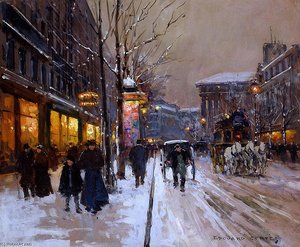
Robert Henri’s "Snow in New York" (1902) captures a gritty NYC street scene with thick impasto and muted tones, reflecting the Ashcan School's realism. Explore urban life through this iconic painting.
Биография художника
Роберт Генри (1865-1929) – пионер американского реализма и Аштанской школы. Его работы отражают жизнь простых людей с искренностью и глубиной, вдохновляя художников до сих пор.
Об этой картине
A Winter’s Gaze: Robert Henri's "Snow in New York"
Robert Henri’s “Snow in New York,” painted in 1902, isn’t merely a depiction of a snowy street; it’s a raw, almost brutal, distillation of urban life captured with an unprecedented honesty for its time. Far removed from the idealized landscapes favored by many of his contemporaries, Henri plunges headfirst into the gritty reality of New York City, presenting a scene both familiar and profoundly unsettling. The painting immediately commands attention not through picturesque beauty, but through its stark simplicity and the palpable sense of unease it evokes – a feeling that speaks volumes about the burgeoning anxieties of a rapidly changing America.
Henri’s style firmly places “Snow in New York” within the Ashcan School movement. Rejecting the academic traditions of the National Academy of Design, the Ashcan painters sought to portray everyday life—often the less glamorous aspects—with unflinching realism. This isn't a romanticized view; instead, we encounter a common side street, devoid of grand avenues or iconic landmarks. The composition is deliberately straightforward, utilizing a single-point perspective that draws the eye directly into the scene, emphasizing its immediacy and lack of embellishment. Thick impasto—a technique where paint is applied thickly to create texture—dominates the canvas, lending a tactile quality to the buildings, the snowdrifts, and even the figures traversing the street. The muted palette – browns, grays, and whites – further contributes to the painting’s somber mood, creating an atmosphere of quiet desperation.
The Painter's Perspective: Henri and the Ashcan School
Understanding Robert Henri requires acknowledging his pivotal role in shaping the Ashcan School. Born Robert Henry Cozad in Cincinnati in 1865, Henri’s early life was marked by instability following a fatal shooting involving his father. This event profoundly shaped his artistic vision, leading him to embrace a radical approach to painting—one that prioritized direct observation and honest representation over idealized beauty. Henri's time in Paris exposed him to the Impressionists, but he quickly moved beyond their focus on light and color, seeking instead to capture the essence of American life with unflinching detail. He famously declared that art should be “akin to journalism,” mirroring the straightforwardness and social commentary found in contemporary newspapers.
Henri’s studio became a hub for a group of like-minded artists—including George Luks, Everett Shinn, and William Glackens—collectively known as the "Philadelphia Four." They gathered regularly to discuss art, literature, and philosophy, fostering a spirit of experimentation and challenging established artistic conventions. This collaborative environment fueled their shared desire to depict the realities of urban America, often focusing on marginalized communities and the struggles faced by ordinary people.
Symbolism in the Streetscape
While seemingly simple, “Snow in New York” is rich with symbolic meaning. The absence of grand buildings or recognizable landmarks suggests a sense of anonymity and isolation within the vastness of the city. The figures walking along the street—carrying handbags, bundled in coats—represent the everyday lives of New Yorkers, their faces obscured by the gloom, lost in their own thoughts. The snow itself acts as a metaphor for both hardship and resilience – covering the streets but also creating a temporary sense of stillness. The presence of a wagon suggests commerce and the relentless cycle of urban activity, highlighting the constant struggle for survival.
Notably, Henri’s choice to depict a common street rather than a major avenue is significant. It reflects his deliberate rejection of romanticized views of New York and his focus on the overlooked corners of the city—the places where life unfolded with quiet intensity. The painting isn't about spectacle; it’s about capturing the essence of an ordinary day in an extraordinary place.
A Legacy of Realism
“Snow in New York” remains a powerful testament to Robert Henri’s artistic vision and his pioneering role in American art. It stands as a crucial example of the Ashcan School, demonstrating a commitment to realism, social commentary, and an honest portrayal of urban life. Reproductions of this evocative painting continue to resonate with viewers today, offering a glimpse into the heart of early 20th-century New York—a city grappling with rapid change, industrialization, and the challenges of modernity. Its enduring appeal lies in its ability to capture not just a scene, but also the complex emotions and experiences of those who lived within it.
Вопросы и ответы
Какую эмоцию передает «Snow in New York», Роберт Генри?
Эмоциональный тон, зафиксированный для «Snow in New York», Роберт Генри, — Melancholic. Он передает суть чувств, которые выражает это произведение.
В какой технике выполнено произведение «Snow in New York», Роберт Генри?
Техника исполнения работы «Snow in New York», Роберт Генри — Acrylic On Canvas. Репродукции стремятся максимально точно передать особенности этой техники.
Из какой страны происходит работа в стиле Ashcan School «Snow in New York»?
Работа в стиле Ashcan School «Snow in New York» была создана художником, уроженцем Соединенные Штаты Америки.
Краткие факты и викторина об искусстве
Об авторе Роберт Генри

Роберт Генри
1865 - 1929, Соединенные Штаты Америки
Биография художника
A Turbulent Genesis: The Early Life of Robert Henri
Robert Henri, born Robert Henry Cozad in Cincinnati, Ohio, in 1865, carried within him from the outset a sense of displacement and reinvention that would profoundly shape both his life and art. His childhood was far from idyllic; shadowed by the volatile relationship between his father, John Jackson Cozad—a man of ambition and risk as a gambler and real estate developer—and his mother, Theresa Gatewood Cozad. This instability culminated in a dramatic event in 1882: a fatal shooting over a land dispute that forced the family into flight, adopting new identities to escape retribution. Young Robert became Robert Henri, a deliberate severing from a past fraught with conflict and a symbolic rebirth as an artist. The westward journey through Nebraska and Colorado, culminating in a settling in New York City and then Atlantic City, instilled within him a deep empathy for those living on the fringes of society—an empathy that would become a defining characteristic of his artistic vision. This early experience of upheaval and reinvention fostered a spirit of independence and a commitment to portraying life as it truly was, unburdened by convention or societal expectation. His father’s involvement in a shooting incident prompted the family to change their names, creating a new identity for themselves.Forging a New Vision: Artistic Development and Influences
Henri’s formal artistic education began at the Pennsylvania Academy of the Fine Arts in Philadelphia under Thomas Anshutz, where he honed his technical skills. However, it was his subsequent journey to Paris in 1888 that truly ignited his artistic awakening. Initially drawn to the academic tradition at the Académie Julian and influenced by masters like William-Adolphe Bouguereau and François Millet, Henri gradually gravitated towards Impressionism. Yet, he wasn’t content with merely replicating what he saw; he sought a more profound engagement with reality—a way to capture not just the fleeting effects of light but also the raw emotion and vitality of modern life. This quest led him to embrace a bolder, more direct approach, influenced by the Dutch Realist Franz Hals, whose loose brushwork and psychological insight resonated deeply with Henri’s own artistic sensibilities. He began experimenting with *pochades*, small wood panels used for quick sketches, encouraging spontaneity and immediacy in his work. Returning to America, he became a dedicated teacher, imparting not just technique but also a philosophy of art rooted in observation, honesty, and individual expression. His early works often depicted scenes of urban life, capturing the energy and grit of New York City with remarkable detail and emotional intensity.Championing the Real: The Ashcan School and “The Eight”
Robert Henri’s impact on American art extended far beyond his own canvases; he became a catalyst for change, challenging the conservative norms of the established art world. He was a central figure in the emergence of the Ashcan School—a group of artists who dared to depict the gritty realities of urban life, from bustling city streets to crowded tenements. Henri’s commitment to realism and his rejection of academic pretension led him to organize “The Eight” in 1908—a collective of like-minded artists including William Glackens, George Luks, Everett Shinn, and John Sloan—who staged an independent exhibition as a direct protest against the restrictive policies of the National Academy of Design. This act of defiance was a watershed moment in American art history, signaling a shift away from European dominance and towards a uniquely American artistic voice. Henri’s paintings during this period, such as “Woman in Manteau” (1899) and his evocative portraits, captured the dignity and resilience of ordinary people, offering a powerful counterpoint to the idealized representations favored by the establishment. The group's work was often characterized by its unflinching portrayal of poverty, corruption, and social injustice, reflecting the realities of life in rapidly industrializing America.Legacy and Enduring Influence
Robert Henri’s influence on subsequent generations of American artists is immeasurable. As a teacher, he mentored a remarkable roster of talent, including Joseph Stella, Edward Hopper, Rockwell Kent, George Bellows, Norman Raeben, Louis D. Fancher, and Stuart Davis—artists who would go on to shape the course of 20th-century art. His book, *The Art Spirit*, published posthumously in 1923, remains a seminal text for aspiring artists, offering timeless wisdom on observation, technique, and the importance of artistic integrity. *Henri’s commitment to portraying life with honesty and empathy*, his rejection of convention, and his unwavering belief in the power of art to connect with audiences continue to inspire artists today. His paintings are not merely representations of reality; they are windows into the human condition—testaments to the beauty, struggle, and resilience of the human spirit. He left an indelible mark on American Realism, paving the way for a more democratic and inclusive art world that celebrated the everyday experiences of ordinary people. His legacy endures not only through his own masterful works but also through the countless artists he inspired to find their own voices and tell their own stories.Краткая информация об авторе: Роберт Генри
- Artistic Movement Or Style: Аштанская школа, Реализм
- Artists Or Movements Influenced By This Artist:
- Эдвард Хоппер
- Восемь
- Artists Who Influenced This Artist:
- Фрэнс Галь
- Франсуа Милет
- Date Of Birth: 24 июня 1865 г.
- Date Of Death: 12 июля 1929 г.
- Full Name: Robert Henry Cozad / Robert Henri
- Nationality: Американский
- Notable Artworks:
- Женщина в мантии
- Снег
- Сиси в желтом
- Place Of Birth: Цинциннати, США
Похожие произведения




Откройте для себя произведения искусства, распределенные по темам, стилям и характеристикам.


Роберт Генри
Snow in New York
() ·
В раме: · Масло по льну, ручная работа
Итого