

На картине: · В раме:
 Предпросмотр
 Поделиться
 Поделиться
 Детали произведения
 Руководство

 Скачать
 Похожие предметы
 Рентгенография
 Слайд-шоу
 Вопросы и ответы
 Статистика просмотров

$ 319
Масляная репродукция ручной работы
Картина маслом на холсте в выбранном вами размере и раме, написанная на заказ нашими художниками. ( Перейти к печатным копиям Перейти к цифровым изображениям)
Размер
·Стандартный размер
на заказ
CM
INCH
Выберите один из наших стандартных размеров, соответствующих оригинальным пропорциям произведения искусства.
Загрузка размеров...

ширина
высота
Введите необходимую ширину и высоту, чтобы репродукция подошла к вашей раме или стене. Поскольку работа выполняется вручную, при изменении пропорций художник может немного увеличить область вокруг картины или, наоборот, обрезать края — выбор за вами. Перед началом работы мы пришлем вам цифровой макет на утверждение. Изображение на этой странице не является точным результатом — увидеть реальный вид можно только на макете.
 Узнать больше
Завершить
·
Белый торцевой край $1

Размытый край $1

С продолжением изображения $1

P118B $10

P118H $10

P118W $10

P438Z $10

P508JH $12

P508YH $12

P805H $10

P805Z $10

P919BZ $10

P919G $10

P919XJ $10

P959ZH $10

P968JZ $12

W106C $8

W218G $10

W218JH $8

W218Y $10

W307PJ $10

W316G $10

W316PJ $8

W316Y $10

W398PJ $8

W4111J $10

W500HY $15

W500JH $15

W692G $12

W849H $8

W940BG $15

W953PJ $8

H24-GOLD $30

H24-SILVER $30

H36-GOLD $45

H36-SILVER $45
Поставляется в защитной тубусе, готовый к оформлению в багет вашей мастерской.
Дополнительные услуги
необязательноЧто входит в дополнительные услуги?
Примеры того, что можно изменить: заменить лицо фотографией клиента; добавить питомца (например, заменить кошку на собаку); добавить скрытое послание на задний план; изменить пейзаж или элементы фона.
После оформления заказа команда TopImpressionists.com свяжется с клиентом по электронной почте для получения инструкций и предоставит предварительный макет
После оформления заказа команда TopImpressionists.com свяжется с клиентом по электронной почте для получения инструкций и предоставит предварительный макет
Доставка по всему миру () за 3–4 недели вместо стандартных 5 недель. (7 Ноябрь). Без компромиссов в качестве.
Защитный лак
Этикетка
Детали гравировки на бронзовой плакетке
This elegant plaque features the artist's name and the title of the artwork, finely engraved for a timeless presentation.
It is made from bronze with a refined, elegant finish. The text is precisely laser-engraved for a sharp and permanent result. Measuring 9x2 cm, the plaque is compact yet easy to read. It's built to be durable and scratch-resistant, offering a professional, museum-quality look. Mounting is simple thanks to the included adhesive backing.
Детали прозрачной акриловой таблички
The plaque includes essential engraved details such as the artist's name, the title of the artwork, the date it was created, the type of media used-like oil on canvas or watercolor-a brief description of the piece, and a QR code that links to the complete artwork information.
It is crafted from clear acrylic, offering a sleek, modern appearance. The text is UV-engraved in black to ensure strong visual contrast. With a size of 10x15 cm, it ensures optimal readability. It comes equipped with two metal hooks for secure wall mounting. The plaque is designed to be weather-resistant, making it suitable for various environments, and it includes interactive features that work seamlessly with smartphone scanning.
Информация о чёрной акриловой табличке
This elegant plaque includes engraved information such as the artist's name, the title of the artwork, the date it was created, the type of media used (like oil on canvas or watercolor), a short description of the artwork, and a QR code for quick access to more information.
The plaque itself is made from refined black acrylic with a premium finish. The text is laser-engraved in white for high contrast and readability. Its size is 10x15 cm, designed to be easy to read. It comes with two metal hooks for professional mounting. The design is sleek and fits any interior style. It is also weather-resistant and durable, with built-in digital integration for mobile compatibility.
Вариант со стеклом доступен только для размеров менее 110 см
 Вариант со стеклом доступен только для размеров менее 110 см
- Бесплатная экспресс-доставка по всему миру
- Высококачественный льняной холст
- Полное страхование при доставке
- Гарантия возмещения таможенных пошлин
- Гарантия точного цветового соответствия
- 100-дневная гарантия возврата (только при обнаружении дефектов)
- Гарантия возврата 100% средств
- Скидка при оптовом заказе


Описание предмета коллекционирования
Explore Walter Ufer’s ‘Sleep,’ a poignant oil painting of Native American women in Taos. Discover realism, rich detail & cultural symbolism – a unique 20th-century artwork.
Биография художника
Вальтер Уфер (1876-1936) — американец немецкого происхождения, известный выразительными картинами жизни индейцев Таос, Нью-Мексико. Участник группы «Десятка Таоса», мастер жанровых сцен и ярких пейзажей. Изучите его творчество.
Об этой картине
The Weight of Tradition: An Encounter with Walter Ufer’s “Sleep”
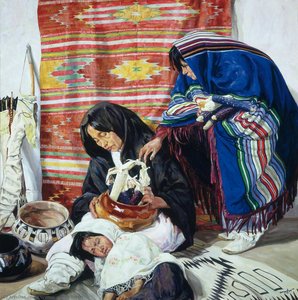
Walter Ufer's "Sleep," painted in 1923, isn’t merely a depiction of three Native American women; it’s an immersion into a world steeped in ritual and profound reverence. The painting immediately draws the viewer in with its rich tapestry of color – predominantly warm reds, oranges, and browns that evoke the earth itself, grounded by cooler blues and greens woven through the textiles and pottery. This palette isn't simply decorative; it speaks to the cultural heritage of the subjects, hinting at a deep connection to the land and ancestral traditions. The composition is carefully orchestrated, centering on the kneeling woman as a focal point, yet subtly inviting us into the periphery of the scene, suggesting an active participation in this sacred space.
Ufer’s masterful technique reveals layers of painstaking detail. He employs a layered oil painting approach, building up texture with deliberate brushstrokes that create a palpable sense of roughness on the clothing – perhaps representing the wear and tear of daily life intertwined with ceremonial garb – while simultaneously rendering the pottery with smooth, almost polished surfaces. This juxtaposition speaks to the duality inherent in Native American culture: the balance between practicality and spirituality, the tangible and the intangible. The lighting, soft and diffused, isn’t dramatic; it's deliberately muted, casting subtle shadows that lend a sense of solemnity and depth to the figures and objects, as if illuminating a secret whispered within a sacred space.
A Window into Taos: Contextualizing Ufer’s Vision
To fully appreciate “Sleep,” it's crucial to understand its historical context. Painted in 1923, during his time in Taos Pueblo, New Mexico, the artwork represents a pivotal moment in Walter Ufer’s career and his deep engagement with Native American culture. He was part of the "Taos Ten," a group of artists who sought to document and celebrate the lives and traditions of the region's indigenous communities. This wasn’t simply an act of observation; it was a deliberate attempt at understanding and portraying these cultures with respect and authenticity, a rare undertaking for American art at the time.
Ufer’s background as a German-born artist profoundly shaped his approach. His training in Europe instilled a meticulous attention to detail and a sophisticated understanding of composition – elements he skillfully translated into his depictions of Native American life. However, it was his immersion within the Taos community that truly informed his work, allowing him to capture not just appearances but also the spirit and essence of these traditions. The painting’s realism is tempered by an underlying sense of mystery, inviting viewers to contemplate the deeper meanings embedded within the scene.
Symbolism Woven into the Fabric
The details within “Sleep” are laden with symbolic significance. The intricately patterned rug serves as a visual anchor, framing the central figures and providing a rich backdrop that speaks to the importance of storytelling and communal life within Native American culture. The pottery, often adorned with geometric designs and natural motifs, represents both artistic skill and spiritual connection – a tangible link to ancestors and the earth. The women themselves, engaged in what appears to be a ritualistic activity, are not simply subjects; they embody generations of tradition, wisdom, and connection to the divine.
The act depicted—kneeling in reverence—suggests healing or a profound spiritual ceremony. The quiet dignity of the figures, coupled with the muted colors and soft lighting, evokes a sense of solemnity and timelessness. It’s an image that transcends mere representation, offering a glimpse into a world governed by ancient beliefs and deeply rooted traditions.
A Legacy of Authenticity: Reproductions and Beyond
Walter Ufer's "Sleep" remains a powerful testament to the beauty and complexity of Native American culture. TopImpressionists offers high-quality, hand-painted reproductions that faithfully capture the painting’s rich detail and evocative atmosphere. These reproductions are more than just images; they are windows into another world—a world of sacred rituals, profound traditions, and enduring wisdom. Investing in a reproduction is an investment in preserving this important piece of American art history and honoring the legacy of Walter Ufer's insightful portrayal.
Вопросы и ответы
Как в произведении «Sleep» сбалансированы свет и тень?
Зафиксированные значения для «Sleep», Вальтер Уфер: яркость — bright, светлота — Gentle Luminance.
Какое настроение передает «Sleep», Вальтер Уфер в рамках направления Contemporary Realism?
Melancholic эмоциональность произведения «Sleep» дополняет его стиль Contemporary Realism.
Кто является автором «Sleep» и к какому направлению относится это произведение?
«Sleep» был создан Вальтер Уфер в стиле Contemporary Realism. Автор и направление определяют художественную традицию этого произведения.
Краткие факты и викторина об искусстве
Об авторе Вальтер Уфер

Вальтер Уфер
1876 - 1936, Германия
Биография художника
Душа Юго-Запада: Жизнь и наследие Вальтера Уфера
Вальтер Уфер занимает центральное место в американском импрессионизме — это художник, чьи мазки не просто улавливали свет, но запечатлевали само сердцебиение целой культуры. Рожденный в 1876 году в немецком Хюккесвагене, Уфер проложил свой путь к высокогорным пустыням Нью-Мексико через суровую европейскую школу и глубокое любопытство к человеческой природе. Его ранние годы прошли в среде немецко-американской диаспоры Луисвилла, штат Кентукки, где он начал впитывать богатую палитру своего наследия. Этот фундаментальный период, отмеченный изучением литографии и печатной графики, наделил его технической точностью, которая впоследствии позволила ему с непревентраемым мастерством управлять сложностями света и тени.
Стремление к художественному совершенству привело его в преображающую одиссею по всей Европе. Будучи странствующим мастером, Уфер погружался в разнообразные художественные традиции континента, оттачивая технику в престижных академиях Гамбурга и Дрездена. Этот период интенсивного интеллектуального и творческого расширения завершился его пребыванием в Мюнхене, где он посвятил себя глубокой студийной практике. Когда в 1911 году он наконец вернулся в Соединенные Штаты, он привез с собой утонченное европейское мироощущение, которое было готово к глубокому столкновению с суровыми, залитыми солнцем пейзажами американского Запада.
Визионер «Десятки Таоса»
1914 год стал решающим поворотным моментом в жизни Уфера и в траектории развития американского искусства. Отправившись в Пуэбло-де-Таос, штат Нью-Мексико, он оказался частью экстраординарной художественной революции. Присоединившись к влиятельной группе, известной как «Десятка Таоса», Уфер стал ключевой фигурой коллектива, стремившегося выйти за рамки простого пейзажа к более подлинному, висцеральному изображению жизни коренных американцев. В отличие от многих современников, видевших Юго-Запад через романтизированную или колониальную призму, Уфер подходил к своим сюжетам с глубоким уважением и вниманием к достоинству повседневного существования.
Его творчество стало мостом между европейскими импрессионистическими техниками и первозданной духовной энергией народа Пуэбло. Он был не просто наблюдателем, но летописцем ритуалов, ландшафтов и тихих ритмов общинной жизни. Центральное место в этой творческой эволюции заняли его отношения с Джимом Мирабалом, индейцем из Таоса, который служил одновременно и музой, и соратником Уфера. Благодаря этой связи художник обрел интимное понимание культурных нюансов региона, что позволило ему наполнить свои полотна ощущением живой истины, резонирующей далеко за пределами границ Нью-Мексико.
Техника, символизм и историческое значение
Творчество Уфера характеризуется виртуозным владением цветом и смелым, экспрессивным наложением краски. Его стиль, хотя и уходит корнями в принципы американского импрессионизма, часто тяготел к более мощному и текстурному подходу, передающему жар пустынного солнца и тяжесть земли. Он использовал свет не только для освещения формы, но и для пробуждения эмоций, создавая сцены, где сама атмосфера кажется пропитанной историей и традицией.
Историческая значимость Вальтера Уфера заключается в его способности возвысить жанровую живопись до уровня глубокого социального и культурного манифеста. Его достижения включают:
- Подлинное представление: Отказ от «живописных» стереотипов о жизни индейцев в пользу более нюансированного и гуманизированного портрета народа Таос.
- Художественный синтез: Успешное слияние формальной академической подготовки Германии с ярким, необузданным духом американского Юго-Запада.
- Наследие «Десятки Таоса»: Решающая роль в становлении Таоса как главного направления американского модернизма и жизненно важного центра искусства, сосредоточенного на коренных народах.
Сегодня картины Уфера остаются непреходящим свидетельством периода интенсивного культурного переплетения. Его способность сплести техническую строгость европейского образования с духовной глубиной культуры Пуэбло гарантирует, что его работы продолжают завораживать, приглашая современных зрителей увидеть вневременной дух долины Таос через его выразительный и мастерский взгляд.
Краткая информация об авторе: Вальтер Уфер
- Artistic Movement Or Style: Таосский импрессионизм
- Artists Or Movements Influenced By This Artist: ['']
- Artists Who Influenced This Artist: ['']
- Date Of Birth: 1876
- Date Of Death: 1936
- Full Name: Уолтер Уфер
- Nationality: немец-американец
- Notable Artworks:
- Ее дочь
- Строители пустыни
- После них
- Place Of Birth: Хюккесваген, Германия


Вальтер Уфер
Sleep
() ·
В раме: · Масло по льну, ручная работа
Итого