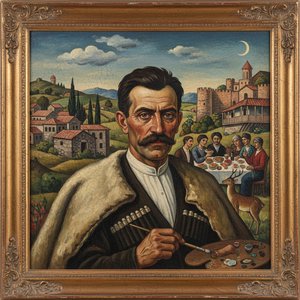
Mingrelian Prince - A Portrait of Caucasus Spirit
Grigory Grigorievich Gagarin (1810-1893), a Russian painter, diplomat & administrator, stands as a pivotal figure in 19th-century Russian art. Born in Saint Petersburg to the noble Rurikid princely gagarin family, his artistic journey began with private lessons from Karl Briullov, shaping him into a master of capturing human emotion and regional landscapes. Gagarin’s legacy extends beyond individual canvases; he profoundly influenced the cultural landscape of Georgia through monumental projects like the Tbilisi Sioni Cathedral fresco and the restoration of ancient Georgian cathedrals—a testament to his dedication to preserving artistic heritage.
- Subject Matter: The painting depicts a Caucasian prince, embodying strength and nobility amidst the rugged beauty of the Caucasus Mountains. Gagarin meticulously rendered the subject’s posture and gaze, conveying an aura of dignity and contemplation.
- Style & Technique: Gagarin adhered to Romanticism's principles, prioritizing emotional expression over strict realism. He employed oil paints on canvas with a masterful brushstroke technique—loose yet controlled—creating textured surfaces that capture the essence of light and shadow.
- Historical Context: Created in 1855 during Mikhail Vorontsov’s governorship of Georgia, Gagarin's work reflects the fascination of the era with ethnographic studies and artistic representations of diverse cultures. Duma’s observations about the Tbilisi Theatre—a building mirroring Pompey Theatre—highlighted Gagarin’s ambition to elevate Georgian culture through architectural grandeur.
- Symbolism: The prince’s stance symbolizes leadership and resilience, mirroring the spirit of the Caucasus region itself – a land known for its dramatic landscapes and proud traditions. Gagarin skillfully utilized color palettes to evoke feelings of serenity and majesty, enhancing the painting's emotional impact.
The Tbilisi Theatre: Inspiration from Roman Antiquity
Alexander Duma’s admiration for the Tbilisi Theatre underscores Gagarin’s artistic vision—a desire to emulate the architectural splendor of Pompey Theatre, symbolizing classical ideals of beauty and grandeur. This deliberate reference demonstrates Gagarin's understanding of artistic influences and his commitment to creating spaces that inspire awe and elevate cultural experience. The theatre’s interior design embodies a harmonious blend of elegance and functionality, reflecting Gagarin’s meticulous attention to detail.
Gagarin’s Sketches & Drawings: Capturing Caucasus Landscapes
“The journey to Caucasus” documented Gagarin's explorations of Georgia’s breathtaking scenery—mountains, valleys, and villages—resulting in a series of sketches and drawings that reveal his artistic sensitivity to natural forms. These preparatory studies showcase his ability to translate visual impressions onto paper with remarkable accuracy and expressive nuance. They serve as invaluable insights into Gagarin’s creative process and his profound connection to the Caucasus region's cultural identity.
A Legacy Enduring Through Reproduction
Today, a high-quality reproduction of “Mingrelian Prince” offers art enthusiasts a chance to experience Gagarin’s artistic brilliance—a masterpiece that encapsulates Romantic ideals and celebrates Georgian heritage. TopImpressionists.com presents this iconic artwork with exceptional care, ensuring its beauty and significance are preserved for generations to come. Explore the collection of Taganrog Art Museum and delve deeper into Russian art history – discover more about Gagarin's contribution to artistic expression!



 Kúpiť tlač
 Odoslať
 Zdieľať
 Podrobnosti o dielo

 Stiahnuť
 Podobné diela
 RTG skúška
 Prezentácia


 Zobraziť viac






































 Možnosť skla je dostupná len pri rozmeroch pod 110 cm