The Sculptural Legacy of Emil Popov
Born in the historic Bulgarian town of Kjustendil in 1951, Emil Popov has emerged as a profound voice in contemporary sculpture, weaving together the rugged textures of the natural world with deep philosophical inquiries. His artistic journey began within the prestigious halls of Sofia’s Academy of Fine Arts, an environment that provided him with a rigorous foundation in classical technique while simultaneously encouraging the exploration of modernistic boundaries. By 1979, his talent was formally recognized through his membership in the Union of Bulgarian Artists, a milestone that launched a prolific career dedicated to the mastery of bronze and the creation of monumental forms that command both public spaces and intimate galleries.
The essence of Popov’s work lies in its remarkable ability to capture dynamic movement within the seemingly static medium of bronze. His sculptures are not merely objects but are living entities that seem to pulse with an internal energy. This vitality is often drawn from a deep, meditative observation of geological formations, botanical specimens, and the intricate complexities of human anatomy. Through his hands, metal is transformed into something fluid and expressive, capturing fleeting moments of natural beauty and translating them into enduring monuments of strength and grace.
A Synthesis of Form and Philosophy
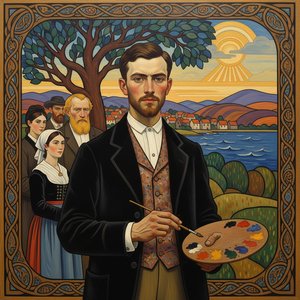
Popov’s stylistic evolution is a fascinating study in the blending of diverse artistic movements. He possesses a unique ability to distill complex organic structures into simplified, powerful shapes, a pursuit that echoes the Synthetism pioneered by Émile Bernard. This drive toward capturing the fundamental essence of a subject allows his work to resonate on both a physical and metaphysical level. Furthermore, his mastery over light and shadow reflects an engagement with Luminist principles, where the interplay of atmosphere and surface creates a sense of profound realism and depth.
Beyond the purely aesthetic, much of Popov’s later work is imbued with a spiritual weight, particularly through his exploration of themes such as ahimsa, or non-violence. Inspired by the philosophy of Mahatma Gandhi, he utilizes the permanence of sculpture to advocate for peace and the sanctity of life. This thematic depth elevates his pieces from mere anatomical or botanical studies to profound meditations on the human condition and our relationship with the living world.
Achievements and Artistic Impact
Throughout his decades-long career, Emil Popov has left an indelible mark on the Bulgarian and international art landscapes. His presence is felt in numerous public squares across Bulgaria, where his bronze works serve as landmarks of cultural identity. His exhibitions have spanned various regions, including notable showcases in Germany and the Netherlands, proving that his visual language transcends national borders.
The significance of his contribution to contemporary sculpture can be summarized through several key pillars of his career:
- Technical Mastery: A profound command over bronze casting and the manipulation of heavy materials to achieve delicate, organic textures.
- Philosophical Depth: The integration of complex concepts like non-violence and metaphysical existence into tangible, sculptural forms.
- Institutional Recognition: A long-standing connection to the Sofia City Art Gallery and prestigious accolades such as the "Ivan Lazarov" award.
- Cultural Legacy: The creation of a monumental body of work that bridges the gap between traditional Bulgarian craftsmanship and modern abstract expressionism.
As his work continues to be exhibited in galleries and museums, Emil Popov remains a vital figure whose sculptures serve as a bridge between the earth's raw, geological power and the delicate, searching spirit of humanity.