Ateliér — Bezplatné celosvetové doručenie — Doručenie za 2–6 týždňov
      Jerzy Faczynski, 1917 – 1943

      69 najznámejších obrazov od Jerzy Faczynski, zoradených podľa popularity

      Najobľúbenejším obrazom, ktorý vytvoril Jerzy Faczynski, je Ballerina. Nasledujú Abstract Woman a Shepherd z pláten, ktoré čitateľom najlepšie známe. Náš katalóg obsahuje 69 diel od umelca Jerzy Faczynski: tu je 69 najznámejších, z ktorých každý uvádza rok vytvorenia, múzeu a to, čo ho robí nezabudnuteľným.

      Poriadkované podľa nášho skóre popularity, ktoré kombinuje počet vyhľadávaní, návštev a objednávok pre každé dielo. Aktualizované november 2026. Každý obraz na tejto stránke si môžete objednať ako ručne maľovanú olejную reprodukciu na ľanovom plátne alebo ako umeleckú tlač, vyrobenú v požadovanom rozмере.

      Portrét Jerzy Faczynski
      Jerzy Faczynski · 1917 – 1943
      Narodený · zomrel
      1917 – 1943
      Diela v našom katalógu
      69
      Najznámejšie
      Ballerina

      Top 10 obrazov umelca Jerzy Faczynski: plátna, ktoré pozná každý

      Viac pláten od Jerzy Faczynski, od 11 do 69

      Čo najčastejšie mal Jerzy Faczynski

      Štyri témy, ktoré sa na týchto plátnach najčastejšie vracajú, každá s jej najobľúbenejším príkladom.

      O plátnach umelca Jerzy Faczynski: odpovede na vaše otázky

      Ktorý obraz od Jerzy Faczynski je najznámejší?Prečítajte si odpoveď

      Ballerina, po ktorom nasledujú Abstract Woman a Shepherd.

      Akých je 10 najznámejších obrazov od Jerzy Faczynski?Prečítajte si odpoveď

      Ballerina, Abstract Woman, Shepherd, Faces, Nude, Nude, Nude, Ballerina, Woman a The Madonna And Child. Každé plátno v uvedenom poradaní obsahuje rok vytvorenia a názov múzeja.

      Koľko celkom diel nakreslil/a Jerzy Faczynski?Prečítajte si odpoveď

      V našom katalógu sa nachádza 69 diel od Jerzy Faczynski.

      Čo najčastejšie mal Jerzy Faczynski?Prečítajte si odpoveď

      Women (11), Nudes (7) a Buildings (6), v rámci 69 diel na tejto stránke.

      Môžem si kúpiť reprodukciu plátna od Jerzy Faczynski?Prečítajte si odpoveď

      Áno. Každý obraz na tejto stránke si môžete objednať z jeho vlastnej stránky ako ručne maľovanú olejную reprodukciu alebo ako umeleckú tlač, v rozmeroch, ktoré si vyberiete.

      Jerzy Faczynski: život v farbách

      A Life Forged in Conflict and Creation


      The life of Jerzy Faczynski was a profound testament to the resilience of the human spirit amidst the wreckage of the twentieth century. Born in 1917 in Yenakiieve, Ukraine, to Polish parents, his early years were steeped in an atmosphere of artistic appreciation, nurtured by his mother, Marian, a dedicated artist and teacher. This foundational connection to beauty would later become his sanctuary during the darkest chapters of his life. When the shadows of World War II descended upon Europe, Faczynaryski’s path took a dramatic turn from the studio to the cockpit, as he enlisted in the Polish Air Force. His journey was marked by the harrowing realities of war, including capture by Nazi forces and a daring, resolute escape that mirrored the very strength found in his later architectural designs. As a refugee in Britain, he did not merely survive; he sought to rebuild the cultural identity of a displaced nation, joining the Polish School of Architecture in Liverpool—a vital beacon of intellectual life for the Polish diaspora.

      The Architecture of Faith and Modernity


      Faczynski’s architectural legacy is defined by a singular mission: to translate the eternal essence of the Catholic faith into the language of modern form. His work represents a masterful intersection of Art Deco elegance and the rigorous, functional principles of Modernism. Drawing deep inspiration from the Bauhaus movement, he sought to strip away the superfluous, focusing instead on how light, space, and structure could evoke spiritual transcendence. This pursuit led him to design more than fifty churches, works that stand as monuments to both his technical precision and his liturgical devotion. His architectural vocabulary was not merely about stone and mortar but about creating sacred spaces that resonated with the contemporary era, blending historical reverence with an innovative, forward-looking aesthetic that sought to capture the very soul of the liturgy.

      A Versatile Hand: From Ink to Expressionism


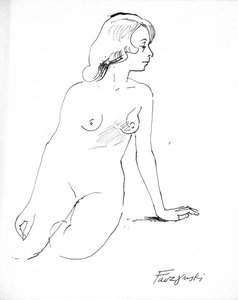
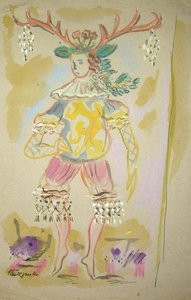
      While his architectural achievements provided a structural legacy, his graphic works offered a window into his emotional landscape. Faczynski’s artistry was remarkably diverse, ranging from the delicate precision of monochrome sketches to the raw, emotive power of watercolor and ink. In pieces such as Manor House, one observes a captivating, almost nostalgic exploration of historical themes through impressionistic detail. Conversely, his more experimental works reveal a fascination with the psychological depths of the human condition. His haunting watercolor, Man With A Cigarette, utilizes expressive distortion and vibrant color to evoke profound feelings of isolation and vulnerability, bordering on the realms of Surrealism. Similarly, his ink drawings, such as the Reclining Woman, utilize the dynamic, fragmented lines of Abstract Expressionism to capture raw emotion. Through these varied mediums, Faczynski remained a lifelong witness to the beauty and the turbulence of the world, leaving behind a body of work that continues to resonate with historical depth and artistic brilliance.