

Prikazano: · Vključno z okvirjem:
 Predogled v realnem okolju
 Pošlji
 Deli
Deli
 Podrobnosti o delu
 Priročnik

 Prenesi sliko
 Podobni izdelki
 Rentgenski posnetek
 Predvajaj diaporama
 Vprašanja in odgovori
 Statistika

€ 240
Ročno izdelana oljna reprodukcija
Ročno slikano olje na platnu v vaši izbiri velikosti in okvirja, izdelano po naročilu naših umetnikov. ( Preklop na tiskanine Preklop na digitalno sliko)
Velikost
·Standardna velikost
po meri
CM
INCH
Izberite eno od naših vnaprej določenih velikosti, ki ustrezajo prvotnim proporcijam umetničkega dela.
Nalagovanje velikosti...

širina
višina
Vnesite širino in višino, ki jih potrebujete, da se slika prilega vašemu okviru ali steni. Ker je delo ročno slikano, lahko umetnik pri različnih oblikih slik pri robovih doda malo več barve ali pa jih malo odreže — izberite sami. Pred začetkom slikanja vam pošljemo digitalni predogled za potrditev. Slika, prikazana na tej strani, ni končni rezultat — le predogled prikazuje dejansko podobo.
 Preberi več
Zaključek
·
Beli rob €1

zamegljen rob €1

Razširjen rob €1

P118B €10

P118H €10

P118W €10

P438Z €10

P508JH €12

P508YH €12

P805H €10

P805Z €10

P919BZ €10

P919G €10

P919XJ €10

P959ZH €10

P968JZ €12

W106C €8

W218G €10

W218JH €8

W218Y €10

W307PJ €10

W316G €10

W316PJ €8

W316Y €10

W398PJ €8

W4111J €10

W500HY €15

W500JH €15

W692G €12

W849H €8

W940BG €15

W953PJ €8

H24-GOLD €30

H24-SILVER €30

H36-GOLD €45

H36-SILVER €45
Pošiljanje v zaščitni tubi, pripravljeno za vaš lastni okvir.
Nad 105 cm se okvir pošlje v obliki kompleta za profesionalnega okvirja — preberite podrobnosti.
Dodatne storitve
po izbogiKaj vse vključujejo dodatki?
Primeri sprememb, ki jih je mogoče izvesti: zamenjava obraza s fotografijo stranke; dodajanje hišnega ljubljenčka (npr. zamenjava mačke s psom); vključitev skritega sporočila v ozadje; sprememba krajine ali elementov v ozadju.
Po oddaji naročila bo ekipa TopImpressionists.com stranki po e-pošti poslala navodila in zagotovila predogled makete
Po oddaji naročila bo ekipa TopImpressionists.com stranki po e-pošti poslala navodila in zagotovila predogled makete
Mednarodna dostava () v 3/4 tednih namesto običajnih 5 tednov. (7 november). Brez kompromisov pri kakovosti.
Zaščitni lak
Značka z imenom
Podrobnosti o gravirani bronasti plošči
This elegant plaque features the artist's name and the title of the artwork, finely engraved for a timeless presentation.
It is made from bronze with a refined, elegant finish. The text is precisely laser-engraved for a sharp and permanent result. Measuring 9x2 cm, the plaque is compact yet easy to read. It's built to be durable and scratch-resistant, offering a professional, museum-quality look. Mounting is simple thanks to the included adhesive backing.
Podrobnosti o transparentni akrilni plošči
The plaque includes essential engraved details such as the artist's name, the title of the artwork, the date it was created, the type of media used-like oil on canvas or watercolor-a brief description of the piece, and a QR code that links to the complete artwork information.
It is crafted from clear acrylic, offering a sleek, modern appearance. The text is UV-engraved in black to ensure strong visual contrast. With a size of 10x15 cm, it ensures optimal readability. It comes equipped with two metal hooks for secure wall mounting. The plaque is designed to be weather-resistant, making it suitable for various environments, and it includes interactive features that work seamlessly with smartphone scanning.
Podrobnosti o črni akrilni plošči
This elegant plaque includes engraved information such as the artist's name, the title of the artwork, the date it was created, the type of media used (like oil on canvas or watercolor), a short description of the artwork, and a QR code for quick access to more information.
The plaque itself is made from refined black acrylic with a premium finish. The text is laser-engraved in white for high contrast and readability. Its size is 10x15 cm, designed to be easy to read. It comes with two metal hooks for professional mounting. The design is sleek and fits any interior style. It is also weather-resistant and durable, with built-in digital integration for mobile compatibility.
Možnost stekla je na voljo le za velikosti pod 110 cm
 Možnost stekla je na voljo le za velikosti pod 110 cm
- Brezplačna ekspresna dostava po vsem svetu
- Visokokakovostno laneno platno
- Popolno zavarovanje pošiljke
- Garancija povračila carine in uvoznih davkov
- Garancija popolnega barvnega ujemanja
- 100-dnevna politika vračil (le v primeru okvar)
- Garancija 100% povračila denarja
- Popust pri večjem naročilu


Opis zbirateljskega predmeta
Discover Egon Schiele's 'Village by the River' (1908), an early Expressionist landscape showcasing a quaint village and train, reflecting his unique style.
Biografija umetnika
Raziskujte intenzivne ekspresionistične umetnosti Egon Schieleja (1890-1918): izrazite portrete, psihološke teme in edinstvene črte. Odkrijte reprodukcije že danes!
O sliki
A Glimpse into Tranquility: Egon Schiele’s ‘Village by the River’
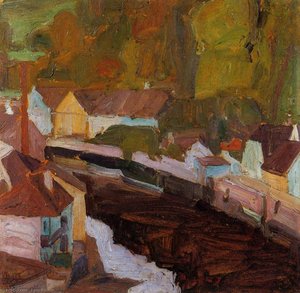
Egon Schiele's 1908 painting, ‘Village by the River,’ offers a serene departure from the emotionally charged and often unsettling portraits for which he is best known. This landscape, rendered with an Impressionistic touch, presents a picturesque scene of domesticity nestled along a waterway. Several houses, distinguished by their vibrant red roofs contrasting against white or muted walls, cluster together, creating a sense of community. The inclusion of a passing train—a subtle nod to the artist’s childhood fascination stemming from his father's profession as a station master—adds a touch of modernity and hints at the changing world around this idyllic setting. A small boat gliding along the river further enhances the peaceful atmosphere, completing a vision of tranquil rural life.
Early Expressionism and the Austrian Landscape
Painted during a pivotal period in Schiele’s artistic development, ‘Village by the River’ reveals his early exploration beyond the confines of academic training. While he briefly studied at the Kunstgewerbeschule and later the Akademie der bildenden Künste in Vienna, Schiele quickly diverged from traditional methods, seeking a more direct and emotionally honest form of expression. This painting, created before the full force of Expressionism gripped his work, demonstrates an embrace of Impressionistic techniques – visible brushstrokes and a focus on capturing light and atmosphere. However, even within this seemingly conventional landscape, hints of Schiele’s future style emerge in the slightly fractured forms and the expressive use of color. The painting stands as a testament to a young artist finding his voice amidst the burgeoning artistic movements of early 20th-century Austria.
Symbolism of Place and Passing Time
The village itself, with its tightly grouped houses, can be interpreted as a symbol of human connection and shared existence. The river, a constant flow, represents the passage of time and the enduring nature of life. The train, though seemingly innocuous, introduces an element of transience and change—a foreshadowing of the societal shifts that would soon engulf Europe. Schiele’s choice to depict this scene with a slightly elevated perspective allows the viewer to encompass the entirety of the village, fostering a sense of both intimacy and detachment. It's as if we are observing a moment frozen in time, a fleeting glimpse into a world on the cusp of transformation. The painting isn’t merely a representation of a place; it is an evocation of a feeling—a quiet contemplation of life’s rhythms.
A Collector’s Resonance: Bringing Schiele's Vision Home
For collectors and interior designers, ‘Village by the River’ offers a unique opportunity to introduce a touch of Austrian Expressionism into any space. Unlike many of Schiele’s more intense works, this painting possesses a calming quality that lends itself well to living rooms, studies, or bedrooms. Its warm color palette and inviting subject matter create an atmosphere of serenity and contemplation. A high-quality reproduction captures the delicate brushwork and nuanced colors, allowing the viewer to appreciate Schiele's skill and vision. This artwork is not just a decorative element; it’s a window into a specific moment in art history, a testament to the power of landscape painting, and an invitation to reflect on the beauty of simple, peaceful existence.
Vprašanja in odgovori
Kdo je ustvaril "Village by the River"?
Delo "Village by the River" je ustvaril Egon Ščile. Informacije na tej strani opisujejo izvirno delo umetnika Egon Ščile.
Kakšno vzdušje bi v prostor prineslo "Village by the River"?
"Village by the River" avtorja Egon Ščile ima Calm vzdušje in se priporoča za Living Room. Razpoloženje je tisto, kar delo vnese v okoliški prostor.
Kje lahko prenesem "Village by the River" avtorja Egon Ščile?
Digitalno sliko za "Village by the River" lahko prenesete na strani Prenos digitalne slike, kjer je na voljo možnost prenos digitalne slike visoke ločljivosti.
Hitri podatki in kviz o umetnosti
O Egon Ščile

Egon Ščile
1890 - 1918, Avstrija
Biografija umetnika
Egon Schiele: Austrian Expressionist Painter
Austrian art has since acquired legendary status in interdisciplinary cultural studies. Histories of modern Austrian art generally begin with the architectural boom that swept Vienna in the second half of the nineteenth century. During this period of strong economic growth, the Emperor Franz Josef constructed a necklace of public edifices along the broad Ringstrasse that encircles Vienna’s inner city, prompting artists to flock to the capital from all over to compete for decorative mural commissions. The most renowned painter of the era was Hans Makart, but the young Gustav Klimt also earned his reputation executing commissions on the interior walls of structures such as theaters and museums. The favored style combined a sort of blowsy eroticism with a firm grip on classical and historical allegory. Starting from his masterpiece *The Kiss*, Klimt gradually moved away from the accepted formula, however, evolving a personal symbolism that was less conventionally readable as well as more overtly sexual. This combination proved devastating so far as the tasted of staid Vienna were concerned: Klimt was banished from the ranks of public muralists, and henceforth had to seek support solely from well-heeled private patrons.
Early Life & Influences
Egon Schiele was born in Tulln an der Donau – a picturesque region with vineyards, onion-domed towers and Baroque monasteries. Yet this idyllic setting is hardly reflected in his work.
Instead, many of his landscapes appear melancholic, sometimes sombre. Perhaps he was processing the early death of his father from syphilis and the subsequent loss of his sister Elvira.
Raised initially by his mother and then under the somewhat controlling guardianship of his uncle Leopold Czihaczek, Schiele’s childhood lacked conventional stability but fostered a fiercely independent spirit. Even as a boy, he displayed an intense fascination with trains—a motif that subtly reappeared in later paintings—and a burgeoning talent for drawing, though this was initially met with disapproval from his father who saw it as a distraction from more practical pursuits. The early death of his sister Elvira also cast a long shadow over the young artist’s psyche. These formative experiences instilled within him a sensitivity and an emotional rawness that would become hallmarks of his artistic expression, a constant grappling with themes of life, death, and the human condition.
Vienna Secession & Artistic Breakthrough
Schiele's formal artistic training began at the Kunstgewerbeschule (School of Arts and Crafts) in Vienna, but he quickly found itself stifled by its conservative approach. He transferred to the Akademie der bildenden Künste (Academy of Fine Arts), only to become further disillusioned with its rigid academic traditions. This dissatisfaction led him to abandon formal training altogether, choosing instead to forge his own path, a testament to his unwavering artistic conviction.
The influence of Gustav Klimt was pivotal during these early years; Schiele admired Klimt’s decorative style and exploration of symbolism, even receiving mentorship from the established artist.
He co-founded the Neues Wiener Kunstgruppe (New Viennese Art Group) in 1909, aligning himself with other progressive artists who challenged the prevailing artistic norms. His distinctive style features elongated figures, contorted poses, and expressive lines that convey a sense of unease and emotional intensity.
Style Characteristics & Recurring Themes
Schiele’s art is immediately recognizable for its raw honesty and psychological depth.
He fearlessly confronted themes often considered taboo – sexuality, death, anxiety, isolation – with an unflinching gaze.
His distinctive style features elongated figures, contorted poses, and expressive lines that convey a sense of unease and emotional intensity. The human form, particularly the nude, became his primary subject, not as an object of idealized beauty but as a vessel for exploring the complexities of human experience.
Schiele didn’t shy away from depicting himself in unflattering or vulnerable poses, revealing a profound level of self-awareness and introspection.
Legacy & Recognition
Despite facing censorship and legal challenges – including a brief imprisonment for allegedly corrupting minors with his art – Schiele gained recognition within Vienna’s avant-garde circles.
His work challenged the conventions of the time, provoking both admiration and outrage.
By the time of his untimely death during the Spanish flu pandemic in 1918 at the age of twenty-eight, he had established himself as a leading figure in Austrian Expressionism. Significant works such as *Self-Portrait with Physalis*, *Couple Embracing*, and *Field Landscape (Kreuzberg near Krumau)* stand as testaments to his artistic genius.
His influence on subsequent generations of artists is undeniable, particularly those interested in exploring psychological themes and challenging conventional artistic norms.
Kratek pregled o Egon Ščile
- Artistic Movement Or Style: Expresionismo
- Artists Who Influenced This Artist: ['Gustav Klimt']
- Date Of Birth: 12 giugno 1890
- Date Of Death: 31 octubre 1918
- Full Name: Egon Schiele
- Nationality: Austriaco
- Notable Artworks:
- Autoritratto con Physalis
- Giovane coppia
- Paesaggio campo (Kreuzberg)
- Place Of Birth: Tulln an der Donau, Austria
Raziščite umetniška dela, razvrščena po temah, slogih in značilnostih.


Egon Ščile
Village by the River
() ·
Vključno z okvirjem: · Ročno slikano z oljem na platnu
Skupni znesek