

 Predogled v realnem okolju
 Pošlji
 Deli
Deli
 Podrobnosti o delu
 Priročnik

 Prenesi sliko
 Podobni izdelki
 Rentgenski posnetek
 Predvajaj diaporama
 Vprašanja in odgovori
 Statistika
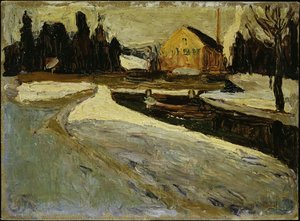
Delaware Canal


A serene winter scene of the Delaware Canal captured by Pennsylvania Impressionist Frederick Roland Wagner features snow-covered landscapes and tranquil boats, inviting you to bring this peaceful moment into your home.
 Preberi več
Discover Frederick R. Wagner (1860-1940), a pioneering Pennsylvania Impressionist painter. Explore his captivating scenes of Philadelphia – harbors, bridges & everyday life – and learn about his legacy at PAFA & beyond.
Pridobite datoteko, pripravljeno za tiskanje, ki presega kakovost spletnega predogleda. Vsaka digitalna slika v naši ponudbi izvira iz visoko ločljive izvirne datoteke v naši bazi — običajno široke od 5.000 do 15.000 pikselov — zato lahko z zaupanjem tiskate v večji format, tesno izrezujete ali reproducirate fine podrobnosti.
Nobena datoteka ne zapusti našega studia nedotiknjena. Digitalni strokovnjak preveri barve v primerjavi z izvirno sliko in jih po potrebi popravi, nato pa s profesionalnimi orodji za retuširanje izboljša jasnost in podrobnosti — pri čemer vedno ostaja zvest umetnikovim potezam in slogu. Rezultat je slika, ki izgleda kot samo slikarstvo, ne pa kot le filtriran sken.
Potrditev pred dokončanjem dela: naš strokovnjak vam v roku 72 ur pošlje sliko po e-pošti na pregled. Niste zadovoljni? Zahtevajte izboljšave ali popravke ali prosite za povračilo denarja, če kakovost ni v skladu z pričakovanimi standardi.
To je kakovost, po kateri temeljijo založniki, oblikovalni studii, galerije in tiskarne.
Digitalna slika
Prenesite datoteko visoke ločljivosti za osebno uporabo, tiskanje in kreativne projekte. ( Preklop na tiskanine Kupite ročno slikano delo)
Vključeno v vsako naročilo digitalne slike
Zagotovljena strokovna digitalna dostava
Z izbiro TopImpressionists.com ne prejmete le slike – prejmete profesionalno urejeno digitalno umetniško delo, izdelano z največjo natančnostjo in zavestno podprto z garancijo za zadovoljstvo. Tukaj je vse, kar bo z vašim naročilom samodejno priloženo:

Hitra dostava prek e-pošte
Vaša digitalna slika visoke ločljivosti bo na vaš e-naslov poslana v roku 72 ur od zaklopa naročila – pripravljena za takojšnjo uporabo.

Digitalna datoteka z uporabo AI
Vaše umetniško delo je strokovno optimizirano z uporabo naprednih orodij umetne inteligence in ročne obdelave, kar zagotavlja največjo stopnjo podrobnosti, jasnosti in barvne natančnosti.

Brezplačna doletna ponovna dostava
Ste datoteko zaradi nespremietne napake izgubili ali izbrisali? Ni težav – vam jo bomo ponovno poslali kadar koli in brezplačno.

Brez uvoznih pristojbin – vedno
Svoje umetniško del uživajte takoj, brez carin, davkov ali stroškov dostave – digitalni prenosi so vedno brezdavčni.

Zagotovilo natančnosti barv
Z uporabo profesionalnih orodij in procesov upravljanja barv zagotavljamo, da vaša digitalna slika čim bolj natančno odraža prvotne barve.

100-dnevna garancija zadovoljstva
Če niste zadovoljni s svojo digitalno sliko, jo bomo uredili ali vam v 100 dneh povrnili 100% denarja – brez kakršnih koli vprašanj.

100% Garancija povračila denarja
Niste zadovoljni? Zagotavljamo vam popoln povračilo sredstev v 100 dneh po prejemu digitalne datoteke – brez dodatnih vprašanj.

Popusti pri večjih naročilih
Kupite 3 slike, prihranite 10% - Kupite 5 slik, prihranite 15% - Kupite 10+ slik, prihranite 20%. Odlično za kreativne projekte, galerije in agencije.
Wagner began his studies at the Pennsylvania Academy of the Fine Arts under Thomas Eakins and Thomas Anshutz in the early 1880s. Like many of his New Hope colleagues, the artist preferred painting en plein air, especially winter scenes and specialized in railroad and canal views such as this work. In 1913, Wagner exhibited two works in the landmark Armory Show in New York that introduced Americans to trends in European modernism.
Vprašanja in odgovori
V katerem muzeju se nahaja original dela "Delaware Canal"?
Originalno delo "Delaware Canal" avtorja Frederick Roland Wagner se nahaja v muzeju Reading Public Museum, Reading, Združene države Amerike. Reprodukcija omogoča, da ta sklad prikazujete tudi v svojem domu.
Priporočena uporaba in prostor za "Delaware Canal" avtorja Frederick Roland Wagner?
Za Seasonal se priporoča "Delaware Canal", priporočena prostorina pa je Hotel Room.
Za kakšno umetniško delo velja "Delaware Canal"?
"Delaware Canal" avtorja Frederick Roland Wagner je razvrščeno v kategorijo WallArt. Ta kategorija opisuje vrsto umetniškega dela, da je original.
Sorodna umetniška dela




Biografija umetnika
Frederick Roland Wagner: Capturing the Soul of Philadelphia
Born in Port Kennedy, Pennsylvania, in 1860, Frederick Roland Wagner emerged as a pivotal figure in early 20th-century American art, specifically within the burgeoning Pennsylvania Impressionist movement. His life and career were inextricably linked to the vibrant, evolving cityscape of Philadelphia, a subject he relentlessly pursued with a keen eye for detail and an ability to imbue everyday scenes with profound emotional resonance. Wagner’s work wasn't merely documentation; it was a deeply felt exploration of urban life, capturing both its grandeur and its inherent melancholy.
Wagner’s artistic journey began under the tutelage of Thomas Eakins at the Pennsylvania Academy of the Fine Arts, an institution that profoundly shaped his approach to painting. This early immersion in academic training provided him with a solid technical foundation, but it was Wagner's subsequent engagement with the burgeoning Impressionist circle – including Robert Henri and William Glackens – that truly ignited his artistic spirit. These figures encouraged a shift away from rigid realism towards capturing fleeting moments of light and color, emphasizing subjective experience over objective representation. He embraced this new approach, developing a distinctive style characterized by loose brushwork, vibrant palettes, and an intimate portrayal of Philadelphia’s industrial heartland.
Early life and education saw Wagner demonstrating anatomy at the Pennsylvania Academy, showcasing his meticulous observation skills – a trait that undoubtedly informed his ability to render figures and architectural details with remarkable accuracy. He spent time studying in Europe before returning to America, where he honed his craft through independent study and experimentation. His work quickly gained recognition within the Pennsylvania art community, earning him inclusion in prestigious exhibitions such as those of the Pennsylvania Academy and the Corcoran Gallery of Art. These venues provided a crucial platform for showcasing his evolving style and establishing his reputation.
The Urban Landscape: A Philadelphia Portrait
Wagner’s artistic focus centered almost exclusively on scenes within Philadelphia – its canals, bridges, train stations, harbors, and bustling streets. He wasn't interested in grand historical narratives or idealized landscapes; instead, he sought to capture the essence of urban life as it unfolded before him. His paintings of the Delaware Canal, exemplified by “Delaware Canal and Canal at Lumberville,” are particularly noteworthy for their evocative atmosphere and subtle shifts in light and shadow. These works aren’t simply depictions of physical spaces; they're meditations on time, industry, and the human experience within a rapidly changing environment.
His series depicting scenes like “Broad Street Station, Spring” offer a glimpse into the daily rhythms of Philadelphia – the arrival of trains, the flow of pedestrians, the interplay of light and color. Wagner’s compositions often feature figures rendered with remarkable sensitivity, suggesting a quiet awareness of their presence within the larger urban landscape. He skillfully used atmospheric perspective to create a sense of depth and distance, drawing the viewer into the heart of his scenes.
Technique and Style
Wagner's technique was characterized by a loose, expressive brushstroke—a hallmark of Impressionism. He favored working outdoors ("en plein air") whenever possible, allowing him to directly observe and capture the nuances of natural light. His palette was generally bright and vibrant, utilizing complementary colors to create visual excitement and depth. He often employed a technique of applying paint in thin layers, building up color gradually to achieve a luminous effect.
Despite his embrace of Impressionist principles, Wagner’s work retained a strong sense of realism. He meticulously rendered architectural details, figures, and textures, demonstrating a remarkable attention to detail. However, he never sacrificed spontaneity or emotional expression in the pursuit of accuracy. His paintings are imbued with a palpable sense of immediacy—as if he were capturing a fleeting moment in time.
Recognition and Legacy
Wagner’s contributions to American art were recognized throughout his career. He received the Pennsylvania Academy's fellowship prize in 1914, a testament to his artistic merit and dedication. He also earned an honorable mention at the International Exhibition of the Carnegie Institute in Pittsburgh in 1922, further solidifying his place within the broader American art scene. His works are now held in prestigious institutions such as the Philadelphia Museum of Art, the Reading Museum, the Woodmere Art Museum, and the James A. Michener Art Museum, ensuring that his legacy will continue to inspire future generations of artists.
Frederick Roland Wagner’s paintings offer a unique window into the soul of Philadelphia at the turn of the 20th century. His ability to capture the beauty and complexity of urban life—its grandeur, its melancholy, and its inherent humanity—solidifies his position as one of the most important figures in Pennsylvania Impressionism. His work remains a powerful reminder of the enduring appeal of capturing everyday moments with sensitivity and artistic vision.

Frederick Roland Wagner
1860 - 1940 , United States of America
Ključne informacije
- Full Name: Frederick Roland Wagner
- Nationality: American
- Date Of Birth: 1860
- Date Of Death: 1940
- Place Of Birth: Port Kennedy, United States of America
- Notable Artworks:
- Delaware Canal
- Canal at Lumberville
- Artistic Movement Or Style: Pennsylvania Impressionist
- Artists Who Influenced This Artist: ['Thomas Eakins']