

Prikazano: · Vključno z okvirjem:
 Predogled v realnem okolju
 Pošlji
 Deli
Deli
 Podrobnosti o delu
 Priročnik

 Prenesi sliko
 Podobni izdelki
 Rentgenski posnetek
 Predvajaj diaporama
 Vprašanja in odgovori
 Statistika
- 33.0 x 55.0 cm


€ 240
Ročno izdelana oljna reprodukcija
Ročno slikano olje na platnu v vaši izbiri velikosti in okvirja, izdelano po naročilu naših umetnikov. ( Preklop na tiskanine Preklop na digitalno sliko)
Velikost
·Standardna velikost
po meri
CM
INCH
Izberite eno od naših vnaprej določenih velikosti, ki ustrezajo prvotnim proporcijam umetničkega dela.
Nalagovanje velikosti...

širina
višina
Vnesite širino in višino, ki jih potrebujete, da se slika prilega vašemu okviru ali steni. Ker je delo ročno slikano, lahko umetnik pri različnih oblikih slik pri robovih doda malo več barve ali pa jih malo odreže — izberite sami. Pred začetkom slikanja vam pošljemo digitalni predogled za potrditev. Slika, prikazana na tej strani, ni končni rezultat — le predogled prikazuje dejansko podobo.
 Preberi več
Zaključek
·
Beli rob €1

zamegljen rob €1

Razširjen rob €1

P118B €10

P118H €10

P118W €10

P438Z €10

P508JH €12

P508YH €12

P805H €10

P805Z €10

P919BZ €10

P919G €10

P919XJ €10

P959ZH €10

P968JZ €12

W106C €8

W218G €10

W218JH €8

W218Y €10

W307PJ €10

W316G €10

W316PJ €8

W316Y €10

W398PJ €8

W4111J €10

W500HY €15

W500JH €15

W692G €12

W849H €8

W940BG €15

W953PJ €8

H24-GOLD €30

H24-SILVER €30

H36-GOLD €45

H36-SILVER €45
Pošiljanje v zaščitni tubi, pripravljeno za vaš lastni okvir.
Nad 105 cm se okvir pošlje v obliki kompleta za profesionalnega okvirja — preberite podrobnosti.
Dodatne storitve
po izbogiKaj vse vključujejo dodatki?
Primeri sprememb, ki jih je mogoče izvesti: zamenjava obraza s fotografijo stranke; dodajanje hišnega ljubljenčka (npr. zamenjava mačke s psom); vključitev skritega sporočila v ozadje; sprememba krajine ali elementov v ozadju.
Po oddaji naročila bo ekipa TopImpressionists.com stranki po e-pošti poslala navodila in zagotovila predogled makete
Po oddaji naročila bo ekipa TopImpressionists.com stranki po e-pošti poslala navodila in zagotovila predogled makete
Mednarodna dostava () v 3/4 tednih namesto običajnih 5 tednov. (4 november). Brez kompromisov pri kakovosti.
Zaščitni lak
Značka z imenom
Podrobnosti o gravirani bronasti plošči
This elegant plaque features the artist's name and the title of the artwork, finely engraved for a timeless presentation.
It is made from bronze with a refined, elegant finish. The text is precisely laser-engraved for a sharp and permanent result. Measuring 9x2 cm, the plaque is compact yet easy to read. It's built to be durable and scratch-resistant, offering a professional, museum-quality look. Mounting is simple thanks to the included adhesive backing.
Podrobnosti o transparentni akrilni plošči
The plaque includes essential engraved details such as the artist's name, the title of the artwork, the date it was created, the type of media used-like oil on canvas or watercolor-a brief description of the piece, and a QR code that links to the complete artwork information.
It is crafted from clear acrylic, offering a sleek, modern appearance. The text is UV-engraved in black to ensure strong visual contrast. With a size of 10x15 cm, it ensures optimal readability. It comes equipped with two metal hooks for secure wall mounting. The plaque is designed to be weather-resistant, making it suitable for various environments, and it includes interactive features that work seamlessly with smartphone scanning.
Podrobnosti o črni akrilni plošči
This elegant plaque includes engraved information such as the artist's name, the title of the artwork, the date it was created, the type of media used (like oil on canvas or watercolor), a short description of the artwork, and a QR code for quick access to more information.
The plaque itself is made from refined black acrylic with a premium finish. The text is laser-engraved in white for high contrast and readability. Its size is 10x15 cm, designed to be easy to read. It comes with two metal hooks for professional mounting. The design is sleek and fits any interior style. It is also weather-resistant and durable, with built-in digital integration for mobile compatibility.
Možnost stekla je na voljo le za velikosti pod 110 cm
 Možnost stekla je na voljo le za velikosti pod 110 cm
- Brezplačna ekspresna dostava po vsem svetu
- Visokokakovostno laneno platno
- Popolno zavarovanje pošiljke
- Garancija povračila carine in uvoznih davkov
- Garancija popolnega barvnega ujemanja
- 100-dnevna politika vračil (le v primeru okvar)
- Garancija 100% povračila denarja
- Popust pri večjem naročilu


Opis zbirateljskega predmeta
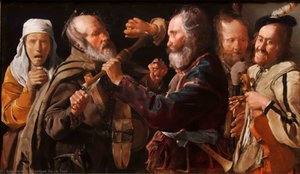
Georges de La Tour's 'The Beggars’ Brawl' (1620) captures a tense scene of urban conflict with dramatic chiaroscuro lighting. Explore this Baroque masterpiece depicting poverty, dispute, and human drama – a captivating work of art.
Biografija umetnika
Georges de La Tour (1593-1652): Francoski barokni mojster dramatične svetlobe in senc. Raziskujte očarljive krščanske prizorje, osvetljene notranjihosti kot "Predvidatelj sreče" ter njegovo trajno dediščino.
O sliki
A Shadowed Tableau: Unveiling Georges de la Tour’s ‘The Beggars’ Brawl’
Georges de la Tour’s “The Beggars’ Brawl,” painted in 1620, isn't merely a depiction of a street scene; it’s a meticulously crafted exploration of human nature bathed in the dramatic chiaroscuro that defined his signature style. This intimate canvas, measuring just 33 x 55 cm, transports us to a dimly lit corner of 17th-century Lorraine, a world where poverty and desperation simmer beneath a veneer of uneasy truce. The painting immediately arrests the eye with its masterful use of light – a single, almost theatrical lantern illuminating the central figures while plunging the surrounding space into deep shadow. This technique, characteristic of Tenebrism, isn’t simply an aesthetic choice; it serves to heighten the drama and focus our attention on the intense interaction unfolding before us.

A Study in Human Condition: Symbolism and Narrative
At the heart of the scene stands a man, identifiable by his prominent beard and animated gestures, holding what appears to be an object – perhaps a coin or a piece of food – that fuels the dispute. His face is etched with a mixture of anger and desperation, mirroring the expressions of those around him. The other figures—a collection of beggars, their clothing ragged and worn—are caught in a moment of intense confrontation. The bowl on the right side of the painting isn’t just a prop; it suggests a shared hardship, a communal reliance on meager resources. It speaks to a society where survival was often precarious, and even the simplest interactions could escalate into conflict. The inclusion of a drum-beater further emphasizes the chaotic nature of the gathering – a signal for attention, perhaps a call to action or simply a desperate attempt to draw sympathy.
The Master’s Technique: Chiaroscuro and Baroque Realism
Georges de la Tour was a master of light and shadow, meticulously rendering textures and forms with an almost photographic realism. He achieved this through painstaking layering of thin glazes of oil paint, building up the image gradually to create a sense of depth and volume. Notice how he captures the sheen of wet clothing, the roughness of weathered skin, and the subtle folds in the fabric. His use of color is restrained – predominantly browns, ochres, and blacks—further enhancing the dramatic effect. De la Tour’s work represents a departure from the idealized representations common in earlier Renaissance art; instead, he presents a raw and unflinching portrayal of everyday life, capturing not just appearances but also the underlying emotions and tensions of his subjects.
Historical Context: Lorraine in Transition
“The Beggars’ Brawl” was painted during a period of significant social and political upheaval in France. The Duchy of Lorraine, then under French control, experienced a complex interplay of religious fervor, economic hardship, and political instability. De la Tour's work reflects this atmosphere, offering a glimpse into the lives of those marginalized by society – the poor, the dispossessed, and the forgotten. The painting’s setting in Lunévi, a small town within Lorraine, adds to its authenticity, grounding the scene in a specific time and place. It’s important to note that de la Tour's artistic career unfolded largely outside of Paris, allowing him to develop a distinct style influenced by both Northern European traditions (particularly the Dutch Caravaggisti) and the spiritual intensity of his own region.
Bringing ‘The Beggars’ Brawl’ Home: A Reproduction for Your Space
TopImpressionists offers meticulously crafted hand-painted reproductions of “The Beggars’ Brawl,” allowing you to experience the power and beauty of de la Tour's masterpiece in your own home. Our skilled artists replicate every detail, from the subtle nuances of light and shadow to the expressive faces of the figures, ensuring an authentic representation of this iconic work. Available in a range of sizes and mediums – including fine art prints on premium canvas or archival paper – our reproductions provide a stunning addition to any collection. Explore our selection today and bring the drama and emotional depth of “The Beggars’ Brawl” into your space.
Vprašanja in odgovori
Pri katerih letih je Žanikanje Svetega Petra ustvaril/a "The Beggars' Brawl"?
Ko je bilo delo "The Beggars' Brawl" ustvarjeno leta 1620, je bil Žanikanje Svetega Petra – rojen leta 1593 – star 27 let.
S katero tehniko je bila izdelana skladba "The Beggars' Brawl" avtorja Žanikanje Svetega Petra?
Žanikanje Svetega Petra je za delo "The Beggars' Brawl" uporabil/a tehniko Oil On Canvas. Ta tehnika opredeljuje materialno naravo izvirnega dela.
Kakšna barvna paleta je uporabljena v delu "The Beggars' Brawl" avtorja Žanikanje Svetega Petra?
Paleta dela "The Beggars' Brawl" avtorja Žanikanje Svetega Petra je opisana kot Earthy, kar predstavlja jedinkaven povzetek barv v tem delu.
Hitri podatki in kviz o umetnosti
O Žanikanje Svetega Petra

Žanikanje Svetega Petra
1593 - 1652, Francija
Biografija umetnika
Georges de La Tour (1593-1652): French Baroque Master of Dramatic Chiaroscuro & Tenebrism
Georges de La Tour, a name that resonates with the hushed reverence reserved for masters of light and shadow, remains one of the most compelling figures of the French Baroque. Born in 1593 in Vic-sur-Seille, a small town nestled within the Duchy of Lorraine, his life unfolded against a backdrop of religious fervor and political upheaval. While details surrounding his early training remain somewhat elusive—scholars speculate about potential journeys to Italy or apprenticeships with local artists like Jacques Bellange—the seeds of his artistic vision were undoubtedly sown in this environment. He wasn’t born into an artistically established family; his father was a baker, yet the circumstances of his mother's lineage hint at a possible connection to nobility, a subtle influence perhaps reflected in the dignity and quiet grace that permeate his work.
Early Life & Artistic Influences
Georges de La Tour’s formative years were marked by the turbulent political landscape of Lorraine under Habsburg rule. Despite limited formal education—he reportedly received instruction from Jacques Bellange—his innate talent for drawing quickly emerged, demonstrating an exceptional sensitivity to observation and form. Crucially, he absorbed the artistic currents circulating throughout Europe during his youth, notably the dramatic innovations championed by Caravaggio in Rome. This encounter with Caravaggism profoundly shaped De La Tour’s aesthetic sensibilities, instilling him with a fascination for tenebrism—the technique of employing extreme contrasts between light and dark to heighten emotional impact.
The Utrecht School & Venetian Tradition
De La Tour's artistic development continued in Lunéville, where he served as court painter to the Dukes of Lorraine. Here, he honed his skills alongside fellow artists from the Utrecht School—Hendrick Terbrugghen and Johannes Vermeer—who embraced a similar approach to chiaroscuro, prioritizing psychological realism over idealized beauty. Simultaneously, De La Tour drew inspiration from Venetian painters like Tintoretto and Paolo Veronese, whose opulent compositions celebrated grandeur and theatrical spectacle. These influences blended seamlessly into his distinctive style, resulting in paintings that are both emotionally resonant and visually arresting.
Major Works & Recurring Themes
Georges de La Tour’s oeuvre is characterized by a remarkable consistency of vision—a preoccupation with religious subjects rendered with unparalleled subtlety and psychological depth. His most celebrated works include The Fortune-Teller, painted around 1630, which captures the eerie atmosphere of nocturnal divination with masterful lighting and expressive detail; Adoration of the Shepherds, created circa 1640, depicting a serene biblical scene imbued with profound spiritual contemplation; Saint Joseph Carpenter, completed in the mid-1650s, portraying a humble domestic tableau illuminated by candlelight—a poignant symbol of faith and domestic tranquility. These paintings aren’t merely depictions of sacred narratives; they are meditations on human experience—exploring themes of piety, humility, grief, and redemption.
Legacy & Enduring Appeal
Despite achieving recognition during his lifetime—he was appointed “Painter to the King” by Louis XIII in 1638—Georges de La Tour’s work remained largely obscure for centuries following his death in 1652. Rediscovery efforts spearheaded by scholars like Hermann Voss brought De La Tour back into focus, revealing an artist of extraordinary originality and innovation. His pioneering use of tenebrism—combined with his profound psychological insight—established him as a pivotal figure in the history of European art. Today, Georges de La Tour’s paintings continue to captivate audiences worldwide—testament to their timeless beauty and enduring relevance. They serve as reminders that true artistic greatness resides not in flamboyant display but in quiet contemplation—illuminating the human condition with the luminous grace of faith.
Kratek pregled o Žanikanje Svetega Petra
- Artistic Movement Or Style: Tenebrism
- Artists Who Influenced This Artist:
- Caravaggio
- Hendrick Terbrugghen
- Date Of Birth: March 13, 1593
- Date Of Death: 1652
- Full Name: Georges de La Tour
- Nationality: Francoz
- Notable Artworks:
- The Fortune Teller
- Adoration of Shepherds
- Saint Joseph Carpenter
- Place Of Birth: Vic-le-Comte, France
Raziščite umetniška dela, razvrščena po temah, slogih in značilnostih.


Žanikanje Svetega Petra
The Beggars' Brawl
() ·
Vključno z okvirjem: · Ročno slikano z oljem na platnu
Skupni znesek