


 Preverite v realnem okolju
 Pošlji kot čestitko
 Deli
Deli
 Podrobnosti
 Priročnik

 Prenesi
 Podobni artefakti
 Rentgenski posnetek
 Predvajaj diaporama
 Statistika
Venice

Discover James Holland’s ‘Venice’ watercolor – a serene canal scene with Venetian architecture & a framed painting. Explore this romantic Impressionistic artwork.
A master of Romantic landscapes and Venice scenes. Discover the exquisite watercolours and oils of James Holland today.
 Preberi več
Kupite digitalno sliko visoke ločljivosti z izboljšano kakovostjo, ki je precej višja od spletnega predogleda.
Vsako datoteko naše strokovnjake v ekipi z največjo mero natančnosti pripravijo z uporabo naprednih orodij in strokovne ročne obdelave. Zagotovimo, da je vsaka slika izjemno jasna, barvno natančna in polna finih podrobnosti.
Končna datoteka je po e-pošti dostavljena v 72 urah, optimizirana za takojšnjo uporabo v profesionalnem, uredniškem in tiskarskem okolju. To je kakovost, ki ji zaupajo vrhunska oblikovalna studia, založniki in galerije.
Digitalna slika
Prenesite datoteko visoke ločljivosti za osebno uporabo, tiskanje in kreativne projekte. ( Preklop na tiskanine Naročite ročno slikano reprodukcijo)
Vključeno v vsako naročilo digitalne slike
Zagotovljena strokovna digitalna dostava
Z izbiro TopImpressionists.com ne prejmete le slike – prejmete profesionalno urejeno digitalno umetniško delo, izdelano z največjo natančnostjo in zavestno podprto z garancijo za zadovoljstvo. Tukaj je vse, kar bo z vašim naročilom samodejno priloženo:

Hitra dostava po e-pošti
Vaša digitalna slika visoke ločljivosti bo na vaš e-naslov poslana v roku 72 ur od zaklopa naročila – pripravljena za takojšnjo uporabo.

Digitalna datoteka z uporabo AI
Vaše umetniško delo je strokovno optimizirano z uporabo naprednih orodij umetne inteligence in ročne obdelave, kar zagotavlja največjo stopnjo podrobnosti, jasnosti in barvne natančnosti.

Brezplačna doletna ponovna dostava
Ste datoteko zaradi nespremietne napake izgubili ali izbrisali? Ni težav – vam jo bomo ponovno poslali kadar koli in brezplačno.

Brez uvoznih pristojbin – vedno
Svoje umetniško del uživajte takoj, brez carin, davkov ali stroškov dostave – digitalni prenosi so vedno brezdavčni.

Zagotovilo natančnosti barv
Z uporabo profesionalnih orodij in procesov upravljanja barv zagotavljamo, da vaša digitalna slika čim bolj natančno odraža prvotne barve.

100-dnevna garancija zadovoljstva
Če niste zadovoljni s svojo digitalno sliko, jo bomo uredili ali vam v 100 dneh povrnili 100% denarja – brez kakršnih koli vprašanj.

100% Garancija povračila denarja
Niste zadovoljni? Zagotavljamo vam popoln povračilo sredstev v 100 dneh po prejemu digitalne datoteke – brez dodatnih vprašanj.

Popusti pri večjih naročilih
Kupite 3 slike, prihranite 10% - Kupite 5 slik, prihranite 15% - Kupite 10+ slik, prihranite 20%. Odlično za kreativne projekte, galerije in agencije.
Sorodna umetniška dela




Biografija umetnika
The Potter's Precision
To understand the technical rigor of James Holland, one must look past the finished landscapes and toward the industrial grit of his beginnings in Burslem, Staffordshire. He did not emerge from a vacuum of pure theory; he was trained by the repetitive, exacting demands of the Davenport Pottery works. From age twelve, his hands were occupied with painting flowers onto porcelain and pottery. This early apprenticeship instilled a specific discipline regarding color and fine detail that remained present even when he transitioned to much larger canvases. He moved to London in 1819, carrying this decorative precision into a new arena of landscape and marine subjects.
His development was marked by a shift from the small-scale botanical accuracy required for ceramics to the broader atmospheric needs of topographical painting. While he continued to work as a pottery painter to sustain himself, his focus expanded toward architecture and natural history. By 1824, his first exhibition at the Royal Academy signaled that his skills were no longer confined to the surface of a teacup. He was a versatile practitioner, equally capable in oils and watercolours, a fact reflected in his prolific exhibition record across various prestigious societies.
Continental Sightings and Technical Shifts
Holland’s reputation was built on his ability to document the European landscape with structural integrity. His travels were not mere sightseeing; they were systematic studies of light and architecture. Between the 1830s and 1850s, he moved through France, Portugal, Switzerland, Austria, and the Netherlands. These excursions provided the raw material for his most recognized works. In France, specifically during visits to Rouen, he focused on architectural studies that demanded a sharp eye for form. His time in Portugal resulted in published works like The Tourist in Portugal, proving his utility as both an artist and a visual chronicler of the era.
His style underwent a visible transformation over the decades. The early watercolours, heavily influenced by the approach of Richard Parkes Bonington, possessed a certain delicate clarity. However, as time progressed, his technique became looser. He began to utilize bodycolour more extensively, moving away from purely transparent washes toward a more substantial, textured application. This shift allowed him to capture the heavier atmosphere of marine scenes and the complex light of Italian vistas with greater weight.
The Venetian Record
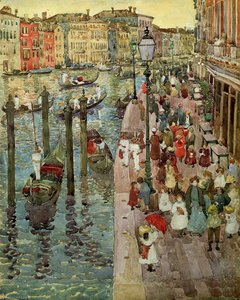
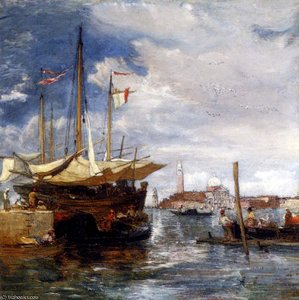
Venice remains the most significant anchor in his body of work. It was not a single visit but a recurring obsession that defined much of his later career. He returned to the city multiple times, notably in 1836, 1857, and throughout the mid-century, finding in its canals a subject that demanded both architectural precision and an understanding of light refraction. His depictions of the Grand Canal and Saint Mark's Basin demonstrate a mastery of the Venetian atmosphere, capturing the movement of gondolas and the play of sun on water without descending into mere sentimentality.
His professional standing was solidified through his involvement with major institutions:
- Royal Watercolour Society: He served as an associate in 1835 and achieved full membership by 1857 or 1858.
- Society of British Artists: He joined this group in 1843, remaining a member until 1848.
- Royal Academy: He exhibited thirty-two works here between 1824 and 1865.
- British Institution: His contributions reached ninety-one pieces at this venue.
Ultimately, Holland’s significance lies in his ability to bridge the gap between the meticulous decorative arts of the Potteries and the expansive, atmospheric demands of Victorian landscape painting. He was a colourist of high caliber, producing works that, while sometimes overlooked during his lifetime, gained substantial value as collectors sought the specific clarity he brought to continental views.

James Holland
1799 - 1870
Kratek pregled
- Artistic Movement Or Style: Romantic Landscape Painting
- Artists Who Influenced This Artist: ['Richard Parkes Bonington']
- Full Name: James Holland
- Nationality: English
- Notable Artworks:
- The Grand Canal, Venice
- Greenwich Hospital as it was in 1837
- Venetian Capriccio
- The Colonnade of Queen Mary Court
- Place Of Birth: Burslem, United Kingdom
- Date Of Birth: 1799
- Date Of Death: 1870