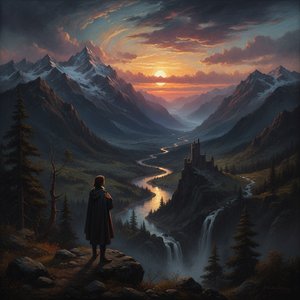
Evening Landscape with Two Men – A Meditation on Solitude and Transcendence
Caspar David Friedrich’s “Evening Landscape with Two Men,” painted in 1824, stands as a quintessential emblem of Romantic landscape painting—a genre defined by its profound engagement with emotion and the sublime. More than just a depiction of a serene twilight scene, this artwork embodies a deeper philosophical inquiry into humanity's relationship with nature and the spiritual realm.
The painting captures a solitary forest at dusk; towering trees dominate the composition, their dark silhouettes punctuated by patches of diffused light filtering through the clouds. Two figures—presumably men—stand on a rocky outcrop overlooking the vista, positioned deliberately to emphasize the vastness of the landscape and the insignificance of human presence against its grandeur.
- Style: Friedrich’s style is characterized by meticulous detail combined with an expressive handling of paint. He eschewed academic conventions in favor of conveying mood and emotion rather than precise topographical accuracy.
- Technique: Employing oil paints on canvas, Friedrich utilized a layering technique—known as glazing—to build up tonal gradations and create atmospheric depth. This method allowed him to capture the subtle nuances of light and shadow, imbuing the scene with an ethereal quality.
Historical Context – The Romantic Spirit
“Evening Landscape with Two Men” emerged during a period of significant intellectual ferment in Germany—the Romantic era (roughly 1790-1840). Philosophers like Kant and Hegel championed the idea that reason alone could not comprehend the mysteries of existence, advocating instead for intuition and emotion as pathways to spiritual understanding. Friedrich’s art reflects this ethos, prioritizing subjective experience over objective observation.
The painting aligns perfectly with Romantic ideals—particularly the concept of “the sublime”—which posits that confronting overwhelming beauty or terror can elevate the human spirit and inspire awe. The desolate yet majestic forest serves as a metaphor for the inner landscape of contemplation and introspection, inviting viewers to contemplate their own mortality and find solace in the grandeur of nature.
Symbolism – Trees as Representations of Eternity
Trees hold profound symbolic significance within Friedrich’s oeuvre—and indeed, throughout Western art history. They represent resilience, permanence, and connection to the divine—symbols that resonate powerfully with Romantic sensibilities. In “Evening Landscape,” the towering trees symbolize not merely physical presence but also spiritual fortitude.
The solitary figures gazing upon the landscape underscore the importance of solitude as a catalyst for self-discovery. Friedrich’s intention wasn't simply to depict a picturesque scene; he sought to provoke contemplation and inspire viewers to confront existential questions about life, death, and transcendence.
Emotional Impact – Tranquility Amidst Vastness
"Evening Landscape with Two Men" evokes a palpable sense of tranquility mingled with melancholy—a feeling that is characteristic of Friedrich’s artistic vision. The muted palette—dominated by shades of gray and brown—contributes to the painting's contemplative atmosphere, mirroring the stillness of twilight.
Ultimately, this artwork transcends mere visual representation; it invites viewers into a dialogue about the human condition—a reminder that amidst the immensity of existence, there is beauty, solace, and an enduring connection to something greater than ourselves. It’s a piece designed to linger in the mind long after viewing, prompting reflection on themes of spirituality, solitude, and the sublime.



 Pregledaj u prostoru
 Kupi print
 Pošalji
 Podeli
 Detalji o delu

 Преузми
 Slični predmeti
 Rendgenski snimak
 Slajdovi
 Pročitaj više






































 Opcija sa staklom dostupna je samo za dimenzije manje od 110 cm