

Shown: · With its frame:
 Pregledaj u prostoru
 Pošalji
 Podeli
 Detalji o delu
 Vodič
Vodič

 Preuzmi
 Slični predmeti
 Rendgenski snimak
 Automatska prezentacija
 Q&A
Q&A Statistika
 Acrylic On Canvas
- WallArt
- Early Renaissance
 1268
1268- Renaissance
 45.0 x 28.0 cm
 San Domenico
дин 30438
Ručno rađena uljana reprodukcija
Ručno oslikano uljanim bojama na platnu u dimenzijama i okviru po vašem izboru, izrađeno po porudžbini od strane naših umetnika. ( Pređi na štampu Pređi na digitalnu sliku)
Size
·Standardne dimenzije
po meri
CM
INCH
Izaberite jednu od naših unapred definisanih veličina koje odgovaraju originalnim proporcijama umetničkog dela.
Loading sizes...

širina
visina
Unesite potrebnu širinu i visinu kako bi se slika uklopila u vaš ram ili zid. Pošto je ovo ručno oslikano delo, umetnik može za dimenzije drugačijeg oblika naslikati malo više prostora oko slike ili malo skratiti ivice — izbor je na vama. Pre početka rada, poslaćemo vam digitalni prikaz radi potvrde. Slika prikazana na ovoj stranici ne predstavlja konačan rezultat — samo digitalni prikaz pokazuje stvarnu sliku.
 Pročitajte više
Finish
·
White дин1

Blurside дин1

Extended дин1

P118B дин10

P118H дин10

P118W дин10

P438Z дин10

P508JH дин12

P508YH дин12

P805H дин10

P805Z дин10

P919BZ дин10

P919G дин10

P919XJ дин10

P959ZH дин10

P968JZ дин12

W106C дин8

W218G дин10

W218JH дин8

W218Y дин10

W307PJ дин10

W316G дин10

W316PJ дин8

W316Y дин10

W398PJ дин8

W4111J дин10

W500HY дин15

W500JH дин15

W692G дин12

W849H дин8

W940BG дин15

W953PJ дин8

H24-GOLD дин30

H24-SILVER дин30

H36-GOLD дин45

H36-SILVER дин45
Shipped in a protective tube, ready for your own framer.
Above 105 cm the frame is shipped as a kit for a professional framer — read the details.
Extras
optionalWhat do the extras include?
Examples of what can be changed: Replace face with customer photo; Add pet (e.g., replace cat with dog); Include hidden message in background; Change background landscape or elements.
After order, TopImpressionists.com team will email client for instructions and provide a mockup preview
After order, TopImpressionists.com team will email client for instructions and provide a mockup preview
Svetska isporuka () za 3/4 nedelje umesto uobičajenih 5 nedelja. (29 октобар). Bez kompromisa po pitanju kvaliteta.
Zaštitni lak
Kratki opis natpisa
Detalji gravirane bronze ploče
This elegant plaque features the artist's name and the title of the artwork, finely engraved for a timeless presentation.
It is made from bronze with a refined, elegant finish. The text is precisely laser-engraved for a sharp and permanent result. Measuring 9x2 cm, the plaque is compact yet easy to read. It's built to be durable and scratch-resistant, offering a professional, museum-quality look. Mounting is simple thanks to the included adhesive backing.
Detalji prozirne akrilne pločice
The plaque includes essential engraved details such as the artist's name, the title of the artwork, the date it was created, the type of media used-like oil on canvas or watercolor-a brief description of the piece, and a QR code that links to the complete artwork information.
It is crafted from clear acrylic, offering a sleek, modern appearance. The text is UV-engraved in black to ensure strong visual contrast. With a size of 10x15 cm, it ensures optimal readability. It comes equipped with two metal hooks for secure wall mounting. The plaque is designed to be weather-resistant, making it suitable for various environments, and it includes interactive features that work seamlessly with smartphone scanning.
Detalji crne akrilne pločice
This elegant plaque includes engraved information such as the artist's name, the title of the artwork, the date it was created, the type of media used (like oil on canvas or watercolor), a short description of the artwork, and a QR code for quick access to more information.
The plaque itself is made from refined black acrylic with a premium finish. The text is laser-engraved in white for high contrast and readability. Its size is 10x15 cm, designed to be easy to read. It comes with two metal hooks for professional mounting. The design is sleek and fits any interior style. It is also weather-resistant and durable, with built-in digital integration for mobile compatibility.
Opcija sa staklom dostupna je samo za dimenzije manje od 110 cm
 Opcija sa staklom dostupna je samo za dimenzije manje od 110 cm
- Besplatna ekspresna dostava širom sveta
- Visokokvalitetno laneno platno
- Potpuno osiguranje transporta
- Garancija povraćaja carine i uvoznih dažbina
- Garancija vernosti boja
- Politika povraćaja u roku od 100 dana (samo u slučaju nedostataka)
- Garancija povrata 100% novca
- Popust na više proizvoda


Opis predmeta
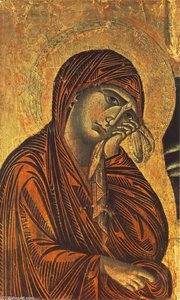
Explore Cimabue’s ‘Crucifix (detail)’ – a poignant 1268 panel painting showcasing early Renaissance emotion & technique. Discover its layered impasto, halo effect, and profound sorrow.
Biografija umetnika
Florence Italy Cimabue Giovanni Cimabue, Cenni di Pepo, Cenni di Pepi Cimabue (c. 1240-1302): Preteča italijanske renesanse! Istražite njegovu kombinaciju bizantskog i renesansnog stila, realistične figure i uticaj na Giotta. Otkrijte remek-dela sada! Bizantski & Renesansni Giotto Giunta Pisano c. 1240 1302 Giovanni Cimabue Italijanski Maestà Romaneski i gotski 2 Cimabue se smatra k
About the painting
A Glimpse into Divine Sorrow: Cimabue’s *Crucifix (detail)*
This exquisite detail from Cimabue's larger *Crucifix* (circa 1268) offers a profoundly moving encounter with the Virgin Mary and infant Jesus. Painted during a pivotal moment in art history, this work transcends mere religious iconography to become a powerful expression of maternal grief and spiritual contemplation. It’s a piece that resonates across centuries, offering both artistic beauty and emotional depth.Historical Context & Artistic Transition
Cimabue – or *Cenni di Pepo* as he was known – stands at the cusp of the Italian Renaissance. He was one of the first artists to actively move away from the rigid conventions of the Italo-Byzantine style, which had dominated Italian painting for generations. While still exhibiting elements of Byzantine formality—note the gold halo and stylized drapery—Cimabue infused his work with a nascent naturalism. This is visible in the attempt to render more lifelike proportions and introduce subtle shading, paving the way for artists like Giotto, who would fully embrace Renaissance ideals. The artwork originates from Florence, Italy, a city rapidly becoming a center of artistic innovation. Originally created for the church of San Francesco in Pisa, it now resides at the Barts Hospital in London.Subject & Symbolism
The detail focuses intensely on the Madonna and Child. Mary cradles the infant Jesus, her expression one of profound sorrow and premonition. This isn’t a joyful depiction of motherhood; rather, it foreshadows the suffering to come – Christ's Passion and crucifixion. Key symbolic elements amplify this emotional weight:- The veil draped over Mary’s head signifies her purity and modesty, traditional attributes associated with the Virgin.
- Her downcast gaze is a powerful visual cue of grief, sorrow, and acceptance of her son's destiny.
- The gold halo surrounding both figures denotes their holiness and divine status.
Technique & Materials
Cimabue masterfully employed tempera paint on a gesso-prepared wood panel. This technique, common in the period, involved layering pigments mixed with egg yolk to create luminous colors. The artist’s skillful use of impasto – applying thick layers of paint – is particularly evident in the folds of Mary's cloak and her skin tones, adding a tactile quality and enhancing the sense of volume. Despite its age, the artwork retains a remarkable vibrancy thanks to the enduring qualities of tempera and the inclusion of gold leaf for highlights. The shallow perspective and limited atmospheric depth are characteristic of panel painting from this era.Emotional Impact & Aesthetic Qualities
The overall effect is one of solemnity, piety, and profound emotional resonance. Cimabue doesn’t simply depict a religious scene; he invites the viewer to share in Mary's sorrow and contemplate the weight of faith and sacrifice. The warm earthy tones – ochre, terracotta, and gold – create a rich, aged aesthetic that evokes a sense of timelessness. While not striving for photorealistic detail, Cimabue’s stylized approach imbues the figures with a dignified grace and emotional power. This *Crucifix (detail)* is more than just an artwork; it's a window into the spiritual world of medieval Italy and a testament to the enduring power of human emotion. It would be a stunning focal point in any collection, adding depth and historical significance to both classic and contemporary interiors.Pitanja i odgovori
Kolika je percepcija osvetljenosti dela „Crucifix (detail)”, autor Кимбаве?
Sveukupno, "Crucifix (detail)" je zabeležen kao balanced. Percepcija osvetljenosti opisuje koliko delo deluje svetlo ili tamno.
Gde mogu pronaći statistiku o delu „Crucifix (detail)”, autor Кимбаве?
Stranica Statistika za delo „Crucifix (detail)”, autor Кимбаве prikazuje statistiku javnih poseta: mesečni broj poseta ovom umetničkom delu, poređenje sa najgledanijim radovima ovog umetnika i poreklom posetilaca.
Koja boja najviše dolazi do izražaja u delu "Crucifix (detail)"?
Dominantna boja dela „Crucifix (detail)”, autor Кимбаве je Clay (#a8713a).
Quick facts and art quiz
About Кимбаве

Кимбаве
1240 - 1302, Italija
Biografija umetnika
Cimabue: Grandfather of the Italian Renaissance
Giovanni Cimabue, born Cenni di Pepo around 1240 in Florence, stands as a monumental figure—a bridge between the established artistic traditions of the Byzantine world and the burgeoning innovations that would define the Italian Renaissance. His life, though partially obscured by time and romanticized accounts – most notably those penned by Giorgio Vasari centuries later – marks an undeniable turning point in Western art history. Cimabue wasn’t simply a painter; he was a courageous innovator who dared to subtly challenge artistic conventions, laying the groundwork for the revolutionary changes that would soon sweep across Italy. Even his nickname, believed to mean “bull-headed,” hints at a strong will and perhaps a rebellious spirit—qualities demonstrably present in his willingness to experiment with form and expression. He represents a crucial moment where art began to shift from being solely devotional imagery towards something more humanistic and emotionally resonant.Early Influences and Artistic Development
Initially immersed in the Italo-Byzantine style prevalent throughout Florence, Cimabue’s early work adhered closely to established aesthetic principles: flattened figures adorned with shimmering gold leaf, symbolic rather than realistic depictions of space, and a profound focus on religious iconography. However, even within these constraints, a nascent desire for naturalism began to emerge. He wasn't content merely replicating existing forms; he sought to imbue his paintings with a greater sense of life and emotional depth. While the precise nature of his early training remains debated, it’s likely he honed his skills within Florentine workshops, absorbing the techniques and influences of the time while simultaneously developing his own unique artistic voice. The Byzantine style, characterized by its formality and spiritual focus, provided him with a solid foundation, but Cimabue began to subtly introduce elements that would foreshadow the coming Renaissance—a greater attention to volume, more expressive facial features, and a nascent understanding of spatial relationships. This wasn’t a sudden break from tradition, but rather a gradual evolution, a delicate balancing act between honoring the past and embracing new possibilities.The Maestro's Vision: Giotto and Beyond
Despite Cimabue’s untimely demise in 1302—leaving behind scant biographical details—his influence on subsequent generations of artists is undeniable. Most notably, he mentored Giotto di Bondone, arguably the first true Renaissance Master. Vasari recounts a legendary tale – one that captures the spirit of their relationship – wherein Cimabue playfully painted a fly onto Giotto’s face, symbolizing his surpassing brilliance. This anecdote underscores not only Cimabue's generosity as a teacher but also the dynamic tension between mentor and pupil—a rivalry fueled by mutual respect and culminating in Giotto’s triumph over his predecessor. Cimabue’s artistic innovations extended beyond Giotto’s training; he challenged the conventions of his time, demonstrating that art could transcend mere symbolism and express profound human emotion. His willingness to experiment with form, proportion, and color paved the way for the groundbreaking achievements of the Renaissance—establishing him as a pivotal transitional figure in Western art history.Notable Works: A Legacy of Innovation
Cimabue’s artistic output is characterized by remarkable stylistic diversity, reflecting his evolving understanding of artistic principles throughout his career. The *Maestà*, commissioned for the Church of San Francesco in Pisa around 1280, stands as a testament to Cimabue's mastery of composition and color—a bold departure from the rigid Byzantine aesthetic that dominated earlier medieval painting. Unlike its predecessors, the *Maestà* achieves a palpable sense of depth and volume, conveying an emotional resonance previously absent from devotional art. The figures are rendered with meticulous detail, capturing subtle nuances of expression and embodying a newfound appreciation for human anatomy. This monumental altarpiece signaled Cimabue’s embrace of Renaissance ideals—a shift toward naturalism and psychological realism that would profoundly reshape the artistic landscape of Italy. Similarly impressive is *The Crucifixion*, executed circa 1270 for the Basilica of San Domenico in Arezzo. Cimabue's depiction of Christ on the cross represents a decisive step away from Byzantine conventions—characterized by stylized figures and distant perspectives. The artist skillfully employs shading to imbue the crucified figure with flesh-like plasticity, conveying the agony of suffering with remarkable sensitivity. Furthermore, Cimabue’s masterful use of color enhances the dramatic impact of the scene—creating a visual experience that transcends mere representation and engages the viewer emotionally. Finally, Cimabue's contribution to Florentine art is cemented through his involvement in the decoration of the Baptistery of Florence – specifically the mosaic depicting Saint John the Evangelist completed between 1301 and 1302. This monumental artwork exemplifies Cimabue’s artistic prowess as a mosaicist—demonstrating his ability to integrate intricate geometric patterns with vibrant colors—creating a visually stunning masterpiece that continues to inspire awe and admiration centuries later. Cimabue's legacy endures not merely as an artist but as a catalyst for change—a visionary who ushered in the dawn of the Renaissance, forever altering the course of Western art history.Quick facts about Кимбаве
- Artistic Movement Or Style: Byzantine & Renaissance
- Artists Who Influenced This Artist:
- Giunta Pisano
- Coppo di Marcovaldo
- Date Of Birth: c. 1240
- Date Of Death: 1302
- Full Name: Giovanni Cimabue
- Nationality: Italian
- Notable Artworks:
- Maestà
- Crucifixion
- Flagellation of Christ
- Place Of Birth: Florence, Italy
Istražite umetnička dela organizovana prema temama, stilovima i karakteristikama.


Кимбаве
Crucifix (detail)
() ·
With its frame: · Hand-painted in oil on linen
Total