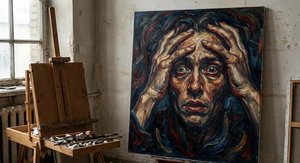
Selfportrait with skeleton
Franz Heinrich Louis Corinth’s “Selfportrait with Skeleton,” completed in 1896, stands as a haunting meditation on mortality and artistic introspection—a cornerstone of Expressionist art that continues to resonate with viewers today. This oil painting on canvas resides within the Lenbachhaus museum in Munich, Germany, offering visitors an intimate glimpse into Corinth’s personal vision during a pivotal moment in his career.
Corinth, born in Tepelero, Germany, in 1858, initially pursued naturalistic landscapes and portraits, influenced by Parisian Impressionism. However, he swiftly embraced the burgeoning Berlin Secession movement, spearheaded by Max Liebermann, marking a decisive shift toward exploring darker themes and emotionally charged compositions. This painting exemplifies Corinth’s mature style—a masterful synthesis of Impressionist luminosity with Expressionist angst.
The artwork depicts Corinth seated before a skeleton positioned behind him. The skeleton holds a skull on its shoulder, creating a stark juxtaposition between life and death. Corinth himself is rendered in meticulous detail, capturing the subtle nuances of his facial expression and posture—a deliberate choice reflecting the influence of Arnold Böcklin’s “Death Playing the Violin,” which Corinth had admired extensively. As Charlotte Berend-Corinth's catalog raisonné notes, Corinth aimed to convey "the artist in front of a large studio window," bathed in the diffused light characteristic of Impressionism.
Beyond its formal elements—the careful brushstrokes and balanced composition—“Selfportrait with Skeleton” carries profound symbolic weight. The skeleton serves as a traditional *Memento mori*, reminding us of the inevitability of death and prompting contemplation on the ephemeral nature of existence. Corinth’s inclusion of a studio window, mirroring Böcklin's motif, reinforces this theme, emphasizing the artist’s confrontation with mortality within his creative space.
The painting’s vibrant palette—dominated by muted blues and browns—contrasts sharply with the stark white of the skull, amplifying its impact. Corinth skillfully utilizes chiaroscuro – dramatic contrasts between light and shadow – to sculpt the figure and skeleton, conveying a palpable sense of vulnerability and solemnity. The meticulous rendering of textures contributes to the artwork’s emotional depth, inviting viewers to engage in a visceral experience of confronting mortality.
“Selfportrait with Skeleton” is more than just a depiction; it's an embodiment of Corinth’s artistic philosophy—a courageous exploration of existential anxieties infused with Impressionistic beauty. Its enduring presence in the Lenbachhaus collection ensures that this powerful image continues to inspire and provoke discussion about art, life, and death.



 Kupi štampu
 Pošalji
 Podeli
 Detalji o delu

 Преузми
 Slični predmeti
 Rendgenski snimak
 Slajdovi


 Pročitaj više






































 Opcija sa staklom dostupna je samo za dimenzije manje od 110 cm