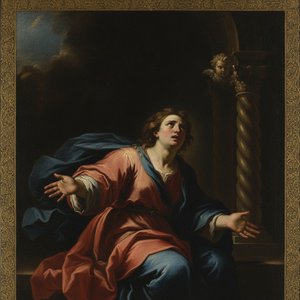
A Window Into Surrealist Consciousness
In the quiet, unsettling stillness of Giorgio de Chirico’s 1920 masterpiece, Self Portrait, we are invited to step beyond the veil of reality and into a dreamscape where time seems to have suspended its march. This oil on canvas is far more than a mere likeness of the artist; it is an arresting testament to the anxieties and intellectual explorations that defined the early 20th century. Through his signature Neo-Baroque style, De Chirico achieves a deliberate juxtaposition of classical grandeur and unsettling, dreamlike distortions, creating a work that functions as a profound meditation on the artist’s inner landscape and the fractured psyche of a post-war Europe.
The composition presents De Chirico himself, rendered with meticulous detail, yet he exists within a space that defies traditional logic. He stands against a backdrop of architectural elements reminiscent of Roman ruins, a choice that serves as a powerful symbol of Western civilization’s crumbling foundations. The presence of these classical columns, juxtaposed with the artist's modern presence, evokes a sense of nostalgia for a lost era while simultaneously highlighting the decay of established norms. This tension between the eternal and the ephemeral is central to the painting's emotional weight, pulling the viewer into a state of contemplative melancholy.
The Mastery of Neo-Baroque Technique
De Chirico’s technical approach is a masterclass in creating atmosphere through controlled precision. Eschewing the vibrant energy of his contemporaries, he employs a muted color palette dominated by somber ochres and ghostly grays, which lends the scene an eerie, nocturnal quality. The artist utilizes flattened perspectives and unsettling spatial ambiguities to manipulate the viewer's sense of depth, making the architecture feel both imposing and strangely unreachable. His brushstrokes are deliberate and disciplined, ensuring that every shadow and architectural edge contributes to a pervasive sense of psychological tension.
This technique does not merely depict a scene; it constructs an emotional environment. The stillness of the painting is almost palpable, an intentional silence that invites the observer to listen to the whispers of the subconscious. For collectors and interior designers, this piece offers a sophisticated focal point—a work that commands attention through its quiet intensity rather than through loud or garish displays. It provides a sense of intellectual depth to any space, acting as a conversation piece that bridges the gap between classical tradition and modern existentialism.
A Legacy of Philosophical Depth
To understand Self Portrait is to understand the intellectual ferment of its era. De Chirico’s vision was deeply informed by the philosophical currents of thinkers like Nietzsche and Schopenhauer, whose explorations of irrationality, human desire, and the subjective nature of reality provided the scaffolding for his artistic rebellion. The painting reflects a broader societal anxiety regarding modernity, questioning the stability of truth and inviting us to confront the unsettling shadows of our own existence.
For those seeking to bring a piece of art history into their personal or professional environments, this reproduction offers an opportunity to possess a fragment of the Surrealist revolution. It is a work that resonates with anyone drawn to the mysteries of the mind and the beauty found in the shadows. Whether placed in a curated gallery setting or a thoughtfully designed study, De Chirico’s vision remains a timeless invitation to explore the profound depths of human consciousness.



 Pregledaj u prostoru
 Kupi ručno naslikanu sliku
 Pošalji
 Podeli
 Detalji o delu

 Преузми
 Slični predmeti
 Rendgenski snimak
 Slajdovi


 Pročitaj više






































 Opcija sa staklom dostupna je samo za dimenzije manje od 110 cm