

Prikazano: · Sa okvirom:
 Pregledaj u prostoru
 Pošalji
 Podeli
 Detalji o delu
 Vodič
Vodič

 Preuzmi
 Slični predmeti
 Rendgenski snimak
 Automatska prezentacija
 Pitanja i odgovori
 Statistika
- 46.0 x 37.0 cm


дин 28219
Ručno rađena uljana reprodukcija
Ručno oslikano uljanim bojama na platnu u dimenzijama i okviru po vašem izboru, izrađeno po porudžbini od strane naših umetnika. ( Pređi na štampu Pređi na digitalnu sliku)
Veličina
·Standardne dimenzije
po meri
CM
INCH
Izaberite jednu od naših unapred definisanih veličina koje odgovaraju originalnim proporcijama umetničkog dela.
Učitavanje dimenzija...

širina
visina
Unesite potrebnu širinu i visinu kako bi se slika uklopila u vaš ram ili zid. Pošto je ovo ručno oslikano delo, umetnik može za dimenzije drugačijeg oblika naslikati malo više prostora oko slike ili malo skratiti ivice — izbor je na vama. Pre početka rada, poslaćemo vam digitalni prikaz radi potvrde. Slika prikazana na ovoj stranici ne predstavlja konačan rezultat — samo digitalni prikaz pokazuje stvarnu sliku.
 Pročitajte više
Završetak
·
Beli rub дин1

zamrljene ivice дин1

Prošireno дин1

P118B дин10

P118H дин10

P118W дин10

P438Z дин10

P508JH дин12

P508YH дин12

P805H дин10

P805Z дин10

P919BZ дин10

P919G дин10

P919XJ дин10

P959ZH дин10

P968JZ дин12

W106C дин8

W218G дин10

W218JH дин8

W218Y дин10

W307PJ дин10

W316G дин10

W316PJ дин8

W316Y дин10

W398PJ дин8

W4111J дин10

W500HY дин15

W500JH дин15

W692G дин12

W849H дин8

W940BG дин15

W953PJ дин8

H24-GOLD дин30

H24-SILVER дин30

H36-GOLD дин45

H36-SILVER дин45
Isporućuje se u zaštitnoj tubi, spremno za ugradnju u vaš ram.
Dodatne usluge
opcionoŠta dodatne opcije uključuju?
Primeri onoga što se može promeniti: Zamena lica fotografijom kupca; Dodavanje ljubimca (npr. zamena mačke psom); Uključivanje skrivene poruke u pozadini; Promena pejzaža ili elemenata u pozadini.
Nakon porudžbine, tim TopImpressionists.com će poslati imejl klijentu radi dobijanja uputstava i dostaviti prikaz makete
Nakon porudžbine, tim TopImpressionists.com će poslati imejl klijentu radi dobijanja uputstava i dostaviti prikaz makete
Svetska isporuka () za 3/4 nedelje umesto uobičajenih 5 nedelja. (11 новембар). Bez kompromisa po pitanju kvaliteta.
Zaštitni lak
Kratki opis natpisa
Detalji gravirane bronze ploče
This elegant plaque features the artist's name and the title of the artwork, finely engraved for a timeless presentation.
It is made from bronze with a refined, elegant finish. The text is precisely laser-engraved for a sharp and permanent result. Measuring 9x2 cm, the plaque is compact yet easy to read. It's built to be durable and scratch-resistant, offering a professional, museum-quality look. Mounting is simple thanks to the included adhesive backing.
Detalji prozirne akrilne pločice
The plaque includes essential engraved details such as the artist's name, the title of the artwork, the date it was created, the type of media used-like oil on canvas or watercolor-a brief description of the piece, and a QR code that links to the complete artwork information.
It is crafted from clear acrylic, offering a sleek, modern appearance. The text is UV-engraved in black to ensure strong visual contrast. With a size of 10x15 cm, it ensures optimal readability. It comes equipped with two metal hooks for secure wall mounting. The plaque is designed to be weather-resistant, making it suitable for various environments, and it includes interactive features that work seamlessly with smartphone scanning.
Detalji crne akrilne pločice
This elegant plaque includes engraved information such as the artist's name, the title of the artwork, the date it was created, the type of media used (like oil on canvas or watercolor), a short description of the artwork, and a QR code for quick access to more information.
The plaque itself is made from refined black acrylic with a premium finish. The text is laser-engraved in white for high contrast and readability. Its size is 10x15 cm, designed to be easy to read. It comes with two metal hooks for professional mounting. The design is sleek and fits any interior style. It is also weather-resistant and durable, with built-in digital integration for mobile compatibility.
Opcija sa staklom dostupna je samo za dimenzije manje od 110 cm
 Opcija sa staklom dostupna je samo za dimenzije manje od 110 cm
- Besplatna ekspresna dostava širom sveta
- Visokokvalitetno laneno platno
- Potpuno osiguranje transporta
- Garancija povraćaja carine i uvoznih dažbina
- Garancija vernosti boja
- Politika povraćaja u roku od 100 dana (samo u slučaju nedostataka)
- Garancija povrata 100% novca
- Popust na više proizvoda


Opis predmeta
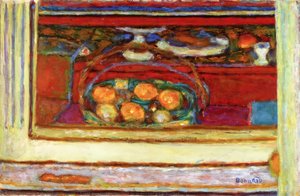
Experience Pierre Bonnard’s ‘Fruit Bowl’ (1914). A vibrant still life showcasing oranges, apples & bananas in his signature Impressionistic style. Hand-painted reproduction available.
Biografija umetnika
Pierre Bonnard je francuski impresionista poznat po svojim intimnim scenama i živim bojama koji su oblikovali umetnički stil Intimizma. Posmatrajte njegove ikonike slike poput "Ženu u kockastom haljotu"!
O slici
A Still Life of Quiet Intensity: Pierre Bonnard’s ‘Fruit Bowl’ (1914)
Pierre Bonnard's Fruit Bowl, painted in 1914, offers a poignant glimpse into the artist’s evolving approach to depicting domestic scenes. Measuring 46 x 37 cm, this intimate composition transcends a simple representation of fruit; it is a carefully constructed meditation on light, color, and the quiet beauty of everyday objects. Executed with Bonnard's signature meticulous brushwork and his masterful manipulation of tonal values, the painting speaks to a period of profound artistic experimentation within the Nabis group, of which he was a key member.
The Nabis Influence and Bonnard’s Palette
Bonnard's association with the Nabis – “The Prophets” – profoundly shaped his artistic vision. This group sought to create religious art through the use of color, drawing inspiration from Spanish mysticism and the works of William Morris. Fruit Bowl reflects this influence in its deliberate avoidance of academic realism. Instead of striving for photographic accuracy, Bonnard prioritized conveying atmosphere and emotion through a vibrant, almost hallucinatory palette. The dominant hues – rich oranges, deep reds, and muted greens – are not merely descriptive; they are imbued with symbolic weight, reflecting the Nabis’s interest in exploring spiritual themes through color.
- Color as Symbol: Bonnard's use of orange is particularly noteworthy. It evokes warmth, vitality, and perhaps even a hint of religious fervor, aligning with the Nabis movement’s exploration of spirituality.
- Tonal Modulation: The subtle shifts in tone – from the luminous highlights on the oranges to the darker shadows within the bowl – create a sense of depth and volume, drawing the viewer into the scene.
Composition and Technique – A Study in Detail
The composition of Fruit Bowl is deceptively simple yet remarkably effective. Bonnard’s close-up perspective forces the viewer to confront the individual elements—the oranges, apples, and banana—with a heightened sense of detail. His brushstrokes are visible, adding a textural quality that enhances the painting's tactile appeal. The arrangement of the fruit itself is not random; it suggests a carefully considered balance, reflecting Bonnard’s meticulous observation skills honed during his early work in caricature.
Historical Context and Emotional Resonance
Painted in 1914, just months before the outbreak of World War I, Fruit Bowl offers a poignant reflection on a world on the brink of upheaval. The painting’s serene subject matter – a commonplace scene transformed into something extraordinary through Bonnard's artistic vision – can be interpreted as a quiet resistance to the impending chaos. The work embodies Bonnard’s ability to find beauty and meaning in the ordinary, a characteristic that resonates deeply with viewers today. It evokes a sense of nostalgia for a simpler time, inviting contemplation on themes of domesticity, memory, and the fleeting nature of beauty.
A Timeless Masterpiece – Reproduction Options
TopImpressionists offers meticulously crafted hand-painted reproductions of Pierre Bonnard’s Fruit Bowl, ensuring that you can experience the full impact of this remarkable artwork. Each reproduction is created using traditional techniques and archival materials, guaranteeing its longevity and preserving the original painting's vibrant colors and exquisite detail. Whether for your home or office, a TopImpressionists reproduction of *Fruit Bowl* will be a timeless addition to any collection.
Pitanja i odgovori
Da li su boje dela "Fruit Bowl" intenzivne ili nežne?
„Fruit Bowl”, autor Пијер Боннар prikazuje Vivid intenzitet boja.
Da li je Пијер Боннар, autor dela "Fruit Bowl", poznat/a i pod drugim imenima?
Пијер Боннар se pojavljuje i pod drugim imenima: Пјер Огист Реноар, Боннар.
Da li je „Fruit Bowl”, autor Пијер Боннар svetlo ili tamno umetničko delo?
Sveukupno, "Fruit Bowl" je zabeležen kao bright. Percepcija osvetljenosti opisuje koliko delo deluje svetlo ili tamno.
Brze činjenice i kviz o umetnosti
O Пијер Боннар

Пијер Боннар
1867 - 1947, Франција
Biografija umetnika
Pierre Bonnard (1867-1947): A Life Bathed in Light
Pierre Bonnard, geboren 1867 in der Pariser Vorstadt Fontenay-aux-Roses, war kein Mann für ein Leben voller künstlerischer Ausdruckskraft. Sein Vater, ein hochrangiger Beamter im französischen Verteidigungsministerium, sah seinem Sohn eine juristische Karriere vor. Junge Pierre verfolgte diese Ausbildung ernsthaft und erhielt seinen Abschluss im Jahr 1888, doch sein Herz lag anders – in der faszinierenden Welt von Farbe und Form. Diese Dichotomie, dieser Spannungsbogen zwischen Erwartung und Leidenschaft würde subtil Einfluss auf seine künstlerische Reise haben und ihm eine einzigartige Nähe zu seinem Werk verleihen. Er begann zunächst mit Karikaturen und entwickelte damit eine Beobachtungsgabe, die später zu exquisit wiedergegebenen häuslichen Szenen aufblühte. Allerdings fand Bonnard in der Académie Julian seinen Weg und begegnete dort Gleichgesinnten, die sich von akademischen Konventionen abwanderten und den Avantgarde Geist einfuhren, der durch Paris zog. Diese Begegnung führte ihn zu den Nabis – einer Gruppe von Künstlern, darunter Maurice Denis, Paul Sérusier und Édouard Vuillard –, die Kunst mit Spiritualität und Symbolismus erfüllten und über reine Darstellung hinaus eine Erforschung innerer Erfahrung suchten.Die Nabi Jahre und die Pflege der Intimität
Die Zusammenarbeit mit den Nabis stellte Bonnards künstlerische Entwicklung entscheidend sicher. Die Gruppens Betonung von flachen Formen, kräftigen Farbpaletten und einer Ablehnung perspektivistischer Tradition resonierte tief in seinen künstlerischen Sensibilitäten. Inspiriert von japanischen Drucken – ihren eleganten Linien und harmonischen Kompositionen – und der Symbolismus Bewegung’s Erforschung subjektiver Emotionen entwickelte Bonnard seinen unverwechselbaren Stil weiter. Er interessierte sich nicht für große Erzählungen oder historische Allegorien; stattdessen wandte er sich innerlich zu und konzentrierte sich auf die ruhigen Momente des Alltagsliebes: Eine Frau beim Baden, eine Familie zum Abendessen versammelt, ein sonnenbeschienenes Gartenstück. Diese Szenen waren nicht nur Darstellungen von Ereignissen, sondern Destillationen von Gefühl – Erinnerungen und Atmosphäre gefiltert durch das Prisma persönlicher Erfahrung. Dieser Fokus auf häusliche Intimität erhielt ihm den Titel „Intimist“ – ein Begriff, der perfekt die emotionale Resonanz seines Werkes einfängt. Seine Gemälde erzählen nicht *was* dargestellt wird, sondern *wie* es sich anfühlt, präsent zu sein in diesen Momenten. Er arbeitete von Erinnerung aus und zeichnete umfassend auf und übersetzte diese Eindrücke dann mit außergewöhnlicher Sensibilität für Licht und Farbe auf die Leinwand.Farbe als Emotion: Ein Meister Farbist
Bonnards Meisterhafte Verwendung von Farbe ist zweifellos sein prägendstes Merkmal. Er verwendete Farbe nicht einfach; er *fühlte* sie, ließ sie den Ton und die Atmosphäre seiner Gemälde bestimmen. Seine Palette war lebendig und doch nuanciert und setzte oft unerwartete Kombinationen ein, die einen Eindruck von schimmernder Luminosität erzeugten. Er würde seine fertigen Leinwände wiederholt besuchen und korrigierte Farben über mehrere Werke hinweg, um perfekte Harmonie zu erreichen – ein Beweis für seine obsessive Hingabe zum chromatischen Gleichgewicht. Das ging nicht um eine realistische Darstellung; es ging darum, die subjektive Erfahrung von Farbe einzufangen – ihre Fähigkeit, Emotionen und Erinnerungen hervorzurufen. Er wandte sich von direkter Beobachtung ab und bevorzugte stattdessen das Malen aus der Erinnerung heraus, was ihm ermöglichte, seine Szenen mit einer traumhaften Qualität zu erfüllen. Seine Landschaftsbilder waren nicht nur Darstellungen von Orten, sondern emotionale Antworten darauf – gefiltert durch das Prisma persönlicher Erfahrung.Späteres Leben und Erblegende Bedeutung
Mit zunehmendem Alter verschob sich Bonnards künstlerischer Fokus noch stärker auf die Erforschung von Farbe und Licht. Er verbrachte immer mehr Zeit im südlichen Frankreich und ließ sich von der mediterranen Landschaft und ihrer intensiven Luminosität faszinieren. Seine Beziehung zu Marthe de Meligny, seiner Frau und lebenslangen Muse, blieb zentral für sein Leben und Werk. Sie erschien häufig in seinen Gemälden und wurde oft beim Baden oder bei alltäglichen Aktivitäten dargestellt – ihre Präsenz strahlte eine ruhige Anmut und Intimität aus. Im Jahr 1912 erwarb er „La Roulotte“ in Vernonnet, nahe Giverny, und gründete eine enge Freundschaft mit Claude Monet. Diese Nähe zum Meister des Impressionismus förderte Bonnards weitere Erforschung von Licht und Farbe weiter – obwohl er stets seinen eigenen unverwechselbaren künstlerischen Blick bewahrte. Er malte bis kurz vor seinem Tod im Jahr 1947 fort und hinterließ ein Werkkörper, das weiterhin fasziniert und inspiriert.Bekannte Werke & Sammlungen
- Frau in Schachbrettmuster (1890): Ein frühes Beispiel seines Nabi-inspirierten Stils, der flache Formen und kräftige Farbkompositionen zeigt.
- Das Esszimmer (1913): Eine quintessenzielle Intimist Szene, die Wärme und Intimität des häuslichen Lebens einfängt.
- Schüssel mit Früchten (ca. 1933): Demonstriert seine Meisterschaft der Stilllebenmalerei mit lebendigen Farben und einem Eindruck von lichtdurchfluteter Tiefe.
- Die Mandelbaumblüte (1947): Eines seiner letzten Gemälde, das kurz vor seinem Tod fertiggestellt wurde und seine kontinuierliche Erforschung von Farbe und Licht zeigte.
- Musée Marmottan Monet, Paris
- Kunstmuseum Chicago
- Museum of Modern Art, New York City
- Tate Modern, London
Kratke činjenice o umetniku Пијер Боннар
- Artistic Movement Or Style: Postimpresionizam, Intimizam
- Artists Or Movements Influenced By This Artist: ['Les Nabis']
- Artists Who Influenced This Artist:
- Paul Gauguin
- Hokusai
- Date Of Birth: 1867-10-03
- Date Of Death: 1947-01-23
- Full Name: Pierre Bonnard
- Nationality: Francuski
- Notable Artworks:
- Žena u kockastom haljotu
- Oraonica u cvjetu naranče
- Place Of Birth: Fontenay-aux-Roses, France
Srodna umetnička dela




Istražite umetnička dela organizovana prema temama, stilovima i karakteristikama.


Пијер Боннар
Fruit Bowl
() ·
Sa okvirom: · Ručno oslikano uljanim bojama na platnu od lana
Ukupno