A Symphony of Color and Emotion: Exploring Kandinsky’s *Ravine Improvisation*
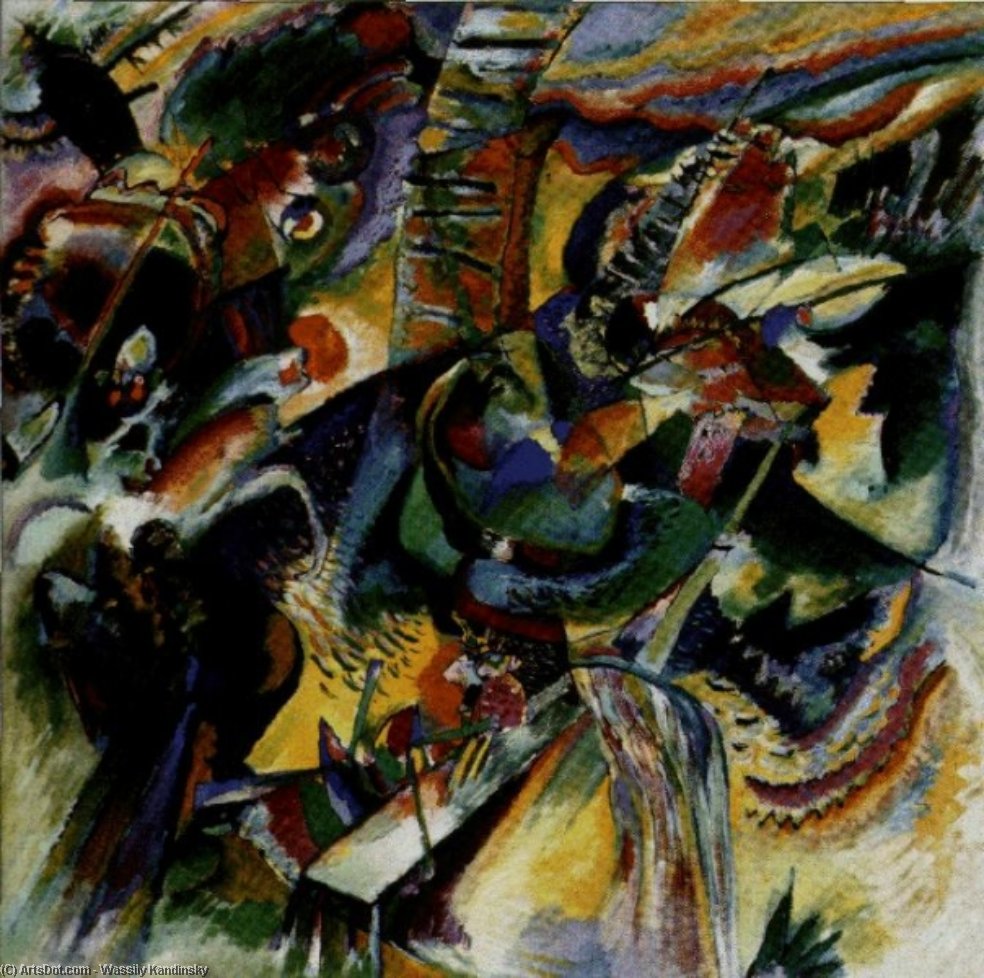
Wassily Kandinsky's *Ravine Improvisation* is more than just a painting; it’s a visual poem, a groundbreaking exploration into the spiritual power of abstract art. Created during a pivotal moment in early 20th-century artistic development, this work embodies the core tenets of Expressionism and foreshadows the full bloom of Abstract Expressionism that would follow. It's a piece that doesn’t depict *what* we see, but rather *how* it feels to experience the world – a radical departure from centuries of representational tradition.
Decoding the Visual Language
The canvas pulsates with energy, dominated by dynamic, fragmented shapes and an intensely vibrant color palette. Forget traditional perspective or recognizable forms; Kandinsky invites us into a realm where color *is* form, and emotion is conveyed through pure abstraction. A large, dominant blue area suggests depth and movement – perhaps the ‘ravine’ of the title, but one experienced not visually, but emotionally. Smaller, almost ghostly figures hint at narratives within this abstract landscape, while a burst of colorful shapes in the upper right corner injects an exhilarating sense of vitality. The painting isn't about *seeing* a ravine; it’s about feeling its power, its mystery, and perhaps even its danger.
Kandinsky: Pioneer of Abstraction
Born in Moscow in 1866,
Wassily Kandinsky was a true intellectual and artistic revolutionary. Initially trained in law and economics, he didn't turn to painting until his thirties, profoundly influenced by seeing Monet’s *Haystacks*. This experience sparked a lifelong fascination with the evocative power of color. He became a key figure in the development of abstract art, believing that paintings could – and should – express inner spiritual realities rather than merely imitate the external world. His theoretical writings, like *Concerning the Spiritual in Art*, laid the foundation for much of 20th-century non-objective painting.
Expressionism & The Power of Feeling
*Ravine Improvisation* is a quintessential example of Expressionism, an art movement that prioritized subjective emotional experience over objective representation. Artists like Kandinsky sought to convey their inner feelings and anxieties through bold colors, distorted forms, and energetic brushwork. This wasn’t about painting what things *look* like; it was about painting what they *feel* like. The raw energy of the piece reflects a period of significant social and political upheaval, mirroring the anxieties and uncertainties of the early 20th century.
Technique & Materials
Kandinsky masterfully employed oil paints on canvas, utilizing thick, gestural brushstrokes – known as *impasto* – to create a tactile surface brimming with texture. The layering of colors adds depth and complexity, inviting the viewer to explore the painting’s nuances. This technique isn't merely about applying paint; it’s about building up layers of emotion and energy on the canvas.
Symbolism & Interpretation
While Kandinsky intentionally moved away from representational symbolism, his work is rich with suggestive forms and emotional resonance. The colors themselves carry symbolic weight – blue often representing spirituality and depth, while warmer tones evoke passion and vitality. The fragmented shapes can be interpreted as representations of a fractured world or the disintegration of traditional values. Ultimately, however, *Ravine Improvisation* resists definitive interpretation; it’s meant to be experienced intuitively, allowing each viewer to project their own emotions and associations onto the canvas.
A Lasting Legacy & Modern Relevance
*Ravine Improvisation* remains a landmark work in the history of modern art. It bridged the gap between traditional representation and complete abstraction, influencing generations of artists who followed. Its innovative approach to color and form continues to inspire today, demonstrating the enduring power of abstract expressionism.
Bring Kandinsky Home with TopImpressionists
For those captivated by this masterpiece,
Ravine Improvisation is available as a meticulously crafted, handmade oil painting reproduction through TopImpressionists. This allows you to experience the energy and emotion of Kandinsky’s vision in your own space, adding a touch of artistic brilliance to any interior.
Explore Further: Other Works by Kandinsky
- Jüngster Tag (The Day of the Last Judgement): A powerful and dramatic work exploring themes of apocalypse and redemption.
- Black Lines I: Another striking example of Kandinsky’s expressionist style, showcasing his mastery of line and form.
- Improvisation 30: A vibrant exploration of color and composition that shares a similar energy with *Ravine Improvisation*.
Discover Kandinsky’s World in Museums Worldwide
Kandinsky's works can be found in prestigious museums around the globe, including:
- The Tretyakov Gallery (Moscow)
- The Solomon R. Guggenheim Museum (New York)
- The Buenos Aires Museum of Modern Art
- The Odessa Fine Art Museum
These institutions offer a unique opportunity to experience the breadth and depth of Kandinsky’s artistic genius firsthand.


 Kupi štampu
 Pošalji
 Podeli
 Detalji o delu

 Преузми
 Slični predmeti
 Rendgenski snimak
 Slajdovi

 Pročitaj više






































 Opcija sa staklom dostupna je samo za dimenzije manje od 110 cm



