

Shown: · With its frame:
 Förhandsvisa
 Skicka
 Dela
Dela
 Visa detaljer
 Guide
Guide

 Ladda ner
 Liknande objekt
 Röntgen
 Bildspel
 Q&A
Q&A Statistik
- 142.0 x 114.0 cm


Skr 3203
Handgjord oljereproduktion
Handmålad olja på duk i din valda storlek och ram, tillverkad efter beställning av våra konstnärer. ( Byt till tryck Byt till digital bild)
Size
·Standardstorlek
skräddarsydd
CM
INCH
Välj bland våra förinställda storlekar som motsvarar konstverkets ursprungliga proportioner.
Loading sizes...

bredd
höjd
Ange den bredd och höjd du behöver för att passa din ram eller din vägg. Eftersom detta är handmålat kan konstnären, vid ett annat format, måla lite mer runt bilden eller beskära den något – det är du som väljer. Vi skickar en digital mockup för godkännande innan målningen påbörjas. Bilden som visas på denna sida representerar inte det slutgiltiga resultatet — det är endast mockuppen som visar det.
 Läs mer
Finish
·
White Skr1

Blurside Skr1

Extended Skr1

P118B Skr10

P118H Skr10

P118W Skr10

P438Z Skr10

P508JH Skr12

P508YH Skr12

P805H Skr10

P805Z Skr10

P919BZ Skr10

P919G Skr10

P919XJ Skr10

P959ZH Skr10

P968JZ Skr12

W106C Skr8

W218G Skr10

W218JH Skr8

W218Y Skr10

W307PJ Skr10

W316G Skr10

W316PJ Skr8

W316Y Skr10

W398PJ Skr8

W4111J Skr10

W500HY Skr15

W500JH Skr15

W692G Skr12

W849H Skr8

W940BG Skr15

W953PJ Skr8

H24-GOLD Skr30

H24-SILVER Skr30

H36-GOLD Skr45

H36-SILVER Skr45
Shipped in a protective tube, ready for your own framer.
Above 105 cm the frame is shipped as a kit for a professional framer — read the details.
Extras
optionalWhat do the extras include?
Examples of what can be changed: Replace face with customer photo; Add pet (e.g., replace cat with dog); Include hidden message in background; Change background landscape or elements.
After order, TopImpressionists.com team will email client for instructions and provide a mockup preview
After order, TopImpressionists.com team will email client for instructions and provide a mockup preview
Leverans över hela världen () på 3–4 veckor istället för standard 5 veckor. (31 oktober). Inga kompromisser med kvaliteten.
Skyddande fernissa
Namnskylt
Detaljer för graverad bronsplatta
This elegant plaque features the artist's name and the title of the artwork, finely engraved for a timeless presentation.
It is made from bronze with a refined, elegant finish. The text is precisely laser-engraved for a sharp and permanent result. Measuring 9x2 cm, the plaque is compact yet easy to read. It's built to be durable and scratch-resistant, offering a professional, museum-quality look. Mounting is simple thanks to the included adhesive backing.
Detaljer för transparent akrylplatta
The plaque includes essential engraved details such as the artist's name, the title of the artwork, the date it was created, the type of media used-like oil on canvas or watercolor-a brief description of the piece, and a QR code that links to the complete artwork information.
It is crafted from clear acrylic, offering a sleek, modern appearance. The text is UV-engraved in black to ensure strong visual contrast. With a size of 10x15 cm, it ensures optimal readability. It comes equipped with two metal hooks for secure wall mounting. The plaque is designed to be weather-resistant, making it suitable for various environments, and it includes interactive features that work seamlessly with smartphone scanning.
Detaljer för svart akrylplatta
This elegant plaque includes engraved information such as the artist's name, the title of the artwork, the date it was created, the type of media used (like oil on canvas or watercolor), a short description of the artwork, and a QR code for quick access to more information.
The plaque itself is made from refined black acrylic with a premium finish. The text is laser-engraved in white for high contrast and readability. Its size is 10x15 cm, designed to be easy to read. It comes with two metal hooks for professional mounting. The design is sleek and fits any interior style. It is also weather-resistant and durable, with built-in digital integration for mobile compatibility.
Glasalternativet är endast tillgängligt i storlekar under 110 cm.
 Glasalternativet är endast tillgängligt i storlekar under 110 cm.
- Fri expressfrakt över hela världen
- Högkvalitativ linnecanvas
- Fullständig fraktförsäkring
- Garantier för återbetalning av tullavgifter
- Garantier för exakt färgåtergivning
- 100 dagars returrätt (endast vid fel)
- 100% pengarna tillbaka-garanti
- Mängdrabatt erbjuds


Beskrivning av samlarobjekt
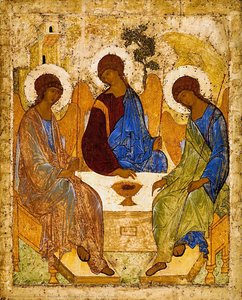
Explore Andrey Rublyov’s ‘Holy Trinity,’ a masterpiece of Russian iconography. Witness Byzantine influence & profound symbolism in this iconic 1411 artwork.
Konstnärens biografi
Andrej Rubljov (ca 1360-1428): En mästare inom rysk ikonmålning, känd för mystiska och känslosamma verk som 'Bebådelsen' och 'Den heliga treenigheten'. Utforska andligt djup och bysantinska influenser.
About the painting
The Holy Trinity by Andrei Rublev: A Window into Russian Spirituality
Andrei Rublev’s “Holy Trinity,” painted circa 1411, stands as an unparalleled testament to the spiritual heart of medieval Russia and a cornerstone of its artistic heritage. This iconic icon, meticulously crafted in the early 15th century, transcends mere representation; it is a profound meditation on divine unity, peace, and humility – values deeply ingrained within the Russian Orthodox tradition. Commissioned for the Trinity Lavra of St. Sergius, the monastery’s spiritual center near Moscow, the painting embodies a period of intense religious fervor and artistic innovation, reflecting Rublev's mastery of Byzantine iconography while forging a distinctly Russian style.
- Subject Matter: The central theme is the Holy Trinity – God the Father, God the Son (Jesus Christ), and God the Holy Spirit – depicted as three angels seated around a table. This arrangement immediately establishes a sense of equality and interconnectedness within the divine realm.
- Historical Context: Created during a time of significant religious and political upheaval in Russia, the icon’s creation coincided with the rise of Saint Sergius of Radonezh, whose leadership during the tumultuous early 15th century solidified the Lavra's importance as a beacon of faith.
- Symbolism: The composition is laden with symbolism. The table represents Abraham’s hospitality in Genesis, while the tree and mountain evoke biblical narratives – Mamre and Mount Moriah – reinforcing the icon’s theological foundation. The cup symbolizes the chalice of the Holy Spirit, further emphasizing the Trinity's multifaceted nature.
A Masterclass in Byzantine Iconography
Rublev’s artistic technique is a remarkable demonstration of traditional Russian icon painting. He employs a layered approach using egg tempera – a durable and luminous medium – meticulously applied to a wood panel. The process involves building up color through countless thin glazes, creating an effect of shimmering depth and spiritual radiance. This painstaking method results in a surface texture that is both subtly rough and profoundly beautiful, hinting at the passage of time and the icon’s enduring significance.
The artist's control over line and form is equally impressive. Figures are rendered with elongated proportions characteristic of Byzantine art, yet imbued with a uniquely Russian sensibility. The geometric shapes – circles for halos, rectangles for clothing – contribute to the icon’s rigid structure, reflecting its sacred purpose. The diffuse lighting, devoid of harsh shadows, further enhances the sense of reverence and spiritual contemplation.
Decoding the Emotional Resonance
“The Holy Trinity” is not simply a beautiful image; it's an experience. The warm, earthy color palette – ochres, browns, and golds – evokes a feeling of age, solemnity, and profound spirituality. The flattened perspective emphasizes the two-dimensional nature of the icon, drawing the viewer into its timeless realm. The overall effect is one of deep contemplation, inviting viewers to reflect on themes of faith, love, and divine grace.
Currently housed in the Cathedral of Christ the Saviour in Moscow after a complex relocation, this masterpiece continues to inspire awe and reverence. Its enduring appeal lies not only in its artistic merit but also in its profound spiritual message – a timeless reminder of the Holy Trinity’s central role within Christian belief.
Frågor och svar
Är färgerna i "Holy Trinity" av Andrej Rubljov mättade eller dämpade?
Färgpaletten i "Holy Trinity" har en mättnad på Clear Color Presence.
Vem är upphovspersonen till "Holy Trinity" och inom vilken stilriktning?
Bakom "Holy Trinity" står Andrej Rubljov och Byzantine Iconography-rörelsen.
Vilken teknik har använts för "Holy Trinity"?
Andrej Rubljov använde tekniken Oil On Panel för "Holy Trinity". Tekniken definierar det ursprungliga verkets materiella karaktär.
Quick facts and art quiz
About Andrej Rubljov

Andrej Rubljov
1360 - 1428, Ryssland
Konstnärsbiografi
Andrei Rublev: Den ryska ikonmåleriets själ
Andrei Rublev (ca 1360 – ca 1430) förblir en av de mest gåtfulla och djupt inflytelserika gestalterna i den ryska konsthistorien. Mer än bara en målare personifierar han en sammansmältning av andlig hängivenhet, konstnärlig mästerskap och själva essensen av det medeltida Ryssland – en nation som brottades med sin identitet under bysantinskt inföde och ett framväxande nationellt medvetande. Även om detaljerna kring hans liv förblir höljda i mysterium, är hans arv som sin eras främsta ikonograf obestridligt; han formade inte bara det visuella språket inom den rysk-ortodoxa konsten utan satte också ett outplånligt avtryck på efterföljande generationer av konstnärer.
Få konkreta uppgifter har överlevt från Rublevs tidiga år. Det antas att han föddes i Moskva, även om vissa källor antyder ett möjligt ursprung i klostret Treenighets-Sankt Serij Lavra nära staden – en plats som skulle ha format hans konstnärliga utveckling djupt. Hans lärlingsskap under Teofanes greken, en berömd bysantinsk ikonmålare som migrerat till Ryssland, gav honom en ovärderlig grund i tidens tekniker och stilistiska konventioner. Rublev lyckades dock snabbt transcendera ren imitation genom att genomsyra dessa etablerade former med en unikt rysk känsla – en påtaglig ödmjukhet, andligt djup och en emotionell resonans som skilde hans verk från hans bysantinska föregångare.
- Tidig karriär i Kreml: Rublevs tidiga bana är oskiljaktigt knuten till Moskvas Kreml. År 1405 förenade han sina krafter med Teofanes och Prokhor av Gorodets för att dekorera Bebådelsekatedralen, ett avgörande ögonblick inom rysk ikonmåleri. Detta samarbete gav Rublev exponering mot maktens högsta skikt och erbjöd honom ovärderlig erfarenhet av arbete i storslagen skala.
- Treenighetsikonen: Rublevs kanske mest hyllade verk, ”Treenigheten” (ca 1420–1428), är ett bevis på hans konstnärliga geni. Detta mästerverk, som nu finns i Tretjakovgalleriet i Moskva, avviker subtilt från traditionell bysantinsk ikonografi. Figurerna Abraham och Sara saknas och har ersatts av en mer intim skildring av Treenigheten – Fadern, Sonen och den Helige Ande – ett skifte som har tolkats som en spegling av Rublevs egen andliga förståelse av gudomlig enhet.
- Andronikov-klostret: Efter sitt arbete i Kreml tillbringade Rublev den senare delen av sin karriär vid Andronikov-klostret nära Moskva. Här fortsatte han att måla ikoner och fresker, inklusive en serie storslagna väggmålningar i Frälsarkatedralen, vilket visade upp hans föränderliga stil och fördjupade andliga utforskande.
Sammansmältningen av bysantinska och ryska traditioner
Rublevs konstnärliga vision föddes inte i isolering; den var djupt rotad i både bysantinska traditioner och framväxande ryska sinnesstämningar. Teofanes inflytande är obestridligt – den noggranna detaljrikedomen, de rika färgerna och kompositionernas formella struktur är alla kännetecken för bysantinskt ikonmåleri. Rublev integrerade dock skickligt dessa element med en utpräglat rysk estetik – en djup känsla av ödmjukhet, ett fokus på emotionellt uttryck och en koppling till det klosterliga livets andlighet.
Symbolik och andligt djup
Rublevs ikoner är inte enbart vackra bilder; de är genomdränkta av lager av symbolisk betydelse som speglar en djup förståelse för kristen teologi och andlig praxis. Hans kompositioner innehåller ofta subtila gester, ansiktsuttryck och rumsliga arrangemang som förmedlar komplexa teologiska idéer.
Arv och historisk betydelse
Trots sitt relativt korta liv lämnade Andrei Rublev ett outplånligt märke på rysk konst och kultur. Hans arbete påverkade efterföljande generationer av ikonmålare djupt och formade utvecklingen av rysk ikonografi under århundraden framåt. Stoglavi Sobor år 1551 förklarade officiellt Rublevs stil som en modell för kyrkomåleri, vilket cementerade hans status som en nationell konsthjälte.
Quick facts about Andrej Rubljov
- Artistic Movement Or Style: Rysk ikonmålning
- Artists Or Movements Influenced By This Artist:
- Bysantinska ikoner
- Rysk ortodox konst
- Artists Who Influenced This Artist:
- Teofanes greken
- Prokhor av Gorodets
- Date Of Birth: ca 1360
- Date Of Death: ca 1428
- Full Name: Andrej Rubljov
- Nationality: Rysk
- Notable Artworks:
- Treenighetsikonen
- Bebådelseikonen
- Place Of Birth: Moskva, Ryssland
Andrej Rubljov
Holy Trinity
() ·
With its frame: · Hand-painted in oil on linen
Total