

Shown: · With its frame:
 Förhandsvisa
 Skicka
 Dela
Dela
 Visa detaljer
 Guide
Guide

 Ladda ner
 Liknande objekt
 Röntgen
 Bildspel
 Q&A
Q&A Statistik
 Acrylic On Canvas
- WallArt
- Early Renaissance
 1268
1268- Renaissance
 45.0 x 28.0 cm
 San Domenico
Skr 2941
Handgjord oljereproduktion
Handmålad olja på duk i din valda storlek och ram, tillverkad efter beställning av våra konstnärer. ( Byt till tryck Byt till digital bild)
Size
·Standardstorlek
skräddarsydd
CM
INCH
Välj bland våra förinställda storlekar som motsvarar konstverkets ursprungliga proportioner.
Loading sizes...

bredd
höjd
Ange den bredd och höjd du behöver för att passa din ram eller din vägg. Eftersom detta är handmålat kan konstnären, vid ett annat format, måla lite mer runt bilden eller beskära den något – det är du som väljer. Vi skickar en digital mockup för godkännande innan målningen påbörjas. Bilden som visas på denna sida representerar inte det slutgiltiga resultatet — det är endast mockuppen som visar det.
 Läs mer
Finish
·
White Skr1

Blurside Skr1

Extended Skr1

P118B Skr10

P118H Skr10

P118W Skr10

P438Z Skr10

P508JH Skr12

P508YH Skr12

P805H Skr10

P805Z Skr10

P919BZ Skr10

P919G Skr10

P919XJ Skr10

P959ZH Skr10

P968JZ Skr12

W106C Skr8

W218G Skr10

W218JH Skr8

W218Y Skr10

W307PJ Skr10

W316G Skr10

W316PJ Skr8

W316Y Skr10

W398PJ Skr8

W4111J Skr10

W500HY Skr15

W500JH Skr15

W692G Skr12

W849H Skr8

W940BG Skr15

W953PJ Skr8

H24-GOLD Skr30

H24-SILVER Skr30

H36-GOLD Skr45

H36-SILVER Skr45
Shipped in a protective tube, ready for your own framer.
Above 105 cm the frame is shipped as a kit for a professional framer — read the details.
Extras
optionalWhat do the extras include?
Examples of what can be changed: Replace face with customer photo; Add pet (e.g., replace cat with dog); Include hidden message in background; Change background landscape or elements.
After order, TopImpressionists.com team will email client for instructions and provide a mockup preview
After order, TopImpressionists.com team will email client for instructions and provide a mockup preview
Leverans över hela världen () på 3–4 veckor istället för standard 5 veckor. (29 oktober). Inga kompromisser med kvaliteten.
Skyddande fernissa
Namnskylt
Detaljer för graverad bronsplatta
This elegant plaque features the artist's name and the title of the artwork, finely engraved for a timeless presentation.
It is made from bronze with a refined, elegant finish. The text is precisely laser-engraved for a sharp and permanent result. Measuring 9x2 cm, the plaque is compact yet easy to read. It's built to be durable and scratch-resistant, offering a professional, museum-quality look. Mounting is simple thanks to the included adhesive backing.
Detaljer för transparent akrylplatta
The plaque includes essential engraved details such as the artist's name, the title of the artwork, the date it was created, the type of media used-like oil on canvas or watercolor-a brief description of the piece, and a QR code that links to the complete artwork information.
It is crafted from clear acrylic, offering a sleek, modern appearance. The text is UV-engraved in black to ensure strong visual contrast. With a size of 10x15 cm, it ensures optimal readability. It comes equipped with two metal hooks for secure wall mounting. The plaque is designed to be weather-resistant, making it suitable for various environments, and it includes interactive features that work seamlessly with smartphone scanning.
Detaljer för svart akrylplatta
This elegant plaque includes engraved information such as the artist's name, the title of the artwork, the date it was created, the type of media used (like oil on canvas or watercolor), a short description of the artwork, and a QR code for quick access to more information.
The plaque itself is made from refined black acrylic with a premium finish. The text is laser-engraved in white for high contrast and readability. Its size is 10x15 cm, designed to be easy to read. It comes with two metal hooks for professional mounting. The design is sleek and fits any interior style. It is also weather-resistant and durable, with built-in digital integration for mobile compatibility.
Glasalternativet är endast tillgängligt i storlekar under 110 cm.
 Glasalternativet är endast tillgängligt i storlekar under 110 cm.
- Fri expressfrakt över hela världen
- Högkvalitativ linnecanvas
- Fullständig fraktförsäkring
- Garantier för återbetalning av tullavgifter
- Garantier för exakt färgåtergivning
- 100 dagars returrätt (endast vid fel)
- 100% pengarna tillbaka-garanti
- Mängdrabatt erbjuds


Beskrivning av samlarobjekt
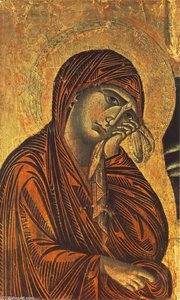
Explore Cimabue’s ‘Crucifix (detail)’ – a poignant 1268 panel painting showcasing early Renaissance emotion & technique. Discover its layered impasto, halo effect, and profound sorrow.
Konstnärens biografi
Cimabue (1240-1302): Pionjär för italiensk målning! Utforska hans blandning av bysantinsk och renässansstil, realistiska figurer & inflytande på Giotto. Upptäck mästerverk nu!
About the painting
A Glimpse into Divine Sorrow: Cimabue’s *Crucifix (detail)*
This exquisite detail from Cimabue's larger *Crucifix* (circa 1268) offers a profoundly moving encounter with the Virgin Mary and infant Jesus. Painted during a pivotal moment in art history, this work transcends mere religious iconography to become a powerful expression of maternal grief and spiritual contemplation. It’s a piece that resonates across centuries, offering both artistic beauty and emotional depth.Historical Context & Artistic Transition
Cimabue – or *Cenni di Pepo* as he was known – stands at the cusp of the Italian Renaissance. He was one of the first artists to actively move away from the rigid conventions of the Italo-Byzantine style, which had dominated Italian painting for generations. While still exhibiting elements of Byzantine formality—note the gold halo and stylized drapery—Cimabue infused his work with a nascent naturalism. This is visible in the attempt to render more lifelike proportions and introduce subtle shading, paving the way for artists like Giotto, who would fully embrace Renaissance ideals. The artwork originates from Florence, Italy, a city rapidly becoming a center of artistic innovation. Originally created for the church of San Francesco in Pisa, it now resides at the Barts Hospital in London.Subject & Symbolism
The detail focuses intensely on the Madonna and Child. Mary cradles the infant Jesus, her expression one of profound sorrow and premonition. This isn’t a joyful depiction of motherhood; rather, it foreshadows the suffering to come – Christ's Passion and crucifixion. Key symbolic elements amplify this emotional weight:- The veil draped over Mary’s head signifies her purity and modesty, traditional attributes associated with the Virgin.
- Her downcast gaze is a powerful visual cue of grief, sorrow, and acceptance of her son's destiny.
- The gold halo surrounding both figures denotes their holiness and divine status.
Technique & Materials
Cimabue masterfully employed tempera paint on a gesso-prepared wood panel. This technique, common in the period, involved layering pigments mixed with egg yolk to create luminous colors. The artist’s skillful use of impasto – applying thick layers of paint – is particularly evident in the folds of Mary's cloak and her skin tones, adding a tactile quality and enhancing the sense of volume. Despite its age, the artwork retains a remarkable vibrancy thanks to the enduring qualities of tempera and the inclusion of gold leaf for highlights. The shallow perspective and limited atmospheric depth are characteristic of panel painting from this era.Emotional Impact & Aesthetic Qualities
The overall effect is one of solemnity, piety, and profound emotional resonance. Cimabue doesn’t simply depict a religious scene; he invites the viewer to share in Mary's sorrow and contemplate the weight of faith and sacrifice. The warm earthy tones – ochre, terracotta, and gold – create a rich, aged aesthetic that evokes a sense of timelessness. While not striving for photorealistic detail, Cimabue’s stylized approach imbues the figures with a dignified grace and emotional power. This *Crucifix (detail)* is more than just an artwork; it's a window into the spiritual world of medieval Italy and a testament to the enduring power of human emotion. It would be a stunning focal point in any collection, adding depth and historical significance to both classic and contemporary interiors.Frågor och svar
Hur upplevs ljusstyrkan i "Crucifix (detail)" av Cimabue?
Sammantaget har "Crucifix (detail)" registrerats som balanced. Upplevd ljusstyrka beskriver hur ljust eller mörkt verket framstår.
Var kan jag hitta statistik för "Crucifix (detail)" av Cimabue?
Sidan Besöksstatistik för "Crucifix (detail)" av Cimabue presenterar statistik över publika besök: månatliga besök för detta konstverk, en jämförelse med konstnärens mest sedda verk samt varifrån besökarna kommer.
Vilken färg dominerar i "Crucifix (detail)"?
Clay (#a8713a) är den dominerande färgen i "Crucifix (detail)" av Cimabue.
Quick facts and art quiz
About Cimabue

Cimabue
1240 - 1302, Italien
Konstnärsbiografi
The Florentine Dawn: Cimabue and the Transition from Byzantium
Giovanni Cimabue, född Cenni di Pepo omkring 1240 i Florens, står som enormt viktig figur – en bro mellan den etablerade konsttraditionen från det bysantinska världen och de växande innovationerna som skulle definiera den italienska renässansen. Hans liv, om än delvis skymtande bakom tidens slöja och romantiserade berättelser – framför allt de skrivna av Giorgio Vasari århundraden senare – markerar ett obestridligt vändpunkt i västerländsk konsthistoria. Cimabue var inte bara en målare; han var en modig innovatör som vågade utmana etablerade konventioner, och lade grunden för de revolutionära förändringar som snart skulle sprida sig över Italien. Även hans smeknamn, tros betyda “nötkreatur”, antyder en stark vilja och kanske ett rebelliskt sinne – kvaliteter som tydligt visar sig i hans villighet att experimentera med form och uttryck. Han representerar en kritisk punkt där konsten började flytta sig från att vara rent andlig konst till något mer mänskligt och emotionellt resonansfullt.Early Influences and Artistic Development
Initialt djupt rotad i den Italo-byskytinska stilen som rådde i Florens, präglades Cimabues tidiga verk av strikta etablerade principer: flattade figurer dekorerade med skimrande guldblad, symboliska snarare än realistiska representationer av utrymme och en djupgående fokus på religiösa ikoner. Men även inom dessa begränsningar började en nyfikenhet på naturalism att växa fram. Han var inte nöjd med att bara kopiera befintliga former; han sökte att infusa sina målningar med en större känsla av liv och emotionell djup. Den exakta karaktären av hans tidiga utbildning är fortfarande debatterad, men det är troligt att han finslipade sina färdigheter i florentinska verkstäder, absorberade teknikerna och influenserna från tiden samtidigt som han utvecklade sin egen unika konstnärliga röst. Den bysantinska stilen, präglad av formellt och andligt fokus, gav honom en solid grund, men Cimabue började subtilt att introducera element som skulle förutse renässansens framstormning – större uppmärksamhet på volym, mer uttrycksfulla ansiktsdrag och en nyfikenhet på rumsliga relationer. Detta var inte en plötslig brytning med traditionen, utan snarare en gradvis utveckling, en delikat balans mellan att hedra det förflutna och att omfamna nya möjligheter.Major Works and Artistic Innovations
Cimabues arv är fastställt genom en rad fantastiska verk som visar hans utvecklande stil. *Maestà* (Louvre), ursprungligen skapad för kyrkan San Francesco i Pisa, står som ett av hans mest berömda mästerverk. Denna monumentala altarepränt exemplifierar hans behärskning av komposition och användning av färg, samtidigt som den antyder en flytt från strikta bysantinska konventioner. Figurerna, även om de fortfarande bär på en viss formellhet, uppvisar en nyfunnen känsla av volym och närvaro. *Kristus på korset* (San Domenico, Arezzo), daterad omkring 1270, är särskilt betydelsefull som ett tidigt exempel på hans avvikelse från strikta bysantinska normer. Här är proportionerna mer realistiska, och scenens emotionella tyngd är uppenbar – en markant kontrast till de ofta avlägsna representationerna som fanns i tidigare religiös konst. Vidare bevis på Cimabues innovativa anda kan ses i verk som *Kristus förkunnelsen* (Frick Collection), vanligtvis tillskrivet hans verkstad. Denna komplexa komposition visar en utvecklad förståelse för perspektiv och rumsliga relationer, vilket framhäver ett växande intresse för att skapa mer immersiva och trovärdiga scener. Hans bidrag var inte begränsade till panelmålningar; Cimabue utmärkte sig också som mosaikist, och bidrog betydelsefullt till dekorationen av Florens Baptisterium – även om dessa mosaiker tyvärr har lidit av nedbrytning över tid.A Pivotal Teacher: Giotto and Beyond
Kanske Cimabues mest bestående arv ligger i hans roll som lärare för Giotto di Bondone. Även om historiska berättelser varierar kring den exakta karaktären av deras relation, är det allmänt accepterat att Giotto fick avgörande träning under Cimabue’s vägledning. Trots att historiska beräkningar har visat sig vara felaktiga, så kan man säga att Cimabue var en mästare som inspirerade och formade den framtida generationen av italienska konstnärer. Han utmanade de konstnärliga normerna i sin tid, och visade att konsten kunde vara mer än bara religiös symbolik; den kunde också återspegla mänskliga känslor och erfarenheter. Hans vilja att experimentera med form, proportioner och uttryck lade grunden för renässansens innovationer, och etablerade honom som en kritisk övergångsfigur i västerländsk konsthistoria.Historical Significance
Cimabue dog 1302 i Pisa, lämnande efter sig ett verk som fortfarande fångar och inspirerar. Trots sina betydande bidrag är detaljerna kring hans senare liv svårt att få tag på. Men hans konstnärliga arv resonerar kraftfullt genom sina elever och utvecklingen av italiensk konst. Han representerar ett kritiskt steg i utvecklingen av västerländsk målning, som flyttar sig från de stiliserade konventionerna i den bysantinska eran mot en mer mänsklig och naturalistisk approach. Hans målningar är inte bara historiska artefakter; de är fönster in i en kritisk punkt i konsthistorien – en tid då konstnärer började ifrågasätta etablerade normer och utforska nya möjligheter. Han var en pionjär, en visionär som vågade utmana det rådande, och lade grunden för den konstnärliga briljans som skulle definiera renässansen. **Cimabue’s verk påminner oss om att även inom tradition finns alltid utrymme för innovation, och att sann konstnärlighet ligger i modet att bryta gränserna och utforska nya horisonter.**Quick facts about Cimabue
- Artistic Movement Or Style: Byzantine & Ren.
- Artists Or Movements Influenced By This Artist:
- Giotto
- Duccio
- Artists Who Influenced This Artist:
- Coppo di Marcovaldo
- Giunta Pisano
- Date Of Birth: c. 1240
- Date Of Death: 1302
- Full Name: Giovanni Cimabue
- Nationality: Italiensk
- Notable Artworks:
- Maestà
- Kristus
- Flagellation
- Place Of Birth: Florens, Italien
Utforska konstverk sorterade efter tema, stil och egenskaper.


Cimabue
Crucifix (detail)
() ·
With its frame: · Hand-painted in oil on linen
Total