Ateljé — Fri frakt i hela världen — Leveranstid 2–6 veckor
Måla efter foto Önskelista Varukorg
Beställ tryck Beställ tryckKöp högupplöst bild Köp högupplöst bild SkickaSkicka
Visa detaljerVisa detaljer Lägg till i favoriter Lägg till i favoriter Ladda nerLadda ner Liknande objektLiknande objekt BildspelBildspel

Cross-Stitch Sampler

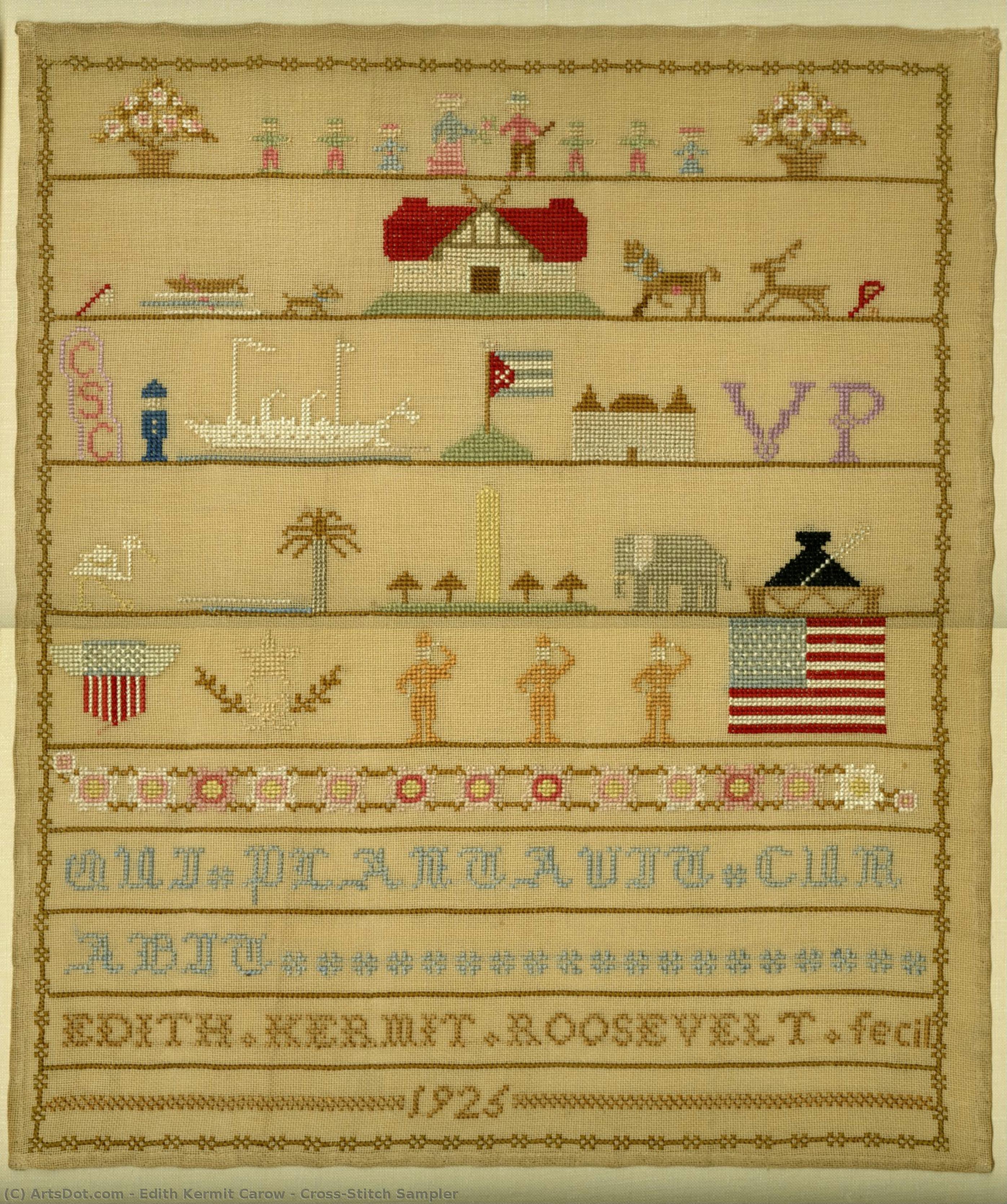
A vibrant 1925 cross-stitch sampler by Edith Kermit Carow featuring intricate global symbols, animals, and flags that captures a rich cultural tapestry, inviting you to explore this exquisite piece of textile art.

Discover Edith Kermit Carow (Edith Roosevelt), an American first lady & artist. Explore her paintings, including a 1908 portrait & cross-stitch work. Learn about her life & legacy at Sagamore Hill.

Handgjord oljereproduktion

Handmålad olja på duk i din valda storlek och ram, tillverkad efter beställning av våra konstnärer. (Beställ tryck Beställ tryckKöp högupplöst bild Köp högupplöst bild)

Standard
custom
CM
INCH

Välj bland våra förinställda storlekar som motsvarar konstverkets ursprungliga proportioner.

bredd
höjd

Du kan ange egna mått för att passa en specifik ram eller yta. Om den valda storleken inte matchar originalbildens proportioner kommer vi antingen att beskära konstverket eller utöka målningen med ytterligare handmålade element. En digital skiss skickas till dig för godkännande innan produktionen påbörjas.
Observera att förhandsvisningen på skärmen inte återspeglar den faktiska beskärningen eller utökningen. Endast skissen visar den slutgiltiga kompositionen korrekt.
Även om anpassade storlekar är möjliga, rekommenderar vi att du väljer en dimension från den fördefinierade listan för att bevara originalproportionerna.

Exempel på vad som kan anpassas: Byt ut ansiktet mot ett foto av kunden; Lägg till ett husdjur (t.ex. byt ut en katt mot en hund); Inkludera ett dolt meddelande i bakgrunden; Ändra bakgrundens landskap eller element.
Efter beställning kommer TopImpressionists.com team att mejla kunden för instruktioner och tillhandahålla en skissförhandsvisning

Leverans över hela världen () på 3–4 veckor istället för standard 5 veckor. (13 augusti). Inga kompromisser med kvaliteten.

why_choose_icon
Fri expressfrakt över hela världen
why_choose_icon
Högkvalitativ linnecanvas
why_choose_icon
Fullständig fraktförsäkring
why_choose_icon
Garantier för återbetalning av tullavgifter
why_choose_icon
Garantier för exakt färgåtergivning
why_choose_icon
60 dagars returrätt (endast vid fabrikationsfel)
why_choose_icon
100% pengarna tillbaka-garanti
why_choose_icon
Mängdrabatt erbjuds

Totalpris

$ 269

reproduction

Cross-Stitch Sampler

Reproduktionsmedium

Storlek på reproduktion

-

Slutgiltigt pris

$ 269

Snabbfakta

  • Medium: Cross-stitch
  • Subject or theme: Global cultures and diverse elements
  • Title: Cross-Stitch Sampler
  • Notable elements or techniques: Flags, people, animals, and buildings
  • Year: 1925

Beskrivning av konstverket

A Tapestry of Global Heritage

In the delicate, meticulous stitches of Edith Kermit Carow’s 1925 Cross-Stitch Sampler, one finds much more than a mere display of needlework; it is a vibrant, woven encyclopedia of a world in transition. This extraordinary piece serves as a visual narrative, capturing a profound appreciation for the diverse tapestry of human culture and the natural world. Through the disciplined medium of cross-stitch, Carow has orchestrated a complex symphony of symbols, ranging from the fluttering flags of distant nations to the quiet dignity of pastoral life. Each tiny X of thread acts as a pixel in a larger story, where people, animals, and architecture converge to celebrate a global interconnectedness that feels both intimate and expansive.

The composition is a masterclass in balanced complexity. As the eye wanders across the fabric, it encounters a lively cast of characters—at least nine distinct figures emerge from the weave, some gathered in quiet companionship while others stand as solitary sentinels within the design. The artist breathes life into the textile by populating it with the fauna of the earth; horses gallop through imagined landscapes, dogs linger near their human companions, and birds flit across the periphery like scattered notes of music. This rhythmic placement of life forms creates a sense of movement that defies the static nature of the medium, inviting the viewer to embark on a journey through a miniature, embroidered universe.

Technique and the Art of Detail

To behold this sampler is to witness the extraordinary patience and technical virtuosity of Edith Kermit Carow. The technique of cross-stitch, often relegated to the realm of domestic craft, is elevated here to the status of fine art. Carow utilizes the precision of her needle to render architectural details, such as a central house and distant buildings, with remarkable clarity. The interplay of color and texture within the thread allows for a subtle shading that gives depth to the figures and landscapes, transforming a flat surface into a multidimensional window onto a storied past.

For the discerning collector or interior designer, this piece offers a unique opportunity to introduce a sense of historical depth and artisanal warmth into a space. A high-quality reproduction of this sampler does not merely decorate a wall; it anchors a room with a sense of heritage and worldly sophistication. The intricate patterns and the nostalgic charm of the 1920s aesthetic provide a perfect focal point for classical, eclectic, or even modern minimalist interiors, where the complexity of the artwork can serve as a sophisticated counterpoint to clean lines. It is an investment in a piece that evokes emotion, sparking conversations about history, travel, and the enduring beauty of handmade artistry.


Konstnärsbiografi

Frederic Remington: A Chronicler of the American West

Frederic Sackrider Remington, born in Canton, New York, on October 4, 1861, wasn’t merely an artist; he was a vital interpreter of a rapidly changing America. His life and work are inextricably linked to the mythologized frontier – a world of cowboys, Native Americans, cavalrymen, and the vast, untamed landscapes of the American West. Remington's legacy rests not just on his stunning visual depictions but also on his ability to capture a romanticized yet undeniably powerful narrative of this era, solidifying his place as one of America’s most iconic Western artists.

Remington’s early life instilled in him a deep appreciation for the outdoors and a fascination with the West. His father, Seth Remington, was a newspaper editor and postmaster, exposing young Frederic to storytelling and illustration from an early age. The Civil War experiences recounted by his father— tales of cavalry charges and frontier skirmishes— profoundly shaped Remington’s artistic vision. Despite expectations for a college education, Remington enrolled at Yale University in 1878, but left after only three semesters following his father's death. This departure marked the beginning of his independent journey west, a pivotal moment that would define his career.

Early Artistic Training and the Rise of a Western Illustrator

Remington’s formal artistic training was surprisingly limited. He received instruction at the School of Fine Arts at Yale and spent a brief period studying drawing with John Henry Niemeyer at the Art Students League in New York City. However, his true education came from direct experience – sketching soldiers on horseback during the Civil War, observing ranch life in Kansas, and immersing himself in the landscapes of Arizona, Texas, and New Mexico. This hands-on approach, combined with a keen eye for detail and dramatic composition, became hallmarks of his style.

Remington’s career began to gain momentum when he secured commissions from *Harper's Weekly* in 1882, illustrating scenes of the West for the prestigious magazine. His evocative depictions of cowboys, Native Americans, and cavalrymen quickly captivated readers and established him as a leading chronicler of frontier life. He skillfully blended romanticism with realism, creating images that resonated deeply with the public’s fascination with the American West – a period often idealized and imbued with notions of rugged individualism and heroic adventure.

Technique and Style: From Academic Influences to Distinctive Vision

Remington's early paintings demonstrate an indebtedness to French academic painters, particularly Ernest Meissonier and Édouard Detaille, known for their dramatic historical scenes. His use of tight brushwork, strong lighting, and meticulously rendered details reflects this influence. However, Remington quickly developed a distinctive style that transcended mere imitation. He masterfully employed color and composition to convey movement, emotion, and the vastness of the Western landscape.

As his career progressed, Remington experimented with watercolor painting and sculpture, showcasing remarkable versatility. His sculptures, particularly those created using the lost wax method, are characterized by their dynamic poses and lifelike quality. He continued to refine his technique throughout his life, always striving for a heightened sense of realism and dramatic narrative.

Themes and Historical Significance

Remington’s work is deeply rooted in the themes of westward expansion, conflict between settlers and Native Americans, and the changing landscape of the American West. His illustrations often presented a romanticized view of frontier life, emphasizing heroism, courage, and the spirit of adventure. However, his later works also explored the darker aspects of this era – the displacement of Native populations, the harsh realities of ranching, and the environmental impact of westward growth.

Frederic Remington’s influence on American art and popular culture is undeniable. His images have been reproduced countless times in books, magazines, and advertisements, shaping public perceptions of the West for generations. His work continues to be studied and admired today as a testament to his artistic skill, his keen observation of the American frontier, and his enduring contribution to the visual narrative of America’s past. The “Marlboro Man” advertisement, inspired by one of Remington's illustrations, stands as a particularly potent example of his lasting impact on American iconography.

edith kermit carow

edith kermit carow

1861 - 1948 , United States of America

Kortfakta

  • Artistic Movement Or Style: Western American Art
  • Artists Or Movements Influenced By This Artist:
    • Ernest Meissonier
    • Édouard Detaille
  • Artists Who Influenced This Artist:
    • George Catlin
    • Earl W. Bascom
  • Date Of Birth: October 4, 1861
  • Date Of Death: December 26, 1909
  • Full Name: Frederic Sackrider Remington
  • Nationality: American
  • Notable Artworks:
    • A Dash for the Timber
    • The Bronco Buster
  • Place Of Birth: Canton, New York, USA
© TopImpressionists.com — Alla rättigheter förbehållna  ·  100% handmålad · Nöjdhetsgaranti · Fri frakt i hela världen
VISA MASTERCARD