

Visas: · Med ram:
 Förhandsvisa
 Skicka
 Dela
Dela
 Visa detaljer
 Guide
Guide

 Ladda ner
 Liknande objekt
 Röntgen
 Bildspel
 Frågor och svar
 Statistik
- 101.0 x 76.0 cm


Skr 2687
Handgjord oljereproduktion
Handmålad olja på duk i din valda storlek och ram, tillverkad efter beställning av våra konstnärer. ( Byt till tryck Byt till digital bild)
Storlek
·Standardstorlek
skräddarsydd
CM
INCH
Välj bland våra förinställda storlekar som motsvarar konstverkets ursprungliga proportioner.
Laddar storlekar...

bredd
höjd
Ange den bredd och höjd du behöver för att passa din ram eller din vägg. Eftersom detta är handmålat kan konstnären, vid ett annat format, måla lite mer runt bilden eller beskära den något – det är du som väljer. Vi skickar en digital mockup för godkännande innan målningen påbörjas. Bilden som visas på denna sida representerar inte det slutgiltiga resultatet — det är endast mockuppen som visar det.
 Läs mer
Slutför
·
Vit kant Skr1

Suddig kantfinish Skr1

Fortsatt motiv Skr1

P118B Skr10

P118H Skr10

P118W Skr10

P438Z Skr10

P508JH Skr12

P508YH Skr12

P805H Skr10

P805Z Skr10

P919BZ Skr10

P919G Skr10

P919XJ Skr10

P959ZH Skr10

P968JZ Skr12

W106C Skr8

W218G Skr10

W218JH Skr8

W218Y Skr10

W307PJ Skr10

W316G Skr10

W316PJ Skr8

W316Y Skr10

W398PJ Skr8

W4111J Skr10

W500HY Skr15

W500JH Skr15

W692G Skr12

W849H Skr8

W940BG Skr15

W953PJ Skr8

H24-GOLD Skr30

H24-SILVER Skr30

H36-GOLD Skr45

H36-SILVER Skr45
Skickas i ett skyddande rör, redo att ramas in av din egen inramare.
För mått över 105 cm levereras ramen som ett kit för en professionell ramverkare — läs detaljerna.
Tillval
valfrittVad ingår i tilläggen?
Exempel på vad som kan ändras: Byt ut ansiktet mot kundens eget foto; Lägg till ett husdjur (t.ex. byt ut en katt mot en hund); Inkludera ett dolt meddelande i bakgrunden; Ändra landskap eller element i bakgrunden.
Efter beställning kommer TopImpressionists.com team att skicka ett e-postmeddelande till kunden för instruktioner och tillhandahålla en förhandsvisning av utkastet
Efter beställning kommer TopImpressionists.com team att skicka ett e-postmeddelande till kunden för instruktioner och tillhandahålla en förhandsvisning av utkastet
Leverans över hela världen () på 3–4 veckor istället för standard 5 veckor. (7 november). Inga kompromisser med kvaliteten.
Skyddande fernissa
Namnskylt
Detaljer för graverad bronsplatta
This elegant plaque features the artist's name and the title of the artwork, finely engraved for a timeless presentation.
It is made from bronze with a refined, elegant finish. The text is precisely laser-engraved for a sharp and permanent result. Measuring 9x2 cm, the plaque is compact yet easy to read. It's built to be durable and scratch-resistant, offering a professional, museum-quality look. Mounting is simple thanks to the included adhesive backing.
Detaljer för transparent akrylplatta
The plaque includes essential engraved details such as the artist's name, the title of the artwork, the date it was created, the type of media used-like oil on canvas or watercolor-a brief description of the piece, and a QR code that links to the complete artwork information.
It is crafted from clear acrylic, offering a sleek, modern appearance. The text is UV-engraved in black to ensure strong visual contrast. With a size of 10x15 cm, it ensures optimal readability. It comes equipped with two metal hooks for secure wall mounting. The plaque is designed to be weather-resistant, making it suitable for various environments, and it includes interactive features that work seamlessly with smartphone scanning.
Detaljer för svart akrylplatta
This elegant plaque includes engraved information such as the artist's name, the title of the artwork, the date it was created, the type of media used (like oil on canvas or watercolor), a short description of the artwork, and a QR code for quick access to more information.
The plaque itself is made from refined black acrylic with a premium finish. The text is laser-engraved in white for high contrast and readability. Its size is 10x15 cm, designed to be easy to read. It comes with two metal hooks for professional mounting. The design is sleek and fits any interior style. It is also weather-resistant and durable, with built-in digital integration for mobile compatibility.
Glasalternativet är endast tillgängligt i storlekar under 110 cm.
 Glasalternativet är endast tillgängligt i storlekar under 110 cm.
- Fri expressfrakt över hela världen
- Högkvalitativ linnecanvas
- Fullständig fraktförsäkring
- Garantier för återbetalning av tullavgifter
- Garantier för exakt färgåtergivning
- 100 dagars returrätt (endast vid fel)
- 100% pengarna tillbaka-garanti
- Mängdrabatt erbjuds


Beskrivning av samlarobjekt
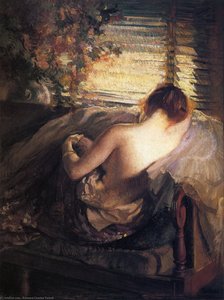
Capturing a serene moment of intimacy through soft American Impressionist brushstrokes, The Bath by Edmund Charles Tarbell offers a tranquil glimpse into 1893 domestic life that you can bring to your own collection.
Konstnärens biografi
Edmund Charles Tarbell (1862-1938) var en amerikansk impressionistkänd för sina ljusa porträtt och inblickar i det amerikanska livet under 1800-talet. En viktig medlem av "Ten American Painters".
Om målningen
An Intimate Encounter with American Impressionism
In the quietude of a private chamber, Edmund Charles Tarbell captures a moment that feels both profoundly personal and timelessly elegant. The Bath, painted in 1893, serves as a masterful window into the world of American Impressionism, a movement defined by its ability to translate the fleeting nuances of light and atmosphere onto canvas. The scene unfolds with a gentle intimacy, depicting a woman seated upon a bed, caught in a transient moment of preparation or repose. There is an undeniable sense of serenity that permeates the room, as if the viewer has been granted a rare, silent invitation to witness a private ritual of self-care. Through Tarbell's lens, the mundane act of bathing becomes a poetic exploration of light, shadow, and the quiet dignity of domestic life.
The technical brilliance of this piece lies in Tarbell’s sophisticated use of color and brushwork. Eschewing the harsh outlines of traditional academic painting, he employs soft, warm tones that bathe the composition in a luminous glow. The interplay between light and shadow is not merely a technical feat but an emotional tool; it adds a palpable depth to the textures of the fabric, the porcelain, and the skin, creating a three-dimensional reality that feels soft to the touch. His brushstrokes are delicate yet purposeful, characteristic of the Impressionist desire to capture the "impression" of a moment rather than a rigid photographic record. This technique allows the light from the yellow lamp to bleed softly into the surrounding shadows, enveloping the subject in a warm, amber embrace that evokes feelings of comfort and tranquility.
Symbolism and the Elegance of the Everyday
Beyond its aesthetic beauty, The Bath resonates with a subtle symbolic depth. The objects surrounding the woman—the vases, the chair, the soft linens—are more than mere props; they are elements of a curated domesticity that speaks to the stability and refinement of the era. The presence of another figure, perhaps an assistant, adds a layer of narrative complexity, suggesting a ritualized routine that emphasizes the subject's status and the importance of personal grooming. This composition reflects the broader themes of the American Impressionist movement, which often sought to find extraordinary beauty within ordinary, domestic settings, elevating the private sphere to a subject worthy of high art.
For the discerning collector or interior designer, this painting offers much more than visual appeal; it provides an emotional anchor for a room. The painting’s palette of warm ochres, soft creams, and gentle shadows makes it an ideal centerpiece for spaces designed for relaxation and contemplation. Whether placed in a sunlit morning room or a sophisticated study, a high-quality reproduction of this work brings with it a sense of historical prestige and a calming, sophisticated atmosphere. It is a piece that does not demand attention through loud colors or jarring subjects, but rather earns its place through a quiet, enduring grace that invites the eye to linger and the mind to wander.
Frågor och svar
Vilken storlek rekommenderas för "The Bath" i ett Bedroom?
För ett Bedroom rekommenderas "The Bath" i tryckstorleken Medium.
Kan jag se en röntgenbild av "The Bath" av Edmund Charles Tarbell?
"The Bath" kan utforskas lager för lager på verkets Röntgenanalys-sida, en interaktiv vy inspirerad av en konservators ljusbord med elva optiska lager av bilden.
Har "The Bath" starka ljus-mörkerkontraster?
Ljus-mörker-kontrasten i "The Bath" är registrerad som Statement. Kontrast beskriver hur starkt ljusa och mörka partier skiljer sig åt.
Snabbfakta och konstquiz
Om Edmund Charles Tarbell

Edmund Charles Tarbell
1862 - 1938, USA
Konstnärsbiografi
Early Life and Education
Edmund Charles Tarbell, en man vars liv var djupt förankrat i den amerikanska historien, föddes i Groton, Massachusetts, år 1862. Hans barndom präglades av ett sorgsna tidiga förlust – hans far, Edmund Whitney Tarbell, dog när han bara var ung, vilket lämnade hans mor, Mary Sophia Fernald, att ensam ta hand om honom och hans syster i West Groton. Denna tidiga erfarenhet av förlust och ansvar skulle senare påverka hans konstnärliga syn på mänsklig existens och det flyktiga ögonblicket. Hans tidiga konstnärliga resa började vid Massachusetts Normal Art School, där han fick grundläggande kunskaper i de elementära principerna för bildkonst. Detta var dock bara en början; hans ambitioner krävde mer, och han fortsatte sin utbildning genom ett lärlingskap hos Forbes Lithographic Company i Boston – en plats som gav honom värdefull erfarenhet av tryckteknik och den industriella konstens praktiska aspekter. En avgörande period i hans utveckling var hans studier under Otto Grundmann vid School of the Museum of Fine Arts i Boston mellan 1879 och 1880. Grundmanns undervisning, som betonade en kombination av akademisk rigor och frilägsande observationer, formade Tarbells konstnärliga grund. Han lärde sig att observera noggrant, att förstå ljusets spel och att förmedla känslor genom färg och form – element som skulle bli centrala i hans senare verk. Denna tidiga utbildning lade grunden för hans framtida stil och vision.Artistic Career and Style
Tarbells konstnärliga karriär var mångfacetterad, omfattande illustrationer, privat konstundervisning och porträttmålningar. Han gifte sig med Emeline Souther år 1888, en kvinna som också delade hans passion för konst och som blev en ständig inspirationskälla och modell för hans verk. Deras familjeliv, präglat av kärlek och kreativitet, speglades i många av hans porträtt och intima scener. Hans stil kan bäst beskrivas som American Impressionism – en rörelse som betonade att fånga ögonblickets flyktighet, ljusets skimmer och atmosfärens känsla snarare än att skapa detaljerade, realistiska representationer. Han var särskilt känd för sina ljusa porträtt, där han lyckades förmedla ett intryck av vänlighet, intelligens och inre liv. Dessutom målade han med stor skicklighet intima hemmanära scener och skapade detaljerade bilder av Colonial Revival interiörer – en stil som återspeglade hans fascination för den amerikanska historien och dess traditioner. Verket *In the Orchard* (1891) är ett utmärkt exempel på Tarbells konstnärliga vision. I denna målning fångar han en familj i en idyllisk trädgård, där ljuset dansar genom lövverken och skapar en känsla av harmoni och tacksamhet. Det är en bild som inte bara visar ett ögonblick i tiden utan också förmedlar en djupare reflektion över livet, familjen och naturen.Membership in "Ten American Painters" and Guild of Boston Artists
Tarbell var en pionjär inom den amerikanska konstscenen och en nyckelperson i gruppen “Ten American Painters”, som bildades 1897. Denna sammanslutning av artister, inklusive John H. White, Joseph Penway Dodge och andra, syftade till att skapa ett alternativt utställningsutrymme för amerikansk konst – en plats där konstnärer kunde visa sina verk utan att behöva konkurrera med de etablerade europeiska institutionerna. “Ten American Painters” var en viktig kraft i att främja amerikansk konst och att definiera en unik amerikansk stil. År 1914 spelade Tarbell en central roll i grundandet av Guild of Boston Artists, där han tjänstgjorde som dess första president fram till 1924. Detta engagemang visade hans starka tro på vikten av att stödja sina kollegor och att skapa ett blomstrande konstnärligt samhälle i Boston. Genom sin ledning bidrog han till att stärka den lokala konstscenen och att främja en kultur av kreativitet och innovation.Major Achievements and Legacy
Tarbells verk har blivit djupt älskade och värderade av samlare och museer över hela världen. Hans målningar finns i prestigefyllda samlingar, inklusive Smithsonian American Art Museum, Corcoran Gallery of Art och National Academy of Design. Han är också erkänd för sin förmåga att fånga den amerikanska idyllen och att skapa bilder som berör och inspirerar. Hans inflytande sträcker sig bortom hans individuella konstverk; han bidrog till att etablera Boston som ett centrum för konstnärlig innovation och spelade en viktig roll i utvecklingen av amerikansk konst på nationell nivå. Han är minnesvärd inte bara för sina mästerliga porträtt och hemmanära scener utan också för sin vision, hans engagemang för sina elever och hans bidrag till den amerikanska konsthistorien.Historical Significance
Som medlem i “Ten American Painters” var Tarbell en pionjär som utmanade de etablerade europeiska konstströmmarna och främjade en unikt amerikansk estetik. Hans verk speglade de sociala förändringarna under slutet av 1800-talet och början av 1900-talet, fångande värderingar och ambitioner hos den växande medelklassen. Tarbells arv sträcker sig bortom hans individuella målningar; han hjälpte till att forma Boston som ett centrum för konstnärlig innovation och bidrog till utvecklingen av amerikansk konst på nationell nivå. Hans konst fortsätter att inspirera och beröra oss idag, vilket vittnar om hans betydelse som en av Amerikas mest framstående impressionistiska målare.Snabbfakta om Edmund Charles Tarbell
- Artistic Movement Or Style: Amer. Impressionism
- Artists Or Movements Influenced By This Artist: ['Boston School']
- Artists Who Influenced This Artist: ['Otto Grundmann']
- Date Of Birth: 26 april 1862
- Date Of Death: 1 augusti 1938
- Full Name: Edmund Charles Tarbell
- Nationality: Amerikansk
- Notable Artworks:
- In Orchard
- Efter Ballen
- Place Of Birth: Groton, USA
Liknande konstverk




Utforska konstverk sorterade efter tema, stil och egenskaper.


Edmund Charles Tarbell
The Bath
() ·
Med ram: · Handmålad med olja på linne
Totalt