
Visas: · Med ram:
 Förhandsvisa
 Skicka
 Dela
Dela
 Visa detaljer
 Guide
Guide

 Ladda ner
 Liknande objekt
 Röntgen
 Bildspel
 Frågor och svar
 Statistik
- 47.0 x 63.0 cm


Skr 2689
Handgjord oljereproduktion
Handmålad olja på duk i din valda storlek och ram, tillverkad efter beställning av våra konstnärer. ( Byt till tryck Byt till digital bild)
Storlek
·Standardstorlek
skräddarsydd
CM
INCH
Välj bland våra förinställda storlekar som motsvarar konstverkets ursprungliga proportioner.
Laddar storlekar...

bredd
höjd
Ange den bredd och höjd du behöver för att passa din ram eller din vägg. Eftersom detta är handmålat kan konstnären, vid ett annat format, måla lite mer runt bilden eller beskära den något – det är du som väljer. Vi skickar en digital mockup för godkännande innan målningen påbörjas. Bilden som visas på denna sida representerar inte det slutgiltiga resultatet — det är endast mockuppen som visar det.
 Läs mer
Slutför
·
Vit kant Skr1

Suddig kantfinish Skr1

Fortsatt motiv Skr1

P118B Skr10

P118H Skr10

P118W Skr10

P438Z Skr10

P508JH Skr12

P508YH Skr12

P805H Skr10

P805Z Skr10

P919BZ Skr10

P919G Skr10

P919XJ Skr10

P959ZH Skr10

P968JZ Skr12

W106C Skr8

W218G Skr10

W218JH Skr8

W218Y Skr10

W307PJ Skr10

W316G Skr10

W316PJ Skr8

W316Y Skr10

W398PJ Skr8

W4111J Skr10

W500HY Skr15

W500JH Skr15

W692G Skr12

W849H Skr8

W940BG Skr15

W953PJ Skr8

H24-GOLD Skr30

H24-SILVER Skr30

H36-GOLD Skr45

H36-SILVER Skr45
Skickas i ett skyddande rör, redo att ramas in av din egen inramare.
För mått över 105 cm levereras ramen som ett kit för en professionell ramverkare — läs detaljerna.
Tillval
valfrittVad ingår i tilläggen?
Exempel på vad som kan ändras: Byt ut ansiktet mot kundens eget foto; Lägg till ett husdjur (t.ex. byt ut en katt mot en hund); Inkludera ett dolt meddelande i bakgrunden; Ändra landskap eller element i bakgrunden.
Efter beställning kommer TopImpressionists.com team att skicka ett e-postmeddelande till kunden för instruktioner och tillhandahålla en förhandsvisning av utkastet
Efter beställning kommer TopImpressionists.com team att skicka ett e-postmeddelande till kunden för instruktioner och tillhandahålla en förhandsvisning av utkastet
Leverans över hela världen () på 3–4 veckor istället för standard 5 veckor. (12 november). Inga kompromisser med kvaliteten.
Skyddande fernissa
Namnskylt
Detaljer för graverad bronsplatta
This elegant plaque features the artist's name and the title of the artwork, finely engraved for a timeless presentation.
It is made from bronze with a refined, elegant finish. The text is precisely laser-engraved for a sharp and permanent result. Measuring 9x2 cm, the plaque is compact yet easy to read. It's built to be durable and scratch-resistant, offering a professional, museum-quality look. Mounting is simple thanks to the included adhesive backing.
Detaljer för transparent akrylplatta
The plaque includes essential engraved details such as the artist's name, the title of the artwork, the date it was created, the type of media used-like oil on canvas or watercolor-a brief description of the piece, and a QR code that links to the complete artwork information.
It is crafted from clear acrylic, offering a sleek, modern appearance. The text is UV-engraved in black to ensure strong visual contrast. With a size of 10x15 cm, it ensures optimal readability. It comes equipped with two metal hooks for secure wall mounting. The plaque is designed to be weather-resistant, making it suitable for various environments, and it includes interactive features that work seamlessly with smartphone scanning.
Detaljer för svart akrylplatta
This elegant plaque includes engraved information such as the artist's name, the title of the artwork, the date it was created, the type of media used (like oil on canvas or watercolor), a short description of the artwork, and a QR code for quick access to more information.
The plaque itself is made from refined black acrylic with a premium finish. The text is laser-engraved in white for high contrast and readability. Its size is 10x15 cm, designed to be easy to read. It comes with two metal hooks for professional mounting. The design is sleek and fits any interior style. It is also weather-resistant and durable, with built-in digital integration for mobile compatibility.
Glasalternativet är endast tillgängligt i storlekar under 110 cm.
 Glasalternativet är endast tillgängligt i storlekar under 110 cm.
- Fri expressfrakt över hela världen
- Högkvalitativ linnecanvas
- Fullständig fraktförsäkring
- Garantier för återbetalning av tullavgifter
- Garantier för exakt färgåtergivning
- 100 dagars returrätt (endast vid fel)
- 100% pengarna tillbaka-garanti
- Mängdrabatt erbjuds


Beskrivning av samlarobjekt
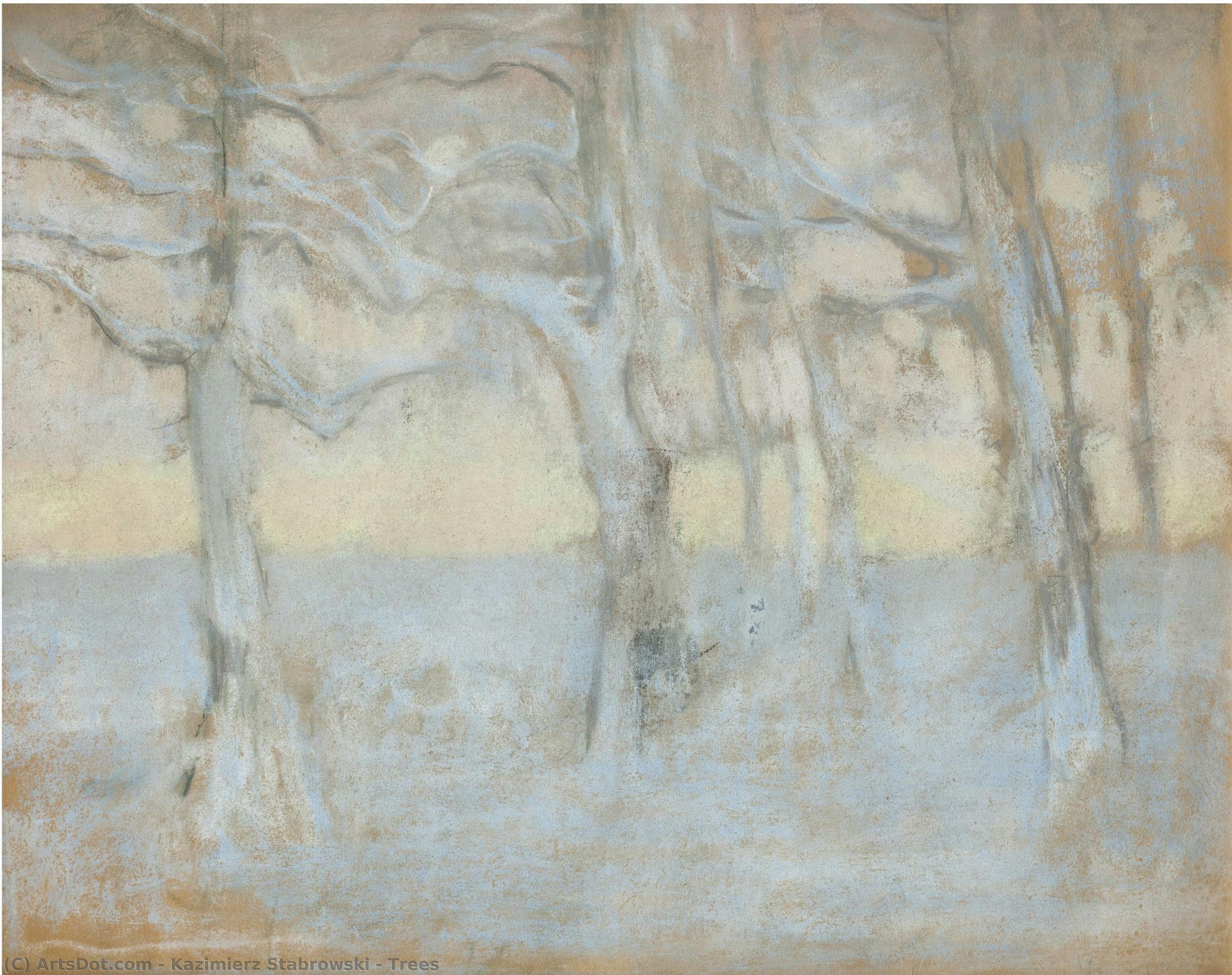
Explore Kazimierz Stabrowski's 'Trees' (1895), a mesmerizing pastel blending symbolism and romanticism. Witness nature's transformation in this unique Polish masterpiece.
Konstnärens biografi
Upptäck Kazimierz Stabrowski (1869-1929), en berömd polsk målare känd för sina drömska symbolistiska landskap och romantiska scener. Rektor för Warszaws konstakademi och grundare av Teosofiska sällskapet i Polen.
Om målningen
Kazimierz Stabrowski's "Trees": A Symbolist Landscape of Transformation
- Artist: Kazimierz Stabrowski (1869-1929)
- Date: 1895
- Medium: Pastel on paper
- Size: 47 x 63 cm
Kazimierz Stabrowski's "Trees" is a captivating pastel drawing that transcends simple representation, offering instead a glimpse into the artist’s exploration of symbolism and romanticism within the natural world. This work, created in 1895, showcases a pivotal moment in Stabrowski's artistic development as he moves away from strict realism towards abstraction, while retaining a profound emotional depth.
Subject Matter & Composition
"Trees" depicts a cluster of trees set against what appears to be a beach or shoreline. The composition is dominated by the verticality of the tree trunks and branches, rendered with loose, flowing lines and blended colors. Unlike traditional landscape paintings that prioritize accurate depiction, Stabrowski prioritizes conveying an atmosphere and feeling. There's no clear focal point; instead, the eye wanders across the dense visual field created by the clustered trees, eventually settling on the hazy background suggesting a distant shoreline. The horizontal format emphasizes the breadth of the scene while maintaining a sense of intimacy through the close proximity of the trees in the foreground.
Style and Technique: A Shift Towards Abstraction
The artwork exemplifies a transition towards abstraction. Stabrowski’s technique is characterized by loose, gestural strokes that capture the essence of the trees rather than their precise form. The blending of colors—primarily muted tones of beige, grey, blue, and brown with subtle hints of yellow and green—creates a hazy, dreamlike effect. This soft palette contributes to the overall melancholic and contemplative mood. The use of pastels lends itself beautifully to this style, creating a velvety texture that enhances the sense of depth and dimension. The lines themselves are not sharp or defined but rather flow into one another, suggesting movement and growth within the trees. It's worth noting the similarities in tree depiction with those found in Mikalojus Konstantinas Čiurlionis’ “Winter” collection (1907), highlighting a shared artistic sensibility of the time.
Symbolism & Emotional Impact
Beyond its aesthetic qualities, "Trees" carries significant symbolic weight. The transforming trees represent change, growth, and potentially even spiritual evolution—themes central to Stabrowski’s interest in symbolism and romanticism. The artist's intention was not merely to depict a scene but to express ideas, feelings, and experiences through the landscape. The hazy atmosphere and muted colors evoke a sense of longing or introspection, inviting viewers to contemplate their own connection to nature and the passage of time. This work is more than just a depiction of trees; it’s an exploration of the human condition within the context of the natural world.
Historical Context & Artistic Significance
Created during a period of artistic experimentation, "Trees" reflects the broader shift away from realism and towards symbolism and abstraction in late 19th-century art. Stabrowski’s work stands as an important example of Polish Symbolism, demonstrating a desire to move beyond mere representation and explore deeper emotional and spiritual truths. His exploration of these themes, combined with his later involvement in the Theosophical Society, further enriches the interpretation of this evocative pastel drawing.
Frågor och svar
Vad föreställer "Trees" av Kazimierz Stabrowski?
Motiven i "Trees" är trees, landscape, symbolism, romanticism, pastel, nature, abstraction, polish art.
Hur förhåller sig motivet i "Trees" till Kazimierz Stabrowskis vanliga teman?
"Trees" skildrar trees, landscape, symbolism, romanticism, pastel, nature, abstraction, polish art, medan Kazimierz Stabrowskis dokumenterade teman är symbolism & romanticism, čiurlionis’ landscape style, transformation and change, spiritual evolution symbolism, polish national identity, exploration of nature's power, early exploration of abstraction. En jämförelse mellan dessa visar hur verket förhåller sig till konstnärens vanliga motiv.
Vilken färgpalett används i "Trees" av Kazimierz Stabrowski?
Färgpaletten i "Trees" av Kazimierz Stabrowski beskrivs som Monochrome. Det är en kortfattad beskrivning av verkets färger.
Snabbfakta och konstquiz
Om Kazimierz Stabrowski

Kazimierz Stabrowski
1869 - 1929, Belarus
Konstnärsbiografi
tidigt liv och utbildning
Kazimierz Stabrowski, en berömd polsk målare, föddes 1869 i Navahrudak, Vitryssland. Han fortsatte sina studier vid den fina konstakademin i Warszawa, där han senare även tillträdde rollen som direktör. Denna avgörande position visade inte bara hans konstnärliga skicklighet utan befäste också hans inflytande över nästa generation av konstnärer.konstnärlig stil och betydande verk
Stabrowskis arbete kännetecknas av sin drömska, symboliska kvalitet, där han ofta väver samman element från symbolismen och romantiken. Ett av hans mest hyllade verk, Snöjungfrun (1891), är ett lysande exempel på denna unika stil som har fångat konstälskares hjärtan i över ett sekel.grundandet av teosofiska sällskapet i Polen
Utöver sina konstnärliga prestationer spelade Stabrowski en betydande roll i etableringen av de första logerna för det teosofiska sällskapet i Polen. Detta filosofiska sällskap, grundat på principer om spiritualitet och det ockulta, understryker ytterligare Stabrowskis mångfacetterade natur.eftermäle och senare liv
Stabrowski gick bort 1929 i Garwolin, Polen, och lämnade efter sig ett arv som fortsätter att inspirera både konstnärer och konstälskare. Hans inflytande kan skönjas i olika aspekter av polsk konst, från konstakademin i Warszawa till hans talrika symboliska och romantiska verk.utvalda verk av Kazimierz Stabrowski på TopImpressionists.com
- Bergets ande (105 x 85 cm, Litauiska konstfonden, Vilnius, Litauen, olja på duk) - ett typexempel på Stabrowskis symboliska stil.
- Colosseum i månskenet (47 x 65 cm, Litauiska konstfonden, Vilnius, Litauen, pastell) - detta verk visar Stabrowskis förmåga att fånga eteriska landskap.
- Träd (47 x 63 cm, Litauiska konstfonden, Vilnius, Litauen, pastell) - en unik blandning av realism och abstrakt bildspråk, karakteristisk för Stabrowskis senare arbete.
museer som visar Kazimierz Stabrowskis verk på TopImpressionists.com
- Litauiska konstfonden (Vilnius, Litauen) - denna institution hyser flera av Stabrowskis betydande verk, inklusive de som nämnts ovan.
Snabbfakta om Kazimierz Stabrowski
- Artistic Movement Or Style: Symbolism
- Artists Who Influenced This Artist:
- Gustav Klimt
- Jean Sibelius
- Date Of Birth: 21 november 1869
- Date Of Death: 10 juni 1929
- Full Name: Kazimierz Stabrowski
- Nationality: Polsk
- Notable Artworks:
- Snöflickan
- Träd
- Rom. Fontana Dei Cavalli Marini
- Place Of Birth: Kruplyany, Vitryssland

Kazimierz Stabrowski
Trees
() ·
Med ram: · Handmålad med olja på linne
Totalt