
Shown: · With its frame:
 Förhandsvisa
 Skicka
 Dela
Dela
 Visa detaljer
 Guide
Guide

 Ladda ner
 Liknande objekt
 Röntgen
 Bildspel
 Q&A
Q&A Statistik

Skr 2701
Handgjord oljereproduktion
Handmålad olja på duk i din valda storlek och ram, tillverkad efter beställning av våra konstnärer. ( Byt till tryck Byt till digital bild)
Detta konstverk är upphovsrättsligt skyddat
Konstverket som visas på denna sida skyddas av upphovsrättslagen, vilket innebär att vi inte lagligt kan skapa eller sälja en identisk reproduktion. Detta skydd upprätthålls genom internationella avtal såsom den Bernkonventionen och genom nationella lagar, inklusive de som fastställs av Amerikansk upphovsrättslag – Titel 17. Alla rättigheter förbehållna. Återgivning av konstverk är förbjuden utan skriftligt tillstånd från WahooArt.
Som ett respektfullt och lagligt alternativ erbjuder vi skräddarsydda, handmålade konstverk inspirerade av originalet. Våra skickliga och professionella konstnärer studerar noggrant originalets stil, stämning och konstnärliga essens för att skapa ett nytt, unikt verk som väcker samma känsla – samtidigt som det förblir en originell skapelse i egen rätt.
Denna metod följer fullt ut upphovsrättsliga regler eftersom den inte innebär kopiering eller duplicering av det skyddade konstverket. Istället är det en kreativ nytolkning – en ny målning som är influerad av originalet men inte identisk med det.
 Läs mer
Size
·Standardstorlek
skräddarsydd
CM
INCH
Välj bland våra förinställda storlekar som motsvarar konstverkets ursprungliga proportioner.
Loading sizes...

bredd
höjd
Ange den bredd och höjd du behöver för att passa din ram eller din vägg. Eftersom detta är handmålat kan konstnären, vid ett annat format, måla lite mer runt bilden eller beskära den något – det är du som väljer. Vi skickar en digital mockup för godkännande innan målningen påbörjas. Bilden som visas på denna sida representerar inte det slutgiltiga resultatet — det är endast mockuppen som visar det.
Finish
·
White Skr1

Blurside Skr1

Extended Skr1

P118B Skr10

P118H Skr10

P118W Skr10

P438Z Skr10

P508JH Skr12

P508YH Skr12

P805H Skr10

P805Z Skr10

P919BZ Skr10

P919G Skr10

P919XJ Skr10

P959ZH Skr10

P968JZ Skr12

W106C Skr8

W218G Skr10

W218JH Skr8

W218Y Skr10

W307PJ Skr10

W316G Skr10

W316PJ Skr8

W316Y Skr10

W398PJ Skr8

W4111J Skr10

W500HY Skr15

W500JH Skr15

W692G Skr12

W849H Skr8

W940BG Skr15

W953PJ Skr8

H24-GOLD Skr30

H24-SILVER Skr30

H36-GOLD Skr45

H36-SILVER Skr45
Shipped in a protective tube, ready for your own framer.
Above 105 cm the frame is shipped as a kit for a professional framer — read the details.
Extras
optionalWhat do the extras include?
Examples of what can be changed: Replace face with customer photo; Add pet (e.g., replace cat with dog); Include hidden message in background; Change background landscape or elements.
After order, TopImpressionists.com team will email client for instructions and provide a mockup preview
After order, TopImpressionists.com team will email client for instructions and provide a mockup preview
Leverans över hela världen () på 3–4 veckor istället för standard 5 veckor. (3 november). Inga kompromisser med kvaliteten.
Skyddande fernissa
Namnskylt
Detaljer för graverad bronsplatta
This elegant plaque features the artist's name and the title of the artwork, finely engraved for a timeless presentation.
It is made from bronze with a refined, elegant finish. The text is precisely laser-engraved for a sharp and permanent result. Measuring 9x2 cm, the plaque is compact yet easy to read. It's built to be durable and scratch-resistant, offering a professional, museum-quality look. Mounting is simple thanks to the included adhesive backing.
Detaljer för transparent akrylplatta
The plaque includes essential engraved details such as the artist's name, the title of the artwork, the date it was created, the type of media used-like oil on canvas or watercolor-a brief description of the piece, and a QR code that links to the complete artwork information.
It is crafted from clear acrylic, offering a sleek, modern appearance. The text is UV-engraved in black to ensure strong visual contrast. With a size of 10x15 cm, it ensures optimal readability. It comes equipped with two metal hooks for secure wall mounting. The plaque is designed to be weather-resistant, making it suitable for various environments, and it includes interactive features that work seamlessly with smartphone scanning.
Detaljer för svart akrylplatta
This elegant plaque includes engraved information such as the artist's name, the title of the artwork, the date it was created, the type of media used (like oil on canvas or watercolor), a short description of the artwork, and a QR code for quick access to more information.
The plaque itself is made from refined black acrylic with a premium finish. The text is laser-engraved in white for high contrast and readability. Its size is 10x15 cm, designed to be easy to read. It comes with two metal hooks for professional mounting. The design is sleek and fits any interior style. It is also weather-resistant and durable, with built-in digital integration for mobile compatibility.
Glasalternativet är endast tillgängligt i storlekar under 110 cm.
 Glasalternativet är endast tillgängligt i storlekar under 110 cm.
- Fri expressfrakt över hela världen
- Högkvalitativ linnecanvas
- Fullständig fraktförsäkring
- Garantier för återbetalning av tullavgifter
- Garantier för exakt färgåtergivning
- 100 dagars returrätt (endast vid fel)
- 100% pengarna tillbaka-garanti
- Mängdrabatt erbjuds


Beskrivning av samlarobjekt
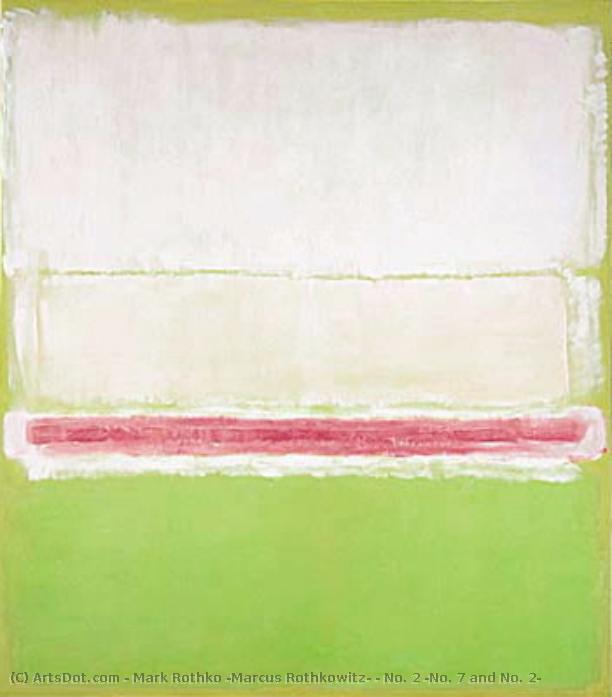
Upptäck Mark Rothkos Nr 2 (Nr 7 och Nr 2), ett kraftfullt Color Field-verk präglat av kontraster mellan grönt och rött. Inspirerad av konstnärliga influenser som Regina Aprijaskis och Basilica di San Marco.
Konstnärens biografi
Utforska Mark Rothko (1903-1970) ikoniska Color Field målningar & Abstrakta Expressionismen! Upptäck känslornas djup och konstnärns betydelsefulla arv inom modern konst.
About the painting
Mark Rothko och den röda och gröna dialogen
Mark Rothko är en konstnär vars verk fortsätter att fascinera oss än idag. Hans minimalistiska målningar, särskilt serien ”No. 2 (No. 7 och No. 2)” från 1951, erbjuder ett djupgående perspektiv på abstrakt konst och dess förmåga att väcka känslor. Detta mästerverk är inte bara en fråga om färger utan också om hur dessa färger interagerar för att skapa en komplex och ofta överraskande visuell upplevelse. För att verkligen förstå dess betydelse måste vi dyka ner i både konstnärens liv och den historiska kontext där hans arbete föddes. Rothko föddes 1903 i Dvinsk, Latvia, till ett judiskt familjemedlem som levde under svåra omständigheter präglade av pogromer och politisk oro. Dessa tidiga erfarenheter väckte en djup känsla för mänskligt lidande vilket skulle komma att påverka hela hans konstnärliga produktion. Efter immigrerationen till Portland, Oregon 1913, möttes han av kulturella förändringar och ett nytt perspektiv på livet – något som ytterligare bidrog till hans konstnärliga utveckling. Förlusten av hans far kort efter deras ankomst var en tragedi som lämnade ett bestående avtryck och inspirerade honom att utforska teman kring förlust och existens. Detta fokus på mänsklig erfarenhet är något som återkommer genom hela hans karriär och förstår man detta kommer man långt när man försöker tolka hans konstverk. Rothko utvecklade sin egen unika stil inom Color Field Painting, en rörelse som föddes i mitten av 1950-talet och där målningar domineras av stora områden av rena färger utan några andra dekorativa element. Tekniken är enkel men effektiv: Rothko applicerade tjocka lager av färg direkt på duken med hjälp av penseldrag eller speciella tekniker som användes för att skapa ett slags ”fält” där färgen själv blir huvudfokus. Detta kontrasterar starkt mot tidigare konstnärliga traditioner och betonar vikten av själva färgens egenskaper och deras förmåga att skapa atmosfär och emotionell resonans. Ett särskilt viktigt verk är "No. 2 (No. 7 och No. 2)", där Rothko använder två sammanhängande röda och två sammanhängande gröna rektanglar för att skapa ett visuellt språk som är både subtilt och kraftfullt. Det röda och det gröna i målningen är inte bara färger utan också symboler. Röda kan associeras med passion, energi och kärlek men också med fara och död – vilket speglas i målningens djup och komplexitet. Grönt representerar ofta tillväxt, harmoni och balans samt även natur och jord – vilket skapar en kontrast till den röda färgens intensitet och bidrar till ett övergripande känsla av stabilitet och lugn. Detta är dock inte bara estetiskt tilltalande utan också ett resultat av Rothko’s filosofiska reflektioner kring livet och döden samt hans önskan att skapa konst som kan väcka frågor om vår plats i världen. Slutligen är det emotionella intrycket från ”No. 2 (No. 7 och No. 2)” något som ofta beskrivs som meditativt och nästan transcendentellt. Målningen uppmanar tittaren att släppa taget om sina tankar och känslor och låta sig dras in i färgens egen rytm och energi. Detta är ingen konstverk som erbjuder enkla svar utan snarare ett verk som väcker frågor om mening och existens – vilket gör det till en särskilt relevant och inspirerande investering för alla som söker konst som kan beröra själen. Reproduktioner av detta mästerverk erbjuder möjligheten att uppleva denna djupa estetiska och filosofiska erfarenhet även utan att nödvändigtvis vara närvarande vid själva målningen.Frågor och svar
Kan jag se "Nr 2 (Nr 7 och Nr 2)" av Mark Rothko på min egen vägg innan jag köper den?
"Nr 2 (Nr 7 och Nr 2)" av Mark Rothko kan förhandsvisas på din egen vägg via konstverkets Förhandsvisning i AR-sida med hjälp av förstärkt verklighet (AR) på en kompatibel enhet.
Är "Nr 2 (Nr 7 och Nr 2)" av Mark Rothko fri från upphovsrätt?
När det gäller upphovsrätt är "Nr 2 (Nr 7 och Nr 2)" fortfarande skyddat av upphovsrätt.
Vilken teknik användes för "Nr 2 (Nr 7 och Nr 2)" av Mark Rothko?
"Nr 2 (Nr 7 och Nr 2)" är utförd i Akryl på duk.
Quick facts and art quiz
About Mark Rothko

Mark Rothko
1903 - 1970, Lettland
Konstnärsbiografi
Early Life and the Seeds of Artistic Vision
Mark Rothko, born Markus Yakovlevich Rothkowitz in Dvinsk, Latvia, in 1903, carried within him from the outset a sense of displacement that would profoundly shape his artistic journey. His early years were marked by the anxieties of a Jewish family living within the Pale of Settlement, shadowed by pogroms and political unrest. This atmosphere instilled a deep sensitivity to human suffering, a theme that would resonate throughout his oeuvre. The 1913 immigration to Portland, Oregon, represented not just a geographical shift but a cultural upheaval for the young Rothko. While his father, a pharmacist and intellectual with socialist leanings, fostered a home filled with debate and learning, the loss of Jacob Rothkowitz shortly after their arrival cast a long shadow. This early experience of loss, coupled with the challenges of assimilation, fueled a lifelong exploration of existential themes – mortality, trauma, and the search for meaning in a chaotic world. Though he excelled academically at Yale University, Rothko found himself drawn more to the vibrant energy of New York City, abandoning formal studies to pursue his passion for art at the Art Students League. These formative years laid the groundwork for an artistic vision that would ultimately challenge conventional notions of painting and redefine the emotional power of color.From Figurative Beginnings to Abstract Expressionism
Rothko’s initial artistic explorations were firmly rooted in realism, depicting urban scenes and portraits with a keen eye for detail. However, these early works already hinted at the psychological depth that would become his hallmark. As the 1940s unfolded, and the world grappled with the horrors of World War II, Rothko’s art underwent a dramatic transformation. Influenced by Surrealism and mythology, he began to move away from representational imagery, seeking instead to express universal human emotions through symbolic forms. This period saw the emergence of multi-form paintings – canvases populated by ambiguous, biomorphic shapes that seemed to hover between figuration and abstraction. These works were not merely experiments in form; they were deeply felt responses to the anxieties and uncertainties of a world at war. By the late 1940s, Rothko had arrived at his signature style: large-scale canvases featuring rectangular blocks of color that appeared to float and resonate with one another. He stripped away all vestiges of recognizable imagery, focusing instead on the pure emotional impact of color and form. This marked a pivotal moment in the development of Abstract Expressionism, and established Rothko as a leading figure in this groundbreaking movement.The Color Field and the Pursuit of Transcendence
Rothko’s mature work is defined by what came to be known as “Color Field” painting – vast expanses of luminous color that envelop the viewer in an immersive experience. These paintings are not about *what* they depict, but rather *how* they make you feel. Rothko believed that art should engage the viewer viscerally, bypassing intellectual analysis and speaking directly to the emotions. He meticulously layered thin washes of paint, creating subtle variations in tone and texture that seemed to emanate from within the canvas. The edges of his rectangular forms are often blurred, allowing them to blend and interact with one another, creating a sense of depth and movement. Rothko deliberately avoided titles beyond numbers – “No. 1,” “No. 6” – encouraging viewers to confront the paintings without preconceived notions and allow their own emotional responses to guide their experience. He sought to create a space for contemplation, a sanctuary where viewers could connect with something larger than themselves. His ambition was nothing less than to evoke profound spiritual experiences through the language of color.Major Achievements and Lasting Legacy
Among Rothko’s most significant achievements are “No. 10 (1950),” a pivotal work that exemplifies his evolving style, and the Seagram Murals (1958). Commissioned for the Four Seasons Restaurant in New York City, these murals were ultimately rejected by Rothko, who felt they would be compromised by their intended environment. He instead donated them to the Tate Gallery in London, where they continue to inspire awe and contemplation. Perhaps his most ambitious project was the Rothko Chapel (1971) in Houston, Texas – a non-denominational sanctuary housing fourteen of his paintings. Designed as a space for quiet reflection, the chapel is considered a sacred place by many, embodying Rothko’s belief in the spiritual power of art. Rothko's influence on subsequent generations of artists has been immense. He paved the way for Minimalist art and continues to inspire contemporary painters who explore the emotional possibilities of abstraction. Despite struggling with depression throughout his life, culminating in his tragic suicide in 1970, Mark Rothko remains one of the most important and influential artists of the 20th century – a master of color whose work continues to resonate with audiences around the world.The Enduring Power of Emotional Resonance
- Rothko’s paintings are celebrated for their ability to convey universal human emotions—tragedy, ecstasy, despair, and hope.
- His exploration of color as a vehicle for emotional expression revolutionized abstract painting.
- The Rothko Chapel stands as a testament to his belief in the spiritual power of art.
- He remains a pivotal figure in Abstract Expressionism and a major influence on contemporary artists.
Quick facts about Mark Rothko
- Artistic Movement Or Style: Color Field Painting
- Artists Or Movements Influenced By This Artist: ['Minimalism']
- Date Of Birth: September 25, 1903
- Date Of Death: February 25, 1970
- Full Name: Mark Rothko
- Nationality: Russisk
- Notable Artworks:
- No. 10 (1950)
- Seagram Murals
- Rothko Chapel
- Place Of Birth: Dvinsk, Latvia
Utforska konstverk sorterade efter tema, stil och egenskaper.


Mark Rothko
Nr 2 (Nr 7 och Nr 2)
() ·
With its frame: · Hand-painted in oil on linen
Total