

 Förhandsvisa
 Skicka
 Dela
Dela
 Visa detaljer
 Guide
Guide

 Ladda ner
 Liknande objekt
 Röntgen
 Bildspel
 Statistik
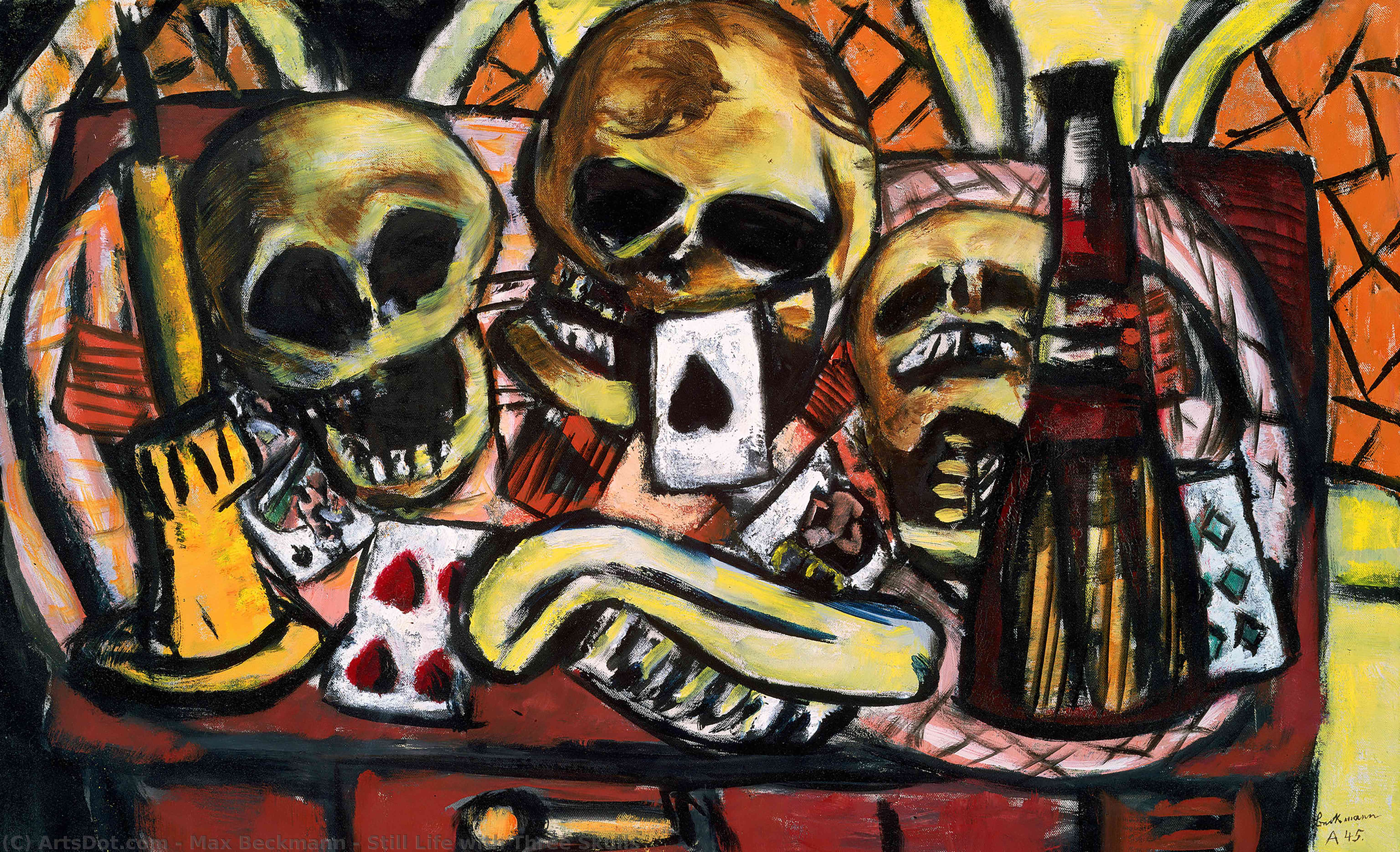
Still Life with Three Skulls


Three haunting skulls and scattered bottles create a profound sense of mortality in this powerful German Expressionist still life by Max Beckmann, inviting you to explore the depths of this evocative masterpiece.
 Visa mer
Upptäck Max Ernsts surrealistiska mästerverk 'Europa efter regnet II', skapad 1942! Ett färgstarkt landskap och komplexa detaljer som väcker fantasin – perfekt för konstälskare!
Get a print-ready file that goes far beyond the web preview. Every digital image we sell comes from a high-resolution master in our stock database — usually 5,000 to 15,000 pixels wide — so you can print large, crop tightly, or reproduce fine detail with confidence.
No file leaves our studio untouched. A digital expert checks the colors against the original painting and corrects them if needed, then improves clarity and detail with professional retouching tools — always staying faithful to the artist's brushwork and style. The result is an image that looks like the painting, not like a filtered scan.
You approve before you're done: our expert sends the image by e-mail within 72 hours for your review. Not satisfied? Ask for improvements or corrections, or request a refund if the quality falls short.
This is the quality relied on by publishers, design studios, galleries and print shops.
Digital bild
Ladda ner en högupplöst fil för personlig visning, utskrift och kreativa projekt. ( Byt till tryck Beställ handmålad reproduktion)
Ingår i varje beställning av digital bild
Professionell digital leverans, garanterad
När du väljer TopImpressionists.com får du inte bara en bild – du får ett professionellt förädlat digitalt konstverk, skapat med precision och med en garanterad tillfredsställelse. Här är allt som ingår i din beställning, automatiskt:

Snabb leverans via e-post
Din högupplösta digitala bild skickas till dig via e-post inom 72 timmar efter beställning – redo för omedelbar användning.

AI-förbättrad digital fil
Ditt konstverk optimeras professionellt med hjälp av avancerade AI-verktyg och manuell redigering, vilket garanterar maximal detaljrikedom, skärpa och färgnoggrannhet.

Fri livstidsåterleverans
Har du råkat radera eller tappa bort din fil? Ingen oro – vi skickar den kostnadsfritt till dig när som helst.

Inga importavgifter – någonsin
Njut av ditt konstverk omedelbart utan tull, importavgifter eller leveranskostnader – digitala nedladdningar är alltid skattefria.

Garanterad färgåtergivning
Vi säkerställer att din digitala bild återger de ursprungliga färgerna så exakt som möjligt med hjälp av professionella verktyg och färghantering.

100 dagars nöjdhetsgaranti
Om du inte är nöjd med din digitala bild kommer vi att revidera den eller återbetala 100% inom 100 dagar – utan frågor.

100% pengarna-tillbaka-garanti
Inte nöjd? Få full återbetalning inom 100 dagar efter att du mottagit din digitala fil – utan frågor.

Rabatt vid storköp
Köp 3 bilder, spara 10% – Köp 5, spara 15% – Köp 10+, spara 20%. Perfekt för kreativa projekt, gallerier och byråer.
A Memento Mori in Modernity
In the hauntingly evocative Still Life with Three Skulls, the viewer is invited into a somber, introspective space where the boundaries between life and death blur through the lens of German Expressionism. Max Beckmann, a master of capturing the psychological weight of the human condition, presents a composition that transcends mere tabletop arrangement. The painting features three skulls arranged across a dark, textured surface, their hollow sockets staring back with an unsettling permanence. Interspersed among these skeletal remains are various bottles and a solitary knife, objects that ground the macabre subject matter in a domestic, almost mundane reality. This juxtaposition creates a profound tension, as the everyday items of life sit alongside the undeniable symbols of mortality.
The technique employed by Beckmann is nothing short of visceral. Eschewing the delicate smoothness of classical still lifes, he utilizes a bold, distorted approach to space and form that reflects his experience as a medical orderly during World War I. The brushwork feels heavy and deliberate, imbuing each object with a sense of sculptural weight. There is a rhythmic quality to the placement of the bottles—one perched in the upper right, another near the center, and a third anchoring the lower left—which guides the eye through a labyrinth of light and shadow. This use of chiaroscuro, reminiscent of the Old Masters like Rembrandt, serves to heighten the drama, pulling the skulls out of the darkness and forcing a confrontation with their stark, bony architecture.
Symbolism and the Weight of Existence
To gaze upon this work is to engage with the ancient tradition of memento mori—the reminder that death is an ever-present companion. However, Beckmann breathes a modern, existential dread into this classical theme. The skulls are not merely decorative symbols; they represent the fragility of the human ego and the inevitable decay of all material things. The presence of the knife adds a layer of latent violence or perhaps the surgical precision of fate, while the bottles suggest the fleeting pleasures of the senses that cannot stave off the end. For the collector or interior designer, this piece offers more than just visual interest; it provides a profound intellectual anchor for a room, sparking conversation about the cyclical nature of life and the enduring legacy of human struggle.
For those seeking to integrate such a powerful work into a curated space, a high-quality reproduction of Still Life with Three Skulls serves as a centerpiece of immense character. It is an ideal selection for a study, a library, or a sophisticated gallery wall where art is intended to provoke thought and evoke emotion. The painting’s dark palette and commanding presence allow it to harmonize with rich textures like leather, dark wood, and velvet, creating an atmosphere of timelessness and intellectual depth. Owning this piece is an invitation to contemplate the beauty found within the shadows and to appreciate the raw, unfiltered truth of the human experience as captured by one of the twentieth century's most significant artistic voices.
Frågor och svar
Är färgerna i "Still Life with Three Skulls" av Max Beckmann klara eller dämpade?
"Still Life with Three Skulls" av Max Beckmann återges med en Balanced Soft mättnad och en Balanced intensitet.
Vilket format har "Still Life with Three Skulls"?
"Still Life with Three Skulls" av Max Beckmann har ett Panoramic-format. Formatet beskriver kompositionens proportioner.
Hur kan jag köpa ett tryck av "Still Life with Three Skulls" av Max Beckmann?
Ett tryck av "Still Life with Three Skulls" av Max Beckmann kan beställas direkt på dess Konsttryck i hög kvalitet-sida: ett konsttryck på bomullscanvas eller arkivbeständigt canvaspapper.
Konstnärsbiografi
Early Life and Artistic Development
Max Beckmann, a German painter, draftsman, printmaker, sculptor, and writer, was born on February 12, 1884, in Leipzig, Saxony. His artistic journey commenced with academically correct depictions—a stylistic choice reflecting the prevailing academic tradition of his time—which subsequently underwent a dramatic transformation into distorted figures and spaces. This shift mirrored Beckmann’s profoundly altered perception of humanity following his harrowing experience as a medical orderly during World War I, an event that indelibly shaped his artistic vision. The trauma of witnessing the horrors of war instilled in him a preoccupation with themes of suffering and decay, influencing his stylistic evolution.Artistic Style and Influences
Beckmann’s distinctive style drew inspiration from a diverse array of artists, establishing connections to movements like Expressionism and Neue Sachlichkeit. Notably, he acknowledged the profound impact of Cézanne's geometric explorations on his compositional approach, mirroring Cézanne's deliberate simplification of forms. Furthermore, Vincent van Gogh’s expressive brushwork served as a crucial model for Beckmann’s technique—a bold departure from academic conventions—capturing the emotional intensity characteristic of Van Gogh’s oeuvre. Blake’s visionary imagery and Rembrandt’s masterful use of chiaroscuro also exerted considerable influence on Beckmann's artistic sensibilities, guiding him toward conveying psychological depth and dramatic tension. Finally, Rubens’ monumental canvases instilled in Beckmann a fascination with grandeur and theatrical presentation.Notable Works and Exhibitions
Beckmann’s oeuvre encompasses a remarkable range of subjects—from landscapes imbued with symbolic resonance to portraits capturing the complexities of human emotion—demonstrating his versatility as an artist. Among his most celebrated creations is “The Bark,” acquired by the National Gallery in Berlin, a monumental canvas depicting a desolate seascape rendered with meticulous detail and conveying a palpable sense of isolation. Equally significant is “Self-Portrait in Tuxedo,” purchased in 1928, which presents Beckmann’s self-image as a figure grappling with existential anxieties—a testament to his introspective artistic spirit. Beckmann's work was showcased in retrospectives at the Städelschule Mannheim (1928) and Basel and Zurich (1930), cementing his position as one of the foremost artists of his era.Later Life and Exile
Beckmann’s life took a decisive turn with the ascent of Adolf Hitler to power, triggering his expulsion from the Frankfurt Art School and resulting in the confiscation of over 500 of his artworks—a devastating blow to his artistic career and personal freedom. Forced into exile, he sought refuge in Amsterdam for ten years, enduring bureaucratic obstacles that prevented him from securing a visa for the United States. During this period, Beckmann continued to produce prolifically, exploring themes of displacement and resilience—themes that would permeate his subsequent artistic endeavors. His unwavering commitment to artistic integrity fueled his determination to resist Nazi oppression and preserve his creative vocation.Legacy
Max Beckmann’s enduring legacy resides in his profound contribution to German Expressionism and his exploration of existential concerns through art. He was honored as a teacher at Washington University in St. Louis and the Brooklyn Museum, nurturing the talents of aspiring artists and fostering intellectual discourse. His first retrospective in the United States occurred in 1948 at the City Art Museum, Saint Louis, marking a pivotal moment in recognizing his artistic significance on an international scale. Beckmann’s unwavering belief in the transformative power of art—expressed eloquently in his correspondence with fellow artist Marie-Louise von Motesiczky—continues to inspire artists and scholars alike. Max Beckmann's influence extends beyond the realm of painting, permeating literature and philosophy, solidifying his place as a multifaceted intellectual figure who wrestled with profound questions about human existence.
Max Beckmann
1884 - 1950 , Tyskland
Kort om konstnären
- Artistic Movement Or Style: Expressionism
- Artists Or Movements Influenced By This Artist: ['Georges Seurat']
- Artists Who Influenced This Artist:
- Rembrandt
- Bosch
- Date Of Birth: Feb 12, 1884
- Date Of Death: Dec 27, 1950
- Full Name: Max Carl Friedrich Beckmann
- Nationality: German
- Notable Artworks:
- The Bark
- Self-Portrait in Tuxedo
- Place Of Birth: Leipzig, Germany