

Shown: · With its frame:
 Förhandsvisa
 Skicka
 Dela
Dela
 Visa detaljer
 Guide
Guide

 Ladda ner
 Liknande objekt
 Röntgen
 Bildspel
 Q&A
Q&A Statistik


Skr 2702
Handgjord oljereproduktion
Handmålad olja på duk i din valda storlek och ram, tillverkad efter beställning av våra konstnärer. ( Byt till tryck Byt till digital bild)
Size
·Standardstorlek
skräddarsydd
CM
INCH
Välj bland våra förinställda storlekar som motsvarar konstverkets ursprungliga proportioner.
Loading sizes...

bredd
höjd
Ange den bredd och höjd du behöver för att passa din ram eller din vägg. Eftersom detta är handmålat kan konstnären, vid ett annat format, måla lite mer runt bilden eller beskära den något – det är du som väljer. Vi skickar en digital mockup för godkännande innan målningen påbörjas. Bilden som visas på denna sida representerar inte det slutgiltiga resultatet — det är endast mockuppen som visar det.
 Läs mer
Finish
·
White Skr1

Blurside Skr1

Extended Skr1

P118B Skr10

P118H Skr10

P118W Skr10

P438Z Skr10

P508JH Skr12

P508YH Skr12

P805H Skr10

P805Z Skr10

P919BZ Skr10

P919G Skr10

P919XJ Skr10

P959ZH Skr10

P968JZ Skr12

W106C Skr8

W218G Skr10

W218JH Skr8

W218Y Skr10

W307PJ Skr10

W316G Skr10

W316PJ Skr8

W316Y Skr10

W398PJ Skr8

W4111J Skr10

W500HY Skr15

W500JH Skr15

W692G Skr12

W849H Skr8

W940BG Skr15

W953PJ Skr8

H24-GOLD Skr30

H24-SILVER Skr30

H36-GOLD Skr45

H36-SILVER Skr45
Shipped in a protective tube, ready for your own framer.
Above 105 cm the frame is shipped as a kit for a professional framer — read the details.
Extras
optionalWhat do the extras include?
Examples of what can be changed: Replace face with customer photo; Add pet (e.g., replace cat with dog); Include hidden message in background; Change background landscape or elements.
After order, TopImpressionists.com team will email client for instructions and provide a mockup preview
After order, TopImpressionists.com team will email client for instructions and provide a mockup preview
Leverans över hela världen () på 3–4 veckor istället för standard 5 veckor. (2 november). Inga kompromisser med kvaliteten.
Skyddande fernissa
Namnskylt
Detaljer för graverad bronsplatta
This elegant plaque features the artist's name and the title of the artwork, finely engraved for a timeless presentation.
It is made from bronze with a refined, elegant finish. The text is precisely laser-engraved for a sharp and permanent result. Measuring 9x2 cm, the plaque is compact yet easy to read. It's built to be durable and scratch-resistant, offering a professional, museum-quality look. Mounting is simple thanks to the included adhesive backing.
Detaljer för transparent akrylplatta
The plaque includes essential engraved details such as the artist's name, the title of the artwork, the date it was created, the type of media used-like oil on canvas or watercolor-a brief description of the piece, and a QR code that links to the complete artwork information.
It is crafted from clear acrylic, offering a sleek, modern appearance. The text is UV-engraved in black to ensure strong visual contrast. With a size of 10x15 cm, it ensures optimal readability. It comes equipped with two metal hooks for secure wall mounting. The plaque is designed to be weather-resistant, making it suitable for various environments, and it includes interactive features that work seamlessly with smartphone scanning.
Detaljer för svart akrylplatta
This elegant plaque includes engraved information such as the artist's name, the title of the artwork, the date it was created, the type of media used (like oil on canvas or watercolor), a short description of the artwork, and a QR code for quick access to more information.
The plaque itself is made from refined black acrylic with a premium finish. The text is laser-engraved in white for high contrast and readability. Its size is 10x15 cm, designed to be easy to read. It comes with two metal hooks for professional mounting. The design is sleek and fits any interior style. It is also weather-resistant and durable, with built-in digital integration for mobile compatibility.
Glasalternativet är endast tillgängligt i storlekar under 110 cm.
 Glasalternativet är endast tillgängligt i storlekar under 110 cm.
- Fri expressfrakt över hela världen
- Högkvalitativ linnecanvas
- Fullständig fraktförsäkring
- Garantier för återbetalning av tullavgifter
- Garantier för exakt färgåtergivning
- 100 dagars returrätt (endast vid fel)
- 100% pengarna tillbaka-garanti
- Mängdrabatt erbjuds


Beskrivning av samlarobjekt
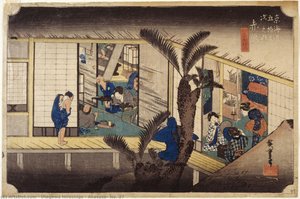
Experience Utagawa Hiroshige's "Asakusa River" – a stunning woodblock print capturing a serene night scene with boats and figures, reflecting Edo Japan’s poetic beauty.
Konstnärens biografi
Utagawa Hiroshige (1797-1858) var en japansk konstnär känd för sina poetiska landskapsbilder, särskilt Fifty-three Stations of the Tōkaidō och One Hundred Famous Views of Edo. Hans stil inspirerade impressionister som Van Gogh och är central för ukiyo-e traditionen.
About the painting
The Essence of a Nighttime Journey
Utagawa Hiroshige’s “Asakusa River” isn't merely a depiction of a scene; it’s an immersion into the heart of Edo-era Tokyo. Painted in 1857, during a period of profound transformation for Japan – grappling with Western influence while clinging fiercely to its traditions – this woodblock print captures a fleeting moment of serenity amidst bustling urban life. The image unfolds like a carefully orchestrated memory: a lone boat glides along the Sumida River under a velvet night sky, reflecting the distant glow of lanterns and the subtle shimmer of water. It’s a scene imbued with a quiet melancholy, a poignant awareness of time's passage, characteristic of Hiroshige’s signature style.
Technique and the Art of *Ukiyo-e*
Hiroshige’s mastery lies in his meticulous application of *ukiyo-e*, or “pictures of the floating world.” This technique, perfected over centuries, involved carving intricate designs onto wooden blocks – one block for each color – then painstakingly printing them onto paper. “Asakusa River” exemplifies this process brilliantly. The artist employs a delicate gradation of Prussian blue and grey to render the sky, creating an atmospheric depth that belies the relatively flat surface of the print. Notice how subtle variations in tone suggest movement within the water and the gentle sway of the boat. The use of *nagashi-zuri*, or loose-ink washes, adds a sense of fluidity and spontaneity, mimicking the ephemeral nature of light and shadow. The composition itself is carefully balanced – the boat’s trajectory draws the eye across the scene, while the distant trees and buildings provide grounding elements.
A Window into Edo Life
Asakusa in 1857 was a vibrant hub, a crossroads of commerce, religion, and entertainment. The temple of Sensō-ji, visible faintly in the background, stood as a focal point for pilgrims and locals alike. The river served as a vital artery for trade and transportation, connecting the city to its surrounding regions. Hiroshige’s choice to depict a simple boat journey – a commonplace activity for many Edo residents – elevates it into something profound. It speaks to the everyday rhythms of life, the quiet moments of contemplation amidst the constant flow of urban activity. The inclusion of figures in the boat, though largely obscured, hints at the human element within this landscape.
Symbolism and a Poetic Mood
Beyond its realistic depiction, “Asakusa River” is rich with symbolic meaning. The lone boat can be interpreted as representing the journey of life itself – a solitary voyage through an uncertain world. The river, a recurring motif in Hiroshige’s work, symbolizes both passage and transformation. The muted colors and soft lighting evoke a sense of nostalgia and melancholy, reflecting the artist's awareness of the fleeting nature of beauty and the inevitable decline of traditional Japan. It is a testament to Hiroshige’s ability to capture not just a scene, but an entire mood – a poignant meditation on time, memory, and the enduring spirit of Edo.
Collecting and Displaying This Masterpiece
Reproductions of “Asakusa River” are available in various sizes and mediums, offering collectors a chance to bring this iconic image into their homes. Consider framing it with simple, natural wood to complement the print’s understated elegance. Its calming aesthetic would be particularly well-suited for spaces seeking tranquility – bedrooms, libraries, or meditation rooms. The print's subtle color palette also harmonizes beautifully with a range of interior design styles, from minimalist to traditional Japanese.
Frågor och svar
Är "Asakusa River:" fri från upphovsrätt?
När det gäller upphovsrätt är "Asakusa River:" allmän egendom – upphovsrätten har löpt ut.
Är "Asakusa River:" av Utagawa Hiroshige ett ljust eller mörkt konstverk?
"Asakusa River:" av Utagawa Hiroshige har registrerats med en ljusstyrka på deep_shadow och en luminans på Soft Shadow.
Var i Utagawa Hiroshiges karriär placeras "Asakusa River:", med tanke på dess datum?
Med tanke på sitt datum från 1857, tillhör "Asakusa River:" Utagawa Hiroshiges Late Period.
Quick facts and art quiz
About Utagawa Hiroshige

Utagawa Hiroshige
1797 - 1858, Japan
Konstnärsbiografi
A Poetic Vision of Edo Japan: The Life and Art of Utagawa Hiroshige
Utagawa Hiroshige, född Andō Tokutarō 1797 i den pulserande staden Edo (modern Tokyo), står som en central figur i världen av *ukiyo-e*, eller ”bilder från det flytande världens” konst. Trots att han var djupt rotad i traditionerna inom japansk träsnitt, överträffade Hiroshige enkel kopiering och infogade sin poetiska känsla i landskap som resonerade djupt både inom Japan och senare, över hela den västerländska konstvärlden. Hans liv utspelades under en period av relativt fred och välstånd under Tokugawa-shogunatet, men också en tid präglad av ökande social förändring och slutligen västerländisering – krafter som bidrog till *ukiyo-e*:s nedgång även om de förstärkte Hiroshiges bestående arv. Initialt var han tänkt att följa en mer konventionell väg inom en samurajfamilj – hans far tjänstgjorde som brandvakt i Edo – men hans konstnärliga ambitioner ledde honom till lärlingskap under Utagawa Toyohiro, en mästare inom Utagawas skola. Detta blev en avgörande vändpunkt, som styrde honom bort från de populära representationerna av kurtisaner och skådespelare som många *ukiyo-e*-konstnärer föredrog, mot ett fokus på landskap – ett genre han skulle slutligen omdefiniera.From Genre Scenes to Evocative Landscapes
Hiroshiges tidiga verk följde skolans konventioner, med porträtt och scener från vardagslivet. Men det var hans omfamning av landskapet som verkligen skiljde honom ut. Påverkade av tidigare mästare som Hokusai – vars *Trettiosex vyder av Fuji* redan hade fångat publikens intresse – utvecklade Hiroshige en unik stil präglad av atmosfärisk perspektiv, subtila färgpaletter och en djup känsla för årstidernas skiftningar. Han porträtterade inte bara platser; han evokerade deras stämning, fångade essensen av ett specifikt ögonblick i tiden. Serien *Femtio-tre stationer på Tōkaidō* (1833–1834), kanske hans mest kända prestation, dokumenterade resan längs Tōkaidō-vägen – den huvudsakliga vägen som förband Edo med Kyoto – inte som en enkel reseberättelse utan som en serie suggestiva vignetter – ett plötsligt regn i Shono, en avlägsen vy av Fuji från Kanaya, den livliga aktiviteten vid Odawara. Varje tryck är fyllt av en känsla av flyktighet och stillhet, inbjudande tittaren att uppleva resan tillsammans med resenärerna. Han behärskade *bokashi*, en teknik som involverar flera intryck för att skapa subtila graderingar av färg, vilket ökade djupet och atmosfären i sina kompositioner.A Master of Atmosphere and Technique
Hiroshiges tekniska skicklighet var lika beundransvärd som hans konstnärliga vision. Han var inte bara intresserad av korrekt representation; han sökte att fånga *känslan* av en plats. Hans användning av färg, även om den ofta var mer restriktiv än hos vissa av sina samtida, var avgörande för att uppnå detta mål. Han använde frekvent flera block för en enda färg, vilket tillät honom att skapa nyanserade skuggor och atmosfäriska effekter som var svåra att återskapa. De delikata blåtonerna i hans representationer av regn eller dimma, de varma tonerna av höstlöven – dessa var inte oavsiktliga; de var noggrant övervägda element designade för att väcka specifika känslor och sensationer. Utöver *bokashi* var Hiroshige skicklig på att använda tomrum – *ma*, ett koncept centralt i japansk estetik, vilket tillät områden i trycket att ”andas” och förstärka den övergripande känslan av fridfullhet. Hans serie *Ett hundra berömda vyer av Edo* (1856–1858) visade ytterligare hans beherskelse, erbjöd intima glimtar in i livet och landskapen i hans älskade stad.The Enduring Legacy: Japonisme and Beyond
Även om *ukiyo-e*-traditionen började avta efter Hiroshiges död 1858 – en nedgång som accelererades av Meiji-restaureringen och den efterföljande strömmen av västerländsk kultur – bevisade hans inflytande världen över att vara anmärkningsvärt bestående. Under sen Victoriansk tid flödade japanska tryck till Europa, vilket utlöste ett fenomen känt som *Japonisme*. Konstnärer som Édouard Manet, Claude Monet och Edgar Degas blev förtrollade av *ukiyo-e*:s djärva kompositioner, platta perspektiv och ovanliga färgskalor, och införde dessa element i sitt eget arbete. Vincent van Gogh var särskilt fascinerad av Hiroshiges tryck, skapade kopior av flera, inklusive ”Blommande Plommonträd efter Hiroshige”, vilket visade hans djupa beundran för den japanska mästarens användning av färg och komposition. Hiroshiges inflytande sträckte sig bortom måleriet; det kan ses i arkitektur, design och till och med litteratur. Idag minns Utagawa Hiroshige inte bara som en briljant konstnär utan också som en kulturell ambassadör som hjälpte till att överbrygga klyftan mellan öst och väst, lämnade ett bestående avtryck på konsthistorien. *Hans stilla landskap inspirerar fortfarande förundran och eftertanke, påminner oss om skönheten och flyktigheten i den naturliga världen.*Notable Works
- Femtio-tre stationer på Tōkaidō: Hiroshiges mest kända serie, som porträtterar resan längs Tōkaidō-vägen.
- Ett hundra berömda vyer av Edo: En suggestiv skildring av livet och landskapen i hans älskade stad.
- Inflytande på Vincent van Goghs Japonaiserie-serie: Inklusive ”Blommande Plommonträd efter Hiroshige”, vilket visar Van Goghs djupa beundran för den japanska mästaren.
Quick facts about Utagawa Hiroshige
- Artistic Movement Or Style: *Ukiyo-e*
- Artists Or Movements Influenced By This Artist: ['Impressionism']
- Artists Who Influenced This Artist: ['Toyohiro']
- Date Of Birth: 1797
- Date Of Death: 1858
- Full Name: Utagawa Hiroshige
- Nationality: Japansk
- Notable Artworks:
- Tokaido Stationer
- Edo Views
- Place Of Birth: Tokyo, Japan
Utforska konstverk sorterade efter tema, stil och egenskaper.




Utagawa Hiroshige
Asakusa River:
() ·
With its frame: · Hand-painted in oil on linen
Total