

Visas: · Med ram:
 Förhandsvisa
 Skicka
 Dela
Dela
 Visa detaljer
 Guide
Guide

 Ladda ner
 Liknande objekt
 Röntgen
 Bildspel
 Frågor och svar
 Statistik

Skr 3187
Handgjord oljereproduktion
Handmålad olja på duk i din valda storlek och ram, tillverkad efter beställning av våra konstnärer. ( Byt till tryck Byt till digital bild)
Storlek
·Standardstorlek
skräddarsydd
CM
INCH
Välj bland våra förinställda storlekar som motsvarar konstverkets ursprungliga proportioner.
Laddar storlekar...

bredd
höjd
Ange den bredd och höjd du behöver för att passa din ram eller din vägg. Eftersom detta är handmålat kan konstnären, vid ett annat format, måla lite mer runt bilden eller beskära den något – det är du som väljer. Vi skickar en digital mockup för godkännande innan målningen påbörjas. Bilden som visas på denna sida representerar inte det slutgiltiga resultatet — det är endast mockuppen som visar det.
 Läs mer
Slutför
·
Vit kant Skr1

Suddig kantfinish Skr1

Fortsatt motiv Skr1

P118B Skr10

P118H Skr10

P118W Skr10

P438Z Skr10

P508JH Skr12

P508YH Skr12

P805H Skr10

P805Z Skr10

P919BZ Skr10

P919G Skr10

P919XJ Skr10

P959ZH Skr10

P968JZ Skr12

W106C Skr8

W218G Skr10

W218JH Skr8

W218Y Skr10

W307PJ Skr10

W316G Skr10

W316PJ Skr8

W316Y Skr10

W398PJ Skr8

W4111J Skr10

W500HY Skr15

W500JH Skr15

W692G Skr12

W849H Skr8

W940BG Skr15

W953PJ Skr8

H24-GOLD Skr30

H24-SILVER Skr30

H36-GOLD Skr45

H36-SILVER Skr45
Skickas i ett skyddande rör, redo att ramas in av din egen inramare.
För mått över 105 cm levereras ramen som ett kit för en professionell ramverkare — läs detaljerna.
Tillval
valfrittVad ingår i tilläggen?
Exempel på vad som kan ändras: Byt ut ansiktet mot kundens eget foto; Lägg till ett husdjur (t.ex. byt ut en katt mot en hund); Inkludera ett dolt meddelande i bakgrunden; Ändra landskap eller element i bakgrunden.
Efter beställning kommer TopImpressionists.com team att skicka ett e-postmeddelande till kunden för instruktioner och tillhandahålla en förhandsvisning av utkastet
Efter beställning kommer TopImpressionists.com team att skicka ett e-postmeddelande till kunden för instruktioner och tillhandahålla en förhandsvisning av utkastet
Leverans över hela världen () på 3–4 veckor istället för standard 5 veckor. (8 november). Inga kompromisser med kvaliteten.
Skyddande fernissa
Namnskylt
Detaljer för graverad bronsplatta
This elegant plaque features the artist's name and the title of the artwork, finely engraved for a timeless presentation.
It is made from bronze with a refined, elegant finish. The text is precisely laser-engraved for a sharp and permanent result. Measuring 9x2 cm, the plaque is compact yet easy to read. It's built to be durable and scratch-resistant, offering a professional, museum-quality look. Mounting is simple thanks to the included adhesive backing.
Detaljer för transparent akrylplatta
The plaque includes essential engraved details such as the artist's name, the title of the artwork, the date it was created, the type of media used-like oil on canvas or watercolor-a brief description of the piece, and a QR code that links to the complete artwork information.
It is crafted from clear acrylic, offering a sleek, modern appearance. The text is UV-engraved in black to ensure strong visual contrast. With a size of 10x15 cm, it ensures optimal readability. It comes equipped with two metal hooks for secure wall mounting. The plaque is designed to be weather-resistant, making it suitable for various environments, and it includes interactive features that work seamlessly with smartphone scanning.
Detaljer för svart akrylplatta
This elegant plaque includes engraved information such as the artist's name, the title of the artwork, the date it was created, the type of media used (like oil on canvas or watercolor), a short description of the artwork, and a QR code for quick access to more information.
The plaque itself is made from refined black acrylic with a premium finish. The text is laser-engraved in white for high contrast and readability. Its size is 10x15 cm, designed to be easy to read. It comes with two metal hooks for professional mounting. The design is sleek and fits any interior style. It is also weather-resistant and durable, with built-in digital integration for mobile compatibility.
Glasalternativet är endast tillgängligt i storlekar under 110 cm.
 Glasalternativet är endast tillgängligt i storlekar under 110 cm.
- Fri expressfrakt över hela världen
- Högkvalitativ linnecanvas
- Fullständig fraktförsäkring
- Garantier för återbetalning av tullavgifter
- Garantier för exakt färgåtergivning
- 100 dagars returrätt (endast vid fel)
- 100% pengarna tillbaka-garanti
- Mängdrabatt erbjuds


Beskrivning av samlarobjekt
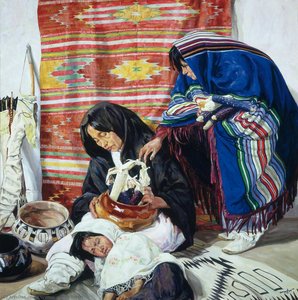
Explore Walter Ufer’s ‘Sleep,’ a poignant oil painting of Native American women in Taos. Discover realism, rich detail & cultural symbolism – a unique 20th-century artwork.
Konstnärens biografi
Walter Ufer (1876-1936) var en tysk-amerikansk konstnär känd för sina stämningsfulla målningar av ursprungsbefolkningens liv i Taos, New Mexico. En nyckelmedlem i 'Taos Ten', känd för genremålningar och levande landskap.
Om målningen
The Weight of Tradition: An Encounter with Walter Ufer’s “Sleep”
Walter Ufer's "Sleep," painted in 1923, isn’t merely a depiction of three Native American women; it’s an immersion into a world steeped in ritual and profound reverence. The painting immediately draws the viewer in with its rich tapestry of color – predominantly warm reds, oranges, and browns that evoke the earth itself, grounded by cooler blues and greens woven through the textiles and pottery. This palette isn't simply decorative; it speaks to the cultural heritage of the subjects, hinting at a deep connection to the land and ancestral traditions. The composition is carefully orchestrated, centering on the kneeling woman as a focal point, yet subtly inviting us into the periphery of the scene, suggesting an active participation in this sacred space.
Ufer’s masterful technique reveals layers of painstaking detail. He employs a layered oil painting approach, building up texture with deliberate brushstrokes that create a palpable sense of roughness on the clothing – perhaps representing the wear and tear of daily life intertwined with ceremonial garb – while simultaneously rendering the pottery with smooth, almost polished surfaces. This juxtaposition speaks to the duality inherent in Native American culture: the balance between practicality and spirituality, the tangible and the intangible. The lighting, soft and diffused, isn’t dramatic; it's deliberately muted, casting subtle shadows that lend a sense of solemnity and depth to the figures and objects, as if illuminating a secret whispered within a sacred space.
A Window into Taos: Contextualizing Ufer’s Vision
To fully appreciate “Sleep,” it's crucial to understand its historical context. Painted in 1923, during his time in Taos Pueblo, New Mexico, the artwork represents a pivotal moment in Walter Ufer’s career and his deep engagement with Native American culture. He was part of the "Taos Ten," a group of artists who sought to document and celebrate the lives and traditions of the region's indigenous communities. This wasn’t simply an act of observation; it was a deliberate attempt at understanding and portraying these cultures with respect and authenticity, a rare undertaking for American art at the time.
Ufer’s background as a German-born artist profoundly shaped his approach. His training in Europe instilled a meticulous attention to detail and a sophisticated understanding of composition – elements he skillfully translated into his depictions of Native American life. However, it was his immersion within the Taos community that truly informed his work, allowing him to capture not just appearances but also the spirit and essence of these traditions. The painting’s realism is tempered by an underlying sense of mystery, inviting viewers to contemplate the deeper meanings embedded within the scene.
Symbolism Woven into the Fabric
The details within “Sleep” are laden with symbolic significance. The intricately patterned rug serves as a visual anchor, framing the central figures and providing a rich backdrop that speaks to the importance of storytelling and communal life within Native American culture. The pottery, often adorned with geometric designs and natural motifs, represents both artistic skill and spiritual connection – a tangible link to ancestors and the earth. The women themselves, engaged in what appears to be a ritualistic activity, are not simply subjects; they embody generations of tradition, wisdom, and connection to the divine.
The act depicted—kneeling in reverence—suggests healing or a profound spiritual ceremony. The quiet dignity of the figures, coupled with the muted colors and soft lighting, evokes a sense of solemnity and timelessness. It’s an image that transcends mere representation, offering a glimpse into a world governed by ancient beliefs and deeply rooted traditions.
A Legacy of Authenticity: Reproductions and Beyond
Walter Ufer's "Sleep" remains a powerful testament to the beauty and complexity of Native American culture. TopImpressionists offers high-quality, hand-painted reproductions that faithfully capture the painting’s rich detail and evocative atmosphere. These reproductions are more than just images; they are windows into another world—a world of sacred rituals, profound traditions, and enduring wisdom. Investing in a reproduction is an investment in preserving this important piece of American art history and honoring the legacy of Walter Ufer's insightful portrayal.
Frågor och svar
Hur balanserar "Sleep" ljus och mörker?
De registrerade värdena för "Sleep" av Walter Ufer är: bright i ljusstyrka och Gentle Luminance i luminans.
Vilket stämningsläge uttrycker "Sleep" av Walter Ufer inom Contemporary Realism?
Den Melancholic känslan i "Sleep" ackompanjeras av dess Contemporary Realism-stil.
Vem är upphovspersonen till "Sleep" och inom vilken stilriktning?
"Sleep" skapades av Walter Ufer i Contemporary Realism-stil. Konstnären och stilen definierar verkets tradition.
Snabbfakta och konstquiz
Om Walter Ufer

Walter Ufer
1876 - 1936, Tyskland
Konstnärsbiografi
Sydvästerns själ: Walter Ufers liv och arv
Walter Ufer står som en central gestalt inom den amerikanska impressionismen, en målare vars penseldrag gjorde mer än att bara fånga ljuset; de fångade en kulturs själva hjärtslag. Ufer föddes 1876 i Hückeswagen, Tyskland, och hans resa mot New Mexicos höga ökenlandskap var banad av en rigorös europeisk utbildning och en djupt rotad nyfikenhet på det mänskliga tillståndet. Hans tidiga år formades av den tyska diasporan i Louisville, Kentucky, där han först började absorbera sitt kulturarvs rika texturer. Denna grundläggande period, präglad av studier inom litografi och grafik, gav honom en teknisk precision som senare skulle göra det möjligt för honom att navigera ljusets och skuggans komplexitet med en oöverträffad mästerlighet.
Hans strävan efter konstnärlig excellens ledde honom ut på en transformativ odyssé genom Europa. Som vandrande gesäll fördjupade sig Ufer i kontinentens mångsidiga konstnärliga traditioner och förfinade sin teknik vid de prestigefyllda akademierna i Hamburg och Dresden. Denna period av intensiv intellektuell och kreativ expansion kulminerade under hans tid i München, där han ägnade sig åt en intensiv ateljéverksamhet. När han slutligen återvände till USA 1911 bar han med sig en sofistikerad europeisk sensualitet som var redo för ett djupt möte med den amerikanska västerns karga, solmättade landskap.
En visionär inom Taos Ten
Året 1914 markerade en avgörande vändpunkt i Ufers liv och i den amerikanska konstens bana. När han gav sig in i Taos Pueblo, New Mexico, fann han sig som en del av en extraordinär konstnärlig revolution. Genom att ansluta sig till den inflytelserika gruppen känd som "Taos Ten," blev Ufer en central figur i ett kollektiv som strävade efter att röra sig bortom ren landskapsmålning mot en mer autentisk och visceral skildring av ursprungsbefolkningens liv. Till skillnad från många av sina samtida, som betraktade sydvästern genom en romantiserad eller kolonial lins, närmade sig Ufer sina motiv med en djup respekt och ett öga för den dagliga existensens värdighet.
Hans arbete blev en bro mellan europeiska impressionistiska tekniker och Pueblo-folkets råa, spirituella energi. Han var inte bara en observatör utan en krönikör av ritualer, landskap och samhällslivets stilla rytmer. Central för denna kreativa utveckling var hans relation med Jim Mirabal, en Taos-indian som fungerade som både Ufers musa och samarbetspartner. Genom denna koppling fick Ufer en intim förståelse för de kulturella nyanser som definierade regionen, vilket gjorde det möjligt för honom att genomstråla sina dukar med en känsla av levd sanning som resonerade långt utanför New Mexicos gränser.
Teknik, symbolism och historisk betydelse
Ufers konstnärskap kännetecknas av en mästerlig kontroll över färgen och en djärv, expressiv applicering av färg. Hans stil, även om den var rotad i den amerikanska impressionismens principer, lutade ofta mot ett mer robust och texturerat tillvägagångssätt som fångade ökensolens hetta och jordens tyngd. Han använde ljuset inte bara för att belysa form, utan för att framkalla känslor – han skapade scener där atmosfären känns mättad av historia och tradition.
Walter Ufers historiska betydelse ligger i hans förmåga att lyfta genremåleriet till ett djupt socialt och kulturellt uttalande. Hans prestationer inkluderar:
- Autentisk representation: Att bryta sig loss från de "pittoreska" stereotyperna av ursprungsbefolkningens liv för att presentera ett mer nyanserat och humaniserat porträtt av Taos-folket.
- Konstnärlig syntes: Att framgångsrikt sammanföra den formella akademiska träningen från Tyskland med den livliga, otämjda anden i det amerikanska sydväst.
- Arvet från Taos Ten: Att spela en avgörande roll i att etablera Taos som en främsta destination för amerikansk modernism och ett vitalt centrum för ursprungsbefolkningsfokuserad konst.
Idag förblir Ufers målningar bestående vittnesbörd om en period av intensiv kulturell sammansmältning. Hans förmåga att väva samman den tekniska stringensen från sin europeiska utbildning med den spirituella djupet i Pueblo-kulturen säkerställer att hans verk fortsätter att fängsla, och bjuder in moderna betraktare att bevittna Taosdalens tidlösa anda genom hans evokativa och mästerliga ögon.
Snabbfakta om Walter Ufer
- Artistic Movement Or Style: Taos-impressionism
- Artists Or Movements Influenced By This Artist: ['']
- Artists Who Influenced This Artist: ['']
- Date Of Birth: 1876
- Date Of Death: 1936
- Full Name: Walter Ufer
- Nationality: Tysk-amerikan
- Notable Artworks:
- Hennes dotter
- Öknens byggare
- Efter dem
- Place Of Birth: Hückeswagen, Tyskland


Walter Ufer
Sleep
() ·
Med ram: · Handmålad med olja på linne
Totalt