

Shown: · With its frame:
 Förhandsvisa
 Skicka
 Dela
Dela
 Visa detaljer
 Guide
Guide

 Ladda ner
 Liknande objekt
 Röntgen
 Bildspel
 Q&A
Q&A Statistik

Skr 2702
Handgjord oljereproduktion
Handmålad olja på duk i din valda storlek och ram, tillverkad efter beställning av våra konstnärer. ( Byt till tryck Byt till digital bild)
Size
·Standardstorlek
skräddarsydd
CM
INCH
Välj bland våra förinställda storlekar som motsvarar konstverkets ursprungliga proportioner.
Loading sizes...

bredd
höjd
Ange den bredd och höjd du behöver för att passa din ram eller din vägg. Eftersom detta är handmålat kan konstnären, vid ett annat format, måla lite mer runt bilden eller beskära den något – det är du som väljer. Vi skickar en digital mockup för godkännande innan målningen påbörjas. Bilden som visas på denna sida representerar inte det slutgiltiga resultatet — det är endast mockuppen som visar det.
 Läs mer
Finish
·
White Skr1

Blurside Skr1

Extended Skr1

P118B Skr10

P118H Skr10

P118W Skr10

P438Z Skr10

P508JH Skr12

P508YH Skr12

P805H Skr10

P805Z Skr10

P919BZ Skr10

P919G Skr10

P919XJ Skr10

P959ZH Skr10

P968JZ Skr12

W106C Skr8

W218G Skr10

W218JH Skr8

W218Y Skr10

W307PJ Skr10

W316G Skr10

W316PJ Skr8

W316Y Skr10

W398PJ Skr8

W4111J Skr10

W500HY Skr15

W500JH Skr15

W692G Skr12

W849H Skr8

W940BG Skr15

W953PJ Skr8

H24-GOLD Skr30

H24-SILVER Skr30

H36-GOLD Skr45

H36-SILVER Skr45
Shipped in a protective tube, ready for your own framer.
Above 105 cm the frame is shipped as a kit for a professional framer — read the details.
Extras
optionalWhat do the extras include?
Examples of what can be changed: Replace face with customer photo; Add pet (e.g., replace cat with dog); Include hidden message in background; Change background landscape or elements.
After order, TopImpressionists.com team will email client for instructions and provide a mockup preview
After order, TopImpressionists.com team will email client for instructions and provide a mockup preview
Leverans över hela världen () på 3–4 veckor istället för standard 5 veckor. (30 oktober). Inga kompromisser med kvaliteten.
Skyddande fernissa
Namnskylt
Detaljer för graverad bronsplatta
This elegant plaque features the artist's name and the title of the artwork, finely engraved for a timeless presentation.
It is made from bronze with a refined, elegant finish. The text is precisely laser-engraved for a sharp and permanent result. Measuring 9x2 cm, the plaque is compact yet easy to read. It's built to be durable and scratch-resistant, offering a professional, museum-quality look. Mounting is simple thanks to the included adhesive backing.
Detaljer för transparent akrylplatta
The plaque includes essential engraved details such as the artist's name, the title of the artwork, the date it was created, the type of media used-like oil on canvas or watercolor-a brief description of the piece, and a QR code that links to the complete artwork information.
It is crafted from clear acrylic, offering a sleek, modern appearance. The text is UV-engraved in black to ensure strong visual contrast. With a size of 10x15 cm, it ensures optimal readability. It comes equipped with two metal hooks for secure wall mounting. The plaque is designed to be weather-resistant, making it suitable for various environments, and it includes interactive features that work seamlessly with smartphone scanning.
Detaljer för svart akrylplatta
This elegant plaque includes engraved information such as the artist's name, the title of the artwork, the date it was created, the type of media used (like oil on canvas or watercolor), a short description of the artwork, and a QR code for quick access to more information.
The plaque itself is made from refined black acrylic with a premium finish. The text is laser-engraved in white for high contrast and readability. Its size is 10x15 cm, designed to be easy to read. It comes with two metal hooks for professional mounting. The design is sleek and fits any interior style. It is also weather-resistant and durable, with built-in digital integration for mobile compatibility.
Glasalternativet är endast tillgängligt i storlekar under 110 cm.
 Glasalternativet är endast tillgängligt i storlekar under 110 cm.
- Fri expressfrakt över hela världen
- Högkvalitativ linnecanvas
- Fullständig fraktförsäkring
- Garantier för återbetalning av tullavgifter
- Garantier för exakt färgåtergivning
- 100 dagars returrätt (endast vid fel)
- 100% pengarna tillbaka-garanti
- Mängdrabatt erbjuds


Beskrivning av samlarobjekt
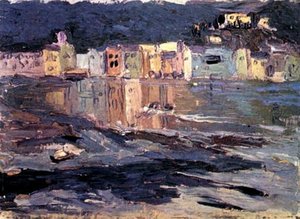
Wassily Kandinsky’s 1901 ‘Study for a Sluice’ is a captivating Post-Impressionist landscape showcasing a serene water scene with a white building, reflecting the artist's pioneering spirit and early exploration of abstraction. Discover or own this iconic artwork.
Konstnärens biografi
Upptäck Wassily Kandinsky (1866-1944), pionjärn för abstrakt konst! Följ med på en resa genom hans färgstarka expressionism, andliga teman & Bauhaus arv – fantastiska reproduktioner finns här.
About the painting
Wassily Kandinsky’s ‘Study for a Sluice’: A Dawn of Abstract Emotion
Wassily Kandinsky's 'Study for a Sluice,' painted in 1901, represents a pivotal moment not just in the artist’s career but in the very trajectory of modern art. This seemingly simple landscape – a serene body of water reflecting a white building nestled amongst trees – is far more than a picturesque depiction; it's an intensely personal and profoundly influential exploration of color and form that foreshadowed the rise of abstract expressionism. Born in Moscow in 1866, Kandinsky’s artistic journey was initially marked by a pragmatic pursuit of law and economics before a transformative encounter with Monet’s “Haystacks” ignited within him a fervent desire to translate inner experience onto canvas. This nascent impulse found further resonance in Wagner's opera "Lohengrin," fueling his ambition to move beyond representational accuracy and capture the essence of emotion through purely visual means.
Post-Impressionist Roots & Early Experimentation
‘Study for a Sluice’ firmly establishes Kandinsky within the Post-Impressionist movement, though he quickly sought to transcend its limitations. The painting's style is characterized by bold color choices and expressive brushwork – hallmarks of the period – yet it demonstrates an unprecedented focus on the *relationships* between colors rather than their objective depiction. Notice how the blues and greens of the water subtly shift and blend, creating a sense of movement and depth. The white building, rendered with simplified forms, acts as a focal point, drawing the eye while simultaneously contributing to the overall atmospheric effect. This early work reveals Kandinsky’s nascent desire to use color not merely to represent reality but to evoke feeling and spiritual experience – a core tenet of his later artistic philosophy.
Symbolic Resonance & Spiritual Intent
Beyond its formal qualities, ‘Study for a Sluice’ is laden with symbolic resonance. The “sluice” itself, a structure designed to control water flow, can be interpreted as representing the artist's own attempt to channel and direct his creative energies. The surrounding landscape – the water, the trees, the building – all contribute to a sense of tranquility and contemplation, suggesting a yearning for spiritual harmony. Kandinsky was deeply interested in the intersection of art, religion, and psychology, believing that color possessed inherent spiritual qualities. This painting exemplifies this belief, demonstrating how he sought to translate subjective experience into tangible form.
Technique & Reproduction – A Window to the Original
This hand-painted reproduction meticulously recreates Kandinsky’s original technique, capturing the nuances of his brushwork and color palette with remarkable fidelity. The artist employed a layering method, building up thin washes of paint to achieve the luminous effects characteristic of his work. The textured surface, achieved through multiple applications of pigment, adds depth and richness to the image, inviting close observation. TopImpressionists’s skilled artisans have painstakingly reproduced this artwork, ensuring that you receive a faithful representation of Kandinsky's vision – a piece that will undoubtedly become a treasured addition to any art collection or interior space.
Frågor och svar
Vem har skapat "Study for a Sluice" och i vilken stil är den utförd?
Wassily Wassilyevich Kandinsky skapade "Study for a Sluice" inom Post-Impressionist Landscape-rörelsen.
Finns "Study for a Sluice" tillgänglig som ett konsttryck?
"Study for a Sluice" finns tillgänglig som ett konsttryck på bomullscanvas eller arkivbeständigt canvaspapper. Beställningar görs via dess Konsttryck i hög kvalitet-sida, i den storlek du själv väljer.
Varifrån kommer besökarna till "Study for a Sluice" av Wassily Wassilyevich Kandinsky?
En Besöksstatistik-sida finns för "Study for a Sluice". Den visar månatliga besök för konstverket och konstnärens övriga verk, uppdelat per land och språk.
Quick facts and art quiz
About Wassily Wassilyevich Kandinsky

Wassily Wassilyevich Kandinsky
1866 - 1944, Ryssland
Konstnärsbiografi
A Life Immersed in Color and Spirit
Wassily Wassilyevich Kandinsky, född i Moskva 1866, var en revolutionär figur som oåterkalleligt förändrade konstens gång. Hans resa var inte en av omedelbar konstnärlig kallning; han var ursprungligen tänkt att ha en karriär inom juridik och ekonomi vid Moskvas universitet, men det var en djupgående möte med impressionistisk målning – särskilt Claude Monets “Häckar” – och en gripande upplevelse under bevittnandet av Wagners opera “Lohengrin” som tändes inom honom en oemotståndlig önskan att ägna sig åt konst. Detta avgörande ögonblick, som inträffade runt 30 års ålder, markerade inte bara ett karriärbyte utan en fullständig perspektivförändring, och lade grunden för hans pionjärarbete inom abstraktion. Han flyttade snart till München och antog en plats vid den prestigefyllda konstakademien där han studerade under Franz von Stuck, men även inom formell utbildning längtade Kandinskys anda efter utforskning bortom konventionella gränser.
Tidiga influenser inkluderade rysk folkkonst, som inhämtades genom en etnografisk expedition till Vologda-regionen 1889, vilket väckte en fascination för livfulla färgpaletter och symboliska bilder. Denna grundläggande utforskning var inte bara ett estetiskt val utan rotade sig i en djup kulturell koppling och en växande förståelse för hur konst kunde kommunicera bortom det bokstavliga. Han såg potentialen i att använda färg som ett språk, liknande musikens förmåga att uttrycka känslor.
The Dawn of Abstraction: From Expressionism to Inner Necessity
Kandinskys tidiga verk visar en stark expressionistisk tendens, präglad av djärva färger och emotionell intensitet – verk som “Papeln (Poplars)” från 1902 exemplifierar denna period. Men han var inte nöjd med att bara representera den yttre världen; han sökte att uttrycka inre verkligheter, andliga sanningar som överträffade rent visuell representation. Denna strävan ledde honom gradvis bort från representativ konst och mot en revolutionerande utforskning av färg, form och deras emotionella resonans. Han var fascinerad av hur färger kunde förmedla känslor och stämningar, och detta blev en central del av hans konstnärliga process.
Han började se på färg som mer än bara en beskrivning av verkligheten; han ansåg att den hade en egen kraft och inneboende betydelse. Han studerade hur olika färger kunde påverka betraktarens sinne, och experimenterade med att kombinera dem för att skapa specifika känslor. Detta påverkades starkt av hans växande intresse för Theosophia, en andlig rörelse som betonade esoterisk kunskap och universell broderskap. Ju djupare han grävde i dessa idéer, desto mer abstraherade Kandinskys målningar, lämnade igenom igenkännliga former till förmån för abstrakta kompositioner drivna av en “inre nödvändighet”. Detta var inte bara att avstå från representation; det handlade om att upptäcka ett nytt visuellt språk som kunde uttrycka de obegripliga domänerna av känslor och andlighet.
Geometric Harmony and Spiritual Resonance
Perioden efter hans engagemang i den inflytelserika konstgruppen Der Blaue Reiter (De Blå Ryttarna), som han grundade i München 1911, såg en ytterligare utveckling i Kandinskys stil. Medan tidigare verk ofta visade flytande, organiska former, började han utforska geometrisk abstraktion, med fokus på interaktionen mellan cirklar, trianglar och kvadrater. “Several Circles” (140 x 140 cm) står som ett exempel på denna fas – en dynamisk komposition där färg och form samverkar i en harmonisk men energirik dans. Han såg geometriska former som innehöll inneboende symbolik, och deras arrangemang inom duken kunde väcka specifika känslor.
Han ansåg att dessa former inte bara var visuella element utan också hade djupare andliga betydelser. Kandinsky trodde att de hade en egen kraft och inneboende betydelse, och att deras arrangemang i målningen kunde väcka specifika känslor hos betraktaren. Hans teoretiska skrifter, särskilt “Concerning the Spiritual in Art” (1911), artikulerade dessa övertygelser, och lade grunden för en ny förståelse av abstrakt konst som ett verktyg för att uttrycka djupgående andliga sanningar. Han argumenterade för att konsten inte skulle syfta till att imitera naturen utan snarare att avslöja konstnärens inre värld och koppla samman med betraktaren på en djupare, mer intuitiv nivå.
Bauhaus Influence and Lasting Legacy
Utbrottet av första världskriget tvingade Kandinsky till flykt tillbaka till Ryssland 1914, men efter den ryska revolutionen fann han sig alltmer i konflikt med det rådande konstliga klimatet. År 1920 accepterade han en undervisningsposition vid Bauhaus-skolan i Tyskland, där han djupt påverkade generationer av konstnärer med sina teorier om färg, form och abstraktion. Bauhaus erbjöd en idealisk miljö för Kandinsky att ytterligare utveckla sina idéer och utforska nya kreativa vägar.
Han fortsatte att experimentera med geometriska former och livfulla färger, ofta genom att använda lager av impasto-teknik för att skapa texturerade ytor som ökade djupet och komplexiteten i sina kompositioner – som syns i senare verk som “An Intimate Party” (1942). Efter stängningen av Bauhaus på grund av nazisternas makt, flyttade Kandinsky till Frankrike, där han dog 1944. Hans inflytande på modern konst är obestridligt; han erkänns allmänt som en pionjär inom abstrakt expressionism och en nyckelperson i utvecklingen av icke-representativ målning. Hans verk finns i viktiga museer över hela världen, inklusive Tretyakov Gallery i Moskva, som bär hans monumentala “Composition VII”, ett testamente till hans konstnärliga vision och bestående arv.
Useful Links
Quick facts about Wassily Wassilyevich Kandinsky
- Artistic Movement Or Style: Abstrakt konst, Expressionism
- Artists Or Movements Influenced By This Artist: ['Abstrakt expressionism']
- Artists Who Influenced This Artist:
- Claude Monet
- Richard Wagner
- Date Of Birth: 1866
- Full Name: Wassily Wassilyevich Kandinsky
- Nationality: Rysk, Fransös
- Notable Artworks:
- Murnau med regnbåge
- Tempererad energi
- En intim fest
- Flera cirklar
- Place Of Birth: Moskva, Ryssland



Utforska konstverk sorterade efter tema, stil och egenskaper.


Wassily Wassilyevich Kandinsky
Study for a Sluice
() ·
With its frame: · Hand-painted in oil on linen
Total