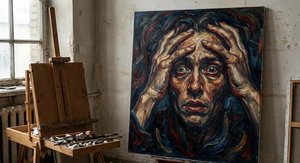
A Descent into Emotion: Unpacking ‘Naked Woman with Dripping Hair’
Pablo Picasso's “Naked Woman with Dripping Hair,” painted in 1902, isn’t merely a depiction of a reclining figure; it’s a visceral plunge into the artist’s turbulent emotional landscape. Created during his formative Blue Period, this oil on canvas piece—measuring a modest 62 x 34 cm—immediately commands attention with its arresting simplicity and raw intensity. The woman, rendered in Picasso's signature distorted forms, appears to be gazing downwards, her posture conveying both vulnerability and a quiet resignation. Her elongated limbs and the unsettling manner in which her hair – depicted as seemingly dripping – cascade around her head contribute to an atmosphere of profound unease and psychological depth. This isn’t a celebration of beauty; it's a confrontation with sorrow, loneliness, and perhaps even despair—themes that would increasingly dominate Picasso’s work throughout his career. The stark blue background further amplifies the painting’s melancholic mood, creating a visual isolation that mirrors the woman’s internal state.
- The Blue Period and its Echoes
- Expressionism's Seeds
- A Conversation with the Masters: Modigliani and Beyond
- Handcrafted Reproductions: Bringing ‘Naked Woman’ Home
The Blue Period and its Echoes
“Naked Woman with Dripping Hair” firmly establishes itself within the context of Picasso's Blue Period (1901-1904). Following the tragic death of his sister, Conchita, Picasso immersed himself in a world of muted blues and greys, reflecting the pervasive sense of grief and poverty that gripped him at the time. This period was characterized by subjects often associated with hardship—the destitute, the marginalized, and those grappling with loss. The painting’s elongated forms, flattened perspective, and somber palette are hallmarks of this era. However, “Naked Woman” transcends mere stylistic adherence; it possesses a unique intensity that distinguishes it from many other works within the Blue Period. The deliberate distortion of the figure's features—particularly her face—suggests an attempt to externalize internal suffering, transforming personal grief into a universal symbol of human anguish. Interestingly, Picasso’s early training emphasized meticulous copying of masters, yet he quickly began to subvert these techniques, forging his own distinct and emotionally charged style.
Expressionism's Seeds
While firmly rooted in the Blue Period, “Naked Woman with Dripping Hair” also foreshadows the rise of Expressionism—a movement that would profoundly influence 20th-century art. The painting’s emphasis on subjective experience, emotional intensity, and distortion of form anticipates the core tenets of Expressionism. The use of color is deliberately jarring, prioritizing emotional impact over realistic representation. The “dripping hair,” a particularly striking element, can be interpreted as a visual metaphor for overwhelming sadness or perhaps even madness—a cascade of emotion threatening to engulf the figure entirely. Furthermore, Picasso’s bold brushstrokes and dynamic composition contribute to a sense of movement and unrest, qualities that are central to Expressionist aesthetics. The painting's influence extends beyond its immediate stylistic connections; it represents an early exploration of psychological themes that would become increasingly prominent in later works by both Picasso and other Expressionist artists.
A Conversation with the Masters: Modigliani and Beyond
Picasso’s artistic journey during this period was marked by a constant dialogue with his predecessors, particularly those working in Spain and France. The influence of Spanish masters like Velázquez and Goya is evident in his use of dramatic lighting and expressive brushwork. However, Picasso also drew inspiration from contemporary artists such as Amedeo Clemente Modigliani, whose “Nude Bust” (1917) shares a similar exploration of the human form through simplified shapes and elongated features—a technique that subtly blends elements of Expressionism and Cubism. Modigliani’s work, like Picasso's "Naked Woman," prioritizes capturing an emotional essence over strict anatomical accuracy. The comparison highlights Picasso’s evolution as an artist, demonstrating his willingness to experiment with different styles while retaining a core commitment to expressing profound human emotions.
Handcrafted Reproductions: Bringing ‘Naked Woman’ Home
TopImpressionists offers meticulously crafted, hand-painted reproductions of “Naked Woman with Dripping Hair,” allowing art enthusiasts to experience the painting's power and beauty in their own homes. These reproductions are created by skilled artists who painstakingly replicate Picasso’s techniques and color palette, ensuring an authentic representation of this iconic work. Beyond simply replicating the image, these hand-painted reproductions capture the emotional depth and psychological complexity that define the original painting. They provide a tangible connection to Picasso's artistic vision—a way to bring a piece of art history into your personal space. Explore our collection today and discover how you can own a stunning reproduction of this emotionally resonant masterpiece.



 Baskıyı satın al
 Paylaş
 Paylaş
 Detayları Gör

 İndir
İndir
 Benzerlerini gör
 X-Işını
 Slayt Gösterisi


 Tümünü Gör






































 Cam seçeneği yalnızca 110 cm altındaki boyutlar için mevcuttur.