Eser Açıklaması
A Symphony of Roofs: Cezanne’s Exploration of Light and Form
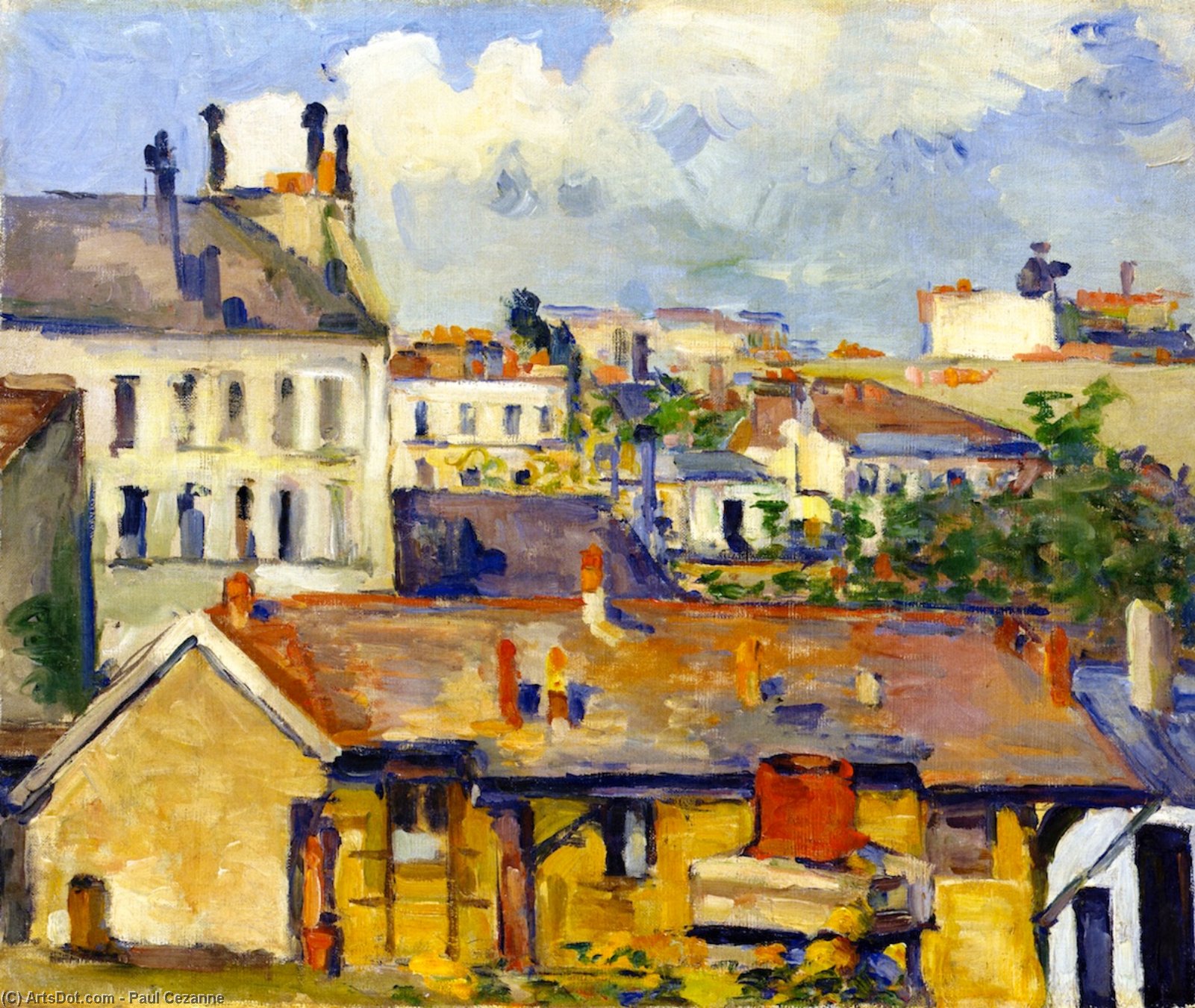
Paul Cézanne's *Group of Houses*, often referred to as *Roofs*, isn’t merely a depiction of buildings; it’s an invitation into the artist’s profound investigation of perception, color, and the very essence of seeing. Completed in 1876-77, this oil on canvas resides within the Villa Flora in Switzerland, a testament to its enduring significance. Cézanne, already wrestling with the tenets of Impressionism, sought to move beyond fleeting impressions of light and shadow towards a more structured, enduring representation of reality – a pursuit that would ultimately lay the groundwork for Cubism. The painting captures a cluster of houses nestled against a hazy backdrop, their red-tiled roofs dominating the composition. Yet, it’s not a straightforward landscape; rather, Cézanne has meticulously dissected and rebuilt these familiar forms, employing a technique that anticipates his later explorations of geometric abstraction. He doesn't aim for photographic accuracy but instead prioritizes conveying the *experience* of seeing – the way light interacts with surfaces, the solidity of form, and the interplay of color. Notice how he uses broken brushstrokes, layering hues of yellow, ochre, and blue to suggest volume and depth, creating a sense of three-dimensionality that transcends the flat surface of the canvas. The lone figure in the foreground serves not as a subject but as a device to anchor the viewer within this carefully constructed space, inviting us to contemplate the scene alongside Cézanne himself.
The Seeds of Modernism: Cezanne’s Revolutionary Approach
Cézanne's *Roofs* stands as a pivotal work in art history, marking a decisive shift away from the ephemeral qualities of Impressionism and towards the nascent ideas of modernism. He was deeply influenced by Japanese woodblock prints – particularly their flattened perspectives and emphasis on decorative patterns – which encouraged him to reconsider traditional notions of perspective and spatial representation. Unlike his Impressionist predecessors who sought to capture the immediate sensation of light, Cézanne focused on defining the underlying structure of objects. This is evident in his deliberate manipulation of form; he breaks down the houses into their essential geometric components—planes, cylinders, and cones—and then reassembles them according to his own visual logic. This process wasn’t simply about technical skill; it was a deeply philosophical undertaking – an attempt to understand how we perceive the world around us and translate that understanding onto canvas. The painting's composition is deliberately ambiguous, creating a sense of spatial uncertainty that challenges the viewer's assumptions about distance and perspective. It’s a subtle yet revolutionary move, foreshadowing the radical innovations of artists like Picasso and Braque in the decades to come.
Echoes of L’Estaque: A Shared Vision
Cézanne’s *Roofs* shares striking similarities with his earlier work, *L'Estaque with Red Roofs*, completed just a few years prior. Both paintings feature prominently red-roofed buildings set against a hazy landscape, and both demonstrate Cézanne’s growing interest in capturing the solidity of form. However, *L'Estaque* is characterized by its more vibrant colors and dynamic composition—a reflection of the Impressionist influence that still lingered in his style. *Roofs*, on the other hand, exhibits a greater degree of geometric simplification and a more deliberate sense of structure. It’s as if Cézanne was consciously moving away from the fleeting effects of light and color towards a more enduring representation of form—a process he would continue to explore throughout his career. The subtle differences between these two paintings reveal the evolution of Cézanne's artistic vision, demonstrating his relentless experimentation and his unwavering commitment to pushing the boundaries of traditional painting.
A Quiet Harmony: Symbolism and Emotional Resonance
Beyond its formal innovations, *Group of Houses* possesses a remarkable sense of tranquility and harmony. The muted color palette, combined with the simplified forms and the solitary figure in the foreground, creates an atmosphere of peaceful contemplation. The red roofs, often associated with warmth and domesticity, evoke a feeling of comfort and security. Yet, there’s also a subtle undercurrent of melancholy—a sense that these idyllic scenes are fleeting and transient. Cézanne wasn't simply depicting houses; he was capturing a moment in time—a glimpse into the beauty of everyday life. The painting invites us to pause, reflect, and appreciate the simple pleasures of existence. It’s a testament to Cézanne’s ability to transform ordinary subjects into works of profound emotional resonance.
Bringing Cezanne Home: Reproductions for Your Space
TopImpressionists offers meticulously crafted hand-painted reproductions of Paul Cézanne's *Group of Houses*, allowing you to bring this iconic masterpiece into your home or office. Our artists replicate the painting’s nuanced color palette, broken brushstrokes, and atmospheric depth with exceptional skill and attention to detail. Available in a range of sizes and framing options, our reproductions provide an authentic representation of Cézanne's vision while preserving the artwork's original spirit. Whether you are an art enthusiast, a collector, or simply seeking to add a touch of artistic sophistication to your space, a TopImpressionists reproduction of *Group of Houses* is a timeless investment that will enrich your surroundings for years to come. Explore our collection today and discover the beauty of Cézanne’s revolutionary approach to painting.


 Baskıyı satın al
 Paylaş
 Paylaş
 Detayları Gör

 İndir
İndir
 Benzerlerini gör
 X-Işını
 Slayt Gösterisi

 Tümünü Gör






































 Cam seçeneği yalnızca 110 cm altındaki boyutlar için mevcuttur.