A Moment of Quietude: Exploring Renoir’s “Seated Nude”
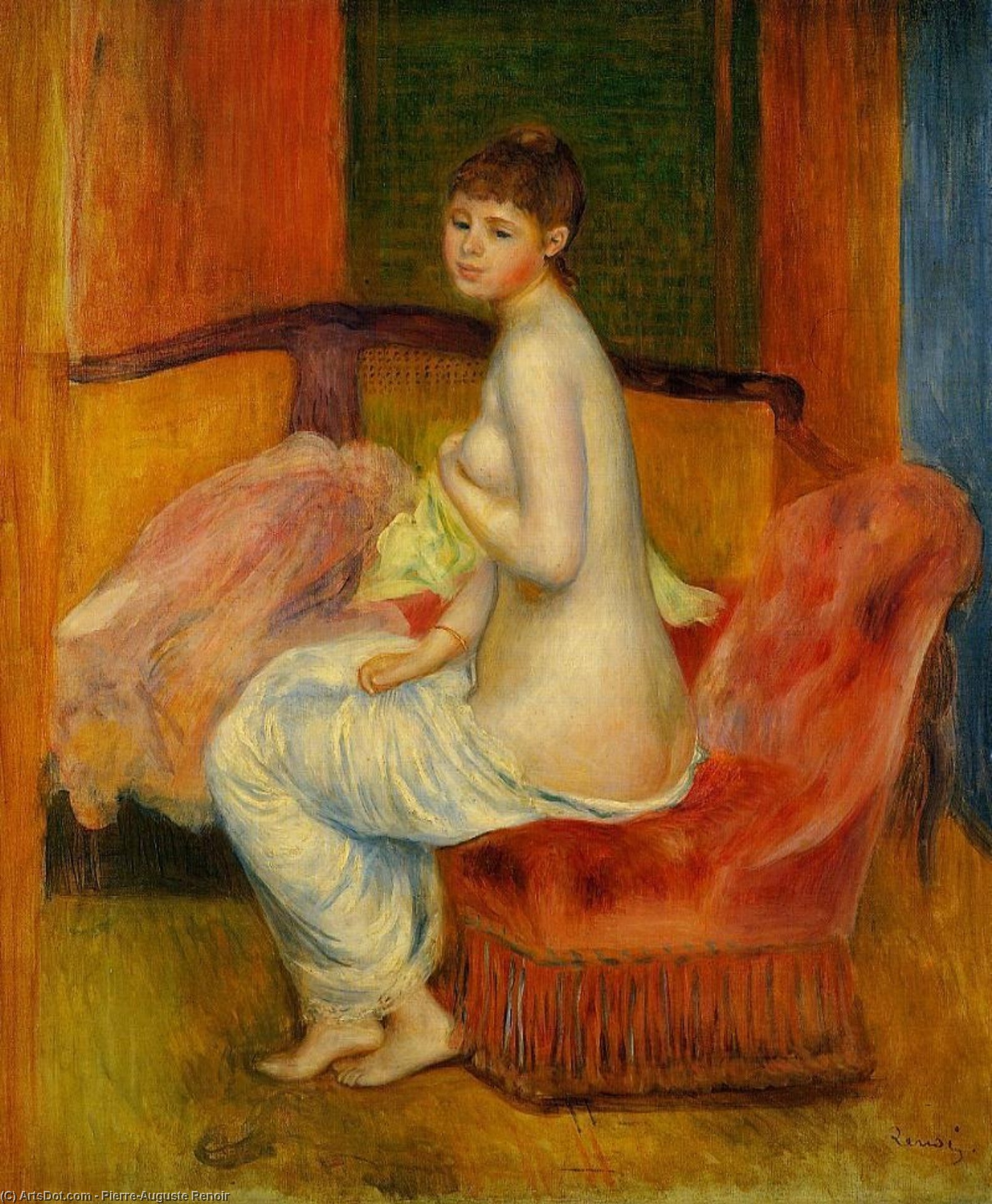
Pierre-Auguste Renoir's "Seated Nude (also known as At East)" – painted in 1885 – isn’t merely a depiction of the human form; it’s an immersion into a fleeting, intimate moment. This captivating oil on canvas transcends simple representation, offering instead a glimpse into a private world of contemplation and sensual awareness. The painting immediately draws the eye to the central figure, a woman seated gracefully on a vibrant red cushion, her back turned towards us, creating an immediate sense of mystery and inviting speculation about what occupies her thoughts. Renoir masterfully employs light and shadow, not with stark contrasts but with a delicate diffusion that softens the edges of the body, lending it an almost ethereal quality. The subtle play of color – dominated by warm reds, oranges, and yellows – evokes a feeling of warmth and comfort, suggesting a space shielded from the outside world.
The composition itself is carefully orchestrated. Two additional chairs in the background, one receding into shadow and another further away, establish depth and context without disrupting the primary focus on the seated woman. A simple bench adds to this sense of domestic tranquility. Notice how Renoir doesn’t attempt a photographic realism; instead, he prioritizes capturing the *feeling* of the scene – a quiet intimacy, a moment suspended in time. The white dress she wears further emphasizes her vulnerability and contributes to the painting's overall mood of serene contemplation.
Impressionism at its Finest: Light, Color, and Atmosphere
“Seated Nude” is a quintessential example of Renoir’s Impressionist style. He wasn’t interested in meticulously detailing every curve or wrinkle; rather, he sought to capture the *impression* of light and color as they shift and change with each passing moment. This is achieved through his loose brushstrokes and vibrant palette. Renoir's technique emphasizes the subjective experience of seeing – how light interacts with surfaces, creating a shimmering effect that’s both beautiful and fleeting. The painting feels alive, imbued with the warmth of sunlight filtering through a window or the glow of an evening fire.
Furthermore, Renoir’s use of color is remarkably nuanced. He doesn't simply apply hues; he mixes them subtly to create variations in tone and texture. The red cushion provides a striking focal point, while the surrounding colors – yellows, oranges, and hints of green – contribute to a harmonious and inviting atmosphere. The overall effect is one of luminous beauty, characteristic of Impressionist painters who were fascinated by capturing the ephemeral qualities of light and color.
A Window into Parisian Life and Artistic Influences
To fully appreciate “Seated Nude,” it’s helpful to consider Renoir's artistic context. He was deeply influenced by artists like Rubens and Watteau, whose works celebrated beauty and sensuality. However, he also absorbed the spirit of Realism, particularly from Édouard Manet, who depicted modern life with a keen eye for detail and social commentary. The painting reflects this synthesis – it’s both intensely personal and deeply rooted in the cultural landscape of late 19th-century Paris.
Interestingly, Renoir's work was also influenced by the “Oskar Reinhart Collection Winterthur,” a remarkable assemblage of art from various periods. This collection exposed him to a diverse range of artistic styles and traditions, enriching his own creative vision. The painting’s emphasis on capturing light and shadow echoes the principles of Luminism, an artistic movement that sought to express the effects of light in a way that was both evocative and emotionally resonant.
Capturing Intimacy: Symbolism and Emotional Resonance
Beyond its technical brilliance, “Seated Nude” possesses a profound emotional resonance. The woman’s averted gaze invites us to imagine her thoughts and feelings – is she lost in contemplation, enjoying a moment of quiet pleasure, or perhaps simply seeking refuge from the outside world? The painting doesn't offer easy answers; instead, it encourages us to project our own emotions and interpretations onto the scene.
Renoir’s ability to capture such subtle nuances of human experience is what makes “Seated Nude” a timeless masterpiece. It’s a testament to his skill as an artist and his profound understanding of the beauty and complexity of the human condition. Reproductions of this painting offer a remarkable opportunity to bring this intimate moment into your own space, allowing you to contemplate its enduring appeal.


 Baskıyı satın al
 Paylaş
 Paylaş
 Detayları Gör

 İndir
İndir
 Benzerlerini gör
 X-Işını
 Slayt Gösterisi

 Tümünü Gör






































 Cam seçeneği yalnızca 110 cm altındaki boyutlar için mevcuttur.



