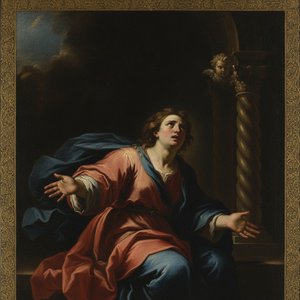
Lady Henrietta Cavendish, Viscountess Huntingtower: A Portrait of Enlightenment Curiosity
Lady Henrietta Cavendish, Viscountess Huntingtower’s portrait by Sir Godfrey Kneller stands as a testament to the burgeoning intellectual fervor of 18th-century England—a period marked by scientific breakthroughs and philosophical debates that reshaped Western thought. Completed in 1715, this masterpiece exemplifies the Grand Manner style championed by Kneller and reflects the aristocratic fascination with portraying subjects not merely as figures of authority but also as individuals imbued with intellect and character.
- Subject Matter: The painting depicts Henrietta Cavendish (1693-1743), a pioneering scientist and aristocrat who defied societal expectations to pursue her passion for experimentation—a bold stance for women during the Enlightenment era. Her dignified pose and gaze convey both composure and intellectual engagement, capturing her spirit as a woman determined to challenge conventional norms.
- Style & Technique: Kneller’s masterful use of chiaroscuro—the dramatic contrast between light and shadow—creates an illusionistic depth that draws the viewer into the scene. The artist meticulously rendered textures, from the satin sheen of Cavendish's gown to the subtle folds of her drapery, demonstrating a dedication to realism that was characteristic of his time.
- Historical Context: Cavendish’s portrait emerged during a pivotal moment in European history—the Enlightenment—when reason and observation supplanted dogma and superstition as guiding principles. The inclusion of a horse symbolizes nobility and status, mirroring the social hierarchy prevalent at the court of George I. Furthermore, the subtle depiction of a dog leash underscores the importance of companionship and loyalty within aristocratic circles.
- Symbolism: Beyond its formal representation, the portrait carries symbolic weight. Cavendish’s gaze directs towards the viewer, inviting contemplation and suggesting that she possesses an inner life as profound as her outward appearance. The horse's presence reinforces notions of power and prestige—qualities valued by both Cavendish and Kneller himself.
- Emotional Impact: Viewing this portrait evokes a sense of admiration for Cavendish’s intellect and courage—a woman who dared to pursue scientific inquiry despite societal constraints. Kneller’s skillful depiction captures not only her physical likeness but also the essence of her personality, conveying an aura of dignity and intellectual curiosity that continues to resonate with audiences today.
About Sir Godfrey Kneller: The Master of Manner
Godfrey Kneller (1646-1723) stands as a monumental figure in English Baroque art, recognized primarily for his unparalleled skill in capturing the likenesses of prominent individuals—particularly what became known as “Kit-Cat portraits.” These exquisitely detailed depictions of cats adorning aristocratic interiors exemplify his meticulous technique and profound understanding of visual culture. Born Gottfried Kniller in Lübeck, Germany, he emigrated to England around 1675, establishing himself as a prolific portraitist and securing prestigious commissions from royalty and nobility throughout the reign of Charles II and George I. His legacy extends beyond mere artistic achievement; he played a crucial role in shaping the visual landscape of Georgian Britain and fostering an enduring fascination with royal patronage.
Further Exploration: Lady Cavendish’s Scientific Legacy
Lady Henrietta Cavendish's contribution to scientific inquiry transcends her portrait’s aesthetic beauty. She conducted groundbreaking experiments on gases—challenging prevailing theories about combustion and demonstrating a remarkable grasp of experimental methodology. Her meticulous observations and unwavering determination paved the way for advancements in chemistry and physics, securing her place as one of the earliest female scientists recognized for their intellectual prowess.
The Kit-Cat Portrait Phenomenon: A Reflection of Georgian Society
Kneller’s “Kit-Cat portraits” represent more than just decorative art; they encapsulate the social values of Georgian Britain—a fascination with status, wealth, and erudition. The inclusion of cats within aristocratic interiors symbolized intellectual pursuits and demonstrated a desire to elevate domestic life through artistic embellishment. Kneller's ability to capture both physical likeness and psychological character exemplifies the Grand Manner style’s commitment to portraying subjects as individuals worthy of admiration.
A Lasting Impression: Kneller’s Influence on Artistic Tradition
Godfrey Kneller’s meticulous technique and stylistic innovations continue to inspire artists today. He remains a symbol of artistic excellence and exemplifies the enduring power of portraiture as a medium for documenting history and capturing the essence of human character—a legacy that ensures his contribution to English Baroque art will be remembered for generations to come.



 Önizleme yap
 Baskı satın al
 Paylaş
 Paylaş
 Detayları Gör

 İndir
İndir
 Benzerlerini gör
 X-Işını
 Slayt Gösterisi


 Tümünü Gör






































 Cam seçeneği yalnızca 110 cm altındaki boyutlar için mevcuttur.