A Moment Frozen in Time: Van Gogh’s “Lange Vijverberg”
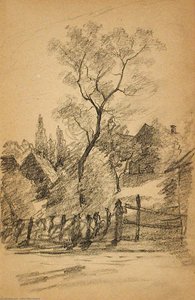
Vincent van Gogh's "Lange Vijverberg," painted in 1883 during his formative years in The Hague, offers a remarkably intimate glimpse into the artist’s burgeoning realism and his nascent ability to capture the essence of everyday life. More than just a depiction of a street scene, this black-and-white drawing—now available as a stunning hand-painted reproduction on TopImpressionists.com – is a testament to Van Gogh's evolving artistic vision and his deep engagement with the world around him. It’s a work that speaks volumes through its quiet observation and masterful use of line and shadow, inviting us into a peaceful moment suspended in time.
The scene unfolds on a sun-drenched street, dominated by the muted tones of charcoal and graphite. A solitary figure, identifiable only as a man carrying a bag, navigates the path, his presence subtly anchoring the composition. Two other individuals—a woman standing near a building and another further back—add layers of depth without disrupting the overall sense of serenity. The careful placement of these figures creates an illusion of space and movement, drawing the viewer’s eye through the scene with a gentle grace.
Realism's Early Embrace
Painted during a period when Van Gogh was actively exploring realism—a movement emphasizing accurate representation of reality—"Lange Vijverberg" showcases his early mastery of this style. Unlike the vibrant colors that would later define his mature work, here he employs a restricted palette to heighten the impact of texture and shading. The stark contrast between light and dark creates a dramatic effect, lending a sculptural quality to the buildings and trees lining the street. This deliberate choice highlights the materiality of the scene—the rough surface of the pavement, the weathered wood of the benches, the delicate branches of the trees—drawing attention to the tactile nature of the world.
The Language of Line and Shadow
What truly distinguishes this drawing is Van Gogh’s extraordinary control over line. He doesn't simply outline forms; instead, he uses a series of short, broken strokes to build up texture and volume. These lines aren’t meant to be perfectly smooth or uniform—they possess an energy and dynamism that imbue the scene with life. The shading is equally expressive, achieved through subtle gradations of tone rather than broad washes of color. This technique creates a sense of depth and atmosphere, suggesting the warmth of the sunlight filtering through the trees and casting long shadows across the street.
Context and Significance
"Lange Vijverberg" was created during Van Gogh’s time in The Hague, a period marked by experimentation and a desire to capture the spirit of Dutch life. While not currently part of the collection at the Rijksmuseum Amsterdam—a renowned institution dedicated to Dutch art history – this drawing provides valuable insight into the artistic trends of the era. It reflects a shift away from purely academic approaches to painting and towards a more subjective, emotionally-driven style. The work’s simplicity and directness are characteristic of Van Gogh's early explorations, foreshadowing the expressive power that would become his hallmark.
Bringing “Lange Vijverberg” Home
TopImpressionists offers meticulously crafted hand-painted reproductions of "Lange Vijverberg," allowing art enthusiasts to experience this iconic work in stunning detail. Each reproduction is created by skilled artists who painstakingly recreate Van Gogh’s technique, capturing the nuances of line and shadow with remarkable accuracy. Whether you're a seasoned collector or simply seeking to add a touch of artistic elegance to your home, a hand-painted reproduction of “Lange Vijverberg” is a beautiful and meaningful way to connect with one of art history’s most beloved figures. Explore the full detail on here.



 Baskıyı satın al
 Paylaş
 Paylaş
 Detayları Gör

 İndir
İndir
 Benzerlerini gör
 X-Işını
 Slayt Gösterisi

 Tümünü Gör






































 Cam seçeneği yalnızca 110 cm altındaki boyutlar için mevcuttur.