Atölye — Dünya çapında ücretsiz gönderim — 2–6 hafta içinde teslimat
      Emil Nolde, 1867 – 1956

      The 100 Most Famous Emil Nolde Paintings, Ranked

      The best-loved painting by Emil Nolde is Sunset. Sea with Red Sky and Couple on the beach (1903) come next among the canvases readers know best. Our catalogue holds 394 works by Emil Nolde: here are the 100 most famous, each with its year, its museum and what makes it memorable.

      Ranked by our popularity score, which combines the searches, visits and orders for each work. Updated Ekim 2026. Each painting on this page can be ordered as an oil reproduction painted by hand on linen canvas, or as a fine art print, made to the size you choose.

      Portrait of Emil Nolde
      Emil Nolde · 1867 – 1956
      Born · died
      1867 – 1956, Nolde
      Movement
      German expressionism
      Works in our catalogue
      394
      Most famous
      Sunset
      Most works at
      Bavarian State Painting Collections

      Top 10 Emil Nolde paintings: the canvases everyone knows

      Sunset by Emil Nolde
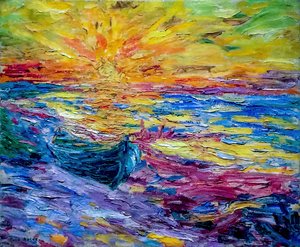
      1

      Sunset

      Oil On Canvas

      The sun hangs as a heavy, bright circle at the center of the sky, a singular eye watching the descent of the day. Below it, the atmosphere burns with shades of yellow, orange, and red, bleeding into one another to create a warm, thick air. The ocean receives this light, its waves rolling gently toward the shore in a rhythmic, quiet motion. A lone boat floats upon the water, a…

      Sea with Red Sky by Emil Nolde
      2

      Sea with Red Sky

      Oil

      Sea with Red Sky is an expressionist painting by Emil Nolde. The canvas captures a moment of intense color, where the sky burns with a deep, saturated red. This work belongs to the early movements of expressionism, a style that prioritizes the internal pulse of a subject over its literal likeness. The artist sought to translate raw sensation into pigment, moving beyond the surface of the natural world to reach…

      Couple on the beach (1903) by Emil Nolde
      3

      Couple on the beach

      1903 · Oil

      In "Couple on the beach" by Emil Nolde, painted about 1903, the arrangement of figures creates a quiet sense of intimacy against a vast landscape. At the center of the composition, a man and a woman stand close together. He has his arm around her, and she is dressed in a long dress. Their bodies are oriented toward the water, their gazes fixed on the horizon. This shared focus directs…

      Masks (1911) by Emil Nolde
      4

      Masks

      1911 · Acrylic On Canvas · Nelson-Atkins Museum of Art, Kansas City

      Emil Nolde's "Masks," painted in 1911, isn’t merely a depiction of carnival revelry; it’s a profound exploration of identity, hidden desires, and the unsettling duality inherent within human nature. Created during his time as a key member of Die Brücke – “The Bridge” – a group pushing the boundaries of German Expressionism in Dresden and Berlin, the painting embodies the movement's core tenets: a rejection of academic realism in favor…

      Christ among the Children by Emil Nolde
      5

      Christ among the Children

      Oil On Canvas

      Emil Nolde’s “Christ Among the Children” is not merely a depiction of a biblical scene; it’s an immersive experience, a visceral outpouring of emotion rendered with the raw energy characteristic of his mature style. This large-scale painting captures a moment of profound intimacy – Christ surrounded by children – yet it vibrates with a primal intensity that speaks to the core of human connection and faith. The photograph reveals a…

      The Great Gardener by Emil Nolde
      6

      The Great Gardener

      The Great Gardener emerges from the brush of Emil Nolde, a man whose very name carries the weight of his birthplace. Born in 1867 in Nolde, Denmark, the artist carries the essence of his origins into every stroke. He moves through the world of color with a sense of purpose, much like the subject of this work. The painting, titled The Great Gardener, captures a moment of quiet connection within…

      Light-flooded Sea (Green) by Emil Nolde
      7

      Light-flooded Sea (Green)

      Watercolor

      Light-flooded Sea (Green) is a work by Emil Nolde. This piece presents a highly stylized and abstracted seascape, stripping the horizon of its literal boundaries. The subject matter focuses on the meeting of water and sky, rendered through a lens of intense, personal feeling rather than precise representation.

      Marshy Landscape under the Evening Sky by Emil Nolde
      8

      Marshy Landscape under the Evening Sky

      Watercolor

      The scene unfolds in Marshy Landscape under the Evening Sky, a work that carries the unmistakable hand of the artist Emil Nolde. This piece captures a specific, quiet moment where the land meets a heavy, atmospheric sky. The artist, Emil Nolde, was born in Nolde, Denmark, in 1867, and his connection to the natural world remains palpable in the way he approaches the canvas. He lived until 1956, leaving behind…

      Animal and Figures (1912) by Emil Nolde
      9

      Animal and Figures

      1912 · Black and White Photography · Bavarian State Painting Collections, Münih

      A monochrome stillness settles over the scene. Two men stand in the rigid geometry of early 20th-century military attire, their forms anchored against a dark, featureless void. They are framed by a slender pedestal that divides the composition with mathematical precision. On the left, a hand rests firmly on a hip; on the right, a hand finds rest upon the stand. The fabric of their tunics, the heavy weave of…

      Anna Wieds Garden by Emil Nolde
      10

      Anna Wieds Garden

      Acrylic

      Emile Nolde, a prominent German-Danish painter and printmaker, is renowned for his vibrant and expressive works of art. One of his notable pieces, Anna Wieds Garden, exemplifies the essence of Expressionism, a modernist movement that emerged in the early 20th century. This captivating oil painting is a testament to Nolde's unique style, which blends elements of Expressionism with a deep appreciation for nature. The Expressionist Style Expressionism, as described by…

      More Emil Nolde canvases, 11 to 100

      Festival Girls (1918) by Emil Nolde
      #11

      Festival Girls

      1918 · Bavarian State Painting Collections

      Festival Girls is a painting by Emil Nolde, executed in 1918. The work measures 67 x 58.5 cm and is rendered on canvas. This piece was created during…

      Order this canvas →
      Nordermühle (1932) by Emil Nolde
      #14

      Nordermühle

      1932 · Bavarian State Painting Collections

      is a studio portrait by the German artist Emile Nolde, dating to 1932. The work captures four individuals in a formal arrangement, presented as a monochromatic study of…

      Order this canvas →
      untitled (1534) by Emil Nolde
      #15

      untitled (1534)

      The horizon is a wound of orange and red. Light bleeds through heavy, dark silhouettes of clouds, casting a warm glow over the quiet landscape. Below, the sand…

      Order this canvas →
      Shivering Russians (1914) by Emil Nolde
      #16

      Shivering Russians

      1914 · Statens Museum For Kunst

      The painting presents two figures in a tight, cropped composition, focusing on their upper bodies as they huddle together. They are enveloped in thick, heavy clothing that obscures…

      Bring this light home →
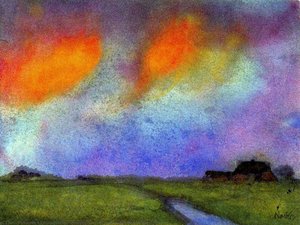
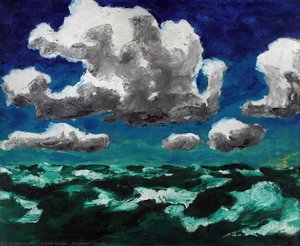
      Summer Clouds by Emil Nolde
      #17

      Summer Clouds

      Summer Clouds is an expressionist work by Emil Nolde. Born in 1867 in Nolde, Denmark, the artist developed a visual language centered on intense, personal feeling and the…

      Order this canvas →
      Wild Animals (1921) by Emil Nolde
      #24

      Wild Animals

      1921 · Bavarian State Painting Collections

      The work belongs to a period of intense experimentation. It reflects a shift toward the subjective, where the internal world dictates the external appearance. The textures are thick…

      Have it painted by hand →
      Autumn Sea by Emil Nolde
      #25

      Autumn Sea

      Emile Nolde’s “Autumn Sea” is not merely a depiction of a seascape; it’s an immersion into the raw, untamed heart of nature itself. Painted during his most intensely…

      Have it painted by hand →
      Mills (1924) by Emil Nolde
      #33

      Mills

      1924 · Bavarian State Painting Collections

      In the large-scale black and white group portrait titled "Mills" by Emil Nolde, a dense assembly of men is positioned in front of a wooden structure. The composition…

      Bring this light home →
      Robbers at Bombüll (1917) by Emil Nolde
      #34

      Robbers at Bombüll

      1917 · Statens Museum For Kunst

      Robbers at Bombüll is a painting by the German artist Emile Nolde. Created in 1917, this work belongs to the Expressionist movement. The piece focuses on a group…

      Have it painted by hand →
      Mask Still Life III, (1911) by Emil Nolde
      #35

      Mask Still Life III,

      1911

      The painting features five different faces on masks, each displaying unique expressions. These masks are arranged across the canvas in a specific configuration: the first face is in…

      Order this canvas →
      Kristus Alayı (1909) by Emil Nolde
      #36

      Kristus Alayı

      1909

      Emil Nolde'nin "Tanrı’nın Alayına" Derin Bir Bakış Emil Nolde’nin 1909 tarihli “Tanrı’nın Alayına” (Die Spotter) adlı eseri, izleyiciyi doğrudan insanlığın karanlık yüzüne ve acının ham gücüne sürükleyen, etkileyici…

      Have it painted by hand →
      Çiçek Bahçesi (Kız ve Çamaşır) (1908) by Emil Nolde
      #37

      Çiçek Bahçesi (Kız ve Çamaşır)

      1908 · Museum Kunstpalast

      Çiçek Bahçesi (Kız ve Yıkama): Duyusal Bir Cennete Bakış Emil Nolde'nin 1908 yılında fırçasından çıkan bu büyüleyici eser, izleyicileri rengin ve hayatın doruklarda olduğu bir çiçek bahçesine davet…

      Order this canvas →
      The Blacksmith (1912) by Emil Nolde
      #38

      The Blacksmith

      1912 · Statens Museum For Kunst

      is an oil painting by Emil Nolde, executed in 1912. The work emerged during a period of significant artistic transition for the creator, who was establishing a distinct…

      Have it painted by hand →
      Young Women (1947) by Emil Nolde
      #69

      Young Women

      1947 · Statens Museum For Kunst

      In this work, titled Young Women, we encounter a significant piece from the later period of Emil Nolde. Painted in 1947, the canvas reflects the artist's continued engagement…

      Bring this light home →
      Large Sunflowers (1928) by Emil Nolde
      #70

      Large Sunflowers

      1928 · Metropolitan Sanat Müzesi

      The Presence of the Bloom In this 1928 oil painting on wood, the sunflowers emerge with a heavy, physical presence. There is no attempt at delicate botanical precision…

      Have it painted by hand →
      Figures and Dahlias (1919) by Emil Nolde
      #71

      Figures and Dahlias

      1919 · Statens Museum For Kunst

      Emile Nolde produced Figures and Dahlias in 1919. The artist, born in 1867 in Nordel, Germany, developed a practice centered on the physical properties of his materials. His…

      Bring this light home →
      Garden path by Emil Nolde
      #72

      Garden path

      A Symphony of Red: Exploring Emile Nolde’s “Garden Path” “Garden Path” by German-Danish Expressionist painter Emile Nolde is a captivating oil painting that plunges the viewer into an…

      Bring this light home →
      Masks (1911) by Emil Nolde
      #79

      Masks

      1911 · Nelson-Atkins Museum of Art

      In the evocative realm of German Expressionism, few works capture the raw, unbridled energy of the human psyche quite like Emil Nolde’s Masks. Painted in 1911, this masterpiece…

      Have it painted by hand →
      Mother and Child by Emil Nolde
      #80

      Mother and Child

      Mother and Child, also known by the German title Mutter und Kind, is a work by the German artist Emil Nolde. Born in 1867, Nolde remained a significant…

      Order this canvas →
      In the coffee by Emil Nolde
      #82

      In the coffee

      In the coffee is a genre painting by Emil Nolde. Created in 1911, the work captures a social gathering within a cafe setting. The canvas holds a moment…

      Have it painted by hand →
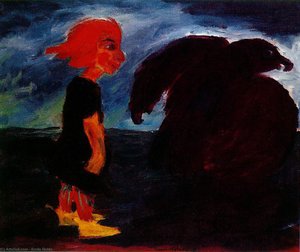
      Child and Large Bird (1912) by Emil Nolde
      #100

      Child and Large Bird

      1912 · Statens Museum For Kunst

      The painting Child and Large Bird by Emile Nolde is a captivating work of art that showcases the artist's unique style and technique. Created in 1912, this oil…

      Have it painted by hand →

      Emil Nolde's canvases, period by period

      What Emil Nolde painted most

      The four subjects that return most often on these canvases, each with its best-loved example.

      Where Emil Nolde's canvases hang

      The 7 museums that hold the most of the paintings on this page.

      Museum City Works by Emil Nolde Paintings from this list
      Bavarian State Painting Collections, MünihBavarian State Painting Collections Münih 10 Animal and Figures, Festival Girls, Nordermühle
      Statens Museum For Kunst, KopenhagStatens Museum For Kunst Kopenhag 10 Shivering Russians, Robbers at Bombüll, The Blacksmith
      Nelson-Atkins Museum of Art, Kansas CityNelson-Atkins Museum of Art Kansas City 2 Masks, Masks
      Staatliche Kunsthalle Karlsruhe, KarlsruheStaatliche Kunsthalle Karlsruhe Karlsruhe 4 At the Fountain
      Brücke Museum, BerlinBrücke Museum Berlin 2 Ridicule (Verspottung)
      Museum Kunstpalast, DüsseldorfMuseum Kunstpalast Düsseldorf 1 Çiçek Bahçesi (Kız ve Çamaşır)
      Metropolitan Sanat Müzesi, New YorkMetropolitan Sanat Müzesi New York 1 Large Sunflowers

      Emil Nolde's best-loved canvas of each decade

      1. 1900s
        Couple on the beach (1903) by Emil Nolde
        Canvas 3 of 100

        Couple on the beach

        Age 33 – 42

        In "Couple on the beach" by Emil Nolde, painted about 1903, the arrangement of figures creates a quiet sense of intimacy against a vast landscape. At the center…

      2. 1910s
        Masks (1911) by Emil Nolde
        4 of 100

        Masks

        Age 43 – 52 · Nelson-Atkins Museum of Art

        Emil Nolde's "Masks," painted in 1911, isn’t merely a depiction of carnival revelry; it’s a profound exploration of identity, hidden desires, and the unsettling duality inherent within human…

      3. 1920s
        Wild Animals (1921) by Emil Nolde
        Canvas 24 of 100

        Wild Animals

        Age 53 – 62 · Bavarian State Painting Collections

        The work belongs to a period of intense experimentation. It reflects a shift toward the subjective, where the internal world dictates the external appearance. The textures are thick…

      4. 1930s
        Nordermühle (1932) by Emil Nolde
        14 of 100

        Nordermühle

        Age 63 – 72 · Bavarian State Painting Collections

        is a studio portrait by the German artist Emile Nolde, dating to 1932. The work captures four individuals in a formal arrangement, presented as a monochromatic study of…

      5. 1940s
        Young Women (1947) by Emil Nolde
        Ranked 69 of 100

        Young Women

        Age 73 – 82 · Statens Museum For Kunst

        In this work, titled Young Women, we encounter a significant piece from the later period of Emil Nolde. Painted in 1947, the canvas reflects the artist's continued engagement…

      About Emil Nolde's canvases: your questions answered

      What is the best-known painting by Emil Nolde?Read the answer

      Sunset, followed by Sea with Red Sky and Couple on the beach (1903).

      What are the 10 most famous paintings by Emil Nolde?Read the answer

      Sunset, Sea with Red Sky, Couple on the beach, Masks, Christ among the Children, The Great Gardener, Light-flooded Sea (Green), Marshy Landscape under the Evening Sky, Animal and Figures and Anna Wieds Garden. Each canvas in the ranking above comes with its year and its museum.

      How many works did Emil Nolde paint in all?Read the answer

      394 works by Emil Nolde are in our catalogue, dated 1903 to 1947.

      Where can I see Emil Nolde's most famous canvases?Read the answer

      Mostly in Bavarian State Painting Collections (Münih), Statens Museum For Kunst (Kopenhag) and Nelson-Atkins Museum of Art (Kansas City); the list above names each museum and its canvases.

      When did Emil Nolde paint the best-loved canvases?Read the answer

      In 1910s, which gave 22 of the 100 works on this page, Masks among them.

      Which are Emil Nolde's earliest and latest famous canvases?Read the answer

      The earliest canvas here is Couple on the beach (1903); the latest is Young Women (1947).

      What did Emil Nolde paint most often?Read the answer

      Figures (11), Sky (10) and Sea (10), across the 100 works on this page.

      Which medium did Emil Nolde paint in most often?Read the answer

      Oil On Canvas, used in 14 of the 100 works on this page.

      Which movement is Emil Nolde's painting part of?Read the answer

      German expressionism, as the canvases on this page show.

      Which Emil Nolde canvases hang at the Bavarian State Painting Collections?Read the answer

      The Bavarian State Painting Collections, Münih holds 7 of the works on this page, among them Animal and Figures, Festival Girls and Nordermühle.

      Can I buy a reproduction of a Emil Nolde canvas?Read the answer

      Yes. Every painting on this page can be ordered from its own page as an oil reproduction painted by hand, or as a fine art print, in the size you choose.

      Emil Nolde: a life in paint

      Emil Nolde'nin Yaşamı ve Kimliği

      7 Ağustos 1867 tarihinde Hans Emil Hansen adıyla dünyaya gelen ve ileride Emil Nolde olarak tanınacak olan sanatçı, Schleswig Dükalığı'ndaki Nolde köyü yakınlarında büyüdü. İlk yılları, ailesinin sürdürdüğü kırsal ve tarıma dayalı yaşamın ritmiyle şekillendi. Ancak zamanla bu yoldan saparak, bir ahşap oymacısı ve mobilya süslemesi ustası olarak çalışmayı tercih etti. Bu dokunsal ve fiziksel emek süreci, onun resim ve baskı sanatına yönelmesinden önce gelen temel bir deneyimdi. Sanatçı, ailesinin beklentilerinden ayrı, kendine has bir kimlik inşa edebilmek adına sanatçı adını bir ayrışma aracı olarak benimsedi.

      20. yüzyılın başlarında sanat dünyasındaki varlığı, içsel ve öznel olanın peşinden gitmesiyle belirginleşti. İlk Ekspresyonistlerden biri olarak, nesnelerin yüzeysel görünüşünün ötesine geçmeyi amaçladı. Akademik geleneklerden kopmayı hedefleyen bir kolektif olan Die Brücke grubuna üye oldu. Eserleri genellikle psikolojik derinliğe ve ilkel olanın gücüne odaklanırken; renk ve formu, basit bir benzerliğin çok daha ötesindeki o derin hakikate ulaşmak için birer araç olarak kullandı. O, dünyayı yoğun ve kişisel duyguların merceğinden izleyen bir ressamdı.

      Erken Yaşam ve Sanatsal Başlangıçlar

      Hans Emil Hansen adıyla dünyaya gelen sanatçı, Schleswig Düklüğü'nde bir çiftlikte büyüdü. Danimanyalı ve Frisli köylü bir ailenin evladı olan Nolde'nin ilk yılları, kırsal yaşamın ritimleriyle şekillendi. Zamanla, bir çiftçinin yaşam tarzının kendisine ait olmadığını fark etti; toprağın o ağır ve tekrarlayan işleyişi ruhunda bir uyumsuzluk hissi uyandırıyordu. Çiftçinin sabanına yönelmek yerine, elleri ahşabın dokusunu aramaya başladı.

      Ahşap oymacılığına bir zanaat olarak yöneldi ve malzemeyle sarsılmaz, dokunsal bir bağ kurarak çalıştı. Bu fiziksel emek dönemi, sanatsal yolculuğunda bir sapma değil, aksine sağlam bir temel oluşturdu. Daha sonra Karlsruhe ve Münih'teki eğitim süreçlerinden geçti; ancak bu kurumların akademik kısıtlamaları ona çoğu zaman engelleyici geldi. Nihayetinde Emil Nolde adını benimseyerek, ailesinin beklentilerinden kopup kendi özgün kimliğine doğru dev bir adım attı.

      Sanatsal Gelişim ve Etkiler

      Tuvale yaklaşımı, Post-Empresyonist üslup ile kurduğu derin bağdan beslenerek şekillendi. Paul Gauguin'in eserlerine yönelerek basit bir temsiliyetin ötesine geçmenin yolunu buldu. Bu değişim, onun bir konunun dış görünüşünden ziyade içsel ağırlığına odaklanmasına olanak tanıdı. Doğal dünyaya olan ilgisi, sıklıkla çiçeklere duyduğu tutkuyla kendini gösterdi; bu alışkanlık, Vincent van Gogh'un etkilerini yansıtan bir tutkuydu. O, sadece bir bahçeyi resmetmiyor; taç yaprakların içindeki o canlı nabzı aramaya çalışıyordu.

      Onun sanatsal yolculuğu hiçbir zaman düz bir çizgi izlemedi. Die Brücke grubunun sanatçıları arasında kendine bir yer bulsa da, ilgi alanları onu sık sık farklı çevrelerin içine çekti. 1912 yılında, Wassily Kandinsky'nin Der Blaue Reiter grubunun üyeleriyle birlikte sergiler açtı. Hayatının bu dönemi, gözlemlerinin yoğunluğunu taşıyabilecek görsel bir dil arayışıyla geçti. Renk ve form üzerine yaptığı çalışmalar arasında gidip gelirken, boyanın dünyanın yüzeyinden çok daha fazlasını anlatmasını sağlayacak o yolu her zaman aradı.

      Die Brücke Grubuna Katılımı

      1906 yılının başlarında, eserlerinin Dresden'deki Arnold'da sergilenmesiyle birlikte sanatçının yolculuğunda köklü bir değişim yaşandı. Bu karşılaşma, onu Die Brücke grubuna katılmaya davet eden bir dönüm noktasına dönüştü. Şubat 1906'dan Kasım 1907'ye kadar bu kolektifin bir parçası olarak kalan sanatçı, grubun 1905'ten beri Dresden'de yeni bir görsel dil arayışıyla akademik geleneklerden kopma çabalarına tanıklık etti.

      Grup ile geçirdiği süre, Post-Empresyonist etkilerin sanatçının ruhunda bıraktığı derin izlerle şekillendi. Grup üyeleri yerleşik normları yıkma noktasında ortak bir amaç paylaşsa da, Emil Nolde'nin izlediği yol her zaman kendine has ve özgün kalmayı başardı. Kendi memleketi Schleswig-Holstein'dan getirdiği ilkel maskelerin ve oymaların sarsıcı ifade gücü, grubun ortak keşiflerine bambaşka bir derinlik kattı. Dresden'deki bu dönem, sanatçının daha bağımsız bir yöne evrilmeden önce renk ve form üzerindeki erken dönem yaklaşımını tanımlayan temel bir süreç oldu.

      Teknik ve Dışavurumcu Üslup

      Fırça darbeleri, rengin anlık duyumsamasına duyulan derin bir tutkuyu ele verir. Emil Nolde, yirminci yüzyılın başlarında rengin kullanım sınırlarını zorlayan ilk yağlı boya ressamlarından ve suluboya sanatçılarından biriydi. Paleti genellikle yoğun, altın sarılarına ve derin kırmızılara meyleder; bu seçimler yüzeye belirli bir ağırlık kazandırarak renklerin yalnızca dekoratif bir unsur olmaktan çıkıp, orada var olan canlı birer güç gibi hissedilmesini sağlar. Geleneksel sanatın izlerini süren o ince ışık oyunlarıyla yetinmemiş, bunun yerine bir öznenin gerçekçi benzerliğinden ziyade, o öznenin uyandırdığı duyguyu önceleyen doğrudan bir anlatımı tercih etmiştir.

      1930'lardan ölümüne kadar olan süreçte suluboya, onun için temel bir ifade aracına dönüştü. Bu medyumun, fikirlerini ve kavramlarını kağıda yağlı boyadan çok daha hızlı bir şekilde aktarmasına olanak tanıdığını keşfetti. Bu hız, pigmenti işleyiş biçiminde kendini açıkça gösterir; canlı, kasvetli fırtına manzaraları ve göz alıcı çiçek kompozisyonları yaratır. Boya, ışığın veya hava durumunun değişmesinden hemen önce o anın ruhunu yakalamak istercesine, çoğu zaman bir aciliyet duygusuyla hareket eder. Onun manzara resimlerinde renk, bir formun üzerine serilmiş basit bir katman değil, bizzat o formun özüdür.

      Baskı ve Nazi Rejimi

      Emil Nolde ile Nazi rejimi arasındaki ilişki, oldukça karmaşık ve çelişkilerle dolu bir doğaya sahipti. Kendisi Nazi Partisi'ne üye olmasına rağmen, kendi tabloları devlet tarafından şiddetle kınanıyordu. Sanat eserleri rejim tarafından "yozlaşmış" olarak damgalandı; bu durum, sanatçının siyasi aidiyetleri ile yaratıcı üretimi arasında doğrudan bir çatışmaya yol açtı. Yaşanan bu gerilim, Nazi Partisi tarafından 1.052 eserinin müzelerden toplatmasına neden olan trajik bir süreci beraberinde getirdi.

      Yıllar geçtikçe, sanat pratiği üzerindeki kısıtlamalar daha da ağırlaştı. 1941 yılından sonra resim yapması resmen yasaklandı. Bu sessizlik döneminde, vizyonunu hayatta tutabilmek için başka yollara başvurdu. Çoğu zaman "Boyanmamış Resimler" olarak anılan ve gizli tuttuğu yüzlerce suluboya eser yarattı. Resmi sanat dünyası onun üslubundan yüz çevirip uzaklaşırken, bu eserler gözlerden uzak bir şekilde varlığını sürdürdü.

      Önemli Eserleri ve Sanatsal Başarıları

      Emil Nolde'nin fırça darbeleri, genellikle rengin doğrudan uygulaması yoluyla bir öznenin özünü yakalamayı amaçlardı. 1912 yılında, nesnelerin ve figürlerin formlarına olan ilgisini yansıtan Man, Woman and Cat adlı eseriyle dikkatleri üzerine çekti. 1917 yılına gelindiğinde ise odağı, Blumengarten (Utenwarf) eserinde olduğu gibi doğal dünyaya doğru kaydı. Bu parçalar, yüzeyi inşa etmek için kalın boya katmanları kullanarak, kendi özgün görme biçimine olan sarsılmaz bağlılığını gözler önüne serer.

      Yıllar geçtikçe, kullandığı tekniklerle olan ilişkisi de dönüştü. 1930'lardan ölümüne kadar geçen süreçte suluboya, fikirlerini yağlı boyadan çok daha hızlı bir şekilde kağıda dökmesine olanak tanıyan temel çalışma yöntemi haline geldi. Bu durum, suyun hareketinin hızlı ve dışavurumcu darbelerle yakalandığı 1930 tarihli Stormy Sea suluboyasında açıkça görülmektedir. Topluluk önünde resim yapması yasaklandığı dönemlerde bile, gizli bir şekilde çalışmaya devam ederek "Boyanmamış Resimler" adını verdiği yüzlerce suluboya eser ortaya çıkardı.

      Sanatçının son yılları, insan formu ve portrenin psikolojik ağırlığı üzerine süregelen bir keşif sürecine tanıklık etti. 1937 yılında, bir dizi suluboya çalışmasından doğan Doppelbildnis adlı çift portresini yarattı. Onun sanatı, rengi belirli ve içsel bir hakikate ulaşmak için kullanan bir adamın ebedi bir kaydı olarak kalmaya devam ediyor.

      • Man, Woman and Cat (1912)
      • Blumengarten (Utenwarf) (1917)
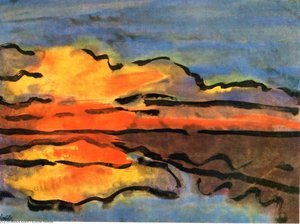
      • Stormy Sea (1930)
      • Doppelbildnis (1937)

      Miras ve Tarihsel Etki

      Emil Nolde'nin bıraktığı etkinin ağırlığı, rengin artık sadece bir betimleme aracı olmaktan çıkarılıp özgürce hareket etmesine izin verilmesinde hissedilir. Bir tuvalin neleri barındırabileceğine dair sınırları zorlayarak, Ekspresyonizm'in yönünü şekillendirmeye yardımcı olmuştur. Eserleri, geçmişin akademik kurallarından uzaklaşarak, dışsal benzerlikten ziyade içsel durumu önceleyen bir doğrudanlığı tercih etmiştir. Bu değişim, boya uygulamasının ve renk seçiminin, ham ve aracısız bir varoluş duygusunu iletmek için kullanıldığı yeni bir görsel dilin kapılarını aralamıştır.

      Yirminci yüzyılın ilk dönem hareketlerindeki varlığı, sanatçının, hakim siyasi veya sosyal iklimle çoğu zaman çatışan bireysel bir ses olarak yer edinmesi konusunda bir emsal teşkil etmiştir. Eserleri kamuoyunun gözünden kaçırılıp "yozlaşmış" olarak damgalandığında bile, o özel dünyasında sanat üretmeye devam etmiştir. Bu kararlılık, renk ve forma olan kendine has yaklaşımının, nihayetinde modern sanata yapılmış önemli bir katkı olarak tanınmasını sağlamıştır. Arkasında, yoğunluğu ve kendi zamanının beklentilerine boyun eğmeyi reddedişiyle incelenmeye devam eden devasa bir külliyat bırakmıştır.

      • The Mocking of Christ
      • Autumn Sea
      • Masks

      Eserlerini Bugün Nerede Görebilirsiniz?

      Sanatçının kamu koleksiyonlarındaki izlerini sürmek, dağınık ancak bir o kadar da anlamlı bir yolculuğu ortaya çıkarıyor. Hannover'deki Sprengel Müzesi, onun suluboya manzara çalışması olan Stormy Sea eserine ev sahipliği yaparken; kuzeye, İsveç'in Stockholm kentine doğru gidildiğinde Moderna Museet, Blumengarten (Utenwarf) çalışmasını barındırır. Bu eserler, sanatçının fırçasının farklı yüzeyler ve konular üzerinde nasıl bir ustalıkla gezindiğini görmek için eşsiz birer kapı aralar.

      Bremen'deki Böttcherstraße Museums da onun eserlerine ev sahipliği yaparak, sanatçının varlığını Alman kültür coğrafyasında hissettirmeye devam eder. Hayatına ve sanatsal üretimine daha yoğun bir perspektiften bakmak isteyenler için ise 1956 yılında Nolde Stiftung Seebüll kurulmuştur. Bu vakıf, sanatçının mirası için merkezi bir odak noktası olma özelliğini korumaktadır.

      • Stormy Sea
      • Blumengarten (Utenwarf)
      All 394 works by Emil Nolde →