

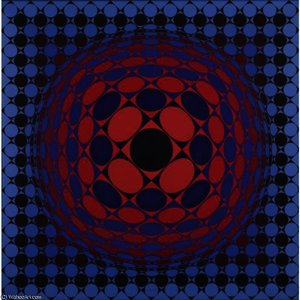
Victor Vasarely denince akla gelen en önemli eser Bivega'dir. Quadrature ve ORION-MC, en sevilen üç tablonun üçlüsünü tamamlıyor. Kataloğumuzda Victor Vasarely tarafından yapılmış 776 eser bulunmaktadır. İşte her bir tuvalin yılı, müzesi ve hikayesiyle birlikte en ünlü 100 eseri.
Her bir eser için yapılan aramalar, ziyaretler ve siparişlerin birleşimiyle oluşturulan popülerlik puanımıza göre sıralanmıştır. Ekim 2026 tarihinde güncellenmiştir.


Victor Vasarely's *Quadrature* isn't merely a painting; it’s an invitation – an invitation to question the very nature of visual reality. Created by a visionary who anticipated the digital age, this work embodies the core tenets of Op Art, a movement that sought to manipulate perception through carefully constructed geometric forms and vibrant color fields. Painted in 1960s, *Quadrature* showcases Vasarely’s mastery of optical illusion, transforming two dynamic spheres into…

Victor Vasarely's ORION-MC is not merely a painting; it’s an invitation to experience the world through a radically altered lens. This captivating work, rendered in a vibrant palette of red, yellow, green, blue, purple, orange, and black, exemplifies the core tenets of Op Art – Optical Art – pioneered by Vasarely himself. Born Károly Vaszary in 1906 in Pécs, Croatia, his artistic trajectory began with an unexpected detour into medicine…

The artwork titled Zebras (white on black) was created by the artist Victor Vasarely. This piece features two zebras positioned against a black background. The composition includes smaller figures of animals in the background, such as two birds and three additional zebras, which contribute to the depth of the image. The visual structure utilizes geometric shapes and patterns to form the figures.

Vega-Wa-3: A Geometric Dance of Perception Victor Vasarely’s “Vega-Wa-3” isn't merely a painting; it’s an invitation into a realm where visual reality bends to the will of mathematical precision. Created in 1968, this striking artwork embodies the very essence of Op Art – Optical Art – a movement that revolutionized artistic expression during the mid-20th century and continues to fascinate audiences today. The piece immediately captivates with its bold palette:…

To stand before Victor Vasarely’s Kaglo II is to enter a realm where the boundaries between the static and the kinetic dissolve into a rhythmic dance of light and color. Created in 1986, this masterful print serves as a profound testament to the enduring power of geometric abstraction. At first glance, the eye is drawn to a central, commanding red sphere, which acts as the sun within a private cosmos.…

Victor Vasarely’s *Vega 1* isn't merely a painting; it’s an invitation. An invitation to step outside the confines of traditional representation and into a world governed by perception itself. Born in 1906 in Pécs, Croatia – then part of Austria-Hungary – Vasarely’s artistic trajectory was initially rooted in medicine before he decisively embraced the burgeoning field of visual abstraction. This pivotal shift, fueled by his studies at the Podolini-Volkmann Academy…

Victor Vasarely’s “NB 22 Caope” is more than just an abstract painting; it's a meticulously crafted portal into the heart of Op Art, a movement that sought to redefine our perception of reality. This striking work, dominated by a precisely arranged grid of black and white circles, exemplifies Vasarely’s pioneering approach to visual illusion – a technique he developed with mathematical rigor and an almost obsessive attention to detail. The…

To stand before a work by Victor Vasarely is not merely to observe paint on canvas; it is to engage in a sophisticated dialogue with perception itself. This piece, characterized by its vibrant, almost pulsating geometric network, draws the viewer into a mesmerizing optical labyrinth. It speaks directly to the intellectual curiosity of the modern collector and the design sensibility of those who appreciate art as an architectural element. The…

To stand before Harmas is to step directly into the mind of its creator, Victor Vasarely. This piece is not merely an arrangement of color and pattern; it is a vibrant intellectual puzzle, a visual meditation on structure itself. The eye is immediately drawn into the intricate dance between the bold red checks and the myriad small circles that populate the background. It possesses the undeniable energy characteristic of Op…

Victor Vasarely's Pal-Ket, painted in 1974, isn’t merely a visual experience; it’s an invitation to reconsider the very nature of perception. This vibrant acrylic on canvas piece, measuring…

Victor Vasarely's "Vonal-2" is more than just a colorful pattern; it’s a meticulously crafted portal into the heart of Op Art and a testament to the revolutionary ideas…

In this 1957 work, titled Vega II, Victor Vasarely explores the fundamental mechanics of sight. The piece is a purely abstract composition, eschewing any recognizable subject matter in…

To stand before Victor Vasarely's Axo 99 is not merely to observe a painting; it is to engage in a visual dialogue with the very mechanics of sight…

Victor Vasarely's “Abstract Composition 9” is more than just a painting; it’s an invitation to experience the world through the lens of perception itself. Created by one of…

The artwork titled Zebras was created by the artist Victor Vasarely. This piece, dated 1938, emerged from a period of intense graphic experimentation. It is considered one of…

To encounter Victor Vasarely’s Kezdi-Ga is to step away from the stillness of traditional viewing and enter a realm where the canvas breathes, pulses, and vibrates with an…

Victor Vasarely’s ‘SIR-RIS,’ a captivating sculpture rendered in meticulous black and white, stands as a cornerstone of Op Art – a movement that fundamentally challenged our understanding of…

To stand before Victor Vasarely’s "Torony-Nagy" is not merely to observe paint on canvas; it is to engage in a sophisticated dialogue with perception itself. This vibrant 1969…

Victor Vasarely's 'Quasar' is not merely a painting; it’s an invitation into the very fabric of perception, a testament to the revolutionary impact of Op Art and the…

To stand before Victor Vasarely's Zett-Ka is not merely to observe a painting; it is to step into a meticulously constructed optical puzzle. This masterful piece, a quintessential…

Victor Vasarely's "Vega-Kontosh-Va" is not merely a painting; it’s an invitation to experience the world through a radically altered lens. This vibrant composition, dominated by a pulsating red…

We are looking at Vèga 3, a significant work by the artist Victor Vasarely. Created about 1968, this piece belongs to the Op Art movement, a style that…

Zoeld V, 1967 – Victor Vasarely’s Geometric Revelation Victor Vasarely (1906-1997), born Károly Vaszary in Pécs, Croatia, stands as a monumental figure in the realm of Op Art…

Victor Vasarely (1906-1997), a Hungarian-born artist, stands as one of the most influential figures in Op Art—Optical Art—a movement that revolutionized visual perception during the mid-20th century. His…

Sir-Ris B: A Geometric Symphony of Color and Illusion Victor Vasarely’s “SIR-RIS” is more than just a painting; it's an invitation into a realm where perception bends to…

In the realm of Op Art, few works capture the hypnotic essence of visual disruption as masterfully as Victor Vasarely’s Zebras (full body white on blue-black). This striking…

Victor Vasarely's "Kezdi-All," a captivating exploration of optical illusion and geometric abstraction, stands as a cornerstone of Op Art – a movement that fundamentally challenged our understanding of…

To stand before Harmas is to step directly into the mind of its creator, Victor Vasarely. This piece is not merely an arrangement of color and pattern; it…

To encounter Victor Vasarely’s 1951 masterpiece, “Terek,” is to step away from the static world of traditional representation and enter a realm where the canvas itself seems to…

To stand before this piece is to step through a portal built entirely of color and calculated form. It is an immediate confrontation with perception itself. The composition,…

To encounter Victor Vasarely's 'Folklore' is to step away from the stillness of traditional viewing and enter a realm where the canvas begins to breathe, pulse, and vibrate…

Victor Vasarely’s “O N D - I I - V A” is more than just a painting; it's an invitation to experience the world through a radically altered…

The artwork is a grid-based abstract composition dominated by concentric circles of varying sizes and shades of red and green. It presents a highly geometric and symmetrical design,…

Victor Vasarely's "F-VERT-BLEU" is not merely a puzzle; it’s a meticulously crafted portal into the heart of Op Art, a movement that fundamentally altered our perception of space…

Victor Vasarely: A Pioneer of Geometric Abstraction and Optical Illusion Victor Vasarely (1906-1997), born Károly Vaszary in Pécs, Hungary – now Croatia – embarked on an artistic journey…

The painting Dia-Tuz-Neg is a blue and white composition characterized by a circular pattern. At the center of the work, a large circle is prominently featured, surrounded by…

Victor Vasarely’s “Caopeo” isn’t merely a painting; it’s an invitation, a carefully constructed illusion designed to challenge and delight the viewer. Created in 1962, this seminal work exemplifies…

Sorata-T is a painted glass triptych executed in 1953. The work is composed of three panels:

The artwork Triond features three colorful balls presented in various shades of blue, purple, pink, and green. These spheres are arranged in a triangular formation, with one ball…

Step closer to observe how the eye begins to move across the surface of Domb-B. At first glance, your attention is drawn to that central blue and yellow…

VP-115 by Victor Vasarely exists as a precise study in the mechanics of sight. The work operates through a calculated arrangement of geometric shapes, specifically a sphere and…

Victor Vasarely's 'Jong,' completed in 1968, is more than just an image; it’s an invitation to question the very nature of reality. This arresting work, a cornerstone of…

The artwork consists of four circles arranged in a square configuration. Each circle is assigned a specific color: blue, orange, yellow, and purple. These shapes are positioned at…

To encounter Victor Vasarely’s “Obor” is to step away from the stillness of traditional viewing and enter a realm where the canvas itself seems to breathe, pulse, and…

Victor Vasarely: Pionerin Op Art ve Görsel Deneyimin Demokratikleştirilmesi Victor Vasarely (1906-1997), Op Art ve kinetik sanatın öncüsü olarak dünya sanat tarihine damgasını vurmuştur. Ancak bu ikonik stilin…

A Dance of Circles on Crimson: Exploring Victor Vasarely's "Untitled 16" Victor Vasarely, a name synonymous with Op Art and kinetic abstraction, gifted the world a visual language…

Tridem K – A Geometric Revelation by Victor Vasarely Victor Vasarely (1906-1997) stands as an undisputed titan of Op Art, a movement that revolutionized visual perception in the…

The artwork Louisiana features a symmetrical, circular design composed of numerous small, overlapping circles in varying shades of red, orange, and brown. A blue grid subtly underlies the…

A Symphony of Geometry: Exploring Victor Vasarely's "Sikra-Z" Victor Vasarely, a name synonymous with Op Art and kinetic art, dedicated his life to unraveling the mysteries of perception…

Victor Vasarely: Bir Görsel Ritminin Dinamik Keşfi – Kalota-MC Victor Vasarely, Op Art ve kinetik sanatın önde gelen figürüdür. Sanatsal yolculuğu geleneksel tablo yapmaktan korkarak görsel deneyimleri kapsayacak…

Victor Vasarely (1906-1997), Op Art hareketinin babası olarak tanınan ve modern sanatın tasarımına uzun süreli bir etkisi olan eşsiz bir figürdür. Aynı zamanda geometrik soyutlamanın önde gelen savunucusu…

Victor Vasarely’s “Quadrature ”X” stands as a cornerstone of Op Art, an artistic movement that emerged in the mid-1960s and captivated audiences with its mastery of optical illusions.…

A Dance of Light and Geometry: Unveiling Victor Vasarely’s “Untitled 18” Victor Vasarely's "Untitled 18" isn’t merely a painting; it’s an invitation to step into a world where…

Victor Vasarely (1906-1997) stands as an undisputed titan of Op art, a movement that irrevocably altered the landscape of 20th-century visual culture. Born Károly Vásárhelyi in Pécs, Hungary…

KALOTA T is an artwork created by the artist Victor Vasarely. Born in 1906 and passing away in 1997, the French/Hungarian artist developed a visual language centered on…

Victor Vasarely's "Sikra," painted in 1966, is more than just a colorful composition; it’s a meticulously crafted portal into the heart of Op Art and a testament to…

Victor Vasarely's "Dia-Or" is not merely a painting; it’s an invitation into the very fabric of perception. This captivating work, rendered in oil with meticulous attention to detail,…

To encounter Victor Vasarely's “Mahn” is to step into a realm where the canvas ceases to be a static surface and begins to breathe, pulse, and vibrate with…

Victor Vasarely’ın İnanılmaz Düzeni: Cheyt - L Üzerine Bir Bakış Viktor Vasarely (1906 – 1997), geometrik abstraktsiyonun zirvesine ulaşmış bir sanatçıdır. Pécs’te doğmuş olan Vasarely, başlangıçta doktor olmak…

To encounter Victor Vasarely’s Caribe Negatif is to step away from the stillness of traditional viewing and enter a realm where the canvas breathes, vibrates, and dances before…

To encounter Victor Vasarely's “Tomor” is to step away from the static world of traditional imagery and enter a realm where the canvas itself seems to breathe, pulse,…

Victor Vasarely's Rhombus-B is more than just a painting; it’s an invitation to question the very nature of visual perception. Created by one of the foremost figures in…

Victor Vasarely's "Sreeh" is more than just a painting; it’s an invitation into the heart of Op Art, a visual exploration of perception itself. This striking work, dominated…

Victor Vasarely's "Hetta," a deceptively simple composition of four vibrant circles – red, orange, green, and blue – is far more than just an abstract arrangement. It’s a…

Victor Vasarely's *Opus 2604* is not merely a painting; it’s an invitation to question the very nature of visual reality. This mesmerizing work, dominated by a vibrant blue…

This vibrant artwork, designated VY-47-C, is a captivating embodiment of Victor Vasarely's groundbreaking contributions to Op Art and his pioneering exploration of geometric abstraction. Executed with a masterful…

Viktor Vasarely’ın Vega-EG Karya Üzerine Bir İnceleme Viktor Vasarely, 1906 yılında Pécs şehrinde doğmuş ve geometrik abstrakisyonun zirvesine ulaşan Op Art hareketinin öncülerinden biri olarak tarihe geçmiş bir…

Guimen: A Symphony of Geometric Illusion Victor Vasarely’s “Guimen” stands as an emblem of Op Art – Optical Art – a movement that fundamentally challenged our perception of…

Victor Vasarely's "Molnar" is more than just a painting; it’s an invitation into the mesmerizing world of Op Art, a realm where perception itself becomes the subject. This…

Victor Vasarely's Folkokta is more than just a colorful arrangement of squares; it’s a meticulously crafted portal into the heart of Op Art and a testament to the…

Victor Vasarely: Pionir Op Art i demokratizacija vizuelnog iskustва Victor Vasarely (1906–1997) био је сликар који је револуционисао свет уметности својим иновативним приступима геометрији и перцепцији. Иако је…


Victor Vasarely's "Andromeda" isn't merely a painting; it’s an invitation into a realm where perception itself becomes the subject. This striking composition, dominated by a meticulously rendered geometric…

Victor Vasarely’nin Geometrik Dünyası ve “Planetary Folklore Participations No. 1” Tablosu Victor Vasarely (1906-1997), Avrupa sanatının ikinci yarısında ortaya çıkan ve Op Art akımını başlatarak görsel algıyı temel…
Victor Vasarely's "Versakk" is not merely a painting; it’s an invitation, a carefully constructed illusion that challenges our very perception of space and form. Created by the Hungarian…

Victor Vasarely's DVA-DVA is more than just a colorful square; it’s a meticulously crafted portal into the heart of Op Art and a testament to the revolutionary approach…

Victor Vasarely’nin Kübik Dünyası ve Görsel İllüzyonlara Yol Açması Victor Vasarely (1906-1997), geometrik abstrakta sanatın zirvesine ulaşmış bir isimdir. Aynı zamanda Pécs şehrinde doğmuş olan Vasarely, Bauhaus hareketinden…

Victor Vasarely ve Koska Kar’ın Görsel Dünyasına Yolculuk Victor Vasarely (1906-1997), Avrupa sanatının ikinci yarısında ortaya çıkan ve özellikle Op Art akımını temsil eden bir Sovyet bilim adamı…

Louisiana 3: A Symphony of Geometric Illusion Victor Vasarely’s “Louisiana” isn't merely a painting; it’s an invitation into a realm where perception bends and reality dances with visual…

Koentoesh: A Geometric Dance of Color Victor Vasarely’s “Koentoosh,” created in 1974, stands as a cornerstone of Op Art—Optical Art—a movement that revolutionized visual perception during the mid-20th…

To encounter Victor Vasarely’s Tridim is to step into a realm where the boundaries of the two-dimensional canvas dissolve, replaced by a pulsating, architectural depth that defies the…

Victor Vasarely ve Koska-Pint Karya Dünyasına Giriş Koska-Pint, Viktor Vasarely’nin Op Art akımının zirvesine ulaşmış ikonik bir eseridir. Bu çarpıcı renklerin ve geometrik desenlerin uyumlu dansı sadece gözlere…


Victor Vasarely ve Geometrik İmajların Dansı: Untitled 22’nin Gizli Düzeni Victor Vasarely (1906-1997), Avrupa sanatının ikinci yarısında ortaya çıkan önemli bir figürdür. Özellikle Op Art hareketiyle tanınan Vasarely,…

Victor Vasarely ve İlik Serisi Victor Vasarely (1906-1997), geometrik abstrakta sanatın öncüsü olarak kabul edilir ve Op Art hareketinin babasıdır. Ancak onun eserleri sadece görsel bir deneyim sunmakla…

“MEH2,” a captivating work by Hungarian artist Victor Vasarely, is more than just a painting; it's an invitation to explore the very nature of visual perception. Executed in…

Victor Vasarely's Vega-Fel is not merely a painting; it’s an invitation to experience the world through a radically altered lens. This captivating work, dominated by a monumental blue…

Victor Vasarely's "Attam" is more than just a painting; it’s an invitation into the very heart of perception, a testament to the revolutionary impact of Op Art and…

To encounter Victor Vasarely’s “Sikra” is to step away from the stillness of traditional viewing and enter a realm where the canvas breathes, pulses, and vibrates with an…

Victor Vasarely's "Atelier Arcay" isn’t merely a painting; it’s an invitation to a perceptual adventure. Created in the heart of the Op Art movement, this vibrant geometric abstraction…

Victor Vasarely’nin Matematiksel Dansı: “Abstract Composition 5” Üzerine Bir İnceleme Viktor Vasarely, 1906 yılında Avusturya İmparatorluğu’nun Pécs şehrinde doğmuş ve geometrik sanatın öncülerinden biri olma yolculuğuna çıkmıştır. İlk…

Victor Vasarely's Composition 7 is more than just a colorful painting; it’s a portal into the heart of Op Art and a testament to the revolutionary ideas of…

Victor Vasarely’s "Variációk" (Variations), created in 1989, is more than just an arrangement of circles; it's a vibrant exploration of perception and the underlying mathematical order that governs…

A Dance of Geometry and Color: Exploring Victor Vasarely's "Abstract Composition 13" Victor Vasarely, a name synonymous with Op Art and kinetic art, gifted the world a visual…

Victor Vasarely's Firaxo II is more than just a colorful textile; it’s a meticulously constructed portal into the heart of Op Art and a testament to the revolutionary…

A Symphony in Black: Exploring Victor Vasarely's Serigraph Victor Vasarely’s serigraphy in black is more than just an image; it’s an experience, a visual puzzle that invites the…

“Vonal-Fegn,” created by Victor Vasarely, is more than just an abstract painting; it's a meticulously crafted exploration of perception itself. Painted in hues of orange, yellow, blue, gray,…

Victor Vasarely's "Ouivar," a captivating exploration of geometric abstraction, invites the viewer into a world where perception itself becomes the subject. This artwork, characterized by its precisely arranged…

Victor Vasarely's "Abstract Composition 17" is more than just an image; it’s an invitation to experience the world anew. Born in 1906 in Pécs, Croatia – then part…
Bu tuvallerde en sık rastlanan ve her biri en sevilen örneğiyle birlikte sunulan dört konu.
Bu sayfadaki tabloların çoğuna ev sahipliği yapan 3 müze.
| Müze | Şehir | Victor Vasarely Eserleri | Bu listedeki tablolar |
|---|---|---|---|
 Bechtler Müzesi of Modern Art |
Charlotte | 4 | NB 22 Caope, SIR-RIS, Tridem K |
 Inter-American Development Bank |
Washington, D.C. | 2 | Kaglo II |
 Bilbao Güzel Sanatlar Müzesi |
Bilbao | 1 | Pal-Ket |
The artwork titled Zebras was created by the artist Victor Vasarely. This piece, dated 1938, emerged from a period of intense graphic experimentation. It is considered one of…
In this 1957 work, titled Vega II, Victor Vasarely explores the fundamental mechanics of sight. The piece is a purely abstract composition, eschewing any recognizable subject matter in…

Vega-Wa-3: A Geometric Dance of Perception Victor Vasarely’s “Vega-Wa-3” isn't merely a painting; it’s an invitation into a realm where visual reality bends to the will of mathematical…
Victor Vasarely's Pal-Ket, painted in 1974, isn’t merely a visual experience; it’s an invitation to reconsider the very nature of perception. This vibrant acrylic on canvas piece, measuring…

To stand before Victor Vasarely’s Kaglo II is to enter a realm where the boundaries between the static and the kinetic dissolve into a rhythmic dance of light…
Bivega, ardından Quadrature ve ORION-MC.
Bivega, Quadrature, ORION-MC, Zebras (white on black), Vega-Wa-3, Kaglo II, Vega 1, NB 22 Caope, Yon ve Harmas. Yukarıdaki sıralamadaki her tuval, yapıldığı yıl ve sergilendiği müze bilgisiyle birlikte sunulmaktadır.
Victor Vasarely tarafından yapılan 776 eser, 1938 ile 1986 tarihleri arasında katalogumuzda yer almaktadır.
Çoğunlukla Bechtler Müzesi of Modern Art (Charlotte), Inter-American Development Bank (Washington, D.C.) ve Bilbao Güzel Sanatlar Müzesi (Bilbao) bünyesinde yer alan; yukarıdaki liste her bir müzeyi ve o müzedeki tabloları belirtmektedir.
Bu sayfadaki 100 eserin 10 tanesi 1960s dönemine aittir ve bunlar arasında Vega-Wa-3 bulunmaktadır.
Buradaki en eski tuval Zebras (1938); en yenisi ise Kaglo II (1986).
Visual perception (36), Geometric abstraction (30) ve Color field (27), bu sayfadaki 100 eser genelinde.
Bu sayfadaki 100 eserin 41 tanesinde Acrylic On Canvas kullanılmıştır.
bu sayfadaki tabloların da gösterdiği gibi Optical art.
Bechtler Müzesi of Modern Art, Charlotte, bu sayfadaki eserlerden 3 tanesine ev sahipliği yapmaktadır; bunlar arasında NB 22 Caope, SIR-RIS ve Tridem K bulunmaktadır.
9 Nisan 1906'da Macaristan'ın Pécs şehrinde Károly Vaszary adıyla dünyaya gelen ve ileride Victor Vasarely olarak tanınacak olan sanatçı, yolculuğuna bambaşka bir alanda başladı. 1925 yılında, tıp eğitimi almak üzere Budapeşte'deki Eötvös Loránd Üniversitesi'nin koridorlarına adım attı. İnsan vücudunun mantığı ve bilimin disiplini iki yıl boyunca vaktini doldursa da, görsel ifadenin büyüleyici cazibesi en sonunda galip geldi. 1927 yılına gelindiğinde, tıp eğitimini geride bırakarak geleneksel akademik resim eğitimi almak üzere Podolini-Volkmann Akademisi'ne yöneldi.
Sanat yolculuğu, Sándor Bortnyik’in műhely adlı atölyesine geçmesiyle devam etti. Bu atölye, işlevsel tasarım ile geometrik soyutlamanın kesişimine odaklanan Bauhaus hareketinin ilkelerinin kök saldığı bir merkezdi. Burada odak noktası, yapısal ve sistematik olana doğru kaymaya başladı. Bu atölyelerde edindiği dersler, şekillerin ve renklerin gözle nasıl etkileşime girdiğine dair gelecekte yapacağı derinlemesine araştırmalar için sağlam bir temel oluşturdu.
1929 ile 1944 yılları arasında Vasarely, odağını grafik çalışmalara çevirdi. Bu yılları, ışık ve gölgenin basit formlarla nasıl bir etkileşim içinde olduğunu keşfederek, adeta bir deneyler süreci gibi geçirdi. Sanatçının erken dönem grafik çalışmaları, Chess Board (1935) ve Girl-power (1934) gibi eserlerle vücut buldu. 1937 yılında ise Zebras üzerine yoğunlaştı. Bu eserler, izleyicinin düz bir yüzeyi nasıl algıladığına dair gelişen bir merakın ve derin bir ilginin yansımasıdır. Sanatçı, geleneksel resim anlayışından uzaklaşarak, çok daha yapılandırılmış ve grafiksel bir yaklaşıma doğru evrildi.
1944 ile 1947 yılları arasında ise sanatçının yönelimi köklü bir değişim yaşadı. Kübist, fütüristik, ekspresyonist, sembolist ve sürrealist yaklaşımlar dahil olmak üzere pek çok farklı üslup arasında geçişler yaptı. Nihayetinde bu deneysel süreçleri geride bırakarak, uzayı organize etmenin çok daha kesin ve matematiksel bir yolunu aramaya başladı. Yeni bir mantık arayışı, onu meşhur Sarı Manifesto'yu (Yellow Manifest) yayımlamaya kadar götürdü. Bu noktadan itibaren çalışmaları, bireysel bir dışavurum olmaktan çıkıp, görme eyleminin mekaniğine odaklanan bir yapı kazandı. İşte bu sistematik metodoloji, onu nihayetinde Op Art hareketinin öncü ismi olarak tarihe kazıdı.
Vasarely’nin yaklaşımı, izleyicide fiziksel bir tepki uyandırmak için geometrinin sistematik kullanımına dayanır. Form yaratmak için geleneksel ışık kaynaklarına veya klasik chiaroscuro tekniğine bel bağlamamıştır. Bunun yerine, derinlik ve hareket illüzyonu yaratmak amacıyla yüksek kontrastlı pigmentlerin sofistike bir etkileşiminden yararlanmıştır. Renk yoğunluğunu manipüle ederek, gözü düz bir düzlem üzerinde çökme veya kabarma algılamaya ikna etmeyi başarmıştır. Bu yöntem, statik bir yüzeyi, sanki şişiyormuş veya geri çekiliyormuş gibi görünen dinamik bir mekana dönüştürür.
Görsel kinetik veya plastique cinétique olarak adlandırdığı yöntemi, şekillerin hassas bir düzenlemesini içerir. Bu illüzyonları inşa etmek için dokusal efektlerden, perspektiften, gölge ve ışıktan faydalanmıştır. Eserleri genellikle dışsal bir aydınlatmadan ziyade, gözün ritmik ve içsel bir parıltıyı nasıl yorumladığına dayanır. Izgaralar ve matematiksel ilkelerin kullanımı sayesinde, görsel titreşim ve girdap efektleri gibi duyular yaratmıştır. Sonuç, tamamen izleyicinin algısı içinde var olan bir hareket hissidir.
Tekniğinin hassasiyeti, mimari bir derinlik yaratmak için renk ve çizgiyi ele alış biçiminde açıkça görülür. Torony-Nagy gibi eserlerde, keskin beyaz çizgilerin derin maviler ve zümrüt yeşilleriyle kesişimi, ritmik bir optik titreşim yaratır. Bu unsurlar, nabız gibi atan bir ışık hissi üretmek için bir arada çalışır. O, bu araçları basit bir temsiliyetin ötesine geçmek ve bunun yerine görme mekaniğimizin işleyişine odaklanmak için kullanmıştır.
1937 yılında Zebra eserinin yaratılması, pek çok kişinin Op Sanatı'nın en erken örneklerinden biri olarak kabul ettiği o büyük kırılma noktasını işaret eder. Bu çalışma, geleneksel temsiliyetin sınırlarını aşarak, gözün basit formları nasıl yorumladığına odaklanan yeni bir evrenin kapılarını araladı. 1960'lı yıllara gelindiğinde ise ritim ve ışık üzerine yaptığı deneyimler, 1969 tarihli Torony-Nagy adlı başyapıtıyla zirve noktasına ulaştı. Dört adet stilize edilmiş kule ve maviler, yeşiller ile turunculardan oluşan yüksek kontrastlı bir renk paleti kullanan bu parça, izleyiciye içsel bir parlaklık hissi sunar. Kompozisyon, kesişen beyaz çizgiler ve renk yoğunluğu sayesinde, düz bir yüzeyin sanki nabız gibi attığı ve geriye doğru çekildiği illüzyonunu yaratır.
Victor Vasarely'nin harekete olan tutkusu, sadece tuvalle sınırlı kalmayıp üç boyutlu uzaya ve gündelik nesnelere de sıçradı. Kendi görsel teorilerini fiziksel ve hareketli bir forma dönüştüren devasa bir kinematik nesne olan Georges Pompidou'yu tasarladı. Geometrinin pratik uygulamalarına duyduğu bu ilgi, aynı zamanda Rosenthal Studio Linie ile yapılan anlamlı bir iş birliğine de zemin hazırladı. Bu ortaklık, sanatçının geometrik desenlerini evlerin mahrem ve günlük alanlarına taşıyan 500 parçalık Suomi sofra takımı serisiyle sonuçlandı.
1966 yılında Victor Vasarely, Fondation Vasarely'nin kurulma sürecini başlatarak sanat dünyasında devrim niteliğinde bir adım attı. Bu proje, sanatçının "herkes için sanat" kavramına dair özgün düşünceleri ve "yarının şehri" vizyonu üzerine inşa edilmişti. Vasarely, bu ilkeleri yansıtmak adına geleneksel galeri deneyiminin sınırlarını aşan, yaşayan bir mekan yaratmayı arzuluyordu. Bu büyük vizyonun somut bir yansıması olan binanın fiziksel inşaatı ise 1973 yılında başladı.
Kurum, 14 Şubat 1976 tarihinde Fransa'nın Aix-en-Provence şehrinde resmen kapılarını açtı. Bu merkez, sadece sanatçının eserlerine ev sahipliği yapmakla kalmayıp, aynı zamanda sanat ile kentsel tasarımın nasıl etkileşime girebileceğine dair teorilerini yaygınlaştırmak amacıyla tasarlandı. Mekanın mimari yapısı bizzat bu vizyonun bir parçasıydı; binanın yerleşimi, sanatçının geometrik formlarının halk tarafından deneyimlenmesini destekleyecek şekilde kurgulanmıştı.
Victor Vasarely'nin görsel dilinin erişimi, bir galerinin duvarlarını çoktan aşmıştı. Onun desenleri ve geometrik yapıları, gündelik hayatın dokularına sızarak moda çizgilerini, iç mekan tasarım düzenlerini ve grafik tasarımın mantığını derinden etkiledi. Hatta bilgisayar grafiklerinin erken dönem gelişiminde bile, onun form ve algıya yönelik sistematik yaklaşımının izlerini sürmek mümkündür. Onun fikirleri tuvalin sınırlarına hapsolmakla kalmadı; nesnelerin işlevsel dünyasına ve ardından gelen dijital yapılara doğru büyük bir yolculuğa çıktı.
1982 yılında, serigraflarının Fransız-Sovyet uzay aracı Salyut 7'ye dahil edilmesiyle eserleri uzaya kadar uzandı. Bu an, sanatçının matematiksel hassasiyeti ile insanlığın keşfetme tutkusu arasındaki o geniş bağı tüm görkemiyle gözler önüne serdi. Victor Vasarely, 15 Mart 1997'de Fransa'nın Paris kentinde hayata gözlerini yumana dek, modern sanat tarihinin en merkezi ve sarsılmaz figürlerinden biri olarak kalmaya devam etti.
Victor Vasarely'nin fiziksel izlerini sürmek, Fransa ve Macaristan'ın farklı noktaları arasında bir yolculuğa çıkmayı gerektiriyor. Fransa'nın Aix-en-Provence şehrinde yer alan Fondation Vasarely, sanatçının üretiminin çok önemli bir kısmına ev sahipliği yapmaktadır. Sanatçının bizzat kendisi tarafından, "herkes için sanat" fikirlerini yaymak amacıyla kurulan bu müze, büyüleyici bir mimari yapıya sahiptir. Mekân, her biri 14 metre genişliğinde ve 11 metre yüksekliğinde olan, 6'ya 8 metre boyutlarındaki kırk iki devasa eseri barındırmak üzere tasarlanmış yedi altıgen hücreden oluşmaktadır.
Sanatçının Macaristan'daki varlığı da özel mekanlar aracılığıyla derinden hissedilmektedir. Doğduğu şehir olan Pécs'te bir Vasarely Müzesi bulunmaktadır. Ayrıca Budapeşte'de, Óbuda'daki Zichy Sarayı'nda konumlanmış bir başka Vasarely Müzesi daha mevcuttur. Bu mekanlar, sanatçının pratiğini tanımlayan geometrik formlarla ve optik efektlerle doğrudan bir buluşma imkânı sunar. Fransa'da ise eserlerinin bir diğer adresi, Gordes'deki Saint-Firmin Sarayı'nda yer alan Vasarely Müzesi'dir.
Bu özel müzelerin ötesinde, sanatçının etkisi çeşitli kurumsal koleksiyonlarda da yankılanmaktadır. Eserlerinin bir kısmı Bilbao Güzel Sanatlar Müzesi'nde korunurken, diğerleri Washington, D.C.'deki Inter-American Development Bank ve Charlotte'daki Bechtler Modern Sanat Müzesi koleksiyonlarında yer almaktadır. Bu farklı coğrafyalara dağılmış lokasyonlar, onun görsel deneylerinin farklı izleyiciler için erişilebilir kalmasını sağlamaktadır.


