

 Переглянути в інтер'єрі
 Надіслати
 Поділитися
 Деталі
 Посібник

 Завантажити
 Схожі предмети колекціонування
 Рентгенівське дослідження
 Слайд-шоу
 Статистика переглядів
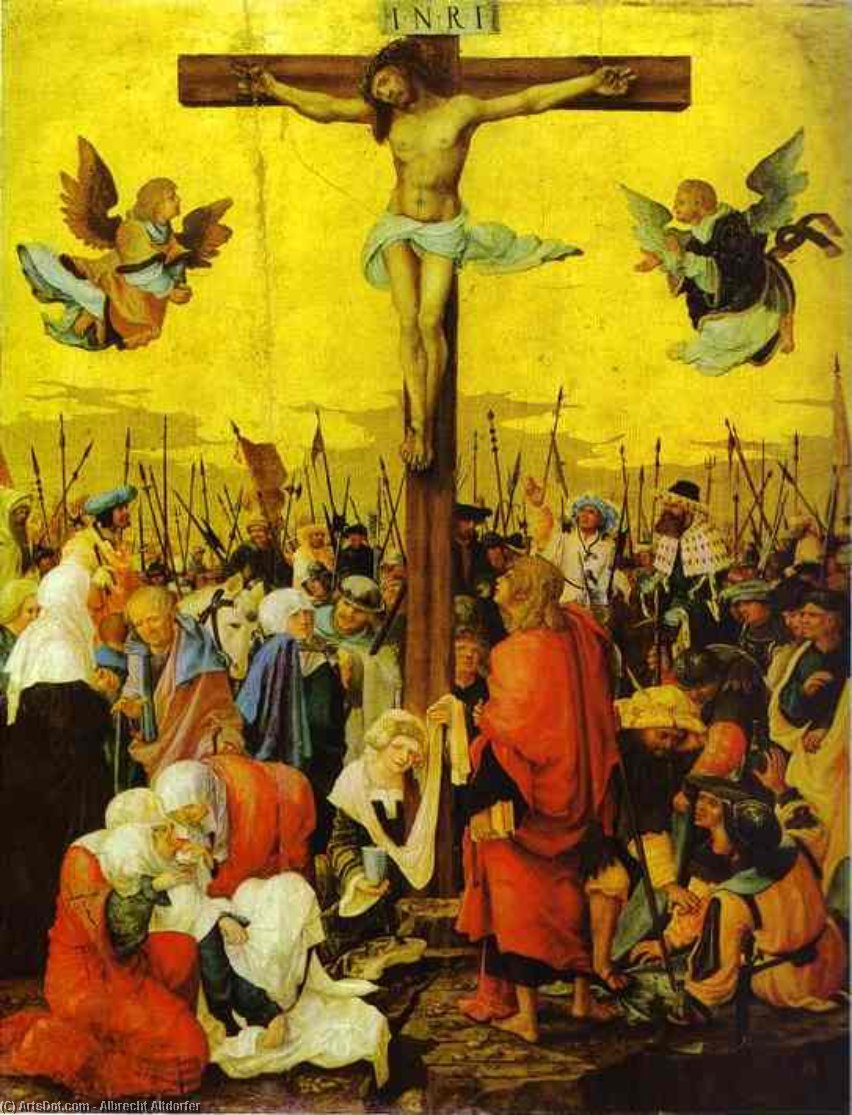
Crucifixion
 Oil On Canvas
- WallArt
- German Renaissance Landscape
 1526
1526 29.0 x 21.0 cm
 Державні музеї Берліна
Albrecht Altdorfer's "Crucifixion" (1526) is a dramatic, evocative depiction of Christ’s suffering, showcasing the artist's pioneering landscape style and masterful use of color within the Northern Renaissance.
 Читати далі
Альбрехт Альтдорфер – німецький художник-пейзажист епохи Віденської школи. Його картини вражають драматизмом, виразністю та глибоким зв’язком з природою. Відкрийте для себе його шедеври!
Гікле / Художній принт
Музейна якість друку جيкле або на полотні з оперативним виготовленням та різноманітними варіантами фінішної обробки. ( Купити картину ручної роботи Перейти до цифрових зображень)




P118B $10

P118H $10

P118W $10

P438Z $10

P508JH $12

P508YH $12

P805H $10

P805Z $10

P919BZ $10

P919G $10

P919XJ $10

P959ZH $10

P968JZ $12

W106C $8

W218G $10

W218JH $8

W218Y $10

W307PJ $10

W316G $10

W316PJ $8

W316Y $10

W398PJ $8

W4111J $10

W500HY $15

W500JH $15

W692G $12

W849H $8

W940BG $15

W953PJ $8




Стандартний розмір
на замовлення
CM
INCH
Обирайте з наших стандартних розмірів, що відповідають оригінальним пропорціям твору мистецтва.
Loading sizes...

ширина
висота
Ви можете вказати власні розміри, щоб репродукція ідеально підійшла до конкретної рами або інтер'єру. Якщо обраний вами розмір не відповідає пропорціям оригіналу, ми або обріжемо полотно, або розширимо зображення за допомогою дзеркального відображення чи суцільної заливки країв. Перед початком виробництва вам буде надіслано цифровий макет для затвердження.
Будь ласка, зверніть увагу, що попередній перегляд на екрані не відображає фактичне обрізання або розширення. Тільки макет точно покаже фінальну композицію.
Хоча можливість замовлення індивідуальних розмірів доступна, ми рекомендуємо обирати формат із попередньо визначеного списку, щоб зберегти оригінальні пропорції.
Доставка по всьому світу () за 2 тижні замість стандартних 4/5 тижнів. (26 Вересень)

Безкоштовна експрес-доставка по всьому світу

Високоякісне лляне полотно

Повне страхове покриття доставки

Гарантія повернення митних зборів

Гарантія точного відтворення кольорів

Політика повернення протягом 100 днів (лише у разі виявлення дефектів)

Гарантія повернення 100% коштів

Знижка на оптові замовлення
 Скляний варіант доступний лише для розмірів до 110 см

Crucifixion
Гікле / Художній принт
Розмір репродукції
-


Загальна вартість
$ 69
The Weight of Sorrow: Albrecht Altdorfer’s “Crucifixion”
Albrecht Altdorfer's "Crucifixion," painted in 1526, isn’t merely a depiction of a pivotal religious event; it’s a visceral experience. Emerging from the burgeoning German Renaissance, Altdorfer wasn’t simply replicating biblical narratives; he was forging a new visual language, one deeply rooted in the natural world yet imbued with profound spiritual intensity. This particular rendition transcends simple illustration, becoming a landscape saturated with grief and a haunting meditation on sacrifice. The painting immediately commands attention not through grand scale – it's remarkably intimate, measuring just 29 x 21 cm – but through its masterful manipulation of light, color, and composition to evoke an overwhelming sense of sorrow.
The scene unfolds against a dramatically rendered landscape—a brooding, almost primeval forest. The trees, rendered in thick, layered brushstrokes of deep greens, browns, and purples, seem to writhe with the weight of the event. This isn’t a picturesque vista; it's a wilderness imbued with an unsettling energy. Altdorfer deliberately eschews traditional depictions of serene backgrounds, instead presenting a landscape actively participating in the drama. The distant mountains, shrouded in mist and shadow, amplify the feeling of isolation and despair. Notice how the artist uses atmospheric perspective – lighter hues for objects further away – to create a sense of depth and distance, drawing the viewer’s eye into the heart of the scene.
A Pioneer of Landscape
Albrecht Altdorfer stands as a pivotal figure in art history, largely credited with establishing landscape painting as an independent artistic subject within Europe. Prior to his work, landscapes were typically relegated to mere backgrounds for religious or mythological scenes. However, Altdorfer recognized the power of the natural world to convey emotion and meaning. His meticulous observation of nature—evident in the detailed rendering of foliage, rocks, and atmospheric conditions—transformed the landscape from a passive backdrop into an active participant in the narrative. This shift was revolutionary, paving the way for later generations of landscape artists like Albert Bierstadt and Frederic Church.
His background as a town architect and council member further informs his artistic approach. Altdorfer possessed a keen eye for spatial relationships and a deep understanding of how to create a sense of harmony and balance within a composition. This skill is brilliantly demonstrated in “Crucifixion,” where the human figure—Jesus—is carefully positioned within the landscape, creating a dynamic interplay between the earthly realm and the divine.
Symbolism and Emotional Resonance
Beyond its technical brilliance, "Crucifixion" resonates deeply with viewers through its potent symbolism. The stark simplicity of Jesus’s pose – arms outstretched, head bowed – is profoundly moving. Altdorfer avoids any overtly dramatic or theatrical elements, opting instead for a quiet, understated portrayal of suffering. The figures surrounding the cross—angels and soldiers—are rendered in muted tones, emphasizing the central tragedy. Even the light itself seems to weep, casting long shadows across the landscape.
The choice of a dark, foreboding forest as the setting is particularly significant. Forests have historically been associated with death, mourning, and the unknown. In this context, it serves as a powerful metaphor for the spiritual darkness surrounding Jesus’s sacrifice. The painting isn't simply depicting an event; it’s exploring the profound emotional consequences of that event—the grief, despair, and sense of loss experienced by those who witnessed it.
A Timeless Masterpiece
“Crucifixion” is more than just a religious painting; it’s a testament to Altdorfer's artistic genius and his ability to capture the essence of human emotion. The meticulous detail, masterful use of color and light, and profound symbolism combine to create an unforgettable image that continues to resonate with viewers centuries after its creation. Reproductions, like this one, offer a remarkable opportunity to experience the power and beauty of this iconic work, bringing its haunting message into our own spaces.
Біографія митця
Albrecht Altdorfer: A Pioneer of German Landscape
Albrecht Altdorfer, a name synonymous with the dawn of modern landscape painting in Germany, was more than just an artist; he was a visionary who fundamentally reshaped how artists perceived and depicted nature. Born around 1480 in Regensburg, a vibrant city nestled on the banks of the Danube River – a location that would profoundly influence his artistic sensibilities – Altdorfer emerged from a family steeped in artistic tradition. His father, Ulrich Altdorfer, was himself a painter and miniaturist, providing Albrecht with an early foundation in the visual arts. Yet, unlike many artists of his time who simply inherited techniques, Altdorfer quickly forged his own distinctive path, becoming a pivotal figure bridging the late Gothic period and the burgeoning German Renaissance. He wasn’t merely *of* his era; he actively shaped its artistic trajectory, particularly through his groundbreaking explorations of landscape. The Danube School and a Revolutionary Shift in Perspective Altdorfer's place within art history is inextricably linked to the Danube School, an influential circle of artists active primarily during the early 16th century in southern Germany. This group shared a remarkable commonality: a deep fascination with capturing the expressive potential of landscape. Prior to Altdorfer’s arrival on the scene, landscapes were largely relegated to serving as mere backdrops for religious or historical narratives – functional spaces within larger compositions. However, Altdorfer dared to elevate nature itself to the subject of his art, imbuing it with atmosphere, emotion, and a profound sense of presence. This wasn’t simply about accurately reproducing what he saw; it was about conveying *the experience* of being immersed in a landscape – its awe-inspiring grandeur, its mysterious depths, and even its spiritual resonance. The pivotal journey down the Danube River and into the Alps around 1511 served as a catalyst for this transformation. The dramatic vistas—towering mountains, dense forests, and winding rivers—ignited within him an intense passion for depicting nature with unprecedented fidelity and emotional depth. He became, arguably, the first true landscape painter in the modern sense, pioneering a new approach that would profoundly influence generations of artists to come. Masterpieces Reflecting a New Vision Altdorfer’s artistic output was remarkably diverse, encompassing paintings, engravings, drawings, and even architectural designs. Among his most celebrated achievements is *The Battle of Alexander at Issus* (1529), a monumental painting commissioned by Duke William IV of Bavaria. This work stands as a testament to Altdorfer's mastery not only of composition and detail but also of his innovative use of landscape to heighten the dramatic tension of the battle scene. The swirling clouds, jagged mountain peaks, and chaotic melee of soldiers are rendered with such dynamism that they create an overwhelming sense of energy and spectacle – a far cry from the static, idealized landscapes of earlier works. His collaboration with Emperor Maximilian I in Innsbruck during the years 1513-1516 further expanded his artistic horizons, providing him with opportunities to undertake large-scale projects and explore new creative avenues. Altdorfer’s style wasn't born in a vacuum; he drew inspiration from a variety of sources – the poetic lyricism of Italian Renaissance masters like Giorgione, the expressive figures of Lucas Cranach the Elder, and the meticulous detail of Albrecht Dürer. However, he skillfully synthesized these influences into a uniquely personal vision, characterized by its intense emotionality, dramatic lighting effects, and evocative landscapes. His engravings, such as *Mucius Scaevola Burning His Hand*, demonstrate his exceptional skill in this medium, showcasing delicate lines and intricate details that convey a remarkable sense of movement and drama. Influences and Techniques Altdorfer’s artistic development was shaped by several key factors. He began his career studying the techniques of established engravers like Jacopo de Barbari and Albrecht Dürer, absorbing their knowledge of line and composition. However, he quickly surpassed these influences, developing a distinctive style that combined meticulous detail with expressive brushwork. His use of color was particularly noteworthy – he employed rich, vibrant hues to capture the light and atmosphere of the landscapes he depicted. He also experimented with new techniques, such as *niello* (a black pigment derived from sulfur), which allowed him to create deep shadows and dramatic contrasts. His early drawings, including *Stygmata of St. Francis* and *St. Jerome*, provide valuable insights into his creative process, revealing his meticulous observation skills and his ability to convey emotion through subtle shifts in tone and texture. Legacy and Enduring Significance Albrecht Altdorfer’s artistic legacy extends far beyond the 55 panels, 120 drawings, and numerous engravings he created during his lifetime. He fundamentally altered the way artists approached landscape painting, paving the way for future generations to explore its expressive possibilities. His influence can be seen in the works of later German Romantic painters who similarly sought to capture the sublime beauty and emotional power of nature. Today, Altdorfer’s art is celebrated in major museum collections around the world – including the Museum Ostdeutsche Galerie in Germany (where his *Madonna (Beautiful Maria of Regensburg)* is housed) and the Kunstsammlungen und Museen Augsburg in Austria. His innovative spirit, technical skill, and profound connection to the natural world continue to inspire artists and captivate audiences centuries after his death in 1538. He remains a towering figure of the German Renaissance – a true pioneer who dared to see landscape not merely as scenery but as a powerful force capable of evoking deep emotion and spiritual meaning. His work stands as a testament to the enduring power of art to transform our perception of the world around us, a legacy that continues to resonate with viewers today.Exploring Altdorfer’s Diverse Works
Beyond his iconic landscapes and battle scenes, Altdorfer's artistic range encompassed religious subjects, mythological narratives, and even architectural designs. His depictions of biblical stories, such as *Abraham’s Sacrifice*, are imbued with a dramatic intensity and emotional depth that set them apart from earlier interpretations. He wasn’t simply illustrating scripture; he was exploring the human condition through the lens of faith.- Engravings: Altdorfer's engravings, like *Mucius Scaevola Burning His Hand*, demonstrate his mastery of line and detail, often conveying a sense of movement and drama.
- Drawings: His drawings offer intimate glimpses into his creative process, revealing his meticulous observation skills and expressive use of shading.
- Architectural Designs: As town architect of Regensburg, Altdorfer contributed to the city’s fortifications and urban planning, showcasing his practical as well as artistic talents.

Альбрехт Альтдорфер
1480 - 1538 , Німеччина
Довідкова інформація
- Artistic Movement Or Style: Данська школа, Ренесанс
- Artists Or Movements Influenced By This Artist: ['Німецький романтизм']
- Artists Who Influenced This Artist:
- Джорджоне
- Лукас Кранх
- Альбрехт Дюрер
- Date Of Birth: c. 1480
- Date Of Death: 1538
- Full Name: Albrecht Altdorfer
- Nationality: Німецький
- Notable Artworks:
- Битва Александра при Іссусі
- Велика сосна
- Святий Георгій і дракон
- Place Of Birth: Регенсбург, Німеччина
Схожі статті

The Magic of Tonalism: Capturing Mood, Mist, and Atmospheric Emotion in Landscape Art
Discover the ethereal beauty of Tonalism. Explore how master artists use mist, soft light, and muted palettes to capture profound emotion and atmospheric mood in landscape painting. A deep dive into this quiet, introspective art movement for true connoisseurs.
Досліджуйте твори мистецтва, впорядковані за темами, стилями та характеристиками.


