

На зображенні: · Разом із рамою:
 Переглянути в інтер'єрі

 Надіслати як листівку
 Поділитися
 Деталі витвору
 Посібник


 Завантажити
 Схожі екземпляри
 Рентгенівське дослідження
 Слайд-шоу
 Питання та відповіді
 Статистика

- 50.0 x 45.0 cm


₴ 12101
Олійная репродукція ручної роботи
Написана вручну олією на полотні у вашому розмірі та рамі, виготовлена на замовлення нашими художниками. ( Перейти до друку Перейти до цифрових зображень)
Розмір
·Стандартний розмір
індивідуальний розмір
CM
INCH
Обирайте з наших стандартних розмірів, що відповідають оригінальним пропорціям твору мистецтва.
Завантаження розмірів...

ширина
висота
Введіть необхідну ширину та висоту, щоб картина підійшла до вашої рами або стіни. Оскільки це ручний розпис, для зміни пропорцій художник може дописати трохи більше по краях або дещо обрізати композицію — вибір за вами. Перед початком роботи ми надішлемо вам цифровий макет для затвердження. Зображення, показане на цій сторінці, не є реальним результатом — лише макет відображає майбутній вигляд.
 Читати далі
Завершити
·
Білий край ₴1

Розмитий край ₴1

З розширенням ₴1

P118B ₴10

P118H ₴10

P118W ₴10

P438Z ₴10

P508JH ₴12

P508YH ₴12

P805H ₴10

P805Z ₴10

P919BZ ₴10

P919G ₴10

P919XJ ₴10

P959ZH ₴10

P968JZ ₴12

W106C ₴8

W218G ₴10

W218JH ₴8

W218Y ₴10

W307PJ ₴10

W316G ₴10

W316PJ ₴8

W316Y ₴10

W398PJ ₴8

W4111J ₴10

W500HY ₴15

W500JH ₴15

W692G ₴12

W849H ₴8

W940BG ₴15

W953PJ ₴8

H24-GOLD ₴30

H24-SILVER ₴30

H36-GOLD ₴45

H36-SILVER ₴45
Доставляється в захисному тубусі, готовий для оформлення у вашій багетній майстерні.
Додаткові послуги
необов'язковоЩо саме входять до додатків?
Приклади того, що можна змінити: замінити обличчя на фото клієнта; додати домашню тварину (наприклад, замінити кота на собаку); додати приховане повідомлення на фоні; змінити пейзаж або елементи фону.
Після оформлення замовлення команда TopImpressionists.com надішле клієнту електронний лист із запитом інструкцій та надасть попередній макет для перегляду
Після оформлення замовлення команда TopImpressionists.com надішле клієнту електронний лист із запитом інструкцій та надасть попередній макет для перегляду
Доставка по всьому світу () за 3–4 тижні замість стандартних 5 тижнів. (17 Листопад). Без жодних компромісів у якості.
Захисний лак
Етикетка експоната
Деталі гравірування на бронзовій табличці
This elegant plaque features the artist's name and the title of the artwork, finely engraved for a timeless presentation.
It is made from bronze with a refined, elegant finish. The text is precisely laser-engraved for a sharp and permanent result. Measuring 9x2 cm, the plaque is compact yet easy to read. It's built to be durable and scratch-resistant, offering a professional, museum-quality look. Mounting is simple thanks to the included adhesive backing.
Деталі прозорої акрилової таблички
The plaque includes essential engraved details such as the artist's name, the title of the artwork, the date it was created, the type of media used-like oil on canvas or watercolor-a brief description of the piece, and a QR code that links to the complete artwork information.
It is crafted from clear acrylic, offering a sleek, modern appearance. The text is UV-engraved in black to ensure strong visual contrast. With a size of 10x15 cm, it ensures optimal readability. It comes equipped with two metal hooks for secure wall mounting. The plaque is designed to be weather-resistant, making it suitable for various environments, and it includes interactive features that work seamlessly with smartphone scanning.
Деталі чорної акрилової таблички
This elegant plaque includes engraved information such as the artist's name, the title of the artwork, the date it was created, the type of media used (like oil on canvas or watercolor), a short description of the artwork, and a QR code for quick access to more information.
The plaque itself is made from refined black acrylic with a premium finish. The text is laser-engraved in white for high contrast and readability. Its size is 10x15 cm, designed to be easy to read. It comes with two metal hooks for professional mounting. The design is sleek and fits any interior style. It is also weather-resistant and durable, with built-in digital integration for mobile compatibility.
Скляний варіант доступний лише для розмірів до 110 см
 Скляний варіант доступний лише для розмірів до 110 см
- Безкоштовна експрес-доставка по всьому світу
- Високоякісне лляне полотно
- Повне страхове покриття доставки
- Гарантія повернення митних зборів
- Гарантія точного відтворення кольорів
- Політика повернення протягом 100 днів (лише у разі виявлення дефектів)
- Гарантія повернення 100% коштів
- Пропозиція на оптові замовлення


Опис експоната
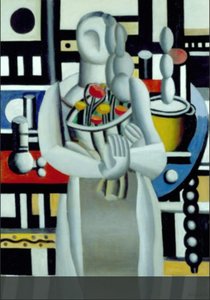
Fernand Léger's 'Head Constructor' is a striking Cubist portrait embodying modernity and industrialization. Bold lines, geometric shapes, and a stark white background create a powerful visual statement of the human form in the machine age.
Біографія митця
Першопроходець тюбізму Фернан Леже зафіксував епоху машин. Відкрийте його сміливі ритмічні полотна вже сьогодні.
Про картину
A Fragmented Portrait of the Machine Age
Fernand Léger’s “Head Constructor,” painted in 1950, isn't merely a portrait; it’s a distilled essence of the burgeoning modernity that gripped Europe after World War I. This striking monochrome work, rendered in a bold and assertive Cubist style, immediately commands attention with its stark contrast between the solid black outlines and the pristine white background – a deliberate choice that emphasizes the geometric forms at the heart of Léger's vision. The image presents a stylized human head, partially obscured by a simple hat or cap, a subtle detail hinting at a profession or perhaps even anonymity within the rapidly changing urban landscape.
Léger’s approach to Cubism wasn’t about deconstructing reality into an abstract puzzle; rather, he sought to integrate the dynamism and structure of the machine age directly into his representation of the human figure. He viewed industrialization not as a destructive force but as a new form of beauty – one characterized by clean lines, precise angles, and a sense of mechanical order. This is powerfully evident in “Head Constructor,” where the head itself is broken down into a series of interlocking squares, rectangles, and triangles—a deliberate rejection of traditional perspective and a celebration of geometric abstraction. The work feels less like a depiction of an individual and more like a schematic diagram, a blueprint for a new kind of human being shaped by the tools and technologies of his time.
The Language of Form: Cubism and Léger’s Vision
To understand “Head Constructor,” it's crucial to grasp the principles of Cubism as Léger embraced them. Unlike Picasso and Braque, who initially focused on dismantling objects into fragmented planes, Léger retained a sense of volume and three-dimensionality within his compositions. He didn’t entirely abandon representation; instead, he simplified forms to their most essential geometric components, creating an effect that is both abstract and strangely familiar. The thick black lines defining the head, hat, and facial features aren't delicate or subtle—they are assertive and deliberate, conveying a sense of construction and engineering. This bold use of line is characteristic of Léger’s style, which he termed “Tubism,” referencing his fascination with cylindrical forms – a visual echo of the pipes and machinery that dominated the industrial world.
The choice of monochrome—black lines on white—further amplifies this sense of construction. It eliminates any distractions from color, forcing the viewer to focus entirely on the interplay of shapes and lines. This deliberate austerity reflects Léger’s desire to strip away sentimentality and emotionalism, presenting a purely rational and objective view of the human figure. The work evokes a feeling of detachment, almost as if we are observing a machine rather than a person—a powerful statement about the increasing mechanization of modern life.
Symbolism and the Modern Condition
The title itself, “Head Constructor,” offers valuable insight into Léger’s intentions. He was deeply interested in the role of labor and industry in shaping society, and he saw the construction worker as a symbol of progress and innovation. The hat or cap worn by the figure could be interpreted as a uniform—a badge of membership within this new industrial order. The overall effect is one of both celebration and unease; Léger acknowledges the beauty and efficiency of modern technology but also hints at its potential to dehumanize individuals.
“Head Constructor” isn’t simply a depiction of a head; it's a meditation on the nature of humanity in an age of rapid technological change. It’s a work that continues to resonate today, prompting us to consider our relationship with machines and the evolving definition of what it means to be human.
Питання та відповіді
Яким чином обґрунтовано статус авторського права на «Head constructor» роботи Фернан Леже?
Статус авторського права на твір "Head constructor" — є суспільним надбанням — термін дії авторського права закінчився — визначається датою смерті митця у 1955.
Яка техніка була використана для створення «Head constructor» і коли цей твір було створено?
«Head constructor» було створено у 1950 році, техніка: Oil On Canvas.
Який розмір та орієнтацію рекомендується для друку «Head constructor» роботи Фернан Леже?
Розмір Medium, орієнтація Square: рекомендовані параметри друку для «Head constructor» роботи Фернан Леже.
Короткі факти та вікторина про мистецтво
Про Фернан Леже

Фернан Леже
1881 - 1955, Франція
Короткі факти про Фернан Леже
- Artistic Movement Or Style:
- Кубізм
- Тюбізм
- Section d'Or
- Пуризм
- Дадаїзм
- Конструктивизм
- Artists Or Movements Influenced By This Artist:
- Поп-арт
- Рой Ліхтенштейн
- Енді Воргол
- Artists Who Influenced This Artist: ['Поль Сезанн']
- Date Of Birth: 1881
- Date Of Death: 1955
- Full Name: Жозеф Фернан Анрі Леже
- Nationality: Француз
- Notable Artworks:
- Нагі в лісі
- Місто
- Механік
- Три жінки
- Жінка в синьому
- Place Of Birth: Аржентан, Франція
Досліджуйте твори мистецтва, впорядковані за темами, стилями та характеристиками.



Фернан Леже
Head constructor
() ·
Разом із рамою: · Написано олією на льоні вручну
Разом