


 Переглянути в інтер'єрі
 Надіслати
 Поділитися
 Деталі
 Посібник

 Завантажити
 Схожі предмети колекціонування
 Рентгенівське дослідження
 Слайд-шоу
 Статистика переглядів
Self-Portrait
 Acrylic On Canvas
- WallArt
- Neoclassical Portraiture
 1790
1790 63.0 x 52.0 cm
 Пушкинский государственный музей изобразительных искусств
 Читати далі
Жак-Луї Давид – видатний французький художник епохи революції та Наполеонівської імперії. Відомий картинами "Клятви Горатіїв", його творчість відображає героїзм, драматизм та класичні ідеали.
Олійная репродукція ручної роботи
Написана вручну олією на полотні у вашому розмірі та рамі, виготовлена на замовлення нашими художниками. ( Перейти до друку Перейти до цифрових зображень)




P118B ₴10

P118H ₴10

P118W ₴10

P438Z ₴10

P508JH ₴12

P508YH ₴12

P805H ₴10

P805Z ₴10

P919BZ ₴10

P919G ₴10

P919XJ ₴10

P959ZH ₴10

P968JZ ₴12

W106C ₴8

W218G ₴10

W218JH ₴8

W218Y ₴10

W307PJ ₴10

W316G ₴10

W316PJ ₴8

W316Y ₴10

W398PJ ₴8

W4111J ₴10

W500HY ₴15

W500JH ₴15

W692G ₴12

W849H ₴8

W940BG ₴15

W953PJ ₴8




Стандартний розмір
на замовлення
CM
INCH
Обирайте з наших стандартних розмірів, що відповідають оригінальним пропорціям твору мистецтва.
Loading sizes...

ширина
висота
Ви можете вказати власні розміри, щоб репродукція ідеально підійшла до конкретної рами або інтер'єру. Якщо вибраний вами розмір не відповідає пропорціям оригіналу, ми або обріжемо полотно, або доповнимо картину додатковими елементами, промальованими вручну. Цифровий макет буде надіслано вам на затвердження перед початком виробництва.
Зверніть увагу, що попередній перегляд на екрані не відображає фактичне обрізання або розширення зображення. Тільки макет точно покаже остаточну композицію.
Хоча ми можемо виготовити виріб у нестандартному розмірі, для збереження оригінальних пропорцій рекомендуємо обирати варіанти зі встановленого списку.
Приклади можливих змін: замінити обличчя на фото клієнта; додати домашню тварину (наприклад, замінити кота на собаку); додати приховане повідомлення на фоні; змінити ландшафт або елементи фону.
Після оформлення замовлення команда TopImpressionists.com зв'яжеться з клієнтом електронною поштою для отримання інструкцій та надасть попередній макет
Після оформлення замовлення команда TopImpressionists.com зв'яжеться з клієнтом електронною поштою для отримання інструкцій та надасть попередній макет
Доставка по всьому світу () за 3–4 тижні замість стандартних 5 тижнів. (4 Жовтень). Без жодних компромісів у якості.

Безкоштовна експрес-доставка по всьому світу

Високоякісне лляне полотно

Повне страхове покриття доставки

Гарантія повернення митних зборів

Гарантія точного відтворення кольорів

Політика повернення протягом 100 днів (лише у разі виявлення дефектів)

Гарантія повернення 100% коштів

Знижка на оптові замовлення
 Скляний варіант доступний лише для розмірів до 110 см

Self-Portrait
Техніка репродукції
Розмір репродукції
-


Загальна вартість
₴ 11998
A Portrait of Quiet Intensity: Jacques-Louis David’s Self-Portrait (1790)
Jacques-Louis David's Self-Portrait, painted in 1790, is not merely a likeness rendered on canvas; it’s a carefully constructed statement about an artist grappling with the seismic shifts of his time. This intimate work, measuring a modest 63 x 52 cm, offers a rare glimpse into the mind of a man poised on the precipice of revolution – a man who would become one of its most ardent and controversial figures. The painting immediately draws the viewer in with an arresting directness; David stares out from the canvas, his gaze unwavering and imbued with a subtle melancholy that belies the confident brushwork evident throughout.
The composition is rooted firmly in Neoclassical principles, a stylistic shift David championed after his early apprenticeship under François Boucher. The dark background, almost entirely devoid of detail, serves to amplify the figure’s presence, forcing us to confront his solemn expression and the carefully chosen details of his attire. He wears a meticulously tailored suit, indicative of the late 18th century, yet the wig – a deliberate stylistic choice – subtly nods towards an earlier, more formal era, creating a fascinating tension between tradition and modernity. The pipe in his hand isn’t simply a prop; it speaks to a contemplative nature, suggesting a man accustomed to quiet reflection amidst the clamor of artistic creation.
The Shadow of Revolution
Painted just two years before the execution of Louis XVI, this self-portrait is inextricably linked to the turbulent events unfolding in France. David’s early career had been marked by a flirtation with Rococo aesthetics, but he quickly embraced the ideals of Neoclassicism – an artistic movement that sought inspiration from the art and philosophy of ancient Greece and Rome. This shift reflected a broader cultural yearning for order, reason, and virtue, values increasingly championed in response to the perceived excesses of the Ancien Régime. The somber palette and restrained gestures within this portrait foreshadow the austere aesthetic that would define David’s most famous works during the Revolution – particularly his monumental depictions of heroic figures like *The Death of Marat* and *The Oath of the Horatii*.
Interestingly, the painting also hints at a personal struggle. The slight asymmetry in David's face, a physical characteristic he had dealt with since childhood, is subtly emphasized here. It’s as if he’s acknowledging his own imperfections while simultaneously projecting an image of unwavering self-assurance. This duality – vulnerability and strength – resonates deeply within the artwork and speaks to the complexities of a man navigating a period of profound social and political upheaval.
Technique and Detail: A Master's Hand
David’s technical skill is undeniable in this portrait. The meticulous rendering of fabric, particularly the texture of the suit and the folds of the wig, demonstrates his mastery of chiaroscuro – the dramatic use of light and shadow to create depth and form. Note the subtle gradations of tone, achieved through careful layering of paint, that give the figure a remarkable sense of volume. The artist’s attention to detail extends to the rendering of the hands, which are clasped together in a gesture of quiet contemplation.
- The precise brushwork reveals a deliberate control and an unwavering focus on capturing the likeness with accuracy.
- David's use of color is restrained, favoring muted tones that contribute to the overall sense of seriousness and introspection.
- The subtle modeling of the face – particularly around the eyes and mouth – conveys a remarkable degree of psychological depth.
Symbolism and Emotional Resonance
Beyond its technical brilliance, Self-Portrait is rich in symbolic meaning. The dark background can be interpreted as representing the uncertainties and anxieties of the era, while the figure’s direct gaze invites a sense of intimacy and engagement. The pipe, again, suggests a contemplative spirit, perhaps reflecting David's own internal struggles as he grappled with his role in shaping the future of France. This portrait isn’t simply a representation of a man; it’s an embodiment of the ideals – and the anxieties – of a nation on the brink of transformation. A reproduction offers a powerful way to connect with this pivotal moment in art history, bringing David's introspective gaze into your own space.
Запитання та відповіді
З яких матеріалів створено "Self-Portrait" та в якому стилі?
У творі "Self-Portrait" техніка Acrylic On Canvas поєднується з напрямом Neoclassical Portraiture.
Скільки років було Жак-Луї Давид, коли створювався твір "Self-Portrait" у 1790 році?
Жак-Луї Давид створив(ла) «Self-Portrait» у віці 42 років. Митець народився(лася) у 1748, а дата створення твору — 1790.
Який домінантний відтінок у «Self-Portrait» Жак-Луї Давид?
Переважаючий відтінок твору «Self-Portrait» Жак-Луї Давид — Golden Yellow Range. Цей відтінок є основою всієї палітри.
У якому році було створено "Self-Portrait"?
«Self-Portrait» датована 1790 роком. Ця дата дозволяє визначити місце твору в творчому шляху Жак-Луї Давид та відповідну епоху.
Як «Self-Portrait» Жак-Луї Давид пов’язує Neoclassical Portraiture з батьківщиною митця?
«Self-Portrait» пов’язує напрям Neoclassical Portraiture із Франція через місце народження його творця.
Як «Self-Portrait» вписується в тематику та стиль Жак-Луї Давид?
«Self-Portrait» належить до Neoclassical Portraiture творчості Жак-Луї Давид, чиї характерні теми включають classical ideals, revolutionary fervor, moralizing, civic virtue themes, napoleonic propaganda, power”, “david’s self-image, artistic stance”.
Хто є автором твору "Self-Portrait"?
Автором твору «Self-Portrait» є Жак-Луї Давид. Робота внесена до каталогу під іменем Жак-Луї Давид.
Біографія митця
A Brushstroke Across Revolution: The Life and Art of Jacques-Louis David
Jacques-Louis David, born in Paris in 1748, was more than just a painter; he was a visual chronicler of an era defined by upheaval, idealism, and the relentless pursuit of new orders. His life mirrored the dramatic shifts unfolding across France – from the waning opulence of the Rococo to the austere clarity of Neoclassicism, and ultimately, through the tumultuous years of revolution and Napoleonic glory. A childhood marked by the early loss of his father and a facial impediment that initially hindered his speech seemed only to sharpen his observational skills and fuel an unwavering dedication to artistic mastery. Though initially apprenticed to François Boucher, David quickly found himself drawn to the more morally resonant work of Joseph-Marie Vien, whose emphasis on history painting and classical subjects resonated with a burgeoning sense of purpose within the young artist. His early attempts to win the prestigious Prix de Rome were fraught with frustration, yet these repeated setbacks only intensified his resolve, forging a relentless perfectionism that would characterize his entire career.The Birth of Neoclassical Drama
David’s artistic evolution wasn't merely a stylistic shift; it was a philosophical statement. He rejected the frivolous ornamentation and playful themes of the Rococo, embracing instead the clarity, order, and moral seriousness inherent in classical antiquity. This commitment was profoundly influenced by archaeological discoveries at Pompeii and Herculaneum, which unveiled a world of Roman art and architecture previously lost to time. These unearthed ruins ignited within him a profound respect for the rationalism and civic virtue of the Roman Republic – values he believed were desperately needed in his own era. His breakthrough came with “Oath of the Horatii” (1784), a painting that transcended mere artistic skill to become an emblem of civic virtue and patriotic sacrifice. The stark composition, dramatic lighting, and precise draftsmanship were revolutionary, signaling a decisive break from the past. It wasn’t simply *what* he painted but *how* – a deliberate construction designed to evoke powerful emotional responses and inspire contemplation on themes of duty, honor, and self-sacrifice. The figures are rendered with an almost sculptural quality, their bodies idealized according to classical principles, while the scene unfolds with a dramatic intensity that captures the essence of heroic commitment. This work didn't just announce a new style; it foreshadowed the ideological currents that would soon sweep across France.Revolution and Remembrance: Art as Political Weapon
As the French Revolution erupted in 1789, David was not merely an observer but an active participant. A fervent supporter of the revolutionary cause and a close associate of Maximilien Robespierre, he saw art as a powerful tool for shaping public opinion and immortalizing the ideals of the new republic. His paintings during this period became potent symbols of revolutionary martyrdom and republican fervor. Perhaps his most iconic work from this era is “The Death of Marat” (1793), a hauntingly realistic depiction of the assassinated journalist, transformed into a secular saint. The pale body, the makeshift desk, the poignant letter clutched in Marat's hand – all contribute to an image of profound sorrow and heroic sacrifice. David deliberately stripped away any trace of personal identification, elevating Marat to the status of a martyr for the revolution. He served on the Committee of Public Safety during the Reign of Terror, even signing Robespierre’s death warrant, demonstrating his deep entanglement with the political machinations of the time. This period reflects a willingness to use art as a tool for propaganda and social control – a controversial aspect of David's legacy.From Revolution to Empire: Serving Napoleon
The fall of Robespierre marked another turning point in David’s career. With remarkable adaptability, he navigated the shifting political landscape and aligned himself with Napoleon Bonaparte, becoming the First Consul’s official court painter. This new patronage ushered in a period of grand-scale commissions designed to glorify Napoleon’s victories and achievements. “Napoleon Crossing the Alps” (1801-1805) is perhaps the most famous example – a masterful piece of propaganda that presents Napoleon as a heroic, almost mythical figure conquering both nature and adversity. The dramatic lighting, the dynamic composition, and the carefully chosen details all contribute to an image of unparalleled power and authority. “The Coronation of Napoleon” (1807), an immense canvas capturing the opulence and grandeur of the imperial ceremony, further cemented David’s position as the preeminent artist of the Napoleonic era. During this time, his palette subtly shifted, incorporating warmer Venetian colors while maintaining the precision and clarity that defined his style – a reflection of Napoleon's ambition to emulate the glories of Rome.Exile, Legacy, and Enduring Influence
The Bourbon Restoration in 1814 brought renewed peril for David, whose association with the fallen Napoleon made him a target of persecution. He chose exile in Brussels in 1816, where he continued to paint and teach until his death on December 29, 1825. Even in exile, his influence remained profound. He trained numerous pupils, including Jean-Auguste-Dominique Ingres, who would become one of the most important neoclassical painters of the 19th century. David’s emphasis on draftsmanship, composition, and historical accuracy left an indelible mark on French art. *His legacy extends beyond mere imitation*; his expressive distortions of form and space even foreshadowed the innovations of later artists like Henri Matisse and Pablo Picasso. Jacques-Louis David was not simply a painter of his time; he *defined* it, capturing its spirit of revolution, ambition, and enduring ideals on canvas for generations to come.- Major Achievements: Established Neoclassicism as the dominant style in French painting.
- Historical Significance: Created iconic images that captured the spirit of the French Revolution and the Napoleonic era.
- Influence: Trained a generation of influential artists who carried on his legacy.

Жак-Луї Давид
1748 - 1800 , Франція
Довідкова інформація
- Artistic Movement Or Style: Неокласицизм
- Artists Or Movements Influenced By This Artist:
- Рококо
- Імпресіонізм
- Artists Who Influenced This Artist:
- Жан-Авґаст Дюмаєр
- Жозеф-Марі Віен
- Date Of Birth: 30 серпня 1748
- Date Of Death: 29 грудня 1825
- Full Name: Jacques-Louis David
- Nationality: Француз
- Notable Artworks:
- Обет орлят
- Смерть Марата
- Наполеон перетинає Альпи
- Place Of Birth: Париж, Франція
Схожі статті
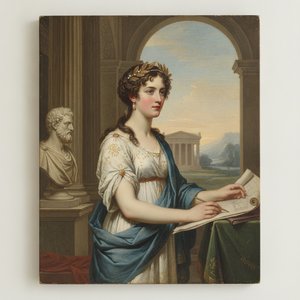
The Revival of Antiquity: Exploring Ideals of Beauty & Power in Neoclassical Portraiture
Explore the captivating world of Neoclassical portraiture! Discover the power & ideals behind masterpieces by David, Girodet & more. Expert analysis, custom reproductions & art appraisal at TopImpressionists.

Illuminating the Enlightenment: Artistic Expression in 18th-Century Europe
Explore the artistic brilliance of the Enlightenment era! Discover Rococo's elegance & Neoclassicism’s virtue with expert insights into 18th-century masterpieces. Learn about David, Kauffmann & more.

Anne-Louis Girodet: Bridging Neoclassicism & Romanticism with Emotional Truth
Explore the captivating world of Anne-Louis Girodet, a pivotal figure bridging Neoclassicism & Romanticism. Discover his masterpieces and unique artistic vision with TopImpressionists.

Jacques-Louis David: Neoclassical Ideals & Revolutionary Witness
Explore the life & art of Jacques-Louis David, leading Neoclassical painter of the French Revolution. Discover iconic works like 'The Death of Marat' and his lasting impact on art history. Expert analysis & high-quality reproductions at TopImpressionists.

Illuminating the Enlightenment: A Comprehensive Exploration of 18th-Century Painting
Explore the captivating world of 18th-century painting! Discover Rococo's playful elegance & Neoclassicism’s Enlightenment ideals with expert insights into Fragonard, David, and more. A comprehensive guide for art enthusiasts.
Досліджуйте твори мистецтва, впорядковані за темами, стилями та характеристиками.


